The Vaishnavite King

Faith and Tolerance in the Deccan

Behind the warrior and statesman stood a man of deep faith. Pulakeshin's personal devotion to Vishnu shaped not just his temples but his understanding of kingship itself. Yet his realm embraced Shaivism, Jainism, and Buddhism with equal protection. This lesson explores the religious philosophy that animated Chalukya rule - how personal piety coexisted with remarkable tolerance, and how dharma guided empire.

The Varaha Devotee

Among all forms of Vishnu, Pulakeshin II held special devotion to Varaha - the divine boar who rescued the earth goddess Bhudevi from the cosmic waters. This was no arbitrary choice. The Varaha incarnation embodies the ideal of the king as protector: just as Vishnu in boar form lifted the earth from chaos, so the righteous king rescues his realm from danger.

The Varaha cave at Badami, though carved before Pulakeshin's time, received his particular attention. Here, the sculpture of Varaha holding Bhudevi on his knee represents one of the masterpieces of Indian art. The cosmic boar's powerful form, the goddess's trusting embrace, the serpent Shesha coiling at their feet - all proclaim the message: the divine rescues and protects.
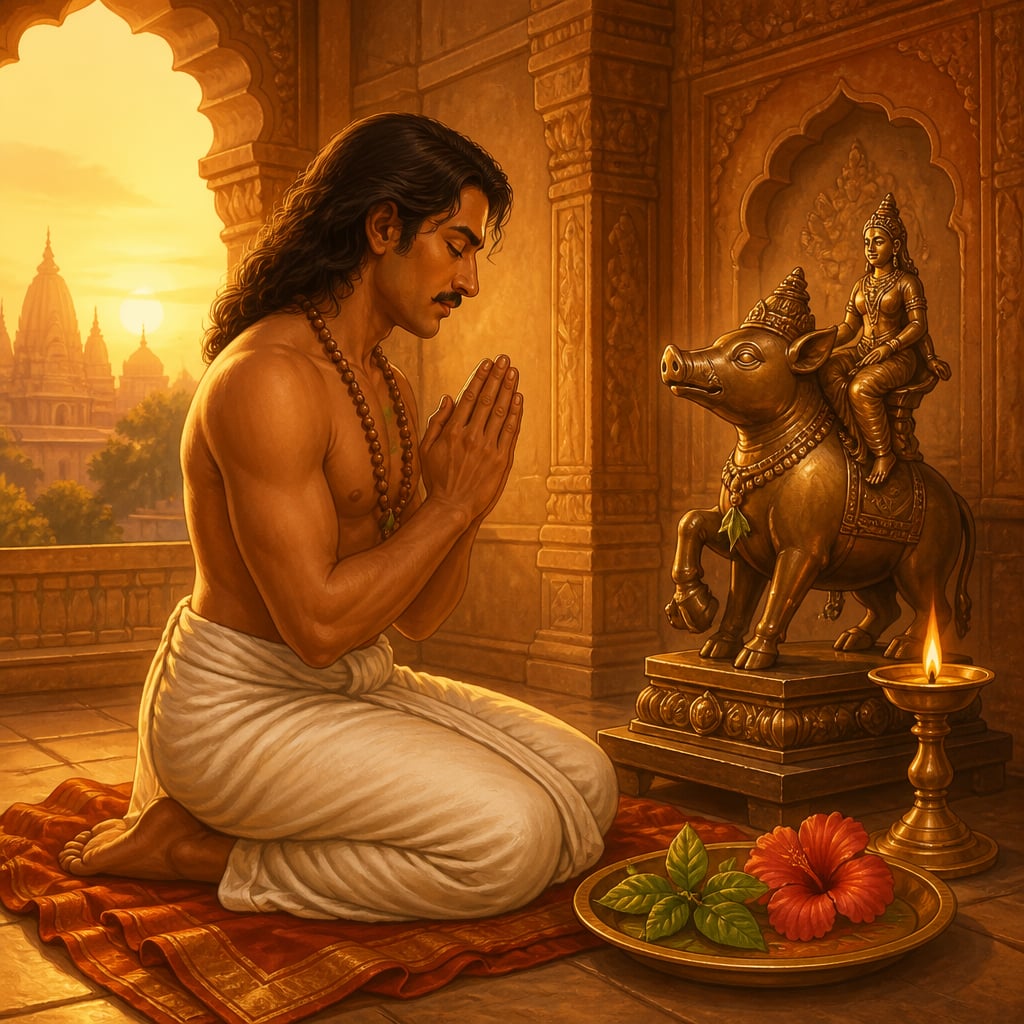
Pulakeshin praying before a bronze Varaha icon in his private shrine

"As Varaha lifted the earth from the waters, so the king lifts his people from their troubles."

Faith and Kingship

In the Chalukya understanding, the king was not merely a political ruler but a dharma-rakshaka - protector of cosmic order. The king's first duty was protection - of territory, of subjects, and of dharma itself. Military victory against Harsha was dharmic because it protected southern independence. Temple building was dharmic because it supported the gods who sustained cosmic order.

But dharma also constrained the king. He could not act arbitrarily; he was bound by sacred law, custom, and the counsel of Brahmins and elders. The king served dharma; dharma did not serve the king.

Pulakeshin's personal epithet was Satyashraya - "Refuge of Truth." Satya (truth) in Indian philosophy is not just factual accuracy but alignment with cosmic reality. A truthful person lives in harmony with rta - the fundamental order of the universe. To be the "refuge" of truth meant that Pulakeshin claimed to be a shelter where truth could thrive - those seeking justice, scholars seeking patronage, devotees seeking protection could all find refuge with him.

Tolerance in Practice

Pulakeshin patronizing three faiths together in a temple courtyard

Despite his personal Vaishnavism, Pulakeshin's kingdom was remarkably pluralistic. The cave temples at Badami include shrines to Shiva and Jain tirthankaras alongside Vishnu. The court poet Ravikirti was a Jain who built a Jain temple and praised a Vaishnavite king without apparent contradiction.

This tolerance was not indifference. Pulakeshin cared deeply about religion - his Varaha devotion was clearly personal. But he practiced what scholars call "royal pluralism": the understanding that a great king protects all paths to the divine, not just his own.

The inscriptions provide evidence. Grants were made to Brahmin scholars regardless of sectarian affiliation. Temples of different traditions received protection. Jain monks and Hindu ascetics both enjoyed royal favor.

The Philosophical Framework

How did this tolerance work philosophically? Several Indian concepts provided the framework.

Ekam sat viprā bahudhā vadanti - "Truth is one; the wise call it by many names." This Rigvedic verse established early the idea that different paths could lead to the same ultimate reality. A Vaishnavite king could honor Shiva temples because both Vishnu and Shiva were understood as aspects of the same divine reality.

Svadharma - One's own dharma depends on one's nature and station. Just as different castes have different duties, different people might worship different deities according to their spiritual temperament. The king's duty was to protect everyone's svadharma, not to impose uniformity.

Ahimsa - Non-violence extended to religious matters. Forcing conversion or destroying others' temples was considered adharmic. The Chalukyas, like most Indian dynasties, would have found such behavior repugnant.

Religious Pluralism in Practice

At Badami, the caves dedicated to Shiva and Vishnu sit side by side, carved by the same craftsmen, patronized by the same dynasty. Many Chalukya inscriptions invoke both Shiva and Vishnu without apparent conflict. Some scholars suggest this reflects Harihara worship - a theological tradition that united Hari (Vishnu) and Hara (Shiva) as two aspects of the same supreme being. A famous relief at Badami shows Harihara, half Vishnu and half Shiva combined.

The presence of Jains at Pulakeshin's court deserves special attention. Ravikirti, his most famous poet, was a Jain. The Meguti temple at Aihole, where Ravikirti's inscription praises the Vaishnavite emperor, is a Jain temple. Jainism in the Deccan had ancient roots, and Pulakeshin's patronage reflected both political wisdom and genuine philosophical openness. The Jain values of careful speech, restraint, and concern for all living beings complemented the king's pursuit of dharmic rule.

Dharma-Vijaya: Righteous Conquest

The concept of dharma-vijaya (righteous conquest) shaped how Pulakeshin understood his military campaigns. This was not conquest for mere territorial gain but expansion in service of dharmic order.

A dharma-vijaya followed rules: non-combatants were protected, temples and holy places were spared, defeated enemies were treated with honor, and conquered territories were governed justly. The goal was not to plunder but to extend the protection of dharmic rule.

Pulakeshin sparing a defeated Pallava king on the battlefield

By this standard, Pulakeshin's restraint toward the Pallavas - defeating but not destroying them - was dharmic. His installation of his brother as viceroy in Vengi brought that region under just governance. His resistance to Harsha protected the South from conquest.

The Unity of Statecraft and Spirituality

What was Pulakeshin's personal religious life like? He performed regular rituals, particularly to Vishnu in his Varaha form. He made donations to Brahmins and temples. He also maintained a court that included learned men of different traditions - Brahmin scholars, Jain monks, Buddhist teachers. The philosophical discussions at such a court must have been sophisticated, exposing the king to multiple perspectives.

Perhaps the deepest lesson of Pulakeshin's religious life is the unity of statecraft and spirituality in his worldview. These were not separate domains but aspects of a single practice. Good governance was worship. Protecting subjects was serving the divine. Building temples was both pious devotion and political statement. Military victory in righteous cause was dharmic action.

This integration gave Chalukya rule its particular character: confident, culturally sophisticated, and genuinely tolerant. Pulakeshin fought fiercely when dharma demanded but ruled with a light hand, allowing diverse traditions to flourish under his protection.

The Vaishnavite king thus offers a model of how deep personal faith can coexist with genuine respect for difference - not despite conviction but because of it. True confidence in one's own path need not require suppression of others.

Historical context

7th Century CE

7th-century India was religiously diverse but largely tolerant. Hinduism (in both Shaiva and Vaishnava forms), Buddhism, and Jainism all flourished, often supported by the same royal patrons. Religious identity was important but sectarian violence was rare. This pattern of pluralism under royal protection would continue until the medieval period's disruptions.

Living traditions

The Chalukya model of religious pluralism continues to influence Karnataka's religious culture. Multi-denominational temple complexes, joint festivals, and the understanding that different paths lead to the same divine reality all trace roots to this era. The Varaha devotion Pulakeshin championed remains important in Karnataka Vaishnavism.

Reflection

More in Pulakeshin II

All lessons in Pulakeshin II · Lesser Known Guardians of Dharma course