Emperor of the South
Diplomacy with Persia and Beyond
News of Pulakeshin's victory over Harsha spread across the ancient world. In the distant Sasanian capital of Ctesiphon, the great Shah Khosrow II took notice and dispatched an embassy to the Deccan. This diplomatic recognition from one of history's great empires elevated Pulakeshin from regional king to international sovereign - and revealed the surprising extent of India's global connections in the 7th century.
The Persian Embassy
In the year 625 CE, an unusual procession made its way through the Deccan plateau toward Vatapi. The travelers bore gifts of silk, silver vessels, and a royal letter sealed with the distinctive stamp of the Sasanian Empire. These were ambassadors from Khosrow II Parviz, the Shah of Shahs, ruler of the mighty Persian Empire that stretched from Mesopotamia to Central Asia.
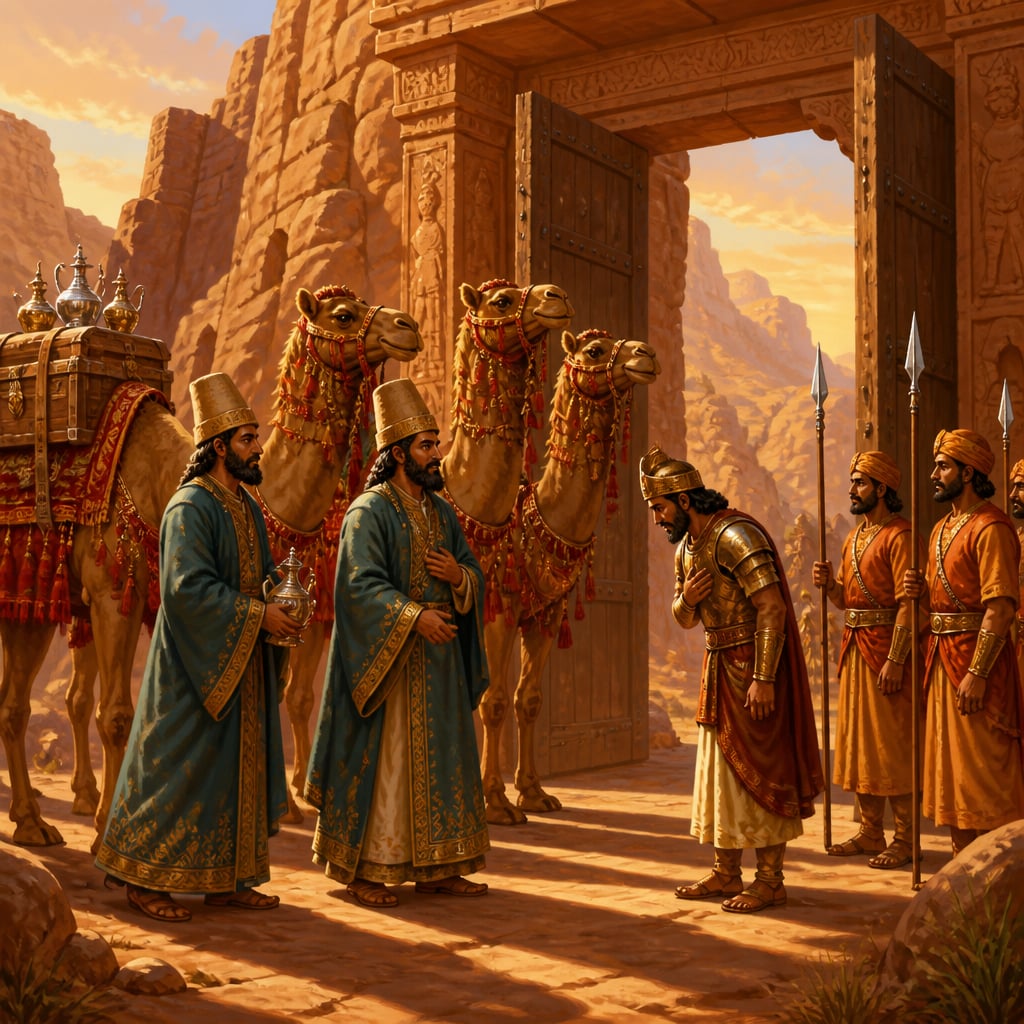
The Sasanians were no ordinary power. They had contested supremacy with Rome and Byzantium for centuries. At the height of his power, Khosrow II had captured Jerusalem and stood at the gates of Constantinople. That such an emperor would send ambassadors to the Deccan was a testament to Pulakeshin's rising stature.
"The fame of Pulakeshin, like the rays of the rising sun, spread to the distant lands, making even the Persian king take notice."
The Exchange of Honors
What drew Persian attention to a kingdom in southern India? Several factors converged: trade (the Chalukya ports controlled access to pepper, textiles, and precious stones), geopolitics (the Sasanians sought allies who could provide strategic depth against their Byzantine enemies), and prestige (recognizing Pulakeshin confirmed that the Deccan had arrived on the world stage).
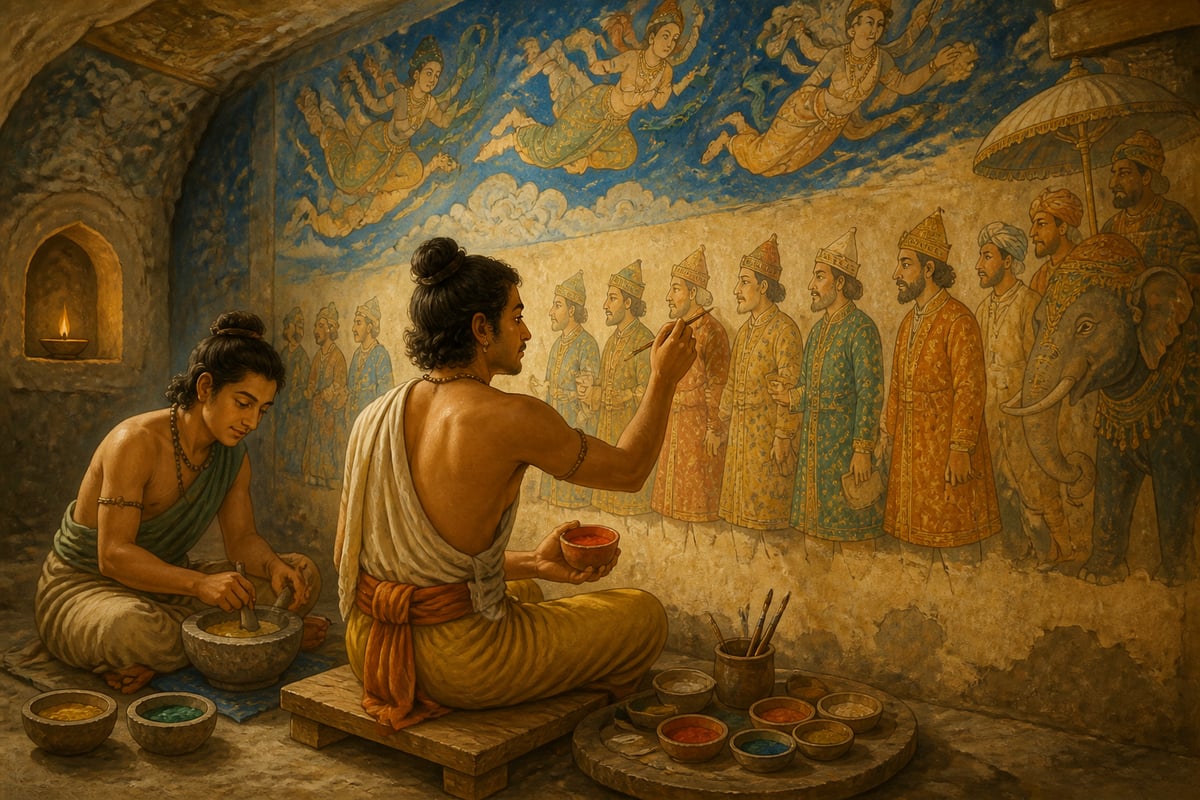
The Ajanta paintings, created during this very period, preserve a remarkable visual record. In Cave 1, a painted panel depicts what scholars believe is the reception of the Persian embassy. The Shah's envoys are shown presenting gifts while Pulakeshin, seated in majesty, receives them with appropriate dignity. The painting shows the Persian ambassadors in their distinctive attire - flowing robes, pointed caps, and elaborate jewelry that spoke of Sasanian sophistication. The scene captures a moment of cultural encounter between two great civilizations.
The exchange was mutual. Pulakeshin sent his own embassy to Ctesiphon, bearing Indian gifts - fine textiles dyed with indigo and lac, aromatic spices like pepper and cardamom, ivory carvings, and perhaps even trained elephants. The Sasanian court, sophisticated connoisseurs of luxury, appreciated these tokens of friendship from the fabled lands of the East.
More significant was the exchange of royal recognition. Khosrow II addressed Pulakeshin with honorifics appropriate to a fellow sovereign. In the hierarchical world of ancient diplomacy, such language mattered enormously. Pulakeshin was not being treated as a tributary or minor king, but as an equal.
The Art of Statecraft
The Persian connection revealed Pulakeshin as more than a warrior. He was a sophisticated statesman who understood that power has many dimensions.
Military victory at the Narmada had established his reputation. But lasting greatness required more - economic prosperity through trade, cultural prestige through patronage, and international recognition through diplomacy. Pulakeshin pursued all three with remarkable skill.
His administration showed similar sophistication. The empire was divided into rāṣṭras (provinces) governed by trusted officials. Local chiefs retained autonomy in exchange for loyalty and tribute. The system balanced central authority with regional flexibility - a model that later Indian empires would emulate.
The Ganga Alliance
Among Pulakeshin's most astute diplomatic moves was his alliance with the Western Gangas of Talakad. King Durvinita, himself a scholar who had translated Sanskrit works into Kannada, recognized Chalukya supremacy and cemented the relationship through a marriage alliance - giving his daughter to Pulakeshin.
This was not mere submission but genuine partnership. The Gangas contributed troops to Chalukya campaigns and governed their territory as loyal feudatories. Durvinita's intellectual accomplishments - he was credited with translating portions of the Kiratarjuniya - meant the alliance brought cultural as well as military benefits. The Ganga relationship exemplified Pulakeshin's approach: treating allies with respect created bonds stronger than those forged by fear alone.
The Alupas of the western coast similarly accepted Chalukya overlordship after Pulakeshin's Konkan campaigns. Rather than impose harsh terms, Pulakeshin rewarded loyal Alupa chiefs with territories formerly held by the defeated Kadambas. This generosity transformed potential enemies into grateful allies.
Beyond Persia: A Network of Relations
The Persian embassy was the most dramatic, but not the only, diplomatic connection. Evidence suggests the Chalukyas maintained relations with multiple foreign powers.
Sri Lanka - The island kingdom had ancient ties to the Deccan. Buddhist texts mention diplomatic exchanges and trade connections. Chalukya control of the southeastern coast facilitated this relationship.
Southeast Asia - Indian influence was spreading across Southeast Asia during this period. While we lack direct evidence of Chalukya diplomatic missions, traders from Chalukya ports certainly reached these lands, carrying with them not just goods but ideas, religions, and artistic traditions.

China - The Chinese pilgrim Xuanzang visited the Chalukya kingdom around 641 CE, near the end of Pulakeshin's reign. His account in the Da Tang Xiyu Ji provides invaluable external testimony. Xuanzang described the Chalukya realm as prosperous and well-governed, praising its people as "honest and sincere" and noting that "kshatriyas form the most numerous class." He observed that the king was a Shaiva but that all religions flourished. This account, reaching Chinese readers, shaped their understanding of the Deccan for generations.
The Diplomat's Dharma
What principles guided Pulakeshin's diplomacy? The inscriptions offer clues.
He is described as mitravatsala - one who cherishes friends. Unlike rulers who discarded allies when convenient, Pulakeshin maintained long-term relationships. His brother in Vengi, his Ganga feudatories, his Persian correspondents - all were treated with consistent respect.
He also understood balance. Rather than seeking hegemony that would unite enemies against him, he maintained a system where multiple powers coexisted. The Pallavas remained subdued but not destroyed. The northern kingdoms were deterred but not provoked. This equilibrium allowed the Chalukyas to prosper without constant war.
The Peak of Power
By 630 CE, Pulakeshin's titles reflected his new status. He was no longer merely Parameshvara (Supreme Lord) but Maharajadhiraja - King of Kings. This title, borrowed from Persian imperial vocabulary, announced his claim to stand among the great emperors of the age.
The Aihole inscription, composed in 634 CE, captures this moment of triumph. Pulakeshin is praised as lord of three oceans, protector of dharma, and friend of distant kingdoms. The inscription's sophisticated Sanskrit, its astronomical dating, and its geographical scope all testify to a court that was culturally as well as politically confident.
The early 630s marked the zenith of Pulakeshin's reign. The empire stretched from sea to sea. Trade flowed through Chalukya ports. Temples rose across the land. The Persian embassy had confirmed international recognition. Xuanzang's visit would soon add another layer of external validation.
Yet even at this peak, storm clouds gathered. To the south, the Pallavas nursed their grievances and waited for opportunity. The next generation would see dramatic reversals. But for now, Pulakeshin stood as the undisputed Emperor of the South - a warrior who had become a statesman, a defender who had become a diplomat, a king who had become a legend.
Historical context
620s-630s CE
India in the 620s-630s was at a civilizational peak. Harsha's northern empire maintained stability in the Gangetic plain. Nalanda University attracted scholars from across Asia. Maritime trade connected Indian ports to Southeast Asia, Persia, and beyond. The Chalukyas controlled crucial trade routes, making diplomatic relations with them valuable to foreign powers.
Living traditions
The Chalukya-Persian connection is remembered as evidence of ancient India's global engagement. It challenges narratives of Indian isolation and shows that 7th-century India was deeply connected to the wider world through trade and diplomacy. The adoption of imperial titles like Maharajadhiraja demonstrates cultural exchange between civilizations.
- Ajanta Caves - Cave 1: The famous painted panel believed to depict the reception of the Persian embassy to Pulakeshin II's court. The paintings show foreign visitors presenting gifts, providing visual evidence of 7th-century international diplomacy.
- Aihole Temple Complex with Meguti Temple: The Meguti Jain temple atop the hill contains Ravikirti's inscription that documents both the Persian embassy and Pulakeshin's imperial titles. The inscription is dated precisely to 634 CE using astronomical calculations.
- Badami Museum: Archaeological museum housing Chalukya sculptures, inscriptions, and artifacts. Provides context for understanding Chalukya court culture and international connections.
Reflection
- The Persian embassy came specifically after Pulakeshin's military victories, not before. What does this suggest about the relationship between military power and diplomatic recognition?
- Pulakeshin adopted the title 'Maharajadhiraja' (King of Kings) - a Persian-influenced title. Was this cultural borrowing a sign of sophistication or a loss of Indian identity? How should we think about cultural exchange between civilizations?
- Pulakeshin was praised as 'mitravatsala' - one who cherishes friends. How do you maintain important professional or personal relationships over time? Do you invest in relationships even when there's no immediate benefit?