Caves of Devotion
Art and Architecture of the Chalukyas
While Pulakeshin forged an empire through conquest and diplomacy, his craftsmen were carving eternity into stone. At Badami, Aihole, and Pattadakal, they created temples that merged northern and southern architectural traditions into something entirely new. These monuments reveal the artistic genius of the Chalukya court and the deep faith that animated their imperial vision.
The Red Cliffs of Badami
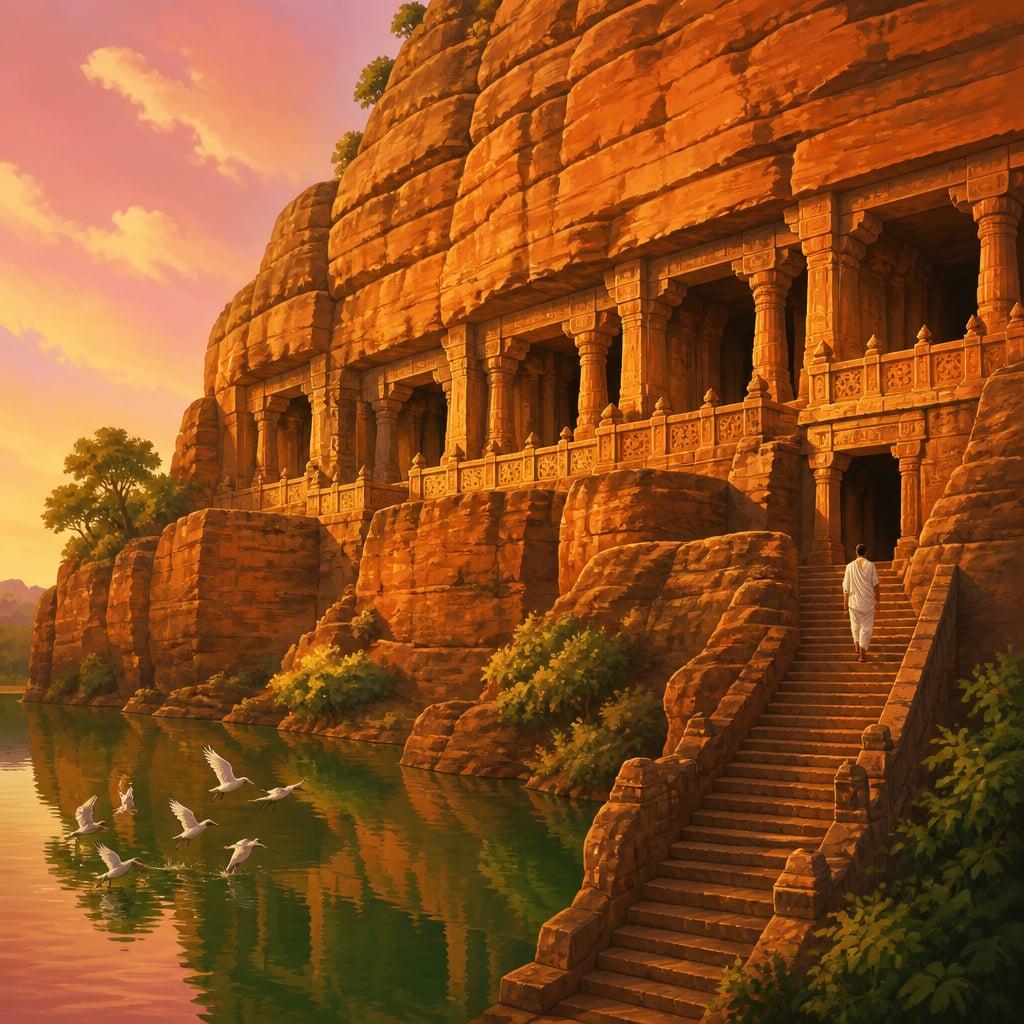
Rising from the dusty plains of northern Karnataka, the red sandstone cliffs of Badami hold one of India's greatest artistic treasures. Here, carved into the living rock, four cave temples stand as testament to Chalukya faith and creative genius.
The caves face the Agastya Lake, a tranquil pool that reflects their facades at dawn and dusk. Ancient steps carved into the cliff connect the caves, creating a pilgrimage path that rises from earth toward heaven. The setting was not accidental - the Chalukyas understood that sacred architecture must work with, not against, the natural landscape.
"In stone we carve our prayers; in temples we house our gods; in art we reveal our souls."
The Four Sacred Caves
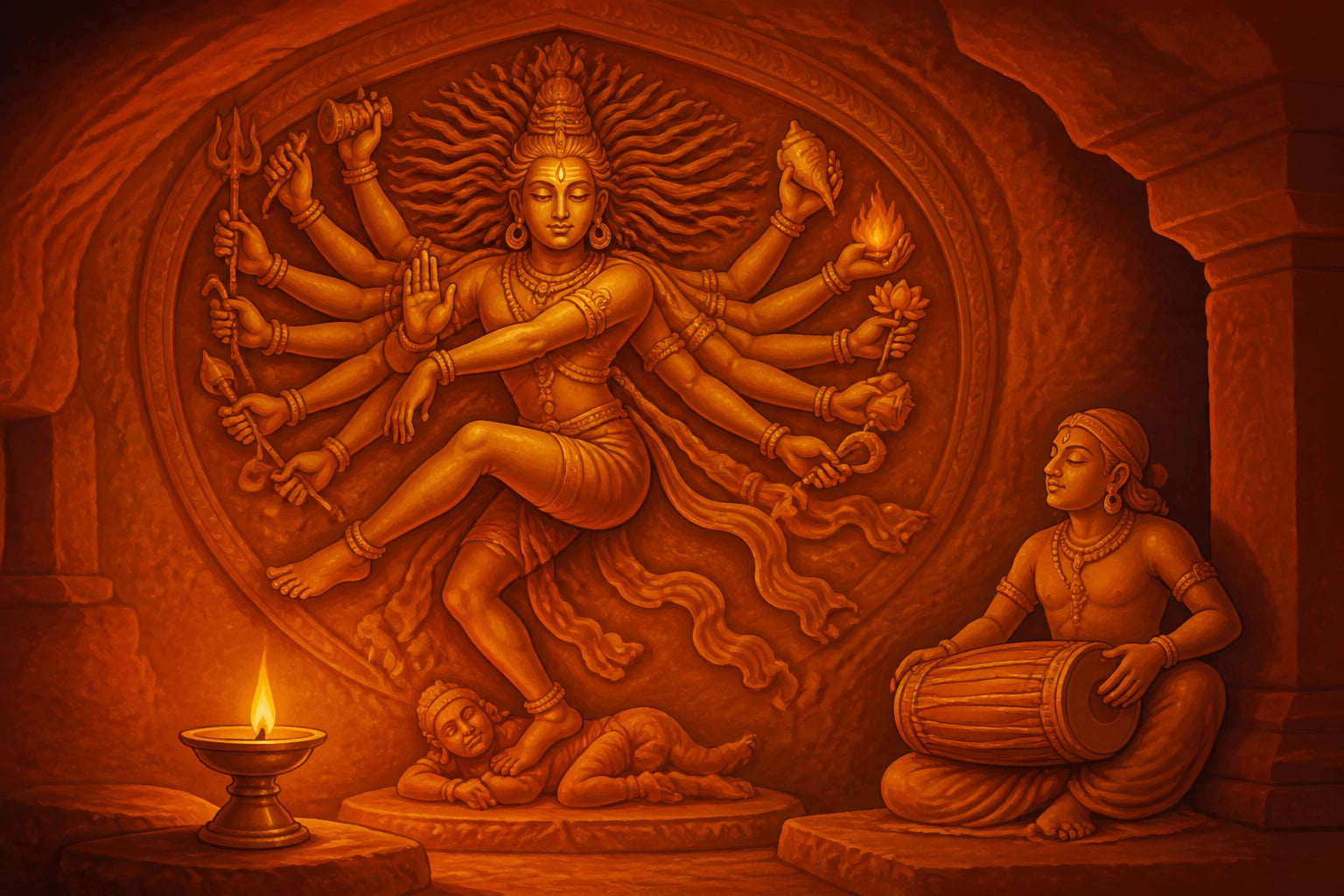
The first cave, dedicated to Shiva, greets visitors with images of the cosmic dancer. The famous Nataraja panel shows Shiva with eighteen arms performing the tandava - the dance that creates and destroys the universe. The most striking image is Ardhanarishvara - Shiva as half-male, half-female, declaring that the divine encompasses and transcends all dualities.
The second cave celebrates Vishnu in his most dramatic incarnations. The panel of Trivikrama - Vishnu spanning the three worlds in three strides - dominates one wall. Equally magnificent is the image of Varaha - Vishnu as the cosmic boar rescuing the earth goddess Bhudevi. Pulakeshin was particularly devoted to this form, seeing in Varaha the ideal of the king as protector.
The third cave is the masterpiece - the largest and most elaborate. The Vishnu Anantashayana - Vishnu reclining on the cosmic serpent Shesha - stretches across an entire wall. Above him, Brahma emerges from a lotus growing from Vishnu's navel. The cave served not only as a temple but as a visual theology textbook. An inscription dated 578 CE - during Mangalesha's reign - confirms this cave's antiquity, making it among the earliest precisely dated Hindu temples in India.
The fourth cave belongs to Jainism. Images of Mahavira and other tirthankaras sit in eternal meditation. This cave testifies to Chalukya religious pluralism - though Pulakeshin was a Vaishnavite, his kingdom embraced Jainism with equal protection. The court poet Ravikirti was himself a Jain.
Aihole: Laboratory of Architecture
If Badami was the capital, Aihole was the architectural laboratory. Within this small town and its surroundings stand over 120 temples, representing virtually every style of early Indian architecture.
Scholars call Aihole the "cradle of Indian temple architecture" because here Chalukya builders experimented with different forms of sanctuary, hall, and tower. Some temples show pure Dravidian (southern) style with stepped pyramidal towers; others use the Nagara (northern) curvilinear shikhara; still others blend both traditions in ways never attempted before.
The Durga Temple, despite its name, is dedicated to Vishnu and features an unusual apsidal (semi-circular) plan reminiscent of Buddhist chaitya halls. The Lad Khan Temple, one of the earliest, preserves elements of wooden architecture translated into stone - its flat roof and internal pillars recall assembly halls of an earlier age. The Meguti Temple atop the hill, where Ravikirti's inscription is found, represents mature Chalukya achievement.
Pattadakal: UNESCO Heritage
The third jewel of Chalukya architecture is Pattadakal, now a UNESCO World Heritage Site. While its greatest temples were built after Pulakeshin's time (by his successors), the site's development began during his reign.
Pattadakal served as a coronation site for Chalukya kings. The temples here represent the culmination of the architectural experiments begun at Aihole. Both Dravidian and Nagara styles are represented, sometimes side by side, demonstrating the Chalukya synthesis of northern and southern traditions.
The Artistic Vision
What animated this explosion of sacred art? The inscriptions provide clues.
First, devotion. The Chalukyas saw temple-building as worship in stone. Every carved image was a prayer made permanent. The act of commissioning a temple accumulated spiritual merit, benefiting the patron in this life and beyond.
Second, prestige. Temples announced power. A king who could build magnificent monuments demonstrated control of resources, command of skilled labor, and civilizational sophistication. In the competition among Indian dynasties, temples were statements of achievement.
Third, theology made visible. Indian religion is rich in philosophical concepts that can seem abstract. The caves and temples made these ideas visible. The cosmic dance of Shiva, the avatars of Vishnu, the serene detachment of the tirthankaras - all became accessible through art.
The Craftsmen and Their Vision

Behind every sculpture stood unnamed shilpins (craftsmen) whose skills transformed vision into stone. These were not ordinary laborers but trained artists following sophisticated technical manuals called shilpa-shastras.
The profession was hereditary - sons learned from fathers across generations. Shilpin guilds maintained strict standards, training apprentices for years before they could work independently. The techniques for proportioning divine images, the symbolism of gestures (mudras) and attributes (ayudhas), the methods for carving hard stone without modern tools - all were closely guarded guild secrets passed down through families. These craftsmen were honored at court, and inscriptions occasionally name master sculptors alongside the kings who commissioned their work.
What makes Chalukya architecture distinctive is its integrative approach. The caves and temples show clear influence from both northern and southern traditions, from Buddhist, Jain, and Hindu sources. Yet the result is not a confused mixture but a coherent Chalukya style. The Chalukyas ruled the transitional zone between North and South India, absorbing influences from both directions. Their artistic synthesis paralleled their political synthesis - creating unity without uniformity.
Monuments That Outlast Memory
Pulakeshin II died around 642 CE in circumstances we will explore in the next lesson. His dynasty rose and fell. His capital was sacked and rebuilt. The political arrangements he created dissolved within centuries.
But the caves and temples remain. Fifteen hundred years later, visitors still stand in wonder before the Varaha panel at Badami or the Durga Temple at Aihole. The stones speak across the centuries of a time when faith found expression in beauty, when power served devotion, and when India's artistic genius reached one of its peaks.
This is perhaps the deepest lesson of Chalukya art: battles are forgotten and treaties expire, but beauty endures. A ruler who invests in the permanent arts creates a legacy that outlasts the temporary arrangements of politics.
Historical context
6th-7th Century CE
The 6th-7th centuries saw a flowering of temple architecture across India. In the North, the Gupta style evolved into regional variations. In the South, the Pallavas developed the Dravidian style at Mahabalipuram. The Chalukyas, positioned between North and South, created a synthesis that drew from both traditions while developing distinctive features.
Living traditions
The Chalukya architectural style influenced temple building across southern India for centuries. Their synthesis of northern and southern styles created a distinctly Deccan aesthetic that evolved through the Rashtrakuta, Later Chalukya, Hoysala, and Vijayanagara periods. Today, temples throughout Karnataka bear the imprint of Chalukya innovations, and the original sites remain active places of worship as well as tourist destinations.
- Badami Cave Temples: Four rock-cut cave temples from the 6th-7th centuries carved into red sandstone cliffs overlooking Agastya Lake. Cave 1 (Shiva), Caves 2 & 3 (Vishnu), Cave 4 (Jain). Each features remarkable sculptures demonstrating the height of early Chalukya art.
- Aihole Temple Complex: Called the 'cradle of Indian temple architecture,' with over 120 temples representing virtually every style of early Indian architecture. Includes the Durga Temple, Lad Khan Temple, and Meguti Temple (with Ravikirti's inscription).
- Pattadakal Temple Complex (UNESCO Site): UNESCO World Heritage Site with temples from the 7th-8th centuries representing the culmination of Chalukya architecture. Features both Dravidian and Nagara style temples, including the grand Virupaksha Temple built after Pulakeshin's time.
Reflection
- The Chalukyas built temples that still stand after fifteen centuries, while their political arrangements dissolved within generations. What does this suggest about where leaders should invest their energy and resources?
- Chalukya art integrated Buddhist, Jain, Hindu, northern, and southern influences into a distinctive synthesis. Is such integration always possible, or are some traditions incompatible? What makes integration successful rather than a confused mixture?
- Ravikirti, a court poet, built his own temple - he was empowered to create, not just serve. In your current environment, are you (or others) empowered to initiate significant projects, or is creative action reserved for those at the top?