The Battle of Narmada

Stopping Harsha's Advance

In 618 CE, the mightiest emperor of northern India marched south with an immense army, determined to add the Deccan to his conquests. At the banks of the sacred Narmada River, Harshavardhana met the one obstacle that would halt his ambitions forever. The Battle of Narmada transformed Pulakeshin II from a regional power into a legend.

The Emperor of the North

By 618 CE, Harshavardhana had accomplished what no ruler had achieved since the Guptas two centuries earlier. From his capital at Kannauj, he commanded an empire stretching from Gujarat to Bengal, from the Himalayas to the Vindhyas. His army was legendary - the Chinese pilgrim Xuanzang would later describe it as having 60,000 war elephants and 100,000 cavalry. Even accounting for exaggeration, Harsha's military might was formidable.

Harsha was no mere conqueror. He was a scholar-king who composed Sanskrit dramas, a patron of Buddhism who hosted the grand assembly at Kannauj, and a ruler renowned for his generosity. Every five years, he distributed his entire treasury to the poor at the great mahādāna ceremonies at Prayag.

But Harsha had one ambition unfulfilled: to unite all of Bharat under his rule. Only one region remained outside his grasp - the Deccan, where the Chalukyas under Pulakeshin II had built an empire to rival his own.

The March South

The Aihole inscription tells us what happened next in vivid terms. Harsha assembled his forces and marched south, crossing the Vindhya mountains toward the sacred Narmada River - the traditional boundary between northern and southern India.
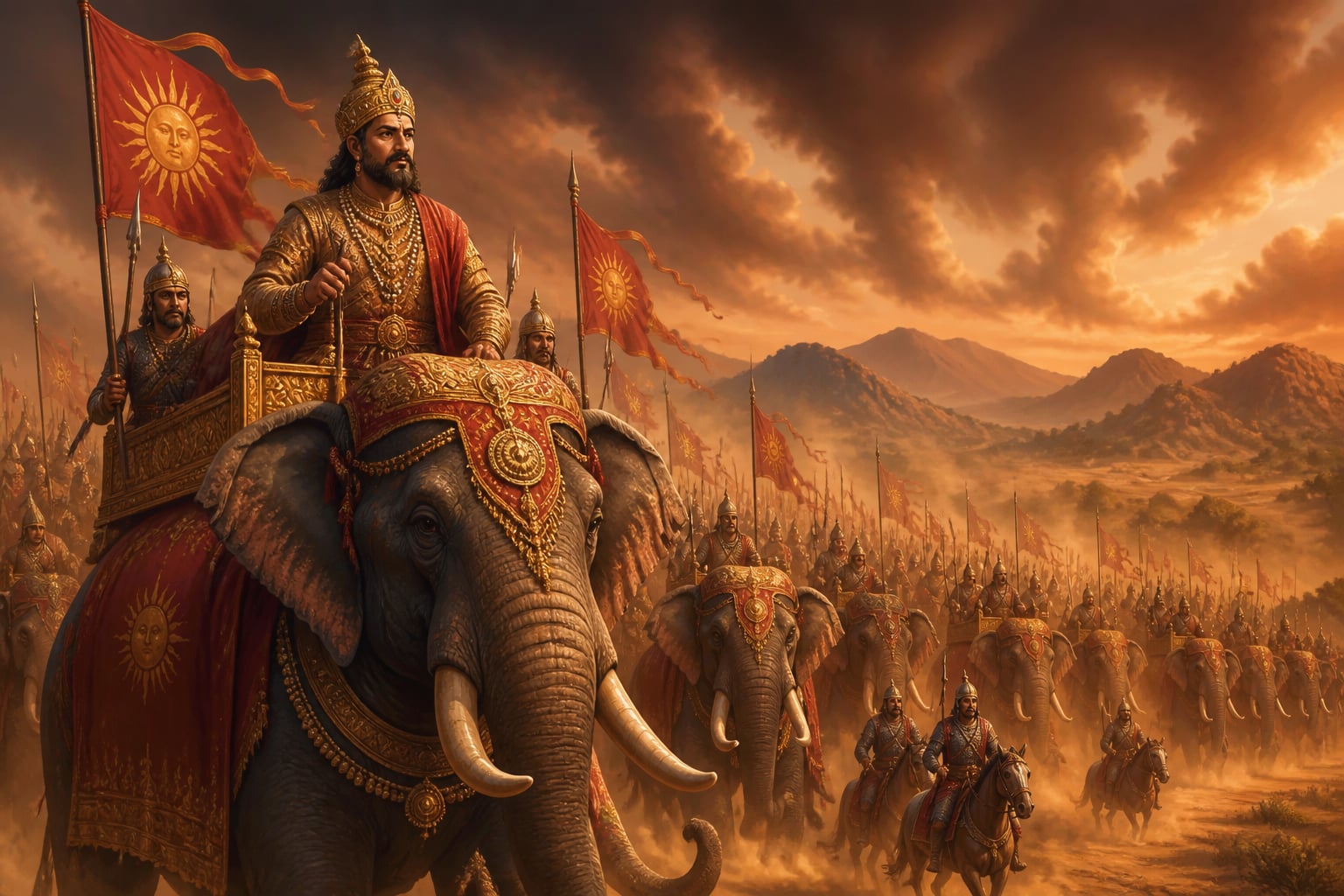
Harshavardhana marching south with his elephant army

"The lord of the entire north, whose war elephants had never known defeat, advanced with an army that darkened the sky."

Why did Harsha choose this moment? Several factors converged. Pulakeshin had just defeated the Pallavas, absorbing their northern territories. He had installed his brother in Vengi, extending Chalukya power to the eastern coast. The Deccan was growing too powerful to ignore.

For Harsha, who dreamed of chakravarti sovereignty over all of Bharat, the rising Chalukya power represented an intolerable challenge. He believed his vastly superior forces would crush the southern upstart as they had crushed so many others.

The Sacred River

The Narmada was not merely a geographical boundary - it was a sacred line. Ancient tradition held that the river was born from the sweat of Lord Shiva's cosmic dance. To this day, pilgrims circumambulate its entire 1,300-kilometer length in a ritual called parikrama.

For Pulakeshin, the Narmada represented something more: it was the line where the South would make its stand. Allowing Harsha to cross would mean fighting on unfamiliar terrain, with supply lines stretched thin. The river had to be held.

The Chalukya army took position on the southern bank. Unlike Harsha's massive force, Pulakeshin's strength lay not in numbers but in the fierce loyalty of his Deccan warriors and his own strategic brilliance.

Pulakeshin holding the southern bank of the Narmada

The Battle

The exact details of the battle are lost to history, but its outcome is unambiguous. The Aihole inscription, composed just sixteen years later, declares:

"Harsha, whose war-elephants had trampled many kingdoms, whose command extended to the shores of all four oceans, was checked by the valor of Pulakeshin. His pride was humbled, his fame eclipsed."

The inscription employs a famous pun that would echo through the centuries: it declares that Harsha's harsha - his joy, his very name meaning happiness - was stripped away by Pulakeshin's valor. The wordplay was deliberate and devastating: the man named "Joy" had lost all joy at the Narmada.

What we can reconstruct suggests that Pulakeshin used the terrain masterfully. The Narmada, swollen during monsoon season, made crossing treacherous. Chalukya forces harassed Harsha's army as it attempted to ford the river, turning the water red with blood. The northern elephants, formidable on open ground, became liabilities in the swirling currents.

The Deccan cavalry, lighter and more mobile than Harsha's elephant corps, struck at supply lines and communication. Harsha found himself unable to establish a secure bridgehead. Every attempt to cross was repulsed with heavy losses.

After what appears to have been several weeks of failed attempts, Harsha made a decision that shocked the world: he withdrew. The invincible emperor of the North had been defeated - not by a larger army, but by superior strategy and the unconquerable will of the South.

The Significance and the Defender's Dharma

The Battle of Narmada was more than a military victory. It established a fundamental principle that would shape Indian history for centuries: the Narmada was the border. Northern empires could expand to the river, southern empires could expand to it, but neither could cross with impunity.

For Pulakeshin, the victory transformed his status. He was no longer merely a powerful regional king - he was the man who had stopped Harsha. The Aihole inscription proudly records that Harsha's harsha (joy) was destroyed by Pulakeshin's valor. Xuanzang himself, though a guest at Harsha's court and admirer of the northern emperor, would later acknowledge that Harsha "was unable to conquer the people of the Deccan."

Contemporary sources suggest that following the battle, Harsha never again attempted to conquer the Deccan. The two empires settled into a pattern of mutual respect, if not formal peace. The Narmada became an accepted boundary.

What drove Pulakeshin to stake everything on defending the Narmada? The inscriptions suggest a ruler deeply conscious of his duty as protector. In the dharmaśāstra tradition, the king's first duty is rakṣā - protection. A king who cannot defend his realm has failed his most fundamental obligation. Pulakeshin understood that allowing Harsha to cross would mean the end of Chalukya independence and the subjugation of the Deccan.

But there was also a cultural dimension. The South had developed its own traditions, its own temple styles, its own interpretation of dharma. Harsha, for all his greatness, represented the imposition of northern ways. Pulakeshin's stand at the Narmada was also a stand for southern identity.

Legacy of the Battle

Pulakeshin celebrated as Dakshinapatheshvara at Vatapi

The Battle of Narmada established Pulakeshin as Dakshinapatheshvara - Lord of the Southern Regions. This was not merely a title but a statement of political reality. The Deccan now had a protector whose strength had been proven against the mightiest force in India.

The victory also had ripple effects across the subcontinent. Other kings took note: the great Harsha could be stopped. The balance of power in India had shifted. No longer could any northern ruler assume automatic superiority over the South.

For Pulakeshin himself, the battle seems to have deepened his sense of mission. In the years following, he invested heavily in temple construction and cultural patronage - as if understanding that military victory alone does not make a great kingdom. The defender must also be a builder.

Historical context

Early 7th Century CE

India in 618 CE was effectively divided between Harsha's northern empire (from Gujarat to Bengal, Bihar to the Himalayas) and multiple competing powers in the South. The Pallavas controlled Tamil Nadu from Kanchipuram, while the Chalukyas dominated the Deccan. Trade continued to flourish despite political divisions, with Indian merchants active from Southeast Asia to the Mediterranean.

Living traditions

The Battle of Narmada remains a touchstone for Deccan identity. It proved that the South could stand against the mightiest northern powers - a pattern that would repeat throughout Indian history. The Narmada continues to serve as a cultural boundary, with distinct traditions north and south of the river. The victory is celebrated in Karnataka's historical memory as a defining moment of regional assertion.

Reflection

More in Pulakeshin II

All lessons in Pulakeshin II · Lesser Known Guardians of Dharma course