Rise of the Chalukyas
From Vatapi to Empire
In the early 7th century, a young prince named Pulakeshin II inherited a kingdom in crisis and transformed it into the greatest power in southern India. His rise from a disputed succession to supreme emperor would establish the Chalukyas as one of India's most illustrious dynasties and set the stage for his legendary confrontation with Emperor Harsha.
The Fortress on the Red Cliffs
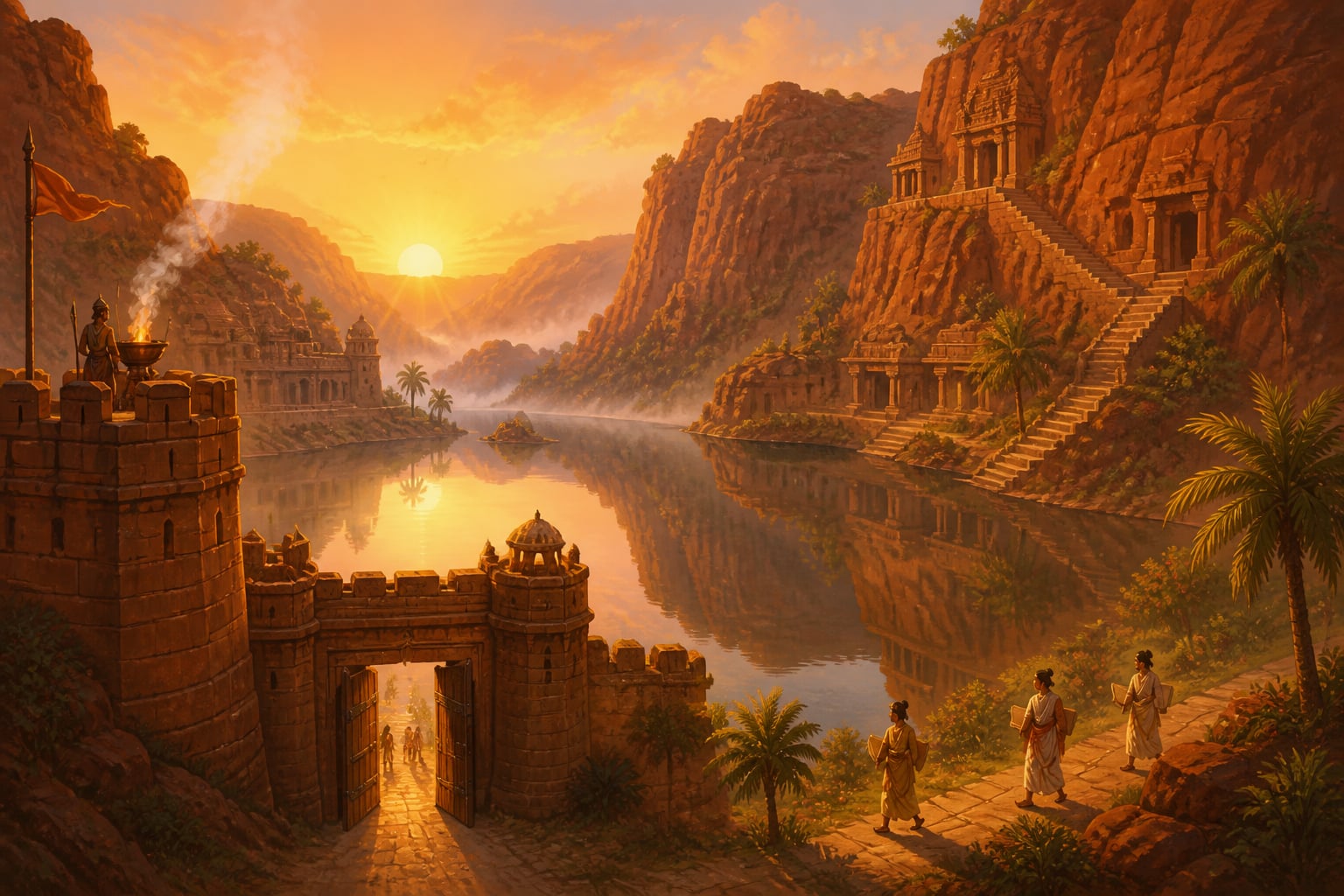
In the heart of the Deccan plateau, where the red sandstone cliffs rise dramatically against the sky, stands the ancient fortress of Vatapi - known today as Badami. Here, in the early 7th century CE, a dynasty was forging its destiny. The Chalukyas had already produced capable rulers, but nothing had prepared India for what was to come.
The fortress city, nestled in a ravine between two rocky hills, was both naturally defensible and strategically positioned. Four magnificent cave temples carved into the cliff face testified to the dynasty's devotion. The Agastya Lake at the base of the cliffs provided water even during the harshest summers. From this stronghold, the Chalukyas controlled the vital trade routes connecting the eastern and western coasts of India.
A Kingdom in Crisis
When Kirtivarman I died around 597 CE, the Chalukya kingdom faced its greatest test. The throne passed not to Kirtivarman's young son, but to his brother Mangalesha, who served as regent. For over a decade, Mangalesha ruled capably, even expanding the kingdom. But as young Pulakeshin II came of age, a fateful question emerged: would Mangalesha surrender the throne to his nephew, or would he attempt to pass it to his own son?
The answer came in blood. Mangalesha chose his son, and civil war erupted. The chronicles tell us that Pulakeshin, though young, displayed remarkable courage and strategic brilliance. He gathered loyal supporters, appealed to the ancient dharma of rightful succession, and challenged his uncle's usurpation.
"The prince, though young in years, was old in wisdom. He understood that a kingdom divided against itself cannot stand."
The conflict was brief but decisive. Around 609-610 CE, Pulakeshin emerged victorious. Mangalesha fell in battle, and the young prince ascended the throne at Vatapi. He was perhaps only in his early twenties, but he had already proven himself in the crucible of civil war.

But the challenges did not end with the throne. Two feudatory chiefs, Appayika and Govinda, sensing weakness in the aftermath of civil war, raised the standard of revolt. The young king crushed this rebellion swiftly and decisively, demonstrating that his victory over Mangalesha was no fluke. The message was clear: Pulakeshin would tolerate no challenges to his authority.
The Qualities of a King
What made Pulakeshin different from ordinary rulers? The Aihole inscription, composed by his court poet Ravikirti in 634 CE, provides vivid testimony. According to this remarkable document - one of the most important inscriptions in Indian history - Pulakeshin possessed a rare combination of virtues.
He was dharmajña - a knower of dharma. He was satyavākya - one whose words were always true. He was śūra - a hero in battle. But perhaps most importantly, he was vidvān - learned in the arts and sciences. This was no mere warrior-king; this was a ruler who understood that true greatness lay in the harmony of martial valor and cultural refinement.
The inscription tells us that Pulakeshin was "like the creator Brahma in giving protection to the world." This was not empty flattery. Under his rule, the Deccan would experience unprecedented peace and prosperity, temples would rise across the land, and scholars would flourish at his court.
Building the Empire
Pulakeshin's first task was to secure his position. The civil war had weakened the kingdom, and neighboring rulers sensed opportunity. But the young king moved with speed and decisiveness that stunned his enemies.
To the south, the Kadambas of Banavasi had grown bold during the civil war. Pulakeshin crushed them utterly, annexing their territory and eliminating them as a threat. To the west, the Mauryas of Konkan - descendants of the ancient Mauryan line who ruled the coastal strip - submitted to Chalukya overlordship. The strategic port of Puri (modern Elephanta) came under Chalukya control, opening valuable maritime trade.
To the east, Pulakeshin's ambitions extended far beyond his immediate borders. He first subdued the rulers of Kosala (in modern Chhattisgarh) and Kalinga (coastal Odisha), sweeping through these eastern territories with an army that seemed unstoppable. Then he turned his attention to the Vishnukundinas, who controlled the Krishna-Godavari delta. This region, known as Vengi, was among the richest in India - the "rice bowl of the South." Through a combination of military pressure and diplomatic marriage, Pulakeshin brought Vengi under his control and installed his brother Kubja Vishnuvardhana as viceroy. This eastern branch would eventually become the Eastern Chalukyas, ruling for centuries.
The Southern Frontier
With his northern and eastern flanks secure, Pulakeshin looked south to the most powerful kingdom in the region: the Pallavas of Kanchipuram. The Pallavas, ruled by Mahendravarman I, were no ordinary opponents. They were cultured, wealthy, and militarily formidable. Their capital Kanchi was one of the great cities of Asia, a center of learning that attracted scholars from across the Buddhist and Hindu world.

The first clash came around 610-615 CE. Pulakeshin invaded Pallava territory and, according to the Aihole inscription, defeated Mahendravarman in battle. The inscription claims that Pulakeshin "caused the lord of Kanchi to lose his splendor." While this may be poetic exaggeration, there is no doubt that the Chalukyas gained significant territory and established themselves as equals to the Pallavas.
But Pulakeshin was too wise to attempt the complete destruction of the Pallavas. He understood the limits of power. A total conquest would overextend his forces and create new enemies. Instead, he established a balance - the Chalukyas dominant, the Pallavas humbled but intact. This policy of strategic restraint would serve his successors well.
The Emperor of the South
By 620 CE, Pulakeshin II had transformed a kingdom in crisis into an empire stretching from the Arabian Sea to the Bay of Bengal. The Aihole inscription proudly declares his titles: Satyashraya (refuge of truth), Prithivivallabha (beloved of the earth), and Parameshvara (supreme lord).
More remarkably, Pulakeshin had achieved this through a combination of military brilliance and diplomatic wisdom. He knew when to fight and when to negotiate. He understood that conquered peoples must be treated justly if they are to become loyal subjects. He patronized temples and scholars, understanding that cultural prestige was as important as military might.
The Deccan had never seen such a ruler. And soon, neither had the rest of India. For as Pulakeshin consolidated his southern empire, news came from the north of another great conqueror - Harshavardhana, the Emperor of the North - who was looking southward with ambition. The stage was being set for one of the most famous confrontations in Indian history.
What gave Pulakeshin his strength? The inscriptions and later accounts suggest a ruler deeply grounded in dharma - not merely as religious observance, but as a complete philosophy of governance. He was a Vaishnavite, devoted to Vishnu in his form as Varaha (the boar incarnation who rescued the earth). But his temples at Badami show equal reverence for Shiva and other deities. This was not religious indifference but genuine tolerance - the understanding that dharma manifests in many forms.
More importantly, Pulakeshin seems to have internalized the ancient ideal of the dharma-vijaya - the righteous conquest. He fought to establish order, not merely to accumulate territory. He protected Brahmins and temples, not merely for political advantage but from genuine conviction. He ruled with justice, understanding that a king's dharma is to be the servant of his people, not their master.
This dharmic foundation would be tested in the coming years. But as the 620s began, Pulakeshin II stood as the unchallenged master of southern India - a warrior, a patron, and a king who had risen from civil war to imperial glory through courage, wisdom, and adherence to dharma.
Historical context
Early 7th Century CE
India was divided between Harsha's empire in the north (covering most of the Indo-Gangetic plain) and multiple competing powers in the south and Deccan. The Pallavas dominated Tamil country, while smaller kingdoms like the Kadambas, Gangas, and Vishnukundinas controlled various regions. Trade flourished through ports on both coasts.
Living traditions
The Chalukyas are celebrated in Karnataka as founders of a distinctive Deccan identity. Their architectural style influenced temple building for centuries. Pulakeshin II is remembered as one of India's greatest emperors, and the Aihole inscription remains a touchstone for Indian historiography.
- Badami Cave Temples: Four rock-cut cave temples from the 6th-7th centuries featuring stunning sculptures of Vishnu, Shiva, and Jain tirthankaras. Cave 3, dedicated to Vishnu, contains an inscription dated 578 CE.
- Aihole Temple Complex: Called the "cradle of Indian temple architecture," Aihole contains over 120 temples from different periods. The Meguti Jain temple atop the hill contains Ravikirti's famous inscription about Pulakeshin II.
- Pattadakal Temple Complex: UNESCO World Heritage Site with temples from the 7th-8th centuries, representing the culmination of Chalukya architecture. Includes both Dravidian and Nagara style temples.
Reflection
- Pulakeshin faced a difficult choice when his uncle tried to usurp the throne: accept the injustice to avoid bloodshed, or fight for his legitimate rights knowing it would cause a civil war. What factors should guide such decisions?
- The inscription compares Pulakeshin to Brahma, the creator god. What does this tell us about how Indians understood the role of kings? Is there something valuable in this conception that modern leadership has lost?
- Pulakeshin combined military success with cultural patronage, understanding that both were essential for lasting achievement. In your own work or life, do you balance "hard" accomplishments (results, metrics, victories) with "soft" investments (relationships, culture, values)? How might you improve this balance?