The Statesman: Building Lasting Power

From Battle Victory to Enduring Institution

After his decisive military victory, Nagabhata I faced the greater challenge of building institutions that would outlast his lifetime. Through sophisticated administration, diplomatic skill, and strategic alliance management, he transformed a temporary military confederacy into a durable political structure that would protect northwestern India for two centuries.

Beyond the Battlefield

The Battle of Rajasthan in 738 CE made Nagabhata I famous, but what made him historically significant was what he did afterward. Many rulers win battles; few transform military victory into lasting political institutions. Nagabhata understood that defeating an invasion was insufficient, he needed to build structures that could prevent future invasions and maintain the unity that had proven so effective.

The challenge was formidable, and it became even more complex when Nagabhata suffered a devastating defeat at the hands of the Rashtrakuta king Dantidurga around 750 CE. The humiliation of being forced to serve as a ceremonial doorkeeper in his own capital could have ended the Pratihara dream. Instead, Nagabhata demonstrated the resilience that distinguished truly great leaders.

Recovery and Rebuilding

After the Rashtrakutas withdrew, Dantidurga had his own challenges to manage in the Deccan, Nagabhata set about recovering lost ground with characteristic determination. By the mid-750s CE, he had regained control over most of Malwa and even expanded his influence, conquering the area around Bhrigukachchha (modern Bharuch) where a Chahamana branch came to rule under Pratihara suzerainty. This territorial recovery was accompanied by renewed diplomatic efforts to strengthen alliance bonds.

This recovery demonstrated that Nagabhata's achievements weren't merely fortunate circumstances but reflected genuine capability and resilience. He could rebuild after setbacks, maintain alliance loyalty despite defeat, and emerge stronger than before. The confederate kingdoms, rather than abandoning the Pratiharas after the Rashtrakuta humiliation, largely remained loyal, testimony to the institutional bonds Nagabhata had created and the trust he had earned through years of fair dealing.

Institutionalizing the Confederacy
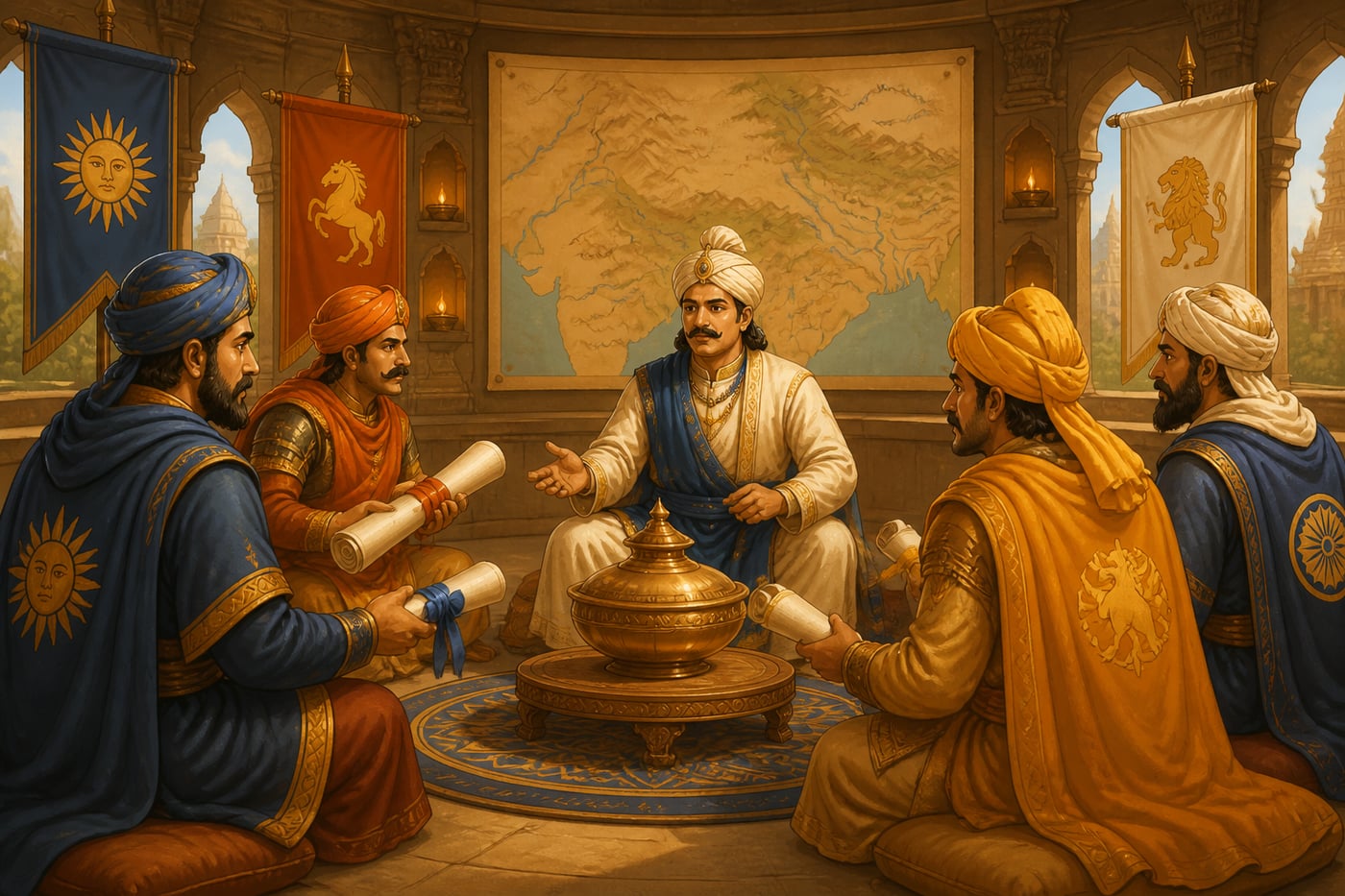
Confederate envoys formalizing the alliance at Ujjain

Nagabhata's first achievement was transforming the temporary alliance into a permanent institution. He established regular councils where allied kings could address disputes, coordinate policies, and plan joint actions. These weren't mere ceremonial gatherings but working sessions where real decisions were made about trade, border management, and defense coordination.

The confederacy created shared protocols for military mobilization. Rather than scrambling to organize defenses when threats emerged, member kingdoms maintained agreed-upon force levels and had predetermined assembly points and command structures. Nagabhata also established a sophisticated intelligence network that served all confederacy members, information about movements along the western frontiers and political developments in Arab-controlled Sindh was shared among allied kingdoms, creating mutual dependence.

Administration, Diplomacy, and Economic Foundations

Within his own territories, Nagabhata built an administration capable of supporting his enlarged responsibilities. The Pratihara administrative system combined central control with local flexibility, provincial governors managed day-to-day administration while maintaining loyalty to the Pratihara court. Revenue collection was systematized, and infrastructure development, roads, rest houses, fortifications, facilitated trade and rapid military movements.

Nagabhata's diplomatic skills were equally important. He managed relationships with diverse kingdoms through marriage alliances, creating kinship networks that bound the confederacy together. The Pratihara court became a center of diplomatic activity where envoys from allied kingdoms maintained permanent presence, and disputes were mediated before escalating into conflicts.

Economic interdependence strengthened the confederacy. The territories under Pratihara control sat astride important trade routes, and the Pratihara administration protected merchants and standardized trade practices. Agricultural development was prioritized through effective water management and land revenue systems. This prosperity generated resources for military maintenance while creating stakeholders in the Pratihara order.

Balancing Power and Partnership

Nagabhata mediating a land dispute between two allied chieftains

Nagabhata walked a delicate line between exercising leadership and respecting allied autonomy. He was powerful enough to coordinate confederate action but wise enough not to assert imperial control that would fracture the alliance. This balance was crucial for the confederacy's longevity.

When disputes arose among allied kingdoms, Nagabhata acted as mediator rather than overlord. His court's judgments were respected because they were perceived as fair, not merely as impositions of superior force. This reputation for justice was itself a form of power, making allied kingdoms willing to accept Pratihara arbitration.

At the same time, Nagabhata maintained military strength that made challenging Pratihara leadership unattractive. The combination of demonstrated capability, fair dealing, and military power created a stable equilibrium. Allied kingdoms saw more benefit in maintaining the confederacy than in pursuing independent paths.

Legitimacy Through Dharma

Throughout his administrative and diplomatic activities, Nagabhata emphasized his role as dharmarakṣaka, protector of dharma. This wasn't merely propaganda; it reflected genuine commitment to supporting temples, brahmins, and traditional institutions. But it also served a political function, providing ideological legitimacy for Pratihara leadership.

The confederacy was framed not as Pratihara imperialism but as collective defense of dharma. Allied kingdoms weren't subordinates but partners in a sacred duty. This framing made collaboration honorable rather than submissive. Kings could maintain their pride and autonomy while participating in a structure led by the Pratiharas.

Nagabhata's patronage of religious institutions across allied territories also reinforced confederacy bonds. Brahmins and temples supported by Pratihara generosity had incentives to promote the confederacy and the dharmic narrative supporting it. Religion and politics reinforced each other, creating a powerful ideology of collective defense.

The Statesman's Enduring Legacy

When Nagabhata I died (traditionally dated around 760 CE, though exact dates are uncertain), the confederacy and Pratihara power continued without crisis. This is perhaps the strongest evidence of his statesmanship. The structures he built, military protocols, diplomatic institutions, economic relationships, and ideological frameworks, functioned beyond his lifetime. His successors inherited not just territories but a functioning system for managing them and coordinating with allies.

The Pratihara dynasty would continue to dominate northwestern India for over two centuries, eventually expanding its power significantly under rulers like Mihira Bhoja. But the foundation was laid by Nagabhata I, who understood that walls are built of institutions as much as stone and steel.

King Nagabhata I holding court at Ujjain reviewing grants and treaties

Nagabhata I is remembered primarily for his military victories, but his statesmanship was equally important. He transformed a military confederacy into a political institution, temporary alliances into durable relationships, and battle victory into lasting security. These achievements required different skills than battlefield leadership, patience, diplomatic subtlety, administrative competence, and long-term vision. The Wall that Nagabhata built was not just military but also political, economic, and ideological. It stood for two centuries because it was constructed with multiple reinforcing elements, each supporting the others. When we study Nagabhata the defender, we should also remember Nagabhata the statesman, whose institutional building was as crucial as his military leadership in protecting India's future.

Historical context

738-760 CE

The period after the Battle of Rajasthan saw consolidation of regional powers. The Pratiharas established administrative control over Malwa and Gujarat. The Chalukyas managed the Deccan, while various Rajput dynasties controlled territories in Rajasthan. The absence of major external threats allowed focus on internal development, though maintaining defense readiness remained essential. Trade flourished, and regional courts patronized arts and scholarship.

Living traditions

Modern understanding of federalism and confederate structures can draw lessons from Nagabhata's successful balancing of central coordination with regional autonomy. His model of institutionalizing crisis-born cooperation has relevance for contemporary regional alliances. The emphasis on economic foundations for political power remains valid, as does the principle that sustainable alliances require fair dealing and respect for partners' autonomy.

Reflection

More in Nagabhata I

All lessons in Nagabhata I · Lesser Known Guardians of Dharma course