Origins & Rise: The Pratihara Awakening

From Mandor to Destiny: The Rise of a Dynasty

Nagabhata I emerged from the Pratihara clan in the early 8th century CE, establishing his power base in Malwa and Gujarat. Through strategic alliances and military prowess, he transformed a regional dynasty into the primary bulwark against Arab expansion, laying the foundation for Pratihara dominance that would last two centuries.

The Dawn of the Pratiharas

In the early decades of the 8th century CE, as the Arab Caliphate extended its reach into the Indian subcontinent, a new power emerged in the region of Malwa and Gujarat. Nagabhata I, founder of the imperial Pratihara dynasty, rose from relative obscurity to become one of Bharat's most crucial defenders. His story begins not with grand pronouncements, but with the quiet determination of a clan that would soon shake the foundations of medieval Indian politics.
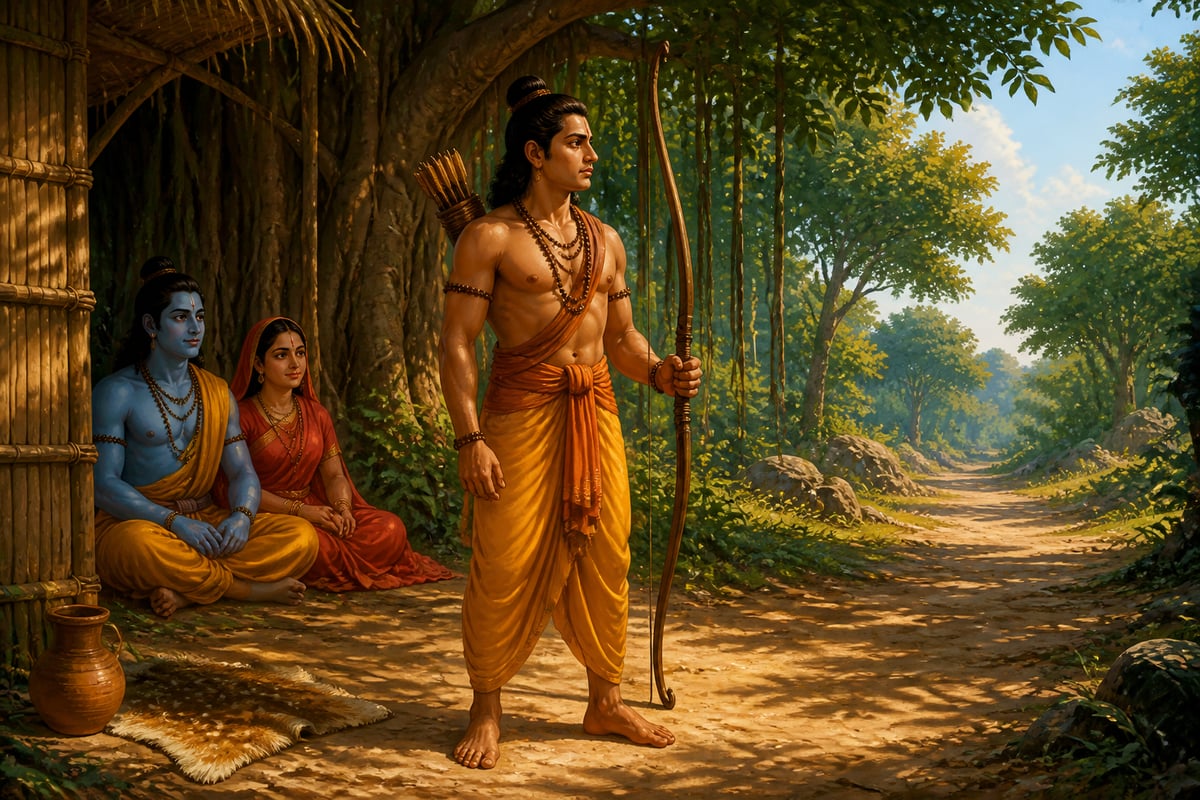
Lakshmana standing as pratihara doorkeeper at Rama's forest hermitage

The Pratiharas claimed descent from Lakshmana, brother of Lord Rama, who served as his pratihara (doorkeeper) during the exile period. This connection to the Ramayana gave the dynasty both legitimacy and a sense of sacred duty. According to their family traditions, preserved in later inscriptions like the Gwalior Prasasti, they belonged to the Kshatriya varna and followed the Raghuvamsha lineage.

From Bhillamala to Mandor: The Pratihara Origins

The early Pratiharas emerged from the region of Bhillamala (modern Bhinmal in Rajasthan), an ancient city that had served as a center of learning and commerce. From Bhillamala, the dynasty gradually extended its influence, establishing themselves more firmly in the Mandor region near present-day Jodhpur. This strategic positioning in southwestern Rajasthan gave them control over important trade routes connecting the western coast with the interior.

Nagabhata I's predecessors had carved out a respectable, though not dominant, position among the various Rajput clans that dotted northwestern India. They were known for their martial prowess and their steadfast devotion to Vishnu, particularly in his Rama avatar. The family had accumulated both military experience and political connections through generations of service and alliance-building in this competitive landscape.

The World Nagabhata Inherited

When Nagabhata I came to power around 730 CE, the political landscape of India was fragmented and vulnerable. The great Harsha's empire had collapsed nearly a century earlier, leaving a power vacuum that numerous regional powers sought to fill. The Chalukyas dominated the Deccan, the Palas were rising in Bengal, and various Rajput clans competed for supremacy in the northwest, often weakening each other through constant warfare.

Meanwhile, to the west, the Umayyad Caliphate had conquered Sindh in 712 CE under Muhammad bin Qasim. Arab governors in Sindh were not content with their conquest, they sought to expand eastward into the rich lands of Gujarat, Rajasthan, and beyond. Between 724 and 740 CE, successive Umayyad caliphs launched aggressive campaigns along all frontiers, including India. The threat was existential: either the Rajput kingdoms would unite and resist, or they would fall one by one to the well-organized Arab armies that had already conquered Persia, Central Asia, and North Africa with devastating efficiency.

Nagabhata's Vision and the Move to Ujjain

What distinguished Nagabhata I from his contemporaries was his strategic vision. Rather than focusing solely on expanding his own territories at the expense of neighboring Rajput kingdoms, he recognized the greater threat. The Arab invasions required a coordinated response, something unprecedented in the often-fractious world of medieval Indian politics.

Nagabhata established his capital in the Ujjain region, a location of immense strategic and symbolic significance. Ujjain had been one of ancient India's greatest cities, a center of learning, commerce, and culture since the time of the Mauryas. The city's association with great rulers like Vikramaditya added to its prestige. By making it his base, Nagabhata connected his nascent empire to India's glorious past while positioning himself to control crucial trade routes linking the western ports with the Gangetic heartland. This move from the Pratihara homeland in Rajasthan to Malwa signaled his imperial ambitions.

Young Nagabhata I on the Ujjain palace terrace at dawn

Building the Coalition

Nagabhata seated in council with allied Rajput and Gurjara chieftains

The young king's diplomatic skills matched his military abilities. Nagabhata began the delicate work of forging alliances with other Rajput clans, the Guhilas of Mewar under the legendary Bappa Rawal, the Chahamanas (Chauhans) of Sapadalaksha, and the Chalukyas of Gujarat. These were proud dynasties with their own ambitions and ancient rivalries. Convincing them to subordinate immediate territorial gains to the greater cause of defending dharma required both persuasion and demonstration of strength.

Nagabhata's approach combined pragmatism with idealism. He presented the confederacy not merely as a military alliance but as a sacred duty, the protection of dharma against those who would destroy Hindu temples, disrupt traditional ways of life, and impose foreign rule. This framing resonated deeply with the warrior clans of Rajasthan and Gujarat, transforming political calculation into religious commitment.

Between 730 and 738 CE, Nagabhata consolidated his position through a series of calculated military campaigns and diplomatic marriages. He expanded Pratihara control over key territories in Malwa and Gujarat, securing his economic base and recruiting the fierce warriors for which these regions were renowned. Each victory enhanced his reputation, making the confederacy more attractive to potential allies. His court at Ujjain became a gathering place for warriors, brahmins, and administrators committed to resisting Arab expansion.

The Test Approaches

By 735 CE, the Arab threat had intensified dramatically. Junaid ibn Abd al-Rahman al-Murri, the ambitious governor of Sindh, had defeated several smaller kingdoms including the Saindhavas, Kachchhelas, and Mauryas. His armies had advanced through Gujarat and Rajasthan, probing for weaknesses in the Hindu kingdoms' defenses. The Arab forces had even reached as far south as Navsari, threatening the Chalukya territories.

Nagabhata's intelligence network, built on merchant connections and diplomatic relationships, kept him informed of Arab preparations. He knew that a decisive confrontation was inevitable, and he used his diplomatic skills to ensure that when it came, he would not face it alone. The Chalukya emperor Vikramaditya II, recognizing the shared threat, agreed to coordinate resistance. The confederacy Nagabhata had painstakingly built would soon be tested in the crucible of battle.

Nagabhata I's rise was not accidental or purely circumstantial. It reflected a rare combination of martial skill, diplomatic acumen, and strategic vision. In an era of fragmentation and self-interest, he saw the larger pattern and acted on it. His understanding that individual kingdoms must sometimes sacrifice autonomy for collective security was revolutionary in the context of medieval Indian politics. The stage was set. The confederacy was formed. And in 738 CE, at the Battle of Rajasthan, Nagabhata would prove that his vision of unity was not merely idealistic rhetoric but a practical strategy for survival and victory. The Wall was about to be tested.

Historical context

730-760 CE

Post-Harsha fragmentation had created numerous regional kingdoms across North India. The Chalukyas dominated the Deccan, while Rajput clans controlled various territories in Rajasthan and Gujarat. The Arab conquest of Sindh (712 CE) created an existential threat, as governors like Junaid sought to expand eastward. The period saw both political fragmentation and cultural flourishing, with regional courts patronizing arts and literature.

Living traditions

The Pratihara confederacy model influenced later Indian military and political strategies. The concept of dharma-based resistance to invasion became central to Rajput identity. Modern Rajasthan celebrates its heritage as defenders of India, with Pratihara history forming a key part of that narrative. The dynasty's role in stopping Arab expansion is increasingly recognized by historians as pivotal to the preservation of Hindu civilization in northern India.

Reflection

More in Nagabhata I

All lessons in Nagabhata I ยท Lesser Known Guardians of Dharma course