Legacy & Lessons: The Wall That Endures
Two Centuries of Guardianship and Timeless Wisdom
Nagabhata I's legacy extended far beyond his lifetime. The confederacy he built, the dynasty he founded, and the principles he embodied protected northwestern India for two centuries. His final years consolidated gains, his successors built on his foundations, and his example offers timeless lessons about leadership, strategic vision, cultural defense, and the integration of power with principle.
The Final Years and Succession
Nagabhata I's later years, following the decisive victory of 738 CE and his recovery from the Rashtrakuta defeat, were spent consolidating the gains achieved through military success, diplomatic skill, and resilience. By the mid-750s CE, he had transformed the Pratiharas from a regional dynasty into the dominant power of northwestern India and established the confederacy as a functioning institution capable of outlasting its founder.
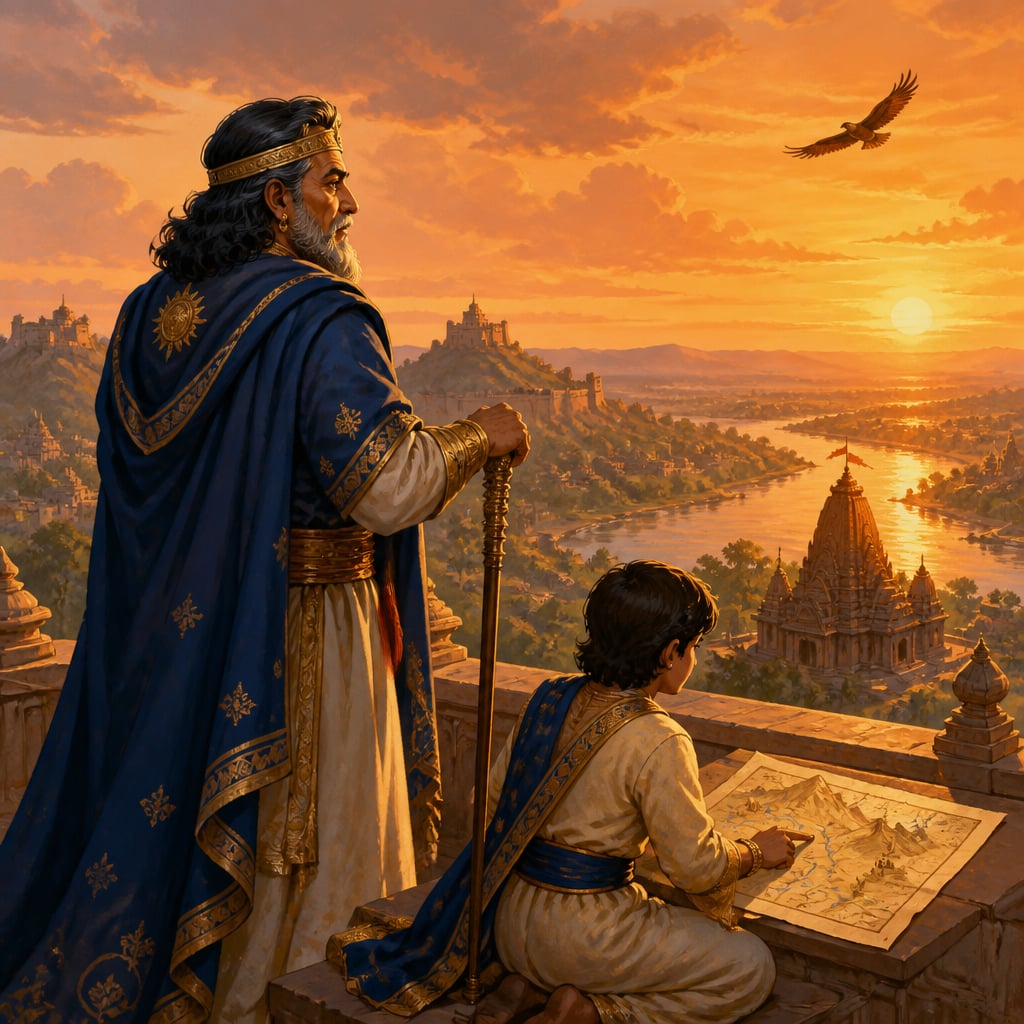
The exact date and circumstances of Nagabhata's death are uncertain, medieval Indian sources often focused more on achievements than biographical details. Tradition places his death around 760 CE, meaning he ruled for approximately three decades. Based on the 756 CE Hansot inscription that identifies him as Nagavaloka, he was likely still active in his final years.
Remarkably, Nagabhata appears to have had no surviving sons. According to the Gwalior Prasasti, he was succeeded by his nephews, Kakustha (also called Kakkuka) and Devaraja, the sons of his unnamed brother. This fraternal succession, rather than creating crisis, proceeded smoothly. Kakustha ruled first but died childless, whereupon his younger brother Devaraja succeeded him. Devaraja's son Vatsaraja would later expand Pratihara power significantly. This peaceful transition demonstrates Nagabhata's statesmanship, he had built institutions strong enough that succession didn't depend on direct biological inheritance.
The Dynasty's Continuation and Tripartite Struggle
Nagabhata I founded a dynasty that would dominate north Indian politics for over two centuries. His conflict with the Rashtrakuta king Dantidurga had initiated what historians call the Tripartite Struggle, the three-way contest between Pratiharas, Rashtrakutas, and Palas for supremacy over northern India, particularly control of the strategic city of Kannauj. This struggle would define Indian politics for the next two hundred years.
Later Pratihara rulers like Vatsaraja, Nagabhata II, and particularly Mihira Bhoja would expand Pratihara power significantly, eventually controlling territories from Gujarat to Bengal. Mihira Bhoja (c. 836-885 CE), perhaps the greatest of Nagabhata's successors, ruled an empire that made the Pratiharas one of the three great powers of 9th century India. Yet even at the height of imperial expansion, the dynasty maintained its identity as dharmarakṣakas and continued the confederate structures and defensive orientation that Nagabhata had established.

The Gwalior Prasasti, erected by Mihira Bhoja over a century after Nagabhata I's death, devoted significant space to praising the dynasty's founder. This wasn't mere antiquarianism but recognition that Nagabhata's achievements laid the foundation for everything that followed. The legitimacy of later rulers rested on connection to the founder who had stopped Arab expansion and established Pratihara leadership.
The Wall That Held

Nagabhata's most important legacy was functional rather than symbolic, the confederacy and Pratihara power actually protected northwestern India from invasion for two centuries. Arab forces, having been decisively defeated in 738 CE, never again attempted major eastward expansion. Subsequent invasion threats from the northwest, whether Arab raids or later Central Asian incursions, faced the organized resistance of Pratihara-led confederacy rather than fragmented kingdoms.
This protective function had profound consequences. Hindu kingdoms in Rajasthan, Gujarat, and Malwa were able to develop culturally, economically, and politically without constant existential threat. The temples, learning centers, and artistic achievements of the Pratihara era were possible because military security enabled cultural flourishing. The 'Wall' that Nagabhata built created space for civilization to thrive.
The contrast with regions that fell to conquest is instructive. In Central Asia and parts of the Mediterranean, sophisticated civilizations were destroyed or fundamentally transformed by Arab conquest. Ancient Persia's Zoroastrian civilization was largely displaced by Islamic culture. In India, thanks partly to Nagabhata's defensive success, Hindu civilization maintained continuity in northern India even as it faced ongoing external pressures.
Strategic, Military, and Cultural Legacy
Nagabhata's confederacy strategy became a model for subsequent resistance to invasion. The principle that diverse kingdoms must unite against common threats, that short-term autonomy sometimes must be subordinated to long-term survival, and that organized confederation can defeat superior individual forces, these lessons were learned and applied repeatedly in medieval Indian history. The Rajput kingdoms that continued to resist invasions for centuries operated within frameworks influenced by Pratihara example.
Militarily, the Pratihara era saw refinement of cavalry tactics, fortress construction, and combined-arms operations that characterized later medieval Indian warfare. The emphasis on mobility, knowledge of terrain, and defensive depth that marked Nagabhata's approach became standard elements of Rajput military doctrine.
Nagabhata's integration of political power with cultural patronage established patterns that continued throughout the Pratihara period and beyond. The dynasty's support for temples, scholars, and arts made the Pratihara era a period of cultural flowering. The great temple architecture of medieval India, including the magnificent structures at Khajuraho, Gwalior, and elsewhere, built on foundations laid during the Pratihara period.
The Pratihara emphasis on dharma protection influenced how later Hindu kingdoms understood their role. The concept of the kshatriya ruler as dharmarakṣaka, protecting not just territory but civilization and tradition, became central to Hindu political ideology. Vaishnavism, particularly Rama devotion, spread partly through Pratihara patronage, connecting political authority with religious devotion in ways that influenced north Indian culture.
Lessons for Leadership
Nagabhata I's career offers multiple lessons relevant beyond his specific historical context:
Strategic Vision Over Tactical Opportunism: Nagabhata saw the larger pattern, that Arab expansion threatened all Hindu kingdoms and required unified response. He built alliances that sacrificed immediate gains for long-term security. Modern leaders facing complex challenges benefit from similar long-term strategic thinking rather than mere tactical reaction.
Institutional Building Creates Lasting Impact: Nagabhata's greatest achievement wasn't winning a battle but building institutions that outlasted him. The confederacy, administrative structures, and alliance networks he created functioned beyond his lifetime. Leaders who build institutions achieve more lasting impact than those who merely exercise personal power.
Cultural Defense Requires Active Investment: Nagabhata understood that defending civilization meant actively supporting the cultural and religious institutions that defined it. Military defense alone was insufficient, temples, schools, and traditions required conscious nurturing. Modern leaders protecting organizational or community cultures face similar requirements.
Power Combined with Principle Creates Legitimate Authority: Nagabhata wielded substantial power but operated within dharmic constraints and for articulated purposes. This combination of capability and principle created authority that transcended mere force. Leaders who integrate power with genuine principles achieve more sustainable influence than those who rely on coercion alone.
Coalition Leadership Requires Balancing Strength with Partnership: Nagabhata led the confederacy but didn't dominate it tyrannically. He balanced demonstrating capability (which made allies willing to follow) with respecting their autonomy (which made them willing to cooperate). Modern coalition leadership, whether in politics, business alliances, or nonprofit collaborations, requires similar balance.
Modern Relevance
Nagabhata's story resonates in contemporary contexts in multiple ways:
Defending Civilization: In an era of cultural conflict and existential threats, whether terrorism, authoritarian expansion, or cultural erosion, Nagabhata's example of determined defense combined with cultural preservation remains relevant. His integration of military resistance with active support for the civilization being defended offers a model for comprehensive defense.
Coalition Building Against Common Threats: Many contemporary challenges, climate change, pandemic response, economic crises, security threats, require coalition responses similar to Nagabhata's confederacy. His success in building and maintaining alliances among diverse actors facing common threats provides lessons for modern coalition building.
Cultural Preservation Amid Globalization: Nagabhata's efforts to preserve Hindu civilization while engaging with external forces parallel modern challenges of maintaining cultural distinctiveness amid globalization. His model of active cultural preservation, supporting traditions, institutions, and practices that define identity, offers approaches for communities seeking to maintain distinctiveness without isolation.
Principle-Based Leadership: In an era often characterized by cynical or purely transactional leadership, Nagabhata's integration of power with dharmic principles demonstrates that effectiveness and ethics need not be opposites. Leaders operating from genuine principles while achieving practical results offer models particularly valuable when public cynicism about leadership is widespread.
Conclusion: The Wall in Memory
Nagabhata I is not as famous as some medieval Indian rulers, Harsha, the Chola emperors, or later figures like Prithviraj Chauhan or Rana Pratap. Yet his historical significance is arguably greater than his popular fame. The two centuries of protection he enabled, the confederacy strategy he pioneered, and the dynasty he founded shaped medieval Indian history profoundly. The epithet 'The Wall' captures his essential role, standing between invasion and civilization, creating space for Hindu culture to flourish, and establishing defensive structures that functioned for generations.
Nagabhata I transformed guardianship from metaphor to reality. He built the Wall, militarily through victory and preparedness, politically through confederacy and alliance, administratively through effective governance, culturally through active patronage, philosophically through integration of power with principle. That Wall stood for two centuries, protecting the civilization it was built to defend.
His legacy is not primarily monuments, though the Pratihara era saw great construction. It's not primarily territorial expansion, though his successors built an empire. His legacy is in what he prevented, the conquest and cultural destruction that befell other sophisticated civilizations. It's in what he enabled, two centuries of Hindu cultural flourishing in northwestern India. And it's in what he demonstrated, that vision, courage, wisdom, and principle can transform circumstances and protect what matters most.
The lesser-known guardian proved to be among the most consequential. The Wall, though not always visible in popular memory, stood when it was needed and shaped the history that followed. Walls are not glamorous, they simply stand, endure, and protect. Yet their presence makes everything else possible. Nagabhata I earned his place among the guardians of dharma not through fame but through effective, sustained, and principled protection of civilization itself.
Historical context
730-760 CE and beyond (legacy through c. 1000 CE)
The two centuries following Nagabhata I's death saw the Pratiharas become one of India's great powers, controlling territories across northern India at their peak. The dynasty's role as northwestern defenders continued throughout this period, with later rulers maintaining the confederacy structures and dharmarakṣaka identity. The Pratihara period saw significant temple construction, cultural patronage, and development of arts and learning. The dynasty finally declined in the 10th century due to repeated invasions and internal fragmentation, but it had fulfilled its protective role for two centuries.
Living traditions
Nagabhata I's legacy resonates in multiple contemporary contexts: the importance of coalition building against common threats; the necessity of comprehensive defense combining military, cultural, and institutional dimensions; the value of principled leadership oriented toward service of greater purposes; and the achievement of building institutions that outlast individual leaders. His example offers lessons for modern challenges requiring sustained collective response, cultural preservation amid external pressure, and leadership that integrates effectiveness with ethics.
- Gwalior Fort and Prasasti: The Gwalior Prasasti inscription is the primary source for Nagabhata I's life and achievements. This inscription, erected by his descendant Mihira Bhoja, preserves the dynasty's memory and articulates its founding principles. The fort itself became a major Pratihara stronghold, symbolizing the enduring power Nagabhata established.
- Pratihara Temples of Central India: Numerous temples from the Pratihara period survive throughout central India, demonstrating the dynasty's cultural patronage and architectural achievement. Sites like Bateshwar, Mitaoli, and others showcase Pratihara-era construction and artistic style, embodying the cultural flowering that Nagabhata's defense enabled.
- Ujjain - Ancient Capital: Nagabhata I's capital and one of India's seven sacred cities. While most current structures post-date the Pratihara period, Ujjain's continued religious significance and historical importance reflect its role as center of Pratihara power. The Mahakaleshwar Temple and other sites connect visitors to the spiritual and cultural context of Nagabhata's rule.
Reflection
- What determines whether a leader's legacy endures beyond their lifetime? Why did Nagabhata's achievements continue through two centuries rather than collapsing after his death?
- Nagabhata was 'The Wall', his primary achievement was what he prevented rather than what he created. How should we value preventive achievement versus creative achievement? Is defense as important as creation?
- What legacy do you wish to leave? Are you focused on personal achievements or on building institutions and capabilities that will outlast you?