The Defender: Battle of Rajasthan
738 CE: When the Wall Held
The Battle of Rajasthan in 738 CE marked the decisive confrontation between Nagabhata's confederacy and Arab forces under Junaid. This engagement stopped Arab expansion into India and validated the confederacy strategy. Through superior coordination, knowledge of terrain, and unified purpose, the Hindu kingdoms demonstrated that organized resistance could overcome even the powerful Arab armies.
The Storm Gathers
By early 738 CE, the confrontation that Nagabhata I had been preparing for became inevitable. Junaid ibn Abd al-Rahman al-Murri, the ambitious governor of Sindh, had consolidated his position and secured reinforcements from the Umayyad Caliphate. His target was clear: the wealthy kingdoms of Gujarat and Rajasthan, gateway to the even richer territories of the Gangetic plain.
Junaid had already demonstrated his military capabilities, conquering smaller kingdoms and extracting tribute from those too weak to resist. His army was disciplined, experienced, and motivated by both religious zeal and the promise of plunder. Arab military tactics had proven devastatingly effective across three continents, and Junaid had every reason to believe that the fragmented Hindu kingdoms would fall as so many others had before them.
The Confederate Response
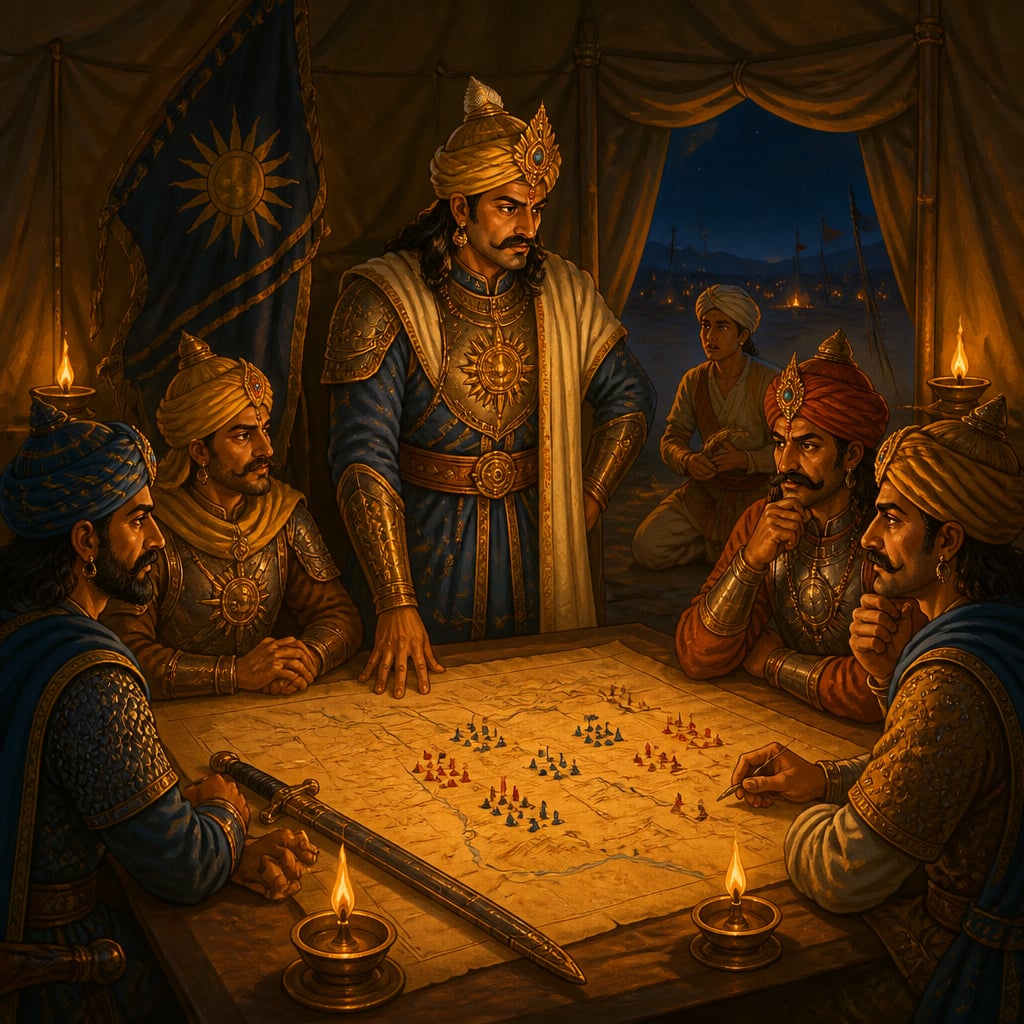
What Junaid didn't fully appreciate was that the political landscape had changed. Nagabhata had spent years preparing for exactly this moment. His intelligence network tracked Arab movements, providing advance warning of the invasion's scale and direction. He activated the alliance system he had built, calling on his confederate kings to honor their commitments.
The response exceeded expectations. Bappa Rawal of Mewar, the legendary Guhila ruler who had already proven himself against Arab raiders, brought the fierce warriors of Chittorgarh. The Chahamanas of Sapadalaksha contributed their cavalry. Most significantly, Chalukya emperor Vikramaditya II recognized the shared threat and dispatched his son Avanijanashraya Pulakeshi with a substantial force to coordinate a southern front. This was no longer a regional defense but a pan-Indian resistance.
Warriors gathered at predetermined assembly points, bringing not just their own forces but also contingents from smaller allied clans. The confederation's military protocols, developed through joint training exercises and smaller collaborative campaigns, now faced their ultimate test.
Two Fronts: Rajasthan and Navsari
The defensive campaign of 738-739 CE was fought on two fronts. In the north, Nagabhata commanded the confederate forces in Rajasthan and Malwa, directly confronting Arab armies that had advanced toward Ujjain. The geography of Rajasthan, with its rocky terrain, limited water sources, and extreme climate, favored defenders who knew the land.

Simultaneously, to the south, Avanijanashraya Pulakeshi confronted Arab forces that had advanced through Gujarat to Navsari. According to the Navsari copper plates dated 739 CE, Pulakeshi decisively defeated a large Arab army that had already conquered the Saindhavas, Kachchhelas, Chavotkas, Mauryas, and other kingdoms. This southern victory was as crucial as the northern one, it prevented the Arabs from outflanking Nagabhata's position.
The Battle Unfolds
The northern battle was likely a series of engagements rather than a single set-piece confrontation. Junaid's forces advanced with confidence, expecting to overwhelm opposition through superior discipline. What they encountered instead was a coordinated defense that refused to break. Where Arab cavalry expected to scatter independent forces, they found prepared positions supported by multiple allied contingents.
Bappa Rawal's Mewar contingent proved particularly formidable. The Guhila warriors, fighting for their homeland and their faith, matched Arab discipline with fierce determination. The Rajput forces employed tactics suited to their terrain, heavy cavalry charges by armored warriors struck Arab formations at carefully chosen moments, while archer units provided covering fire from elevated positions.
Nagabhata's personal leadership was crucial. He commanded the confederacy forces directly, coordinating the various contingents and maintaining unity of purpose. His presence on the battlefield, risking his own life alongside his allies, validated the confederacy and inspired the warriors fighting under his leadership. According to some accounts, Emir Junaid himself fell during the fighting, demoralizing the Arab forces.
The Decisive Victory

As the battle turned against them, the Arab forces faced a terrible choice: continue fighting against an enemy stronger than anticipated, or retreat back to Sindh. They chose survival. The retreat became a rout as confederacy forces pursued, inflicting heavy casualties and capturing significant amounts of equipment and treasure. Some accounts suggest the Arab army numbered over 30,000 men, facing a confederate force of only 5,000-6,000, yet coordination, terrain knowledge, and fighting spirit proved decisive. The 9th century Muslim historian Al-Baladhuri's references to failed campaigns against "Uzain" (Ujjain) confirm the Arab defeat.
For Nagabhata and the confederacy, the victory was transformative. It validated the entire strategy he had spent years building. Kings who had hesitated to fully commit to the alliance now recognized its value. The Gwalior Prasasti would later record that Nagabhata "crushed the large army of the powerful Mlechcha king." The victory demonstrated that the same disciplined Arab armies that had conquered the Persian Empire, Central Asia, and North Africa could be stopped by determined, coordinated Indian resistance.
Pulakeshi's simultaneous victory at Navsari earned him the titles "Solid Pillar of Deccan" (Dakshināpatha-sādhāra) and "Repeller of the Unrepellable" (Anivartaka-nivartayitr). The Navsari copper plates of 739 CE explicitly record his triumph over the Tajika (Arab) forces. Together, the twin victories on the northern and southern fronts established that India's defenders could match and defeat the seemingly invincible Arab armies. The coordinated campaign, with Nagabhata defending the north and Pulakeshi closing the southern route, showed strategic sophistication that the Arabs had not anticipated.
Strategic Implications
The campaign of 738-739 CE established crucial precedents. First, it proved that unified action by Indian kingdoms could defeat even the most powerful foreign armies. Second, it demonstrated that the confederacy model could function effectively under pressure. Third, it positioned the Pratiharas as the legitimate leaders of northwestern India's defense.
Arab expansion into India effectively stopped at the Indus. While Sindh remained under Arab control, further eastward conquest was abandoned. The Hindu kingdoms of Rajasthan, Gujarat, and Malwa were preserved. The cultural, religious, and political landscape of India would develop along very different lines than if Arab conquest had succeeded. Historians have compared this achievement to Charles Martel's victory at the Battle of Tours (732 CE), which halted Arab expansion into Western Europe.
The Defender Proven
Nagabhata I had transformed himself from regional king to the defender of India. The Wall was no longer merely an aspiration or a title, it was a demonstrated reality, tested in the fire of battle and proven effective. The confederacy strategy that had seemed risky or unnecessary to some was now validated by results that could not be denied.
The young dynasty that Nagabhata founded would build on this victory, expanding Pratihara power and influence while maintaining their essential role as guardians of northwestern India. But the foundation was laid in 738 CE, when vision, courage, and unity defeated what had seemed an unstoppable force.
Historical context
738 CE
The 730s CE represented a crisis point for northwestern India. Arab control of Sindh created a permanent base for invasion attempts. The fragmented nature of Indian politics seemed to favor the organized, centralized Arab forces. Nagabhata's confederacy represented a novel solution to this strategic problem, proving that Indian kingdoms could coordinate effectively when facing existential threats.
Living traditions
The Battle of Rajasthan is increasingly recognized by historians as a pivotal moment in Indian history, comparable to Charles Martel's victory at Tours in preventing Arab conquest of Western Europe. The battle demonstrated that organized Indian resistance could defeat powerful foreign armies, preserving Hindu civilization and culture in northern India. Modern Rajasthan's identity as a land of warriors and defenders draws partly from this Pratihara heritage.
- ओसियाँ के मंदिर: यह एक पुराना मंदिर का समूह है। प्रतिहार राजा यहाँ शक्तिशाली थे। आज के मंदिर नागभट के समय के नहीं हैं, पर यह जगह उसी संस्कृति को दिखाती है। ये मंदिर उस धार्मिक परंपरा को बचाते हैं जो अरब विजय में खतरे में पड़ी होती।
- चित्तौड़गढ़ का किला: यह किला गुहिल वंश के राजाओं का था। ये राजा नागभट के साथ मित्र थे। किले में जो खंड आज दिखते हैं वो बाद के हैं, पर यह जगह गुहिल राजाओं की शक्ति को दिखाती है। इस किले का मतलब है - राजपूत कई सदियों तक आक्रमणों से लड़ते रहे।
- ग्वालियर किला और शिलालेख: यह किले में वह शिलालेख है जिसमें नागभट की जीतों का विस्तृत विवरण लिखा है। इसे नागभट के पोते मिहिर भोज ने बनवाया था। यह शिलालेख बताता है कि प्रतिहार वंश की शुरुआत कैसे हुई और राजस्थान की लड़ाई कितनी महत्वपूर्ण थी।
Reflection
- What does it mean to achieve 'sangha-shakti', strength through union? How did Nagabhata maintain unity among diverse allied forces during the intense pressure of battle?
- The inscriptions describe the battle as 'dharmayuddha', righteous war. What makes a defensive war righteous? How do we distinguish between legitimate defense and aggressive militarism?
- When have you faced a situation that required coordination among diverse groups or individuals to overcome a common challenge? What made coordination succeed or fail?