The Succession

Krishna I and the Consolidation

When Dantidurga died around 756 CE without a clear heir, his uncle Krishna I seized the throne. This succession established a pattern that would continue throughout Rashtrakuta history - capable relatives rather than direct descendants often took power. Krishna I consolidated Dantidurga's conquests and began the great works at Ellora.

The Death of the Founder

Dantidurga died around 756 CE, only three years after his triumph over the Chalukyas. The cause of his death is unrecorded - it could have been illness, battle wounds, or any of the many hazards that shortened medieval lives.

What is clear is that he died without an adult son ready to succeed him. In many dynasties, this situation led to chaos. For the Rashtrakutas, it led to a succession by Krishna I, Dantidurga's paternal uncle.
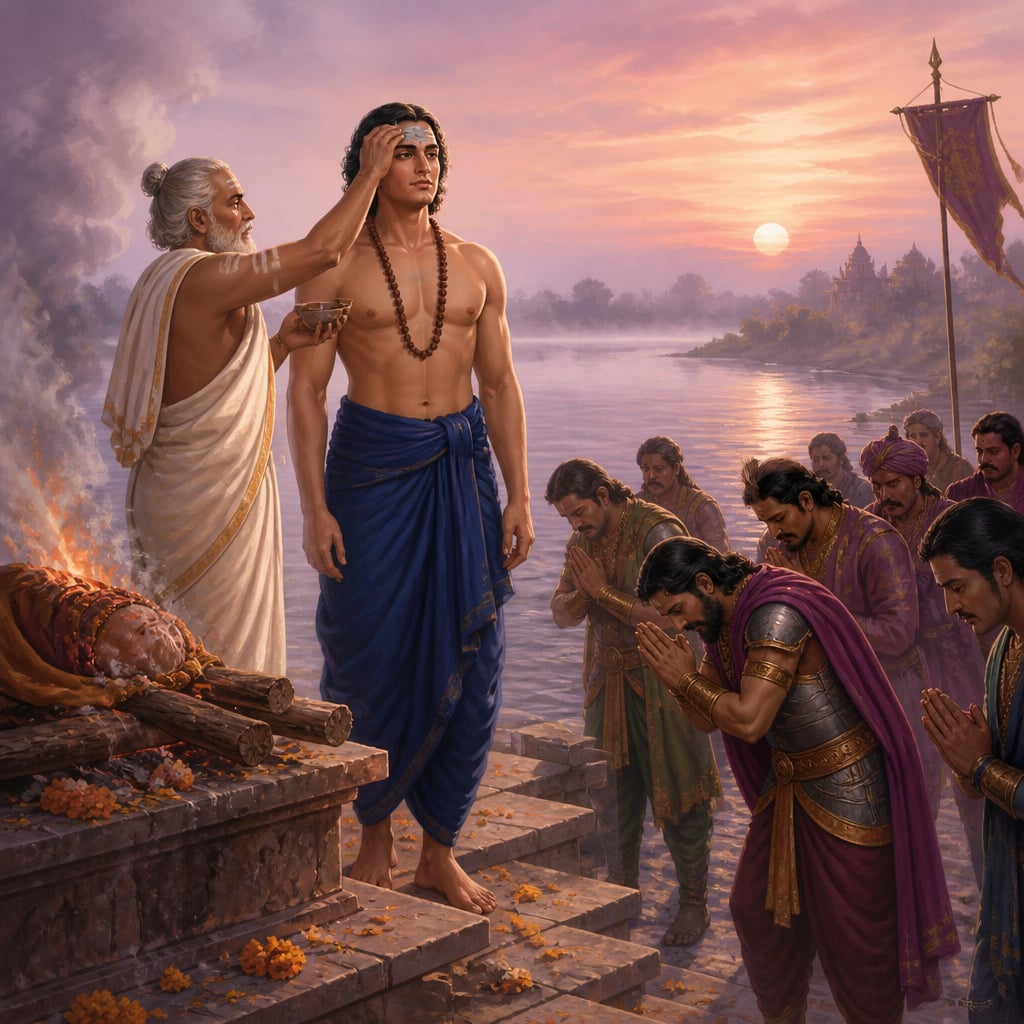
Krishna I acclaimed as emperor at the Godavari river

The Rise of Krishna I

Krishna I (ruled 756-774 CE) was already a mature and experienced leader when Dantidurga died. He had likely served alongside his nephew in the campaigns against the Chalukyas and Arabs. His claim to the throne was based on:

Seniority: As the senior male of the family, he had traditional claims to leadership

Capability: He had proven himself militarily and administratively

Pragmatism: The young empire needed experienced leadership, not an infant heir and a regency

Acceptance: Other nobles accepted his succession, preferring a strong leader to succession crisis

"In the house of Rashtrakuta, the crown went not to blood alone but to the hand that could hold it."

The Succession Precedent

Krishna I's succession established an important precedent: the Rashtrakutas would follow what historians call lateral succession - power passing to brothers, uncles, or cousins rather than always from father to son.

This system had advantages:

But it also had disadvantages:

Krishna I's Achievements

Krishna I proved worthy of the throne he had seized. His reign saw:

Military Expansion: He consolidated and extended Rashtrakuta power, subduing remaining Chalukya loyalists and expanding into new territories.

The Kailasa Temple: His greatest monument was the magnificent Kailasanatha Temple at Ellora - an entire temple carved from a single rock, one of the most remarkable architectural achievements in human history.

Administrative Development: He refined the administrative systems Dantidurga had begun, creating a more stable governmental structure.

Dynastic Legitimacy: His long and successful reign (18 years) established the Rashtrakutas as permanent rulers, not temporary usurpers.

The Kailasa Temple

The Kailasa Temple monolithic shrine under construction at Ellora

The Kailasa Temple (Cave 16 at Ellora) deserves special attention. Krishna I ordered this temple carved from the basalt hillside - not built up but carved down, removing an estimated 200,000 tons of rock to create a freestanding temple within a courtyard.

The temple represents:

This single monument has defined Rashtrakuta legacy in popular imagination.

Comparing Uncle and Nephew

Aspect Dantidurga Krishna I
Years of Rule ~3 years ~18 years
Achievement Founded dynasty Consolidated empire
Monument Began Ellora work Kailasa Temple
Challenge Overthrowing Chalukyas Stabilizing new order
Death ~756 CE ~774 CE
Succession Unclear To his son

Both were essential - Dantidurga's daring created the opportunity, Krishna I's steadiness made it permanent.

The Continuity of Policy

Krishna I continued his nephew's policies:

Military Vigilance: Defense against Arab raids continued, though the threat had diminished

Feudatory Management: The network of subordinate rulers was maintained and extended

Religious Patronage: Temples received generous support, particularly Shaiva establishments

Expansionist Ambition: The goal of all-India supremacy remained central

The transition from Dantidurga to Krishna I was remarkably smooth in policy terms.

The Brothers and Cousins

Krishna I was not the only ambitious man in the Rashtrakuta family. Other relatives had their own claims and ambitions. The dynasty's history would be marked by conflicts between:

This was the price of the lateral succession system. While it produced capable rulers, it also produced endless competition.

The Next Generations

Krishna I was succeeded by his son Govinda II (774-780 CE), who proved less capable. Govinda II was in turn displaced by his brother Dhruva (780-793 CE), a military genius who expanded Rashtrakuta power dramatically.

Dhruva was succeeded by his son Govinda III (793-814 CE), perhaps the greatest Rashtrakuta military leader, who defeated both Pratiharas and Palas and made the Rashtrakutas the paramount power in India.

And Govinda III's son was Amoghavarsha I (814-878 CE), the philosopher-king who would reign for 64 years.

All of this stemmed from Dantidurga's initial act of founding.

The Family Tree Pattern

Dantidurga (753-756) → [no son]
    ↓
Krishna I (756-774) [uncle]
    ↓
Govinda II (774-780) [son]
    ↓
Dhruva (780-793) [brother]
    ↓
Govinda III (793-814) [son]
    ↓
Amoghavarsha I (814-878) [son]

Note how the succession alternates between sons and brothers - the lateral succession pattern in action.

Why the Dynasty Survived

Many new dynasties fail within a generation or two. The Rashtrakutas lasted over 200 years. Several factors explain this:

Initial Success: Dantidurga's victories gave the dynasty momentum and prestige

Capable Successors: Krishna I, Dhruva, and Govinda III were all capable rulers

Flexible Succession: The lateral system, despite its conflicts, produced capable adult rulers

Strong Core Territory: The Deccan heartland provided reliable resources

Cultural Investment: Patronage of religion and arts created ideological support

Dantidurga's True Legacy

Dantidurga's legacy was not just the empire itself but the possibility he created:

He planted a seed that others would nurture into a mighty tree.

The Founder's Memory

Later Rashtrakuta kings honored Dantidurga as their founder. Inscriptions traced the dynasty's glory back to his achievements. The Hiranyagarbha ritual he performed became a touchstone of legitimacy.

But they also surpassed him. The dynasty he founded achieved things Dantidurga could not have imagined in his brief three-year reign. Perhaps that is the greatest legacy a founder can leave: not just what he accomplished, but what he made possible for those who came after.

Historical context

Mid-8th Century CE (756 CE onwards)

The Rashtrakuta Empire successfully transitioned from its founder to his successor. In the north, the Pratiharas under Vatsaraja were expanding. The Palas consolidated power in Bengal under Dharmapala. The 'tripartite struggle' for control of Kannauj and northern India was intensifying.

Living traditions

The Rashtrakuta succession pattern influenced later South Indian dynasties' practices. The debate between capability and bloodline in succession remains relevant today. The Kailasa Temple, Krishna I's greatest achievement, attracts visitors from around the world and stands as testimony to what the dynasty Dantidurga founded could accomplish.

Reflection

More in Dantidurga

All lessons in Dantidurga · Lesser Known Guardians of Dharma course