Fighting the Arab Threat

The Western Shield

Dantidurga's reputation was built on defending the Deccan against Arab raids from Sindh. Working alongside the Chalukya forces he nominally served, he turned back multiple incursions. These victories established him as a protector of dharma and gave him the prestige that would later fuel his rise to empire.

The Arab Presence in India

Since Muhammad bin Qasim's conquest of Sindh in 712 CE, the Umayyad Caliphate had maintained a foothold in the Indian subcontinent. While Sindh remained their base, Arab forces periodically raided deeper into India, seeking plunder, slaves, and perhaps eventual expansion.

By Dantidurga's time (active roughly 735-756 CE), these raids had become a persistent threat to western India. The wealthy temple towns and trading centers of Gujarat and the Deccan were tempting targets for Arab commanders.

The Nature of the Raids

The Arab expeditions into the Deccan were typically:

Not Attempts at Conquest: The distances were too great and Indian resistance too strong for permanent occupation far from Sindh

Focused on Plunder: Temples, wealthy merchants, and prosperous towns were primary targets

Slave-Taking Expeditions: Captives were valuable commodities in the Caliphate's markets

Demonstrations of Power: Successful raids intimidated local rulers into paying tribute or avoiding interference with Arab interests

These were not the massive invasion forces that would threaten India centuries later, but they were nonetheless devastating to the communities they struck.

"Fire and steel came from the west. The temples wept. The people cried out for a defender."
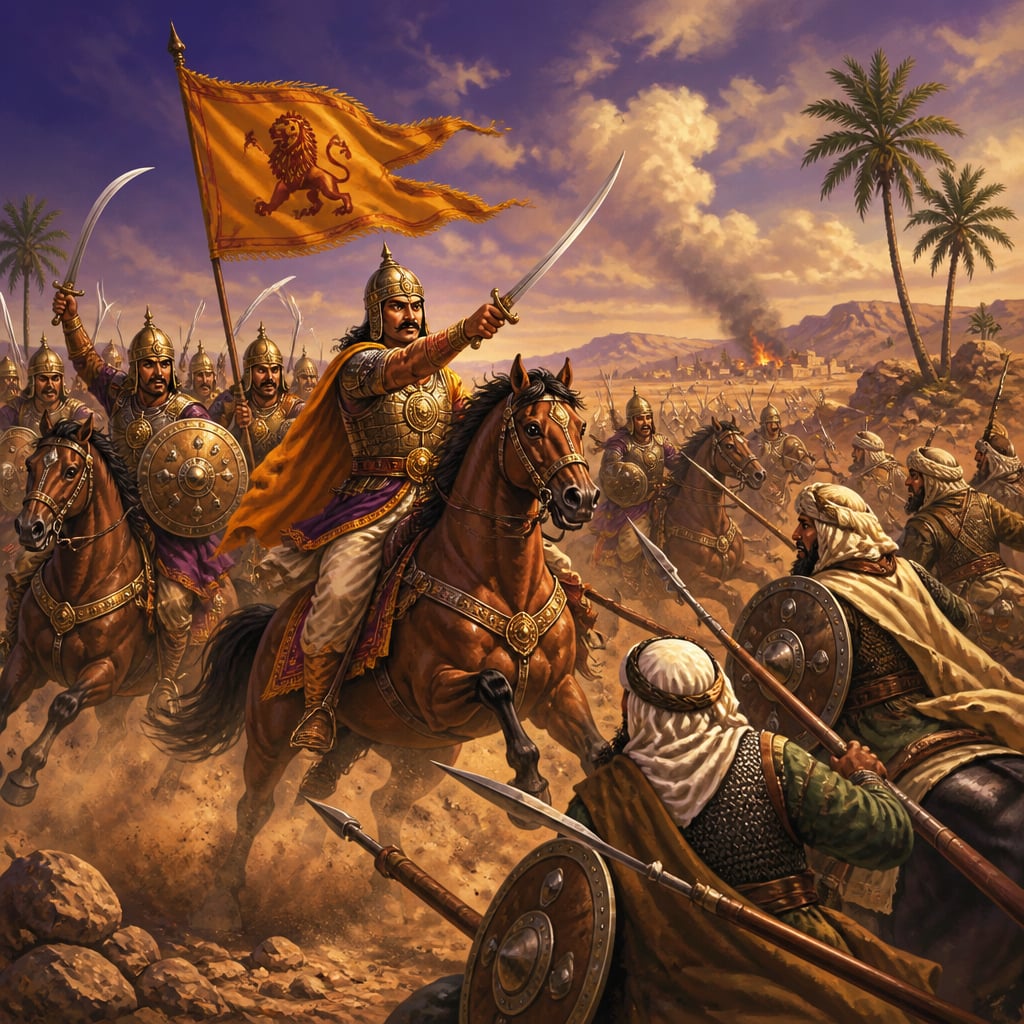
Dantidurga leading his cavalry against Arab raiders

The Chalukya Response

The Chalukyas, as the paramount power in the Deccan, bore primary responsibility for defense against these raids. Under Vikramaditya II (733-744 CE), the Chalukyas organized resistance, sometimes successfully, sometimes not.

But the Chalukyas could not be everywhere. Their empire was vast, threats came from multiple directions, and internal politics consumed energy. Increasingly, the actual defense of western regions fell to local lords - feudatories like Dantidurga.

Dantidurga's Campaigns

The inscriptions credit Dantidurga with significant victories against the "mlecchas" (a term used for foreigners, in this context Arabs). While specific battle details are scarce, the general picture is clear:

Multiple Engagements: Dantidurga fought the Arabs on several occasions, not just once

Defensive Success: He prevented Arab forces from penetrating deep into his territories

Possible Counter-Raids: Some accounts suggest he may have carried the war into Arab-controlled areas

Freed Hindu captives unshackling each other after Dantidurga's victory

Ransom and Recovery: He reportedly freed captives taken by Arab raiders

The Strategic Situation

Dantidurga's territories lay in the path of any Arab advance from Sindh into the Deccan. This geographic position made him:

The First Line of Defense: Arab raiders had to pass through or around his lands to reach the wealthy interior

A Natural Coordinator: Other local lords looked to him for leadership against the common threat

Indispensable to the Chalukyas: Whatever their private feelings about a powerful feudatory, the Chalukyas needed his military strength

This position gave Dantidurga both opportunity and responsibility.

Alliance with Other Powers

Dantidurga did not fight alone. The defense against Arab raids involved cooperation among multiple Indian powers:

The Chalukyas: As overlords, they coordinated overall strategy and contributed forces

The Pratiharas: In the north, the Pratiharas similarly resisted Arab expansion; there may have been informal coordination

Local Chiefs: Numerous smaller rulers contributed to the defense network

The Gurjara Confederacy: Various Gurjara clans in western India formed a buffer against Arab advance

This was not a unified command but a loose network of shared interest in stopping the raids.

Why Dantidurga Succeeded

Several factors contributed to Dantidurga's effectiveness:

Local Knowledge: He knew the terrain, the people, and the best defensive positions

Motivated Troops: His soldiers were defending their own homes and temples, not fighting for a distant overlord

Capable Leadership: He proved himself a skilled commander who could inspire and direct men in battle

Adequate Resources: His territories were prosperous enough to support a capable military force

Religious Motivation: Defense of dharma against mleccha invaders galvanized support

The Impact on His Reputation

Victory against the Arabs transformed Dantidurga's standing:

Among the People: He became a hero, the defender who kept the raiders at bay

Among Warriors: His military reputation attracted capable fighters to his service

Among Brahmins: Temple priests celebrated him as a protector of dharma and sacred institutions

Among Feudatories: Other lords saw him as a natural leader for the region

Among the Chalukyas: His value as a military asset increased even as his power became concerning

The Religious Dimension

Brahmin priests honoring Dantidurga as protector of dharma

Defense against Arab raids was not merely political - it was dharmic duty. The raiders targeted temples, destroyed images, and carried off devotees. Stopping them was an act of religious merit as much as political necessity.

Inscriptions emphasize this dimension. Dantidurga is praised not just as a successful general but as a protector of dharma, a defender of Brahmins and temples, a preserver of sacred traditions. This religious framing legitimized his growing power.

Lessons in Resistance

Dantidurga's campaigns against the Arabs offer lessons that would apply throughout medieval Indian history:

Local Defense Matters: Central empires could not protect every frontier; capable local lords were essential

Unity Through Threat: External danger could overcome internal divisions, at least temporarily

Religious Motivation: Defense of dharma provided powerful ideological support for resistance

Reputation as Capital: Military success could translate into political power

The Limits of Success

Dantidurga's victories did not end the Arab presence in India. Sindh remained under Arab control. Occasional raids continued. The fundamental situation remained unchanged.

But he had demonstrated that Arab expansion beyond Sindh was not inevitable. Indian powers, properly led and motivated, could stop the raids and protect their lands. This psychological victory was perhaps as important as the physical defeats he inflicted.

From Defender to Sovereign

Dantidurga's reputation as a defender against the Arabs was crucial to his later seizure of power. When he moved against the Chalukyas, he could claim:

Proven Capability: He had demonstrated that he could protect the realm

Popular Support: The people loved him for defending them

Religious Legitimacy: He was the true protector of dharma, not the weakening Chalukyas

Practical Necessity: The realm needed strong leadership against continuing threats

The defender of the west became the emperor of the Deccan. The shield that had protected Chalukya territories became the hand that seized the Chalukya throne.

The Continuing Threat

After Dantidurga's rise, the Rashtrakutas continued to face Arab threats. His successors maintained vigilance on the western frontiers. The dynasty he founded would protect the Deccan from western incursions for over two centuries.

But Dantidurga had established the pattern: the Rashtrakutas were defenders of dharma, protectors of temples and Brahmins, shields against foreign invasion. This identity, forged in his battles against Arab raiders, would define the dynasty throughout its existence.

Historical context

Early 8th Century CE (c. 730s-750s CE)

Arab raiders from Sindh periodically attacked wealthy temple towns and trading centers in Gujarat and the Deccan. Indian resistance was fragmented among multiple kingdoms and chiefs. The Chalukyas, as paramount power, coordinated defense but increasingly relied on capable feudatories like Dantidurga for actual military operations.

Living traditions

Dantidurga's defense against Arab raids is remembered as part of the broader narrative of Indian resistance to foreign invasion. His example of building political power through genuine service remains relevant. The religious sites he helped protect continue to be active centers of worship today.

Reflection

More in Dantidurga

All lessons in Dantidurga ยท Lesser Known Guardians of Dharma course