Building the Empire

The First Rashtrakuta Conquests

After overthrowing the Chalukyas, Dantidurga rapidly expanded his new empire. In his brief reign, he established Rashtrakuta authority over the Deccan, received submissions from feudatories, and began the transformation of a regional power into a continental empire.

The Immediate Aftermath

The overthrow of Kirtivarman II in 753 CE gave Dantidurga control of the Chalukya heartland. But seizing the throne was only the beginning. He now faced the challenge of converting military victory into stable rule.

The Chalukya empire had been a complex network of feudatories, alliances, and administrative structures. Dantidurga had to:

Consolidating the Core

Vatapi (Badami) had been the Chalukya capital, but Dantidurga did not make it his primary seat. The old capital carried too many associations with the overthrown dynasty. Instead, the Rashtrakutas would eventually establish their capital at Manyakheta (modern Malkhed in Karnataka).

In the meantime, Dantidurga focused on securing key regions:

Karnataka: The agricultural heartland of the Deccan, essential for revenue and manpower

Maharashtra: Strategic territories that controlled routes north and west

Konkan: The coastal region vital for maritime trade

Feudatory Submissions

The true test of an Indian emperor was whether other rulers accepted his supremacy. Dantidurga moved quickly to secure these submissions:

The Gangas: The Ganga dynasty of Karnataka (not to be confused with the Gangas of the Ganges region) were powerful local rulers. Their acceptance of Rashtrakuta overlordship was crucial.

The Shilaharas: Coastal chiefs who controlled important ports submitted to the new power.

Former Chalukya Feudatories: Many nobles who had served the Chalukyas pragmatically transferred their loyalty to Dantidurga.

The Kalinga Region: Eastern territories gradually came under Rashtrakuta influence.
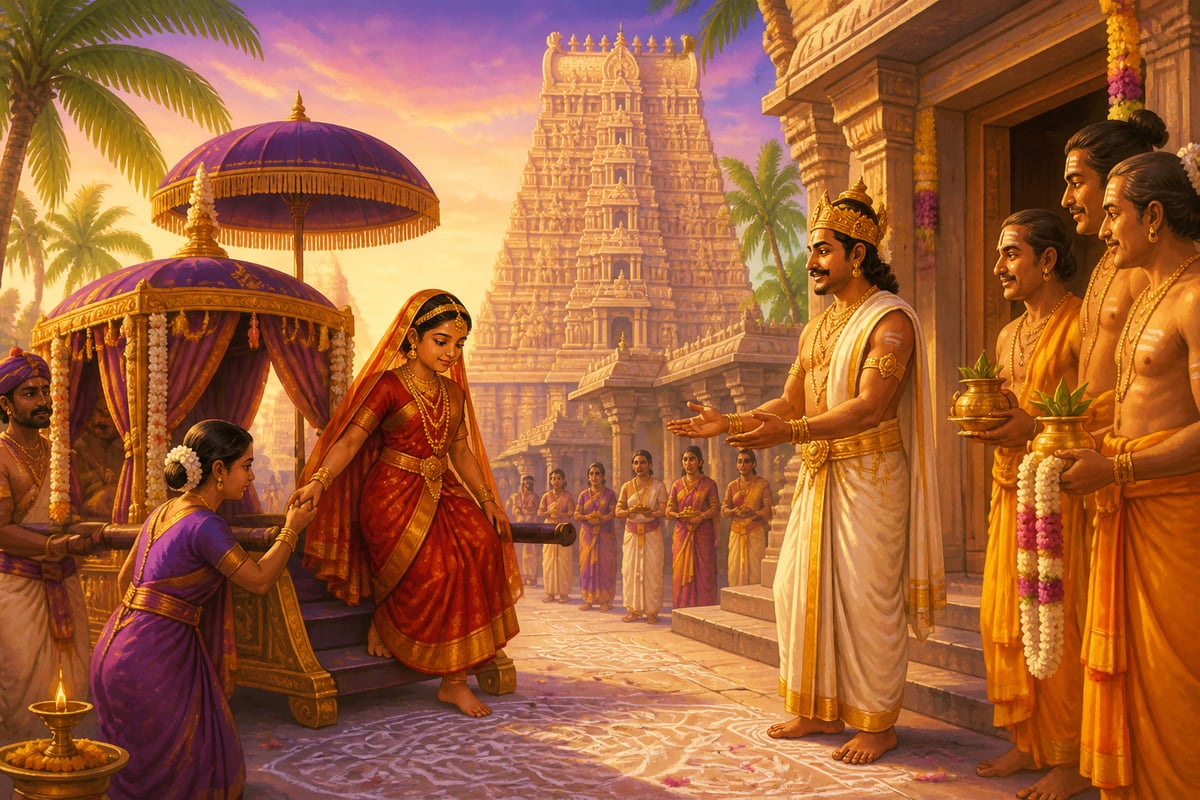
Dantidurga's daughter arriving at Kanchipuram for the Pallava alliance

The Pallava Alliance: Perhaps most significantly, Dantidurga forged an alliance with the Pallavas of Kanchi in the south. His daughter was married to Pallava King Nandivarman II, and Dantidurga reportedly helped Nandivarman recover Kanchi from Chalukya forces. This diplomatic marriage neutralized a potential southern threat while creating a powerful ally - a masterstroke that showed Dantidurga understood that empire required diplomacy as much as force.

"The wise feudatory serves the rising sun. When power shifts, so does loyalty."

Dantidurga riding into the captured city of Ujjain

Northern Ambitions and Far-Flung Conquests

Even in his brief reign, Dantidurga looked far beyond the Deccan. The inscriptions credit him with an impressive list of conquests:

Ujjain: He captured Ujjain, a city of immense cultural and strategic value - one of the seven sacred cities of Hinduism and the ancient capital of Avanti. Controlling Ujjain signaled arrival as a major power.

Lata (Gujarat): He defeated the kings of Lata (Gujarat), extending Rashtrakuta influence to the wealthy western coast.

Kosala and Kalinga: He subdued rulers in Kosala (Chhattisgarh region) and Kalinga (Odisha), extending his reach to eastern India.

Gurjara-Pratiharas of Malwa: He clashed with and subdued the Gurjaras of Malwa, an early demonstration of Rashtrakuta dominance that would continue for centuries.

Conflict with Kannauj: He may have launched expeditions toward the north, clashing with powers of the Gangetic plain. These were likely raids rather than attempts at permanent conquest.

The Tripartite Pattern: The contest between Deccan power, northwestern power (Pratiharas), and eastern power (Palas) for dominance - which would define the next two centuries - began taking shape under Dantidurga.

Administrative Framework

While the military situation demanded immediate attention, Dantidurga also began establishing administrative structures:

Provincial Organization: The empire was divided into rashtras (provinces) governed by appointed officials or trusted feudatories

Revenue System: Land taxes and trade duties were reorganized under Rashtrakuta authority

Military Commands: Trusted generals received territorial commands with both military and civil authority

Religious Grants: Land donations to temples and Brahmins secured religious support and created administrative centers

Religious Policy

Dantidurga, like most Indian rulers, practiced religious tolerance while personally patronizing specific traditions:

Shaivism: His personal inscriptions suggest devotion to Shiva

Temple Construction: He continued the Deccan tradition of cave temple excavation

Brahmin Support: Generous grants to Brahmin communities secured their ideological backing

Jain Tolerance: The substantial Jain community in the Deccan was not persecuted

This ecumenical approach would continue under his successors, particularly Amoghavarsha I, who would personally embrace Jainism.

The Ellora Connection

Dantidurga inspecting early Rashtrakuta excavations at Ellora

Ellora, the magnificent cave temple complex in Maharashtra, was already an important religious site. Under Rashtrakuta rule, it would be transformed into one of the wonders of the ancient world.

Dantidurga's contribution to Ellora is documented in inscriptions found there. While the greatest work - the Kailasa Temple carved by his successor Krishna I - came later, Dantidurga established the Rashtrakuta connection to this sacred site.

Challenges and Resistance

Not everyone accepted the new order peacefully:

Chalukya Remnants: Some branches of the Chalukya family refused to submit. They would eventually revive as the Western Chalukyas (of Kalyani) and Eastern Chalukyas (of Vengi).

Distant Regions: Territories far from the Rashtrakuta heartland were harder to control and sometimes merely nominal vassals.

Economic Disruption: The transition of power inevitably disrupted trade and agriculture, requiring time to stabilize.

The Character of Rashtrakuta Rule

From Dantidurga's brief reign, certain characteristics of Rashtrakuta governance emerged:

Military Foundation: The empire rested on a capable army and the prestige of military victory

Feudatory Structure: Rather than direct rule everywhere, the Rashtrakutas governed through a network of subordinate rulers

Cultural Patronage: From the beginning, the dynasty associated itself with religious and cultural achievement

Expansionist Ambition: The Rashtrakutas sought recognition as paramount sovereigns of all India, not just regional kings

Comparison with Chalukya Administration

The Rashtrakutas inherited much from their Chalukya predecessors:

Aspect Continuity Change
Provincial system Retained rashtra divisions New governors
Revenue Similar taxation Reorganized collection
Feudatories Same structure Different loyalties
Religion Tolerance continued Patronage patterns shifted
Military Similar organization Different leadership

This continuity helped stabilize the transition. People knew what to expect from their rulers.

The Speed of Achievement

What Dantidurga accomplished in approximately three years (753-756 CE) is remarkable:

All this while dealing with the inevitable chaos of regime change.

Why Speed Mattered

Rapid consolidation was essential because:

Opponents Were Regrouping: Chalukya loyalists needed to be defeated before they could organize

Feudatories Were Calculating: Quick success convinced wavering nobles to accept the new order

Resources Were Limited: Extended warfare would exhaust treasury and army

Legitimacy Built on Momentum: Each success reinforced the sense that Rashtrakuta rule was inevitable

Dantidurga understood that the moment after victory was as important as the victory itself.

The Foundation Complete

By the time of his death around 756 CE, Dantidurga had transformed a rebellion into an empire. The foundations he laid - military strength, ritual legitimacy, administrative structure, cultural patronage - would support Rashtrakuta rule for over two centuries.

His successors would expand the empire further, patronize greater architectural and literary achievements, and compete for dominance over all India. But they built on what Dantidurga had begun in those crucial three years.

Historical context

Mid-8th Century CE (753-756 CE)

The Deccan experienced a major political transition as the new Rashtrakuta power consolidated control. Former Chalukya feudatories had to decide whether to accept the new order or resist. In the north, the Pratiharas were rising; in the east, the Palas were consolidating in Bengal. India was entering the era of the 'tripartite struggle' for paramountcy.

Living traditions

The administrative structures Dantidurga established influenced South Indian governance for centuries. The rashtra system of provincial organization continued in various forms. The pattern of rapid consolidation after conquest became a model for later empire-builders.

Reflection

More in Dantidurga

All lessons in Dantidurga ยท Lesser Known Guardians of Dharma course