The Overthrow of the Chalukyas

From Feudatory to Emperor

Around 753 CE, Dantidurga made his move. He defeated Kirtivarman II and brought the Chalukya dynasty of Badami to an end. Through a combination of military force and ritual assertion, the Rashtrakuta chief transformed himself into the paramount sovereign of the Deccan.

The Moment Arrives

By the early 750s, the conditions Dantidurga had patiently awaited finally aligned. Kirtivarman II, the Chalukya king, had lost the confidence of his feudatories. His dynasty's prestige had eroded through decades of internal conflict and military setbacks. The once-mighty Chalukya empire was a hollow shell.

Dantidurga commanded the strongest military force in the Deccan. His victories against Arab raiders had made him a hero. Other nobles respected or feared him. The moment for revolution had arrived.
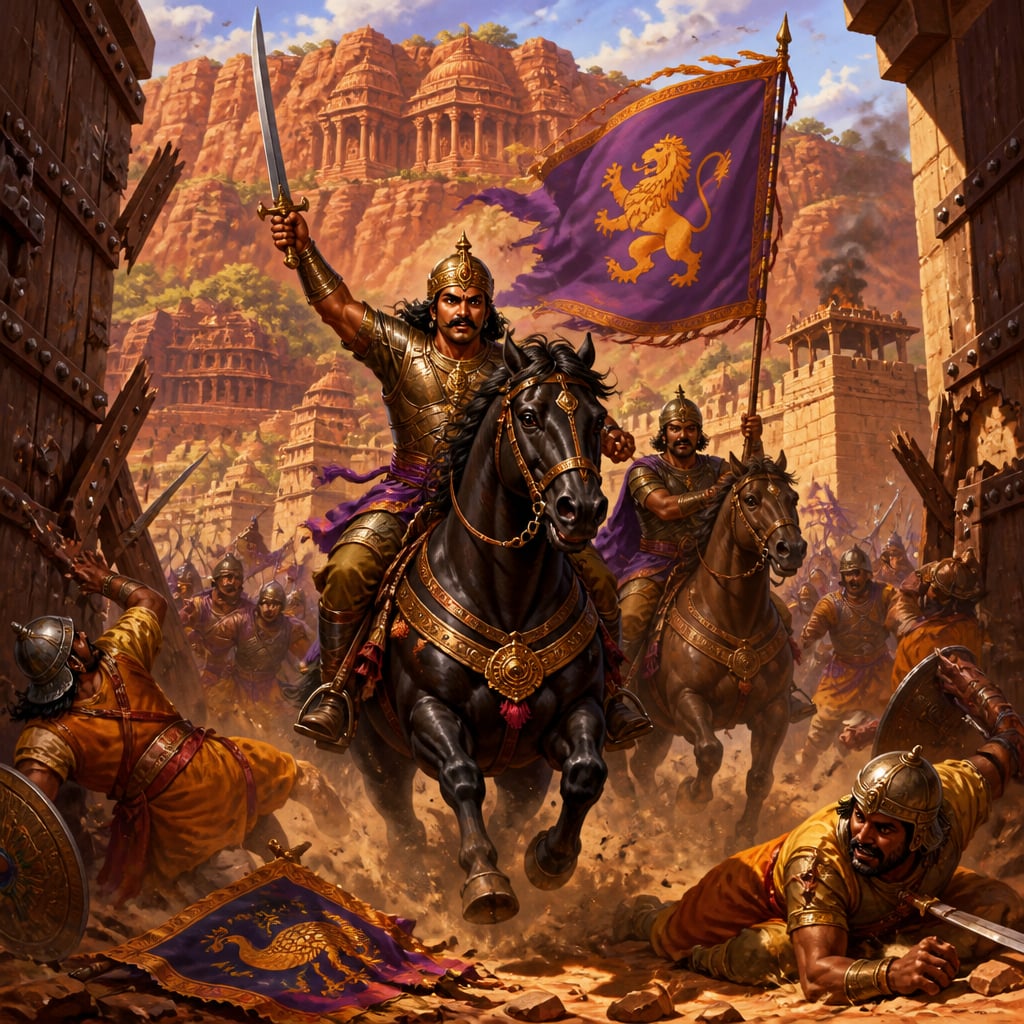
Dantidurga charging through the gates of Vatapi

The Campaign

The details of the actual overthrow are sparse in historical records, but the general outline is clear:

753 CE: Dantidurga openly rebelled against Chalukya authority. This was not a sudden act but the culmination of years of preparation.

Military Victory: In battle, Dantidurga's forces defeated the Chalukya army. Kirtivarman II's remaining loyalists could not match the Rashtrakuta military machine.

Capture of the Capital: Vatapi (modern Badami), the Chalukya capital, fell to Dantidurga's forces. The ancient seat of Chalukya power was now Rashtrakuta property.

Flight of the King: Kirtivarman II either died in the conflict or fled. The Chalukya dynasty of Badami effectively ended.

"What centuries had built, one season destroyed. The mighty fall not slowly but all at once."

The Hiranyagarbha Ritual

Military conquest gave Dantidurga power. But he needed something more: the aura of legitimate kingship. For this, he turned to ancient Vedic ritual.
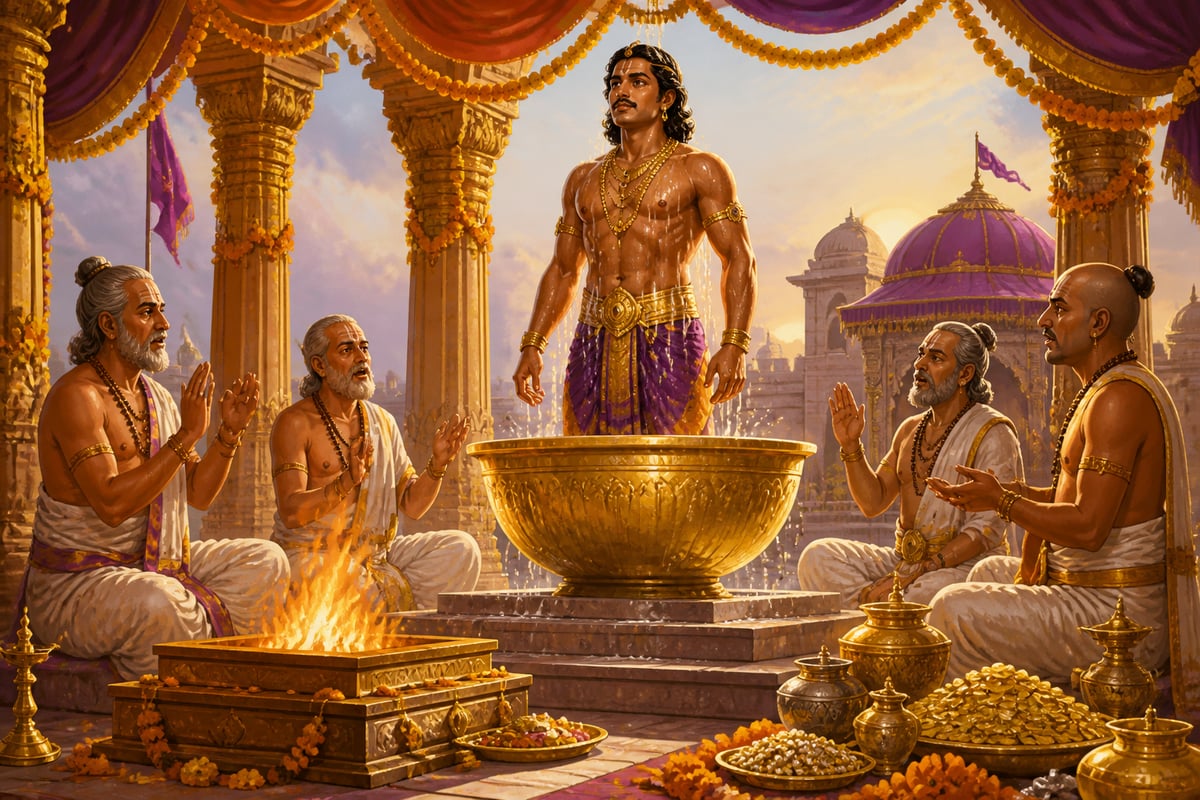
Dantidurga emerging from the Hiranyagarbha golden vessel

The Hiranyagarbha ("golden womb") was one of the most elaborate royal ceremonies in Indian tradition. In this ritual:

  1. A golden vessel large enough to contain a person was constructed
  2. The aspirant king was placed inside, symbolizing a return to the womb
  3. He emerged "reborn" as a legitimate sovereign
  4. Massive gifts were distributed to Brahmins

Dantidurga performed this expensive ceremony, probably around 753-754 CE. By doing so, he claimed not just military supremacy but divine sanction for his rule.

Significance of the Ritual

The Hiranyagarbha had specific implications:

Purification: Any taint of usurpation was symbolically washed away. The rebel was "reborn" as a rightful king.

Kshatriya Status: The ceremony confirmed Dantidurga's status as a true Kshatriya warrior-king, not merely a successful rebel.

Brahmin Support: The massive gifts to Brahmins secured their endorsement - crucial for ideological legitimacy.

Divine Authority: The ritual connected the new king to cosmic order. He ruled not by might alone but by dharmic right.

The Samangad inscription notes that Dantidurga performed many Vedic sacrifices (bahuyajñakṛt) - the Hiranyagarbha was the most prominent, but not the only ritual through which he built his sacred legitimacy.

Imperial Titles

Emperor Dantidurga receiving imperial titles in the audience hall

After his victory and ritual consecration, Dantidurga assumed a full array of imperial titles that announced his new status to the world:

These titles were not mere vanity - each carried specific meaning. Paramabhattaraka and Parameshvara placed him at the apex of sovereignty. Maharajadhiraja declared supremacy over other kings. Prithivivallabha claimed a mystical bond with the earth itself. Together, they proclaimed that a new era had begun.

Establishing the Empire

With military victory achieved and ritual legitimacy secured, Dantidurga quickly moved to consolidate his new empire:

Administrative Reorganization: The old Chalukya administrative structure was adapted to Rashtrakuta control. Loyal followers received key positions.

Feudatory Management: Nobles who accepted the new order were confirmed in their positions. Those who resisted were replaced.

Capital Establishment: While Vatapi was captured, the Rashtrakutas would eventually establish their capital at Manyakheta (modern Malkhed).

Religious Patronage: Temples received new grants. Brahmins were honored. The new regime demonstrated its commitment to dharma.

The Extent of Power

Dantidurga's realm at its founding was substantial:

This was already one of the largest states in India. But Dantidurga and his successors would expand it further.

The Four Great Empires

Arab geographers of the period identified four great empires in the known world:

  1. The Abbasid Caliphate (centered on Baghdad)
  2. The Byzantine Empire (centered on Constantinople)
  3. The Tang Dynasty of China
  4. The Rashtrakuta Empire of India

This assessment came later in the dynasty's history, but the foundation Dantidurga laid made it possible. He created an empire that would be recognized across the medieval world.

Why the Chalukyas Fell

The Chalukya collapse teaches important lessons about imperial decline:

Internal Division: Succession disputes had weakened the royal family for generations.

Feudatory Drift: Powerful subordinates like Dantidurga had been allowed to grow too strong.

Military Decline: The core Chalukya military could no longer dominate its feudatories.

Legitimacy Erosion: Failed policies and internal conflicts had damaged the dynasty's prestige.

External Pressure: Threats from Pallavas and Arab raiders had stretched resources.

No single factor caused the fall, but together they made the Chalukyas vulnerable to a determined challenger.

The Speed of Transformation

Remarkably, the transition from Chalukya to Rashtrakuta rule seems to have been relatively quick and relatively accepted. Several factors explain this:

Prior Recognition: Dantidurga was already a known and respected figure, not an unknown usurper.

Continuity: Much of the existing administrative structure remained. The change was at the top, not throughout.

Capable Leadership: Dantidurga demonstrated he could rule effectively, maintaining order and protecting the realm.

Exhaustion: After decades of Chalukya decline, many were ready for new leadership.

The New Order

The Rashtrakuta empire that Dantidurga founded would rule the Deccan for over two centuries (753-973 CE). Its achievements would include:

All this began with Dantidurga's calculated rebellion.

The Price of Success

Dantidurga's success came at a cost. The Chalukya legacy was not entirely erased - branches of the family would eventually revive as the Western Chalukyas and Eastern Chalukyas. The memory of Chalukya greatness remained, sometimes inspiring challenges to Rashtrakuta rule.

Moreover, the precedent Dantidurga set - a feudatory overthrowing his overlord - could be used against his own successors. The Rashtrakutas would eventually fall to a similar feudatory revolt by the Chalukyas of Kalyani around 973 CE.

Legacy of the Founder

Dantidurga reigned only briefly after his triumph, dying around 756 CE. His reign as emperor lasted perhaps three years - long enough to establish the dynasty but not long enough to consolidate it fully.

He was succeeded by his uncle Krishna I, who would continue the work of empire-building. The Rashtrakuta dynasty would reach its zenith under later rulers like Govinda III and Amoghavarsha I.

But all of them built on the foundation Dantidurga laid: the bold act of rebellion, the military victory, the ritual legitimization, and the establishment of an imperial order that would last for over two hundred years.

Historical context

Mid-8th Century CE (753-756 CE)

The Deccan witnessed a major political transition as the Chalukya dynasty collapsed after nearly two centuries of rule. The Pallavas continued to dominate the far south, while in the north, the Pratiharas were consolidating power. The Palas were rising in Bengal. India was entering the era of the 'tripartite struggle' for dominance.

Living traditions

The transition from Chalukya to Rashtrakuta rule is studied as a classic case of dynastic succession through capable feudatory rebellion. The Hiranyagarbha ritual that Dantidurga performed remains significant in discussions of how medieval Indian rulers legitimized power. The Rashtrakuta legacy, especially their architectural achievements, draws visitors from around the world to sites like Ellora.

Reflection

More in Dantidurga

All lessons in Dantidurga · Lesser Known Guardians of Dharma course