The Ordinary Day as Practice
The kitchen and the commute are the ashram.
The achara material: the well-run daily life of a householder as itself the spiritual path, a map drawn for people with jobs and families. The retreat-and-app industry sells escape from daily life; the text says the kitchen and the commute are the ashram.
The Saint Arrived Before Dawn, With a Broom
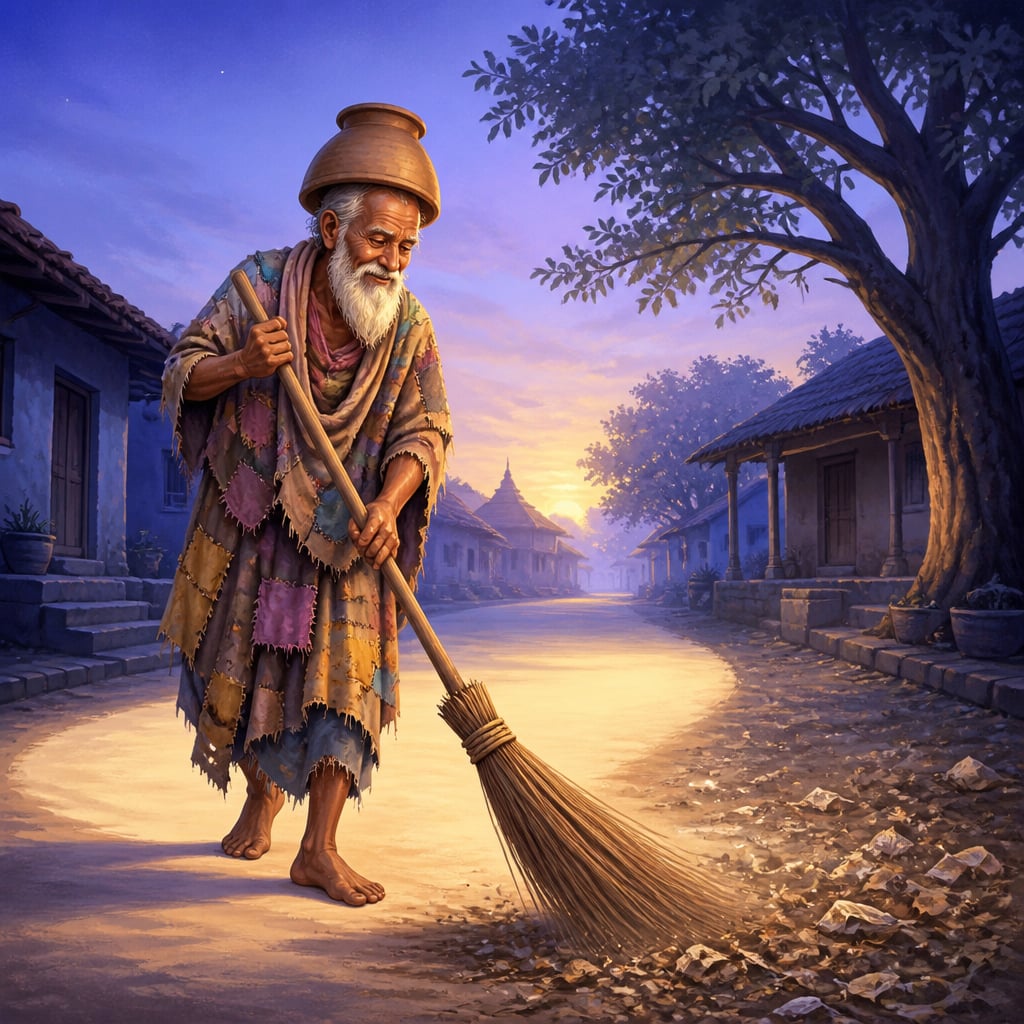
In the villages of early twentieth-century Maharashtra, a strange figure would arrive before first light. A wiry man in castoff clothes, an earthen pot for a hat, a broom over his shoulder. Before the village woke, he would be in its filthiest lanes, sweeping. Gutters cleared, rubbish moved. When the villagers rose and recognised him, and tried to press coins and reverence on the famous visitor, he would laugh and hand them the broom.
This was Gadge Baba: a washerman by birth, unlettered, and one of the most loved sant figures of modern Maharashtra. He built no ashram and accepted no donations for himself; the money pressed on him became schools, hostels, and shelters for the destitute. His teaching happened at night, in kirtans where he sang, joked, and hammered at superstition, debt-fuelled weddings, and addiction. But the villagers always said the real sermon had happened at dawn, wordlessly. The holiest man they knew had come to their village and done the lowest work in it, superbly, and gone. The broom was the teaching: there is no spiritual work and unspiritual work. There is only work, done as worship or not.
The counsel chapter ends here because this is where the Garuda Purana's counsel has been heading from its first verse. Money, company, speech, the body: audit them all, and what remains is the container they all sit in, the ordinary day. The text's final and largest claim is about that container: the well-run ordinary day is not the obstacle to the path. It is the path.
The Achara Material
The claim is not an interpretation; it is the text's own table of contents. Alongside the funeral liturgy and the niti verses, the Garuda Purana's encyclopedic half carries achara material: the tradition's genre of daily conduct. When to rise. How to clean the body and the house. How food is to be cooked, offered, and eaten. The duties of the householder's stations, hospitality to the guest, honesty in the trade, the daily offerings that thread the hours. An entire literature of the ordinary Tuesday, sitting in the book of death.
And its presence completes the course's central reveal. A text obsessed only with dying would have no reason to legislate breakfast. This text details the daily round because of everything it taught on the road: the ledger records ordinary days, the last thought is trained in ordinary days, the river is crossed on what ordinary days gave away. Having shown that the whole road runs through the daily round, the text does the only consistent thing: it takes the daily round as seriously as the road. The praiseworthy person of its verses is not a renunciate on a peak. It is a householder, described entirely in terms of conduct:
यो धर्मशीलो जितमानरोषो विद्याविनीतो न परोपतापी । स्वदारतुष्टः परदारदूरः स वै नरो भुवि वन्दनीयः ॥
yo dharma-śīlo jita-māna-roṣo vidyā-vinīto na paropatāpī sva-dāra-tuṣṭaḥ para-dāra-dūraḥ sa vai naro bhuvi vandanīyaḥ
One of dharmic conduct, who has conquered pride and anger; learned yet humble; who troubles no one; content with his own spouse and far from another's: that person is worthy of honour on this earth.
Garuda Purana, Preta Khanda 48.40
Read the portrait's setting. Every clause happens at home and at work: temper governed in the household, humility carried into rooms where learning could swagger, no one troubled in the day's dealings, faithfulness kept. No cave, no austerity, no departure. The tradition's honoured life, in the text of the funeral priests, is an ordinary life, run extraordinarily well.
The Escape Industry

Set against this the quiet premise of the modern wellness economy. The retreat is somewhere else; the app is a pause from your real life; the practice is what happens when the noise stops. Peace, in this model, is a place you visit, which makes daily life the thing peace is from, and guarantees the market: if practice requires leaving your life, you must keep buying exits.
The achara model inverts the premise. There is nowhere to go, because nothing is happening anywhere else. The kitchen where food is cooked with attention and offered before eating; the commute where the mind rehearses its trained thought; the desk where speech passes its gates and work is done as it should be done; the doorway where the guest is received: these are not interruptions of practice. They are the entire apparatus. The tradition does have its forest stages and its renunciates, and honours them; but its map for the householder never treats the household as exile. Seventeenth-century Europe produced its own witness in Brother Lawrence, the French monastery cook. His slim recorded conversations, The Practice of the Presence of God, report that he felt God as fully among his pots and pans as at the altar. The kitchen, done with love, was the altar. The villagers of Maharashtra saw the identical sermon in a swept gutter.
The Chapter's Verdict
Gather the five counsels, and watch them converge on the day. Wealth: earned honestly and routed to the river, decisions made daily. Company: chosen and kept, evening by evening. Speech: gated hundreds of times between breakfast and sleep. The body: maintained in walks and meals, none of them dramatic. Every counsel in the chapter cashes out in the same currency, the ordinary day, and none of them requires a different life than the one you have. That is the deliberate design of a text addressed to householders: the map was drawn for people with jobs and families. The aha it has been building is that you are already standing on the practice ground, at the sink, holding the broom.
The question the whole course now faces is the one this discovery sharpens. If the daily round is the path, walked under a finite clock, toward a court that reads everything, then why does the tradition also insist the soul is eternal? Would eternity not drain the urgency from every Tuesday? The text's answer fills the next chapter: where you came from, what you forgot, and why this particular life is the rarest ticket in the cosmos. It begins in the strangest place any scripture ever chose to begin: the womb, month by month.
Case studies
The Sermon of the Swept Gutter
Debuji Zhingraji Janorkar, born to a washerman's family in 1876, walked away from settled life and became Gadge Baba: arriving unannounced in Maharashtra's villages before dawn, sweeping their filthiest lanes with his own broom, refusing coins and reverence, and teaching at night in riotous kirtans against superstition, animal sacrifice, ruinous wedding debt, and drink. Donations pressed on him became schools, hostels, and shelters for the destitute; he kept nothing, dying in 1956 owning his broom, his pot, and his stick.
Gadge Baba collapsed the sacred-menial division with a broom: the achara teaching that no work is unspiritual, performed daily in public, at the bottom of the village's hierarchy of tasks. His kirtans taught what his mornings demonstrated: dharma lives in the conduct of ordinary days, cleanliness, honesty, sobriety, service, not in ceremony purchased at their expense.
Maharashtra reveres him as one of its greatest modern sants; his institutions still operate, and the state's village-cleanliness mission is named for him. National sanitation campaigns have repeatedly invoked him as their spiritual ancestor: the broom now marches at policy scale.
The lowest task in town, done superbly by the holiest man in town, re-prices all work forever for everyone watching. Category is alibi; attention is everything.
Sant Gadge Baba's name is carried today by a Maharashtra state cleanliness mission and by Amravati's university; his institutions for the destitute have operated for over a century.
The Kitchen as Altar
Nicolas Herman, a lame ex-soldier of seventeenth-century Lorraine, entered a Paris monastery as a lay brother and was assigned its kitchen for decades: cooking, cleaning, and later sandal repair, the community's least exalted posts. After his death in 1691, a few recorded conversations and letters were published as The Practice of the Presence of God, reporting his single discovery: that turning his omelette with love, he possessed God as fully as his brothers did at the high altar, and that the kitchen's clatter, offered rightly, was prayer.
Lawrence reached the achara verdict from inside another tradition entirely: the day's least ceremonial work, done with total attention and offered, is practice at full strength. His kitchen and Gadge Baba's gutter and the householder's stove of the achara texts are one location: the ordinary task as the standing altar of the ordinary day.
The slim book became one of the most enduring spiritual classics in any European language, continuously in print for three centuries and read far beyond its origin, precisely because its practice requires no monastery: only a kitchen, which everyone has.
The discovery keeps being made across traditions because it is structural: attention consecrates the task, and the task is always the one in front of you.
The Practice of the Presence of God, compiled from Lawrence's conversations after his death in 1691, has remained continuously in print for over 300 years.
Living traditions
The achara instinct persists wherever Indian households thread the day with small consecrations: the bath before the kitchen, the first roti set aside for the cow or the crow, the lamp at dusk, the kolam at dawn. Gadge Baba's broom leads state cleanliness missions; langar and community kitchens across traditions keep proving that cooking is practice; and the modern rediscoveries, deep work, mindful chores, monk mode, keep re-marketing the oldest claim of the householder's texts: the ordinary day, run with attention, was the ashram all along.
Reflection
- Which parts of your day do you currently live as the real thing, and which as the corridor between real things? What would change if the corridor were the practice ground?
- Read the verse's portrait clause by clause: temper, humility, harmlessness, faithfulness. Which clause is currently weakest in your household version, and what would strengthening it this month look like?
- What is your current escape purchase: the retreat, the app, the someday-cabin? What has it actually installed in your ordinary week, and what would you demand of it if you measured it that way?