The Letter to Gandhi
The one letter in which Sukhdev Thapar speaks for himself, printed a month after he was hanged
Sukhdev Thapar ran the HSRA's Punjab wing while others fired the shots, and the only place he speaks in his own voice is a letter to Gandhi written in Lahore Central Jail in March 1931. Gandhi printed it in Young India on 23 April 1931, a month after the hanging, and answered it in the same issue. The letter asks nothing for himself and everything for the prisoners nobody was arguing about.
The Letter That Arrived Too Late
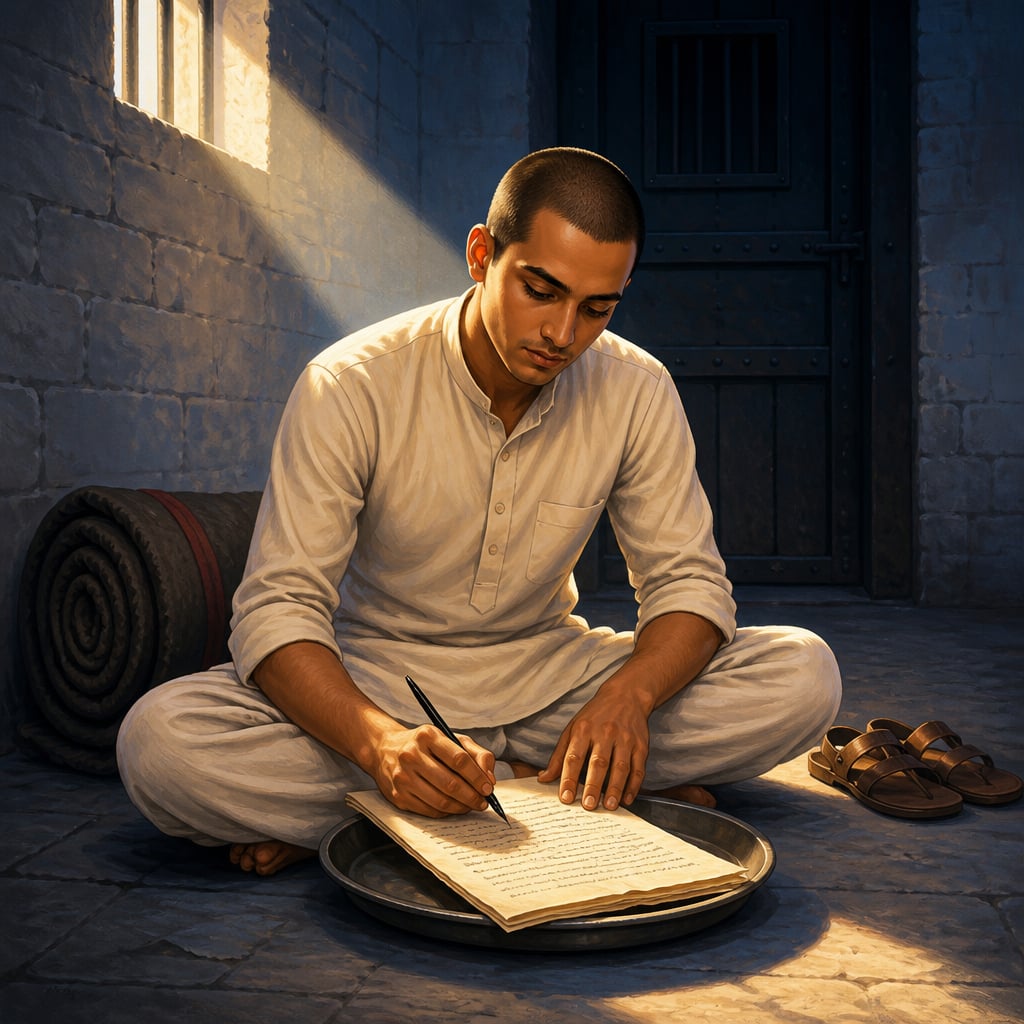
It is the first week of March 1931, in a cell in Lahore Central Jail. A twenty-three-year-old prisoner called Sukhdev Thapar is writing to Mohandas Gandhi. The gallows are being tested in the same compound. He has been the first name on the charge sheet for nearly two years: the case against him is titled, in the government's own words, Crown versus Sukhdev and others.
He does not ask Gandhi to save his life. Not one line of the letter asks for that. He writes about the men nobody is arguing about: the Ghadar prisoners of 1915 still in jail sixteen years later, the Kakori men, the Chittagong accused, the women in hiding. He signs it with a false name, One of the Many.
The letter left the jail with a visiting relative. Gandhi received it after the hanging. He printed it in his weekly paper Young India on 23 April 1931, a month and a day after Sukhdev was dead, and answered it in the same issue. That answer is the last argument Sukhdev ever had, and he was not alive to hear it.
This is the only lesson in this book where a man argues with Gandhi in his own words. Everything else about Sukhdev has to be reconstructed from files. The letter is the one place he speaks.
The Boy Who Never Met His Father
Sukhdev Thapar was born at Ludhiana on 15 May 1907. His father Ramlal died about three months before he was born. His mother Ralli Devi died while he was still a child. He was raised by his uncle, Lala Achintram, and went to school at Lyallpur.
Then Lahore. He joined the National College, which Lala Lajpat Rai had set up in 1921 for students who walked out of government schools. The college had a library named after the educationist Dwarka Das. Its shelves carried the Russian revolutionaries, the Irish, the French. Students went there to read and stayed to talk.