Sri Sukta: The Hymn of Divine Prosperity
The Vedic Blueprint for Abundance
Explore the Sri Sukta, the Rig Veda's powerful hymn to Lakshmi, which reveals the Vedic understanding of prosperity as divine energy that flows through righteous living and sacred intention.
The Merchant's Dawn Prayer
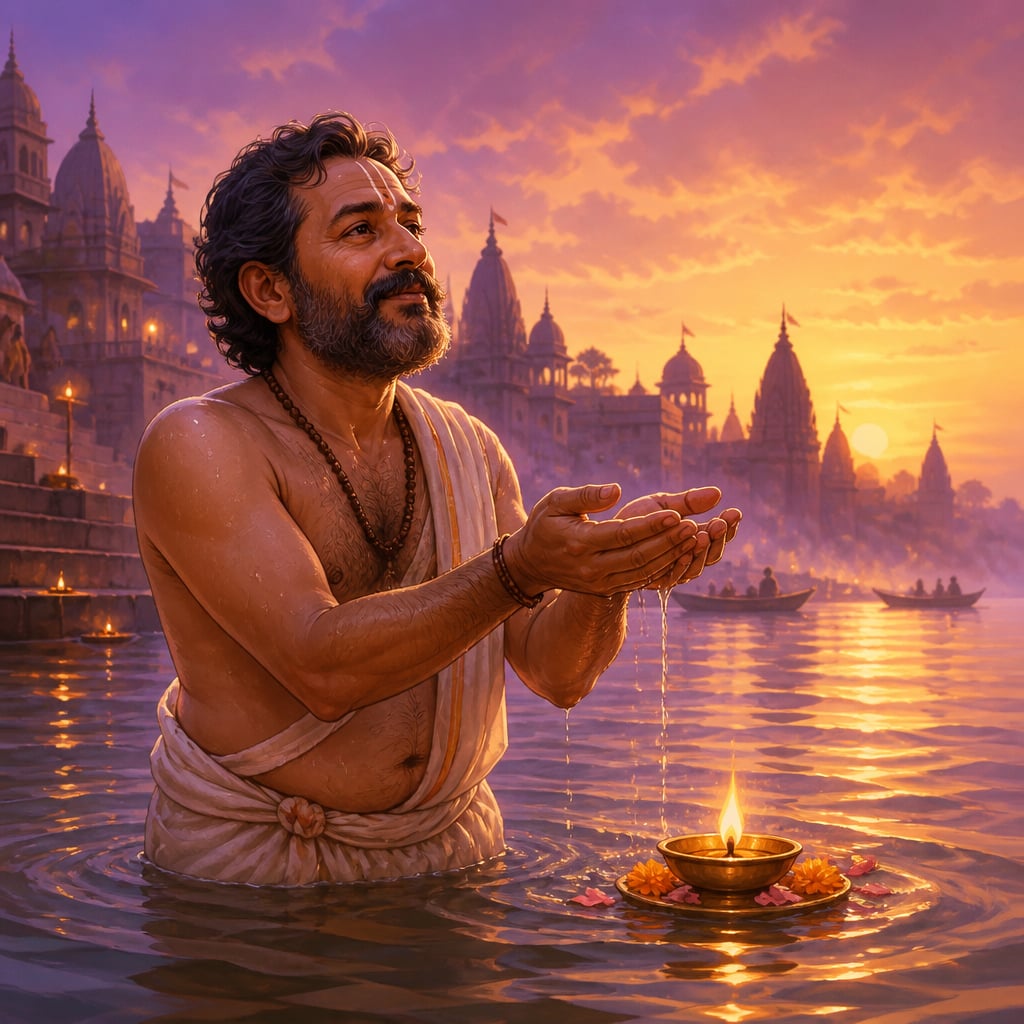
In the pre-dawn darkness of a Varanasi ghaat, circa 800 BCE, a merchant named Dhanavardhana stood waist-deep in the Ganga's cold waters. Behind him, his warehouse held forty bales of fine cotton destined for the western ports. Ahead lay a journey of three months, through bandit-infested routes and monsoon-swollen rivers. Before taking a single step, he would first recite fifteen verses that his grandfather had taught him, the Sri Sukta, the Rig Veda's most powerful hymn to prosperity.
"Hiranyavarnam harinim suvarna rajatasrajam", he began, invoking the golden-hued goddess adorned with silver garlands. This wasn't superstition. This was economic philosophy encoded in sacred verse.
The Ancient Context: Why Wealth Needed a Hymn
The Sri Sukta is an appendix (khila) to the Rig Veda, comprising fifteen verses dedicated to Lakshmi, the personification of prosperity. But to ancient Indians, prosperity wasn't merely material, it was cosmic order made manifest in human life.
The Vedic worldview saw the universe as a flowing exchange. The sun gives light, plants give food, humans give offerings, and in this great cycle, wealth (shri) naturally accumulates where the flow is unobstructed. The merchant Dhanavardhana understood: his cotton would sell not merely through clever bargaining, but because he participated correctly in this cosmic economy.
The Sri Sukta emerged in a period when trade was expanding across the subcontinent. The Vedic people needed a theology that honored wealth-creation without reducing it to mere greed. They found it in Lakshmi, a goddess who represents abundance, but only abundance that flows from dharma.
The Principle Revealed: What the Sri Sukta Actually Teaches
The opening verse sets the entire philosophy:
"Hiranyavarnam harinim suvarna rajatasrajam Chandram hiranmayim Lakshmim jatavedo ma avaha"
"O Fire-born one, bring to me Lakshmi, she of golden hue, radiant as the sun, adorned with gold and silver garlands, resplendent as the moon."
Notice what the supplicant asks for: not gold itself, but Lakshmi, the principle of prosperity. The distinction is crucial. Gold can be stolen, hoarded, or lost. But the capacity to generate wealth, what we might call "prosperity consciousness" or economic virtue, travels with the person.
The Sri Sukta continues with an extraordinary image:
"Padmapriye padmini padmahaste padmalaye padmadalayatakshi"
"O lotus-loving one, holding lotuses, dwelling in lotuses, with eyes like lotus petals."

The lotus blooms in mud but remains unstained. Lakshmi, goddess of wealth, dwells amidst the material world without being corrupted by it. This is the Vedic answer to a question that still troubles us: Can one be wealthy and virtuous? The Sri Sukta says yes, if wealth is held like the lotus holds water, present but not penetrating.
The Comparative Lens: East Meets West on Wealth
When Adam Smith wrote The Wealth of Nations in 1776, he argued that individual self-interest, guided by the "invisible hand," produces collective prosperity. The Vedic view is remarkably similar in mechanism but different in spirit.
Both traditions recognize that prosperity flows through exchange. But where Smith emphasizes the mechanics (supply, demand, division of labor), the Sri Sukta emphasizes the ethics. Lakshmi doesn't merely appear where goods are traded, she appears where trade is conducted righteously.
The verse "Kshut pipasam alakshmir nashayamyaham" ("I destroy the alakshmi of hunger and thirst") introduces Alakshmi, the opposite of Lakshmi, representing poverty, misfortune, and decay. This isn't mere absence of wealth; it's a distinct force that enters where dharma exits. In modern economic terms, we might call this "institutional decay" or "corruption", the forces that destroy value rather than create it.
Modern Resonance: Sri Sukta in India's Economic Rise
Nirmala Sitharaman, India's Finance Minister, has spoken of creating a "wealth-creating ecosystem" rather than merely redistributing existing wealth. This Vedic distinction, between capturing existing wealth and generating new prosperity, echoes the Sri Sukta's teaching.
Consider the UPI revolution. In 2025, India processes over 15 billion UPI transactions monthly, more than the combined total of all credit and debit card transactions in the country. This wasn't just technology; it was the creation of new economic participation. Millions of small vendors, previously excluded from the formal economy, now participate in the cosmic exchange that the Vedic seers envisioned.
The Sri Sukta verse "Samriddhi, svasti, sampad, yasho balam" ("prosperity, well-being, wealth, fame, and strength") lists five dimensions of abundance. Modern India's digital infrastructure creates all five: economic prosperity through UPI, well-being through DBT welfare transfers, wealth through financial inclusion, national fame through technology leadership, and institutional strength through transparent transactions.
Your Turn: The Personal Sri Sukta
You might be wondering: what does a 3,000-year-old hymn mean for your financial life today?
The Sri Sukta suggests that prosperity flows to those who:
- Participate in exchange rather than hoarding (the lotus gives fragrance while floating on water)
- Remain unstained by the pursuit (wealth held lightly, not grasped tightly)
- Invoke the principle before the material (ask for the capacity, not just the cash)
The merchant Dhanavardhana, standing in the Ganga, wasn't asking Lakshmi to magically fill his warehouse. He was aligning his consciousness with the principle of righteous prosperity, so that when he negotiated, traded, and calculated, he would do so as a channel for shri, not merely a hunter of profit.
In the next lesson, we'll explore Lakshmi-Tattva, the philosophical principle that explains why prosperity flows and where it chooses to dwell.
Nobel laureate Amartya Sen's 'capability approach' argues that development should focus on expanding human capabilities rather than merely GDP. The Sri Sukta anticipated this by millennia, asking for the capacity to generate prosperity rather than prosperity itself.
The Vedic approach adds a spiritual dimension: capabilities are not merely skills but alignment with cosmic order (rita). This provides both motivation (sacred duty) and ethics (dharmic constraints).
India's 500 million+ Jan Dhan accounts represent 'invoked capability', giving people the tool (bank account) rather than just the money, enabling them to channel prosperity themselves.
Ethical business practice and stakeholder capitalism
The modern ESG (Environmental, Social, Governance) movement argues that ethical constraints enhance rather than diminish long-term profitability. The lotus principle suggests the same: purity and prosperity are not opposites but allies.
The Vedic approach goes beyond compliance to character. It's not just 'do no harm' but 'be like the lotus', engaging fully while maintaining essence. This internalizes ethics rather than externalizing them as rules.
Key terms
- Shri
- Sacred prosperity; auspicious abundance; the quality of flourishing that encompasses beauty, wealth, and spiritual radiance together.
- Alakshmi
- The anti-principle to Lakshmi; representing poverty, misfortune, decay, and the breakdown of beneficial exchange. Often personified as Lakshmi's elder sister.
- Hiranya
- Gold; golden; anything precious and valuable. In Vedic usage, often refers to the cosmic golden essence that underlies all material prosperity.
- Jātavedas
- A name for Agni (fire); literally 'one who knows all that is born' or 'one in whom all creatures are born.' In the Sri Sukta, Jātavedas is invoked to bring Lakshmi to the supplicant.
Key figures
The Vedic Rishis (Seers of the Sri Sukta)
c. 1000-500 BCE
Sanjeev Sanyal
Contemporary (b. 1971)
Max Weber
1864-1920
Case studies
Zerodha: Invoking Lakshmi Through Radical Simplicity
In 2010, Nithin Kamath and his brother Nikhil started Zerodha with a radical premise: what if a brokerage firm succeeded by making customers wealthier rather than by churning trades? At the time, Indian brokerages thrived on complex fee structures, hidden charges, and encouraging frequent trading, classic Alakshmi behavior that extracted value rather than creating it. Zerodha introduced flat-fee trading (₹20 per trade regardless of size), eliminated account maintenance charges, and built free educational platforms (Varsity) to help customers make better decisions. They took no external funding, grew entirely through word-of-mouth, and by 2024 became India's largest retail brokerage with over 10 million customers and a valuation exceeding $3.6 billion.
The Sri Sukta teaches that Lakshmi dwells where there is righteousness, not extraction. Conventional brokerage wisdom said 'more trades = more revenue.' Zerodha inverted this: by aligning their interests with customers (flat fees mean they don't benefit from churning), they invoked the Lakshmi principle, prosperity flowing through ethical exchange. Their refusal of VC funding mirrors the lotus principle: participating in the market without being controlled by external pressures for unsustainable growth. Nithin Kamath has spoken openly about building 'a business that would make his parents proud', an echo of the dharmic constraint on wealth-seeking.
Zerodha became profitable from year one and has remained so without external capital. They've distributed over ₹100 crores in ESOP wealth to employees. The company runs on ~1,100 employees, remarkably lean for its scale. More significantly, they've transformed Indian retail investing culture, with Varsity educating millions for free. When competitors copied their pricing, Zerodha retained customers through trust, Lakshmi staying where she's honored.
Zerodha demonstrates the Sri Sukta's core teaching: invoke the principle (customer wealth creation) and the result (company prosperity) follows. By refusing to extract Alakshmi-style, they became a channel for Lakshmi, and she stayed.
As zero-commission trading has become the global norm following Robinhood's model, Zerodha's version stands apart for actually aligning customer and company interests. While Robinhood monetizes through payment for order flow that can disadvantage users, Zerodha's transparent fee structure shows that customer-first design can be more profitable than hidden extraction.
Zerodha processes 15% of all retail trading volume in India with just 1,100 employees, among the highest revenue-per-employee ratios in Indian financial services.
Tirumala Tirupati Devasthanams: The World's Richest Temple Economy
The Tirumala Venkateswara Temple (Tirupati) manages annual donations exceeding ₹3,000 crores ($360 million), making it arguably the wealthiest religious institution on Earth. But unlike many wealthy institutions, Tirupati operates as a massive redistribution engine: it feeds 100,000+ pilgrims daily through its free Anna Prasadam program, runs free hospitals, schools, and universities, and employs over 16,000 people directly. The temple's treasury holds gold deposits worth billions, yet it continuously channels wealth outward. Sri Sukta recitation is central to the temple's daily rituals, the hymn that promises prosperity to those who invoke Lakshmi righteously is literally chanted as wealth flows in and out.
Tirupati embodies the Sri Sukta's lotus principle at institutional scale: immersed in enormous wealth yet unstained by hoarding. The temple treats donations as Lakshmi passing through, not Lakshmi captured. The Anna Prasadam program reflects the verse 'Kshutpipasam alakshmir nashayamyaham' (I destroy the Alakshmi of hunger), literally feeding the hungry to expel poverty. The temple's gold deposits function like a reserve currency, stabilizing the institution across centuries, while current flows fund immediate seva. This balance of accumulation-for-stability and distribution-for-dharma is the Sri Sukta's economic philosophy made institutional.
Tirupati has operated continuously for over 1,200 years, surviving invasions, political changes, and economic upheavals. Its wealth has grown precisely because it's trusted, devotees give knowing their offerings will serve others. The temple's modern management (TTD) has professionalized operations while maintaining dharmic principles, proving the model scales. In 2023, despite economic uncertainty, donations increased 23% year-over-year.
Tirupati proves that the Sri Sukta's prosperity theology works at civilizational scale: wealth that flows through righteous channels multiplies; wealth that's hoarded or extracted eventually depletes. The temple is wealthy because it gives, not despite giving.
Tirupati's model of voluntary wealth redistribution through devotion offers an alternative to both state-mandated taxation and market-driven philanthropy. Its feeding programs operate at scales that rival government welfare schemes, sustained entirely by voluntary contributions, challenging assumptions about what motivates large-scale generosity.
Tirupati's Anna Prasadam kitchen is the world's largest free meal operation, serving 100,000+ meals daily, more than most commercial food operations globally.
Historical context
Late Vedic Period (c. 1000-500 BCE)
The Sri Sukta emerged during India's transition from pastoral-agricultural village economies to urbanized trade networks. The Vedic civilization was developing sophisticated commerce, including long-distance trade with Mesopotamia and Central Asia. This economic expansion required a spiritual framework that could bless prosperity without encouraging greed.
While the Greeks were developing philosophical ethics (Socrates would come c. 470 BCE), the Vedic Indians were integrating ethics directly into religious practice. Unlike the later Protestant work ethic that emerged from Reformation Christianity, the Sri Sukta's prosperity theology was devotional and ritualistic rather than moralistic.
Archaeological evidence from Vedic-era sites shows standardized weights and measures, indicating sophisticated trade. The largest weights found correspond to multiples of the 'krishnala' (a seed used as standard weight), suggesting the Vedic economy had already developed abstract valuation systems.
The Sri Sukta represents the moment when Indian civilization decided that wealth-creation was not merely tolerated but sacred, provided it followed dharmic principles. This foundational choice shaped three millennia of Indian business ethics and continues to influence contemporary concepts like 'conscious capitalism.'
Living traditions
The core teaching of the Sri Sukta, that prosperity flows through righteous conduct, directly informs India's contemporary discourse on 'conscious capitalism,' the emphasis on CSR (Corporate Social Responsibility) in Indian business culture, and the spiritual framing of economic policy by leaders who reference dharmic prosperity.
- Lakshmi Puja with Sri Sukta Recitation: During Diwali and every Friday (Lakshmi's day), families recite the Sri Sukta while offering flowers, incense, and sweets to an image of Lakshmi. This combines ancient Vedic practice with contemporary household worship.
- Business Inaugurations: New businesses across India, from tech startups in Bangalore to shops in small towns, traditionally begin with Sri Sukta recitation and Lakshmi puja. The first transaction is often a symbolic sale invoking prosperity.
- Temple Lakshmi Archana: Major temples like Tirupati perform daily archana (worship) with Sri Sukta chanting. Devotees can sponsor this service, connecting the ancient hymn to the temple's modern microfinancing of millions of devotees' aspirations.
- Mahalakshmi Temple, Kolhapur: One of the most sacred Lakshmi temples, where Sri Sukta has been chanted continuously for over a millennium. The temple's economy, managing donations, running charitable programs, employing hundreds, itself demonstrates Lakshmi's principles in action.
- Ashtalakshmi Temple, Chennai: Built in 1976, this temple honors eight forms of Lakshmi, each representing a different aspect of prosperity (wealth, courage, knowledge, etc.). The Sri Sukta is chanted at each shrine, showing the hymn's contemporary vitality.
- Mahalakshmi Temple, Kolhapur: One of the Shakti Peethas, this ancient temple has been a center for Sri Sukta recitation for over a millennium. The temple's economy demonstrates Lakshmi's principles in action, managing substantial donations while running extensive charitable programs.
- Tirumala Venkateswara Temple: The world's richest temple, receiving over Rs. 3,000 crores annually, exemplifies the Sri Sukta's teaching that prosperity flows where dharma is honored. The temple's wealth redistribution through free meals, education, and healthcare demonstrates Lakshmi's principle of abundance through circulation.
Reflection
- The Sri Sukta distinguishes between invoking Lakshmi (the capacity for prosperity) and merely acquiring hiranya (gold/wealth). In your own life, have you been focused on building sustainable capability or just chasing immediate gains? What would change if you shifted from 'gold-seeking' to 'Lakshmi-invoking'?
- The Sri Sukta warns against Alakshmi, forces of decay that destroy prosperity. Identify one 'Alakshmi' in your financial life (a bad habit, toxic relationship, neglected account, or inefficient process). What concrete step could you take this week to 'expel' this Alakshmi?