Relevance in 2026 and Beyond
Vedic Prosperity in the Age of UPI and Unicorns
How the teachings of Vedic prosperity philosophy apply to modern life, from psychology to leadership to personal practice, connecting ancient abundance wisdom to India's digital economy revolution.
Your Morning Transaction
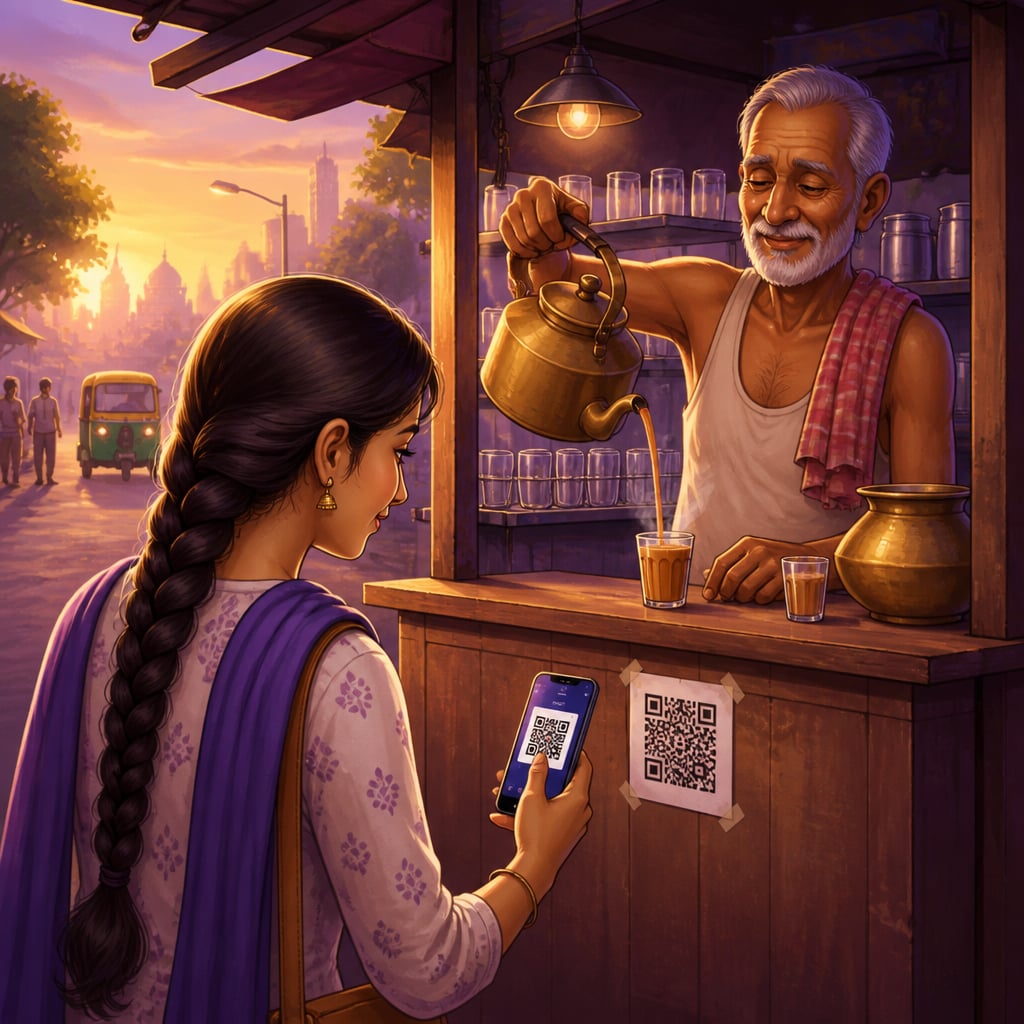
You scan a QR code at a chai stall. In 0.3 seconds, ₹15 moves from your account to the vendor's. Neither of you thinks about it, it's as natural as breathing. Yet this small act represents the largest real-time payments system in the world: 13 billion transactions monthly, more than the US and Europe combined.
UPI isn't just technology. It's Lakshmi flowing through digital channels, prosperity reaching 300 million merchants who previously couldn't accept digital payments. The street vendor now participates in the formal economy. The farmer receives government subsidies directly. Wealth circulates rather than pooling in privileged hands.
The Vedic seers who sang the Sri Sukta would recognize what's happening: Lakshmi is chanchala, prosperity moves. India built the infrastructure to let her move freely.
The Modern Challenge: Prosperity in the Digital Age
India in 2026 presents a paradox. The nation produces more unicorn startups than any country except the US and China. GDP growth exceeds 6% annually. Yet meaningful prosperity, the shri that encompasses beauty, dignity, and community benefit, seems unevenly distributed.
Consider the contradictions:
UPI's success and fintech's struggles. UPI processes ₹200+ trillion annually, yet fintech startups that built on it face profitability challenges. The infrastructure enables flow, but building sustainable businesses atop it requires more than technology, it requires the prosperity consciousness we've studied.
Startup wealth and founder burnout. India's startup ecosystem has created 100+ unicorns, minting dozens of billionaires. Yet founder mental health crises, toxic work cultures, and quick-flip exits suggest that dhana (material wealth) isn't translating into shri (flourishing abundance).
AI opportunity and displacement anxiety. As AI transforms industries, India faces both massive opportunity (AI services, global capability centers) and genuine concern about job displacement. How do we navigate technological abundance while ensuring it serves dharmic purposes?
Temple wealth and social need. Temples like Tirupati and Padmanabhaswamy hold billions in assets while surrounding communities face poverty. The Kubera question, who guards wealth, and for what purpose?, isn't ancient history but live policy debate.
These aren't problems that technology alone can solve. They're questions about how we pursue prosperity, not just whether we achieve it.
The Ancient Insight: What This Chapter Taught
Across six lessons, we explored a comprehensive Vedic philosophy of prosperity:
Sri Sukta revealed that prosperity is invoked, not just earned, we ask for Lakshmi (the capacity for abundance), not just hiranya (gold). True wealth is the ability to generate, not just accumulate.
Lakshmi-Tattva taught that prosperity flows according to cosmic laws. The five dwellings, satya (truth), dharma (righteousness), daya (compassion), tyaga (generosity), and shaucha (purity), predict where Lakshmi will stay and where she'll flee.
Shri expanded our definition of prosperity beyond money to include beauty, dignity, and auspiciousness. The shrimant person isn't the richest but the one whose wealth radiates blessing.
Kubera-Dharma distinguished ownership from guardianship. Great wealth requires not possessors but stewards who diversify holdings (the nine treasures), maintain flow, and exercise dharmic discernment in deployment.
Dhana-Mangala integrated prayer and practice through sankalpa (intention-setting), mantra (focus), and dana (generosity). Prosperity isn't separate from spiritual practice, it's sanctified by it.
Samriddhi-Chetana described the mindset that creates sustainable abundance: abundance orientation, service motivation, long-term vision, stakeholder inclusion, and gratitude cultivation.
Together, these teachings form a complete framework for prosperity that creates rather than extracts, flows rather than hoards, and blesses rather than corrupts.
The Bridge: Vedic Principles in Modern Practice

How do these ancient teachings apply to specific modern challenges?
For the Founder Building a Startup: Zerodha's Nithin Kamath embodied samriddhi-chetana when he chose zero brokerage over maximum extraction. The result: India's largest broker by clients, built on service rather than extraction. The lesson isn't "don't make money" but "create value, and capture follows."
Practically: Before your next major decision, apply the five-stakeholder test (customers, employees, suppliers, community, shareholders). Does this serve all, or extract from some for others?
For the Professional Navigating AI Disruption: The Lakshmi-Tattva teaches that prosperity flows to those who cultivate the five dwellings. In an AI age, this means: develop skills AI can't replace (truth-telling in ambiguous situations, dharmic judgment in ethical dilemmas, compassionate human connection). AI is a tool, your shri depends on how wisely you use it.
Practically: This week, identify one task where AI could free your time. Use that freed time for high-value human activities, mentoring, creative problem-solving, relationship building.
For the Investor Choosing Where to Allocate: Kubera's nine treasures remind us that diversification isn't just about asset classes but dimensions of value. A portfolio that maximizes financial returns while neglecting human capital (your skills), social capital (relationships), and intellectual capital (knowledge) is dangerously concentrated.
Practically: Audit your "nine treasures." Where are you over-indexed? Under-indexed? Rebalance not just your portfolio but your life investments.
For the Policy Maker Designing Systems: UPI's architects, Nandan Nilekani and team, applied shaucha (purity/clean systems) at infrastructure level. Open APIs, interoperability, and low barriers created the conditions for Lakshmi to flow to 300 million merchants. The policy lesson: build clean channels, and prosperity finds its way.
Practically: In any system you design, ask: does this enable flow or create blockages? Does it serve the five dwellings or violate them?
Addressing Skepticism
"Isn't this just positive thinking dressed in Sanskrit?"
No. Positive thinking says "believe and it will happen." The Vedic framework says "cultivate specific conditions, practice specific disciplines, and prosperity naturally flows where those conditions exist." It's not magic, it's economics understood through an ethical lens.
"Can ancient texts really inform modern business?"
The question isn't whether ancient texts "apply directly" but whether they encode patterns that persist. The Lakshmi-Tattva's five dwellings map remarkably to modern institutional economics (trust, rule of law, social capital, capital circulation, institutional integrity). The Vedic seers observed the same patterns we measure today, they just used mythological language.
"Doesn't India's poverty contradict these teachings?"
The Vedic framework explains India's economic history precisely: periods of dharmic governance saw prosperity flourish; periods of adharmic extraction saw Alakshmi enter. The License Raj violated all five dwellings, and Lakshmi fled. Reforms that restored them saw prosperity return. The framework doesn't promise easy wealth; it describes conditions for sustainable prosperity.
"I'm not religious, does this apply to me?"
You don't need to believe in Lakshmi as a goddess to observe that trust attracts customers, generosity builds networks, and ethical conduct creates sustainable success. The Vedic framework offers language and imagery for principles that work regardless of belief.
Your Practice Begins Now
The chapter ends, but the practice begins. Three commitments for the coming weeks:
Daily Sankalpa: Each morning, state one intention for the day's economic activity. Connect it to larger purpose beyond personal gain. Notice how this framing affects your decisions.
Weekly Dana: Give something meaningful each week, money, time, knowledge. Track whether giving depletes or energizes you. Test the Vedic claim that generosity increases rather than decreases prosperity.
Monthly Audit: At month's end, review your activity against the five dwellings. Where did you honor truth, dharma, compassion, generosity, and purity? Where did you fall short? What one change would strengthen your weakest dwelling?
The street vendor receiving your ₹15 via UPI is part of a 3,000-year tradition: Lakshmi flowing through channels that honor her nature. You're part of that tradition too. The question isn't whether these principles work, India's digital payments revolution demonstrates they do. The question is whether you'll apply them consciously in your own prosperity journey.
The Vedic seers sang of prosperity that blesses both giver and receiver, that flows rather than pools, that beautifies rather than corrupts. That prosperity remains available, to anyone willing to cultivate the conditions that attract it.