Lakshmi-Tattva: Understanding Wealth as Divine Energy
The Philosophy of Prosperity Consciousness
Discover how Vedic philosophy views wealth not as mere accumulation but as Lakshmi's divine energy that flows toward those who cultivate virtue, generosity, and alignment with cosmic order.
The Question That Haunted a King
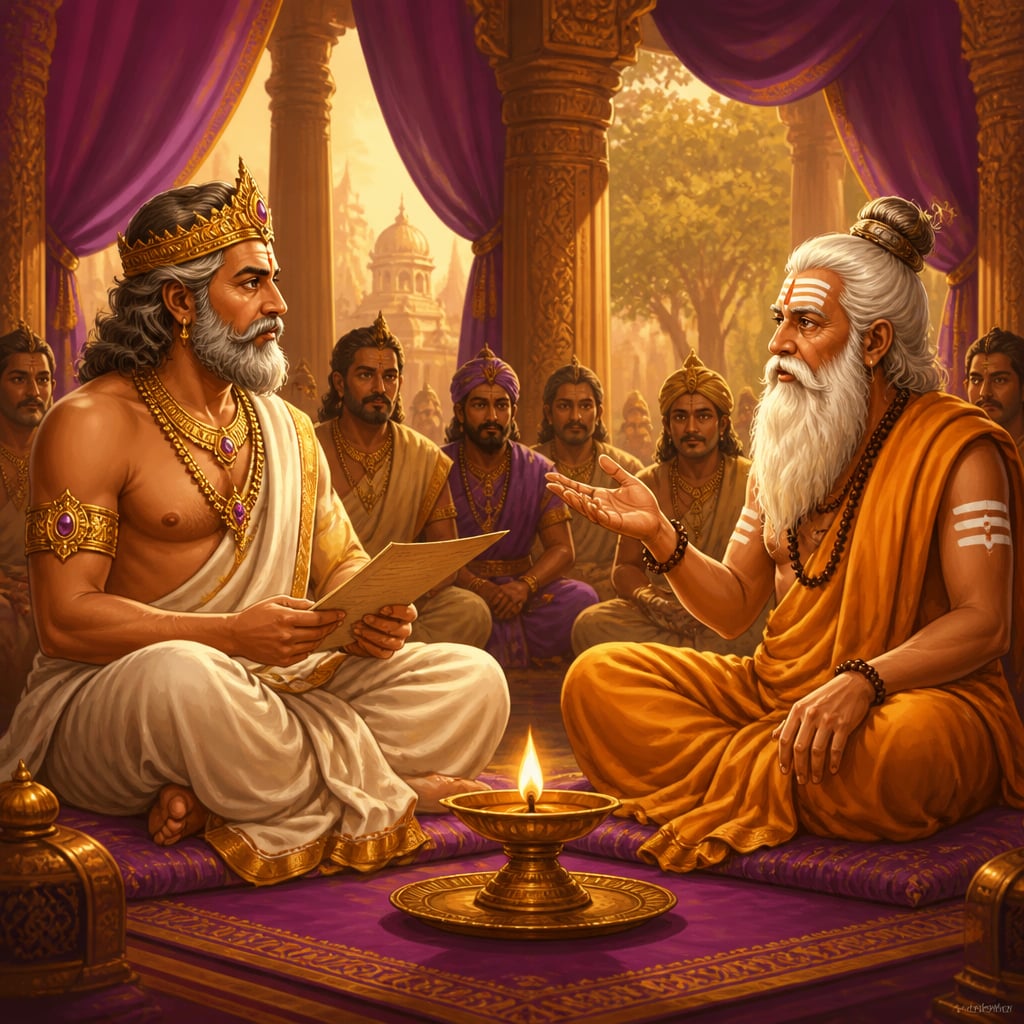
King Janaka of Videha was the wealthiest monarch of his age. His granaries overflowed, his treasury gleamed, and traders from distant lands competed for entry to his markets. Yet one question haunted him: Why does wealth flow to some and flee from others?
He posed this question to the sage Yajnavalkya, who had renounced all possessions. The answer would become one of the most profound economic teachings in the Upanishadic literature, the doctrine of Lakshmi-Tattva, the 'principle of Lakshmi.'
"O King," Yajnavalkya replied, "you ask why Lakshmi chooses her dwelling? She is not gold, which can be seized. She is shakti, energy. And energy flows according to its own laws."
The Ancient Context: Wealth as Living Energy
The Vedic seers did not see wealth as inert matter to be accumulated. They saw it as shakti, a living, flowing energy with its own intelligence. Just as water finds its level, just as electricity flows through conductors, Lakshmi-shakti flows through channels that welcome and honor her.
This isn't mysticism dressed as economics. It's a sophisticated observation about value creation. Wealth genuinely does 'flow', capital moves from unproductive to productive uses, talent gravitates toward opportunity, and customers choose vendors who serve them well. The ancients personified this flow as Lakshmi's choice of dwelling.
The Vishnu Purana explains: "Lakshmi dwells where there is satya (truth), dharma (righteousness), shama (tranquility), and dama (self-control). She flees from where there is adharma (unrighteousness), krodha (anger), and lobha (greed)."
This is economics as ecology, prosperity as a system that rewards certain behaviors and punishes others, not through external enforcement, but through the natural laws of energy flow.
The Principle Revealed: The Five Dwellings of Lakshmi
The Lakshmi Tantra, a medieval text elaborating Vedic prosperity philosophy, identifies five conditions that attract Lakshmi:
"Satye tisthati Lakshmi, dharme tisthati Lakshmi, Daye tisthati Lakshmi, tyage tisthati Lakshmi, Shauche tisthati Lakshmi, iti pancha-sthana."
"Lakshmi dwells in truth, Lakshmi dwells in dharma, Lakshmi dwells in compassion, Lakshmi dwells in generosity, Lakshmi dwells in purity, these are the five dwellings."
Notice the logic: these aren't moral platitudes but functional descriptions. Truth (satya) builds the trust that enables complex trade. Dharma ensures the rule of law that protects property. Compassion (daya) creates the social stability that allows markets to function. Generosity (tyaga) circulates wealth rather than hoarding it. Purity (shaucha) maintains the integrity of institutions.

Where these five exist, prosperity naturally accumulates, not as divine reward, but as systemic consequence.
The Comparative Lens: Energy Economics East and West
Western economics treats wealth as stock, a quantity to be measured, hoarded, and protected. The Lakshmi-Tattva treats wealth as flow, an energy that must circulate to remain vital.
This difference has profound implications. Stock-thinking leads to zero-sum competition: if you have more, I have less. Flow-thinking recognizes that prosperity can multiply: your wealth can increase mine through exchange, investment, and collaboration.
The 18th-century physiocrats (precursors to Adam Smith) glimpsed this when they argued that wealth flows from agriculture like blood through the body. But they limited the metaphor to material production. The Lakshmi-Tattva extends it to the entire moral-economic ecosystem: wealth flows where virtue flows.
Modern network economics echoes this. Metcalfe's Law states that the value of a network grows exponentially with its connections. This is Lakshmi-Tattva in mathematical form: prosperity multiplies through connection, not accumulation.
The Chanchala Paradox: Why Lakshmi Is Called 'Fickle'

Lakshmi is traditionally called Chanchala, the fickle one, the restless one who doesn't stay in one place. This isn't a character flaw; it's a description of how value actually behaves.
Consider: in 2008, Lehman Brothers was worth $45 billion. Within weeks, it was worthless. The buildings remained, the computers still worked, the employee skills hadn't changed, but Lakshmi had departed. The trust, the flow of capital, the network of relationships that constituted the firm's actual value had evaporated.
The Lakshmi-Tattva teaches that Lakshmi's departure is always preceded by the departure of dharma. Before the financial crisis, Wall Street had abandoned truth (fraudulent ratings), compassion (predatory lending), and purity (corrupt incentives). Lakshmi followed dharma out the door.
"Alakshmi prathame yati, tato yati Sarasvati, Tato yati Lakshmi, iti krama."
"First Alakshmi (misfortune) arrives, then Sarasvati (wisdom) departs, Then Lakshmi leaves, this is the sequence."
The Puranas teach that poverty doesn't arrive randomly. First comes Alakshmi (dysfunction, decay), then wisdom leaves (poor decisions compound), then prosperity follows wisdom out. The sequence is predictable, and reversible.
Modern Resonance: Lakshmi-Tattva in India's Economic Rise
Bibek Debroy, economist and translator of Indian classics, has argued that India's economic reforms since 1991 can be understood as inviting Lakshmi back after decades of policies that repelled her.
The License Raj was, in Lakshmi-Tattva terms, a violation of all five dwellings: it bred corruption (anti-satya), created unjust barriers (anti-dharma), showed no compassion for entrepreneurs (anti-daya), hoarded power instead of sharing it (anti-tyaga), and corrupted institutions (anti-shaucha). No wonder Lakshmi fled to more welcoming shores.
The liberalization reversed these: transparency replaced opacity, rule of law replaced rule of license, entrepreneurship was honored, and wealth was allowed to circulate. By 2025, India has become the world's fastest-growing major economy, not through magic, but through creating conditions where Lakshmi naturally dwells.
The Startup India ecosystem demonstrates Lakshmi-Tattva in action. In 2015, India had 7,000 startups. By 2025, it has over 115,000, the third-largest startup ecosystem globally. Capital, talent, and customers 'flowed' to India because the five dwellings were being restored: better IP protection (satya), startup-friendly regulations (dharma), government support programs (daya), angel networks sharing risk (tyaga), and digital infrastructure (shaucha).
Your Turn: Becoming a Dwelling of Lakshmi
The Lakshmi-Tattva isn't abstract philosophy, it's a practical diagnostic. If prosperity seems to avoid you, check the five dwellings:
- Satya (Truth): Are you honest in your dealings? Do people trust you?
- Dharma (Righteousness): Do you follow ethical principles even when it's costly?
- Daya (Compassion): Do you serve others, or only extract from them?
- Tyaga (Generosity): Do you circulate wealth, or hoard it fearfully?
- Shaucha (Purity): Are your processes clean, your books accurate, your intentions clear?
King Janaka, hearing Yajnavalkya's teaching, realized why his kingdom prospered: he had unconsciously cultivated all five dwellings. His courts were just, his charity legendary, his administration transparent. Lakshmi didn't favor him arbitrarily, she dwelt where her conditions were met.
In the next lesson, we explore Shri, the multidimensional concept that encompasses not just wealth, but beauty, auspiciousness, and flourishing together.
Irving Fisher's equation MV=PT recognizes that money's velocity (V) matters as much as its quantity (M). The Lakshmi-Tattva anticipates this: prosperity isn't about how much you hold but how productively it flows.
The Vedic framework adds ethical guidance: wealth should flow toward productive, dharmic uses. This aligns individual incentives (circulate to prosper) with social good (productive circulation creates value).
India's UPI processed ₹250+ trillion in 2025, value circulating, not sitting idle. This 'velocity of digital money' is Lakshmi-Tattva made measurable: prosperity through flow, not hoarding.
The World Bank's governance indicators measure similar factors: rule of law (dharma), control of corruption (shaucha), government effectiveness (satya in policy), and voice/accountability (daya/tyaga). The five dwellings anticipated institutional economics by millennia.
The Vedic framework integrates these as spiritual qualities, not just bureaucratic metrics. This internalizes the motivation: be truthful because it's dharmic, not just because inspectors might check.
Countries scoring above 70 on the World Bank's governance indicators have average per-capita income 6x higher than those below 30. The five dwellings predict economic outcomes.
Key terms
- Tattva
- Principle; essence; truth; the fundamental nature or 'thatness' of something. In philosophy, refers to the irreducible elements that constitute reality.
- Shakti
- Power; energy; the dynamic, creative force of the universe. In Vedic thought, all manifestation (including wealth) is shakti in motion.
- Chanchala
- Restless; fickle; ever-moving; not staying in one place. An epithet of Lakshmi describing the mobile nature of prosperity.
- Sthira
- Stable; steady; firmly established; unchanging. The complementary opposite of Chanchala. While Lakshmi is naturally Chanchala (mobile), she becomes Sthira (stable) where dharmic conditions are maintained.
Key figures
King Janaka of Videha
c. 8th-7th century BCE (Upanishadic period)
Bibek Debroy
Contemporary (b. 1955)
Irving Fisher
1867-1947
Case studies
HDFC: How the Five Dwellings Built India's Most Trusted Financial Brand
In 1977, Hasmukhbhai Parekh founded Housing Development Finance Corporation (HDFC) with a simple premise: Indians deserved home loans at fair rates with transparent terms. At the time, housing finance barely existed in India, banks distrusted retail lending, and whatever loans existed came with opaque terms and corruption. Parekh, and later his protégé Deepak Parekh, built HDFC on the five dwellings: Satya (transparent documentation, no hidden charges), Dharma (ethical lending practices, refusing to finance dubious projects), Daya (customer-centric policies, including lending to lower-income borrowers), Tyaga (reinvesting profits into expanding access rather than maximizing extraction), and Shaucha (clean governance with zero tolerance for corruption). When HDFC Bank was spun off in 1994 under Aditya Puri, it carried the same DNA.
The Lakshmi-Tattva predicts that prosperity becomes 'Sthira' (stable) where all five dwellings are maintained. HDFC exemplifies this: while competitors chased short-term profits through aggressive lending and opaque fees, HDFC maintained all five conditions. The result was trust, and trust, in financial services, is the currency that never depreciates. Deepak Parekh famously said, 'We have never made a decision we couldn't explain to our grandmother', a perfect encapsulation of the Satya principle. When the 2008 financial crisis devastated Western banks built on Alakshmi principles (deceptive products, regulatory arbitrage), HDFC emerged stronger.
By 2023, HDFC completed its merger with HDFC Bank to create India's largest private sector bank by market capitalization (over $150 billion). More remarkably: through five decades, multiple economic cycles, and countless scandals in Indian banking, HDFC maintained an almost unblemished reputation. Deepak Parekh served for 46 years without a single major scandal. The institution became 'Sthira Lakshmi' incarnate, Lakshmi who decided to stay.
HDFC demonstrates that the five dwellings aren't constraints on profitability, they're the foundation of sustainable prosperity. In financial services, where trust is everything, maintaining Lakshmi's conditions transforms Chanchala (fickle capital) into Sthira (stable wealth). The patient approach compounded over decades into India's most valuable financial institution.
The global housing affordability crisis, from London to San Francisco to Mumbai, highlights the enduring relevance of HDFC's founding mission. As fintech lenders compete on speed and convenience, HDFC's legacy shows that trust built through decades of fair dealing creates institutional value that no algorithm can replicate.
HDFC disbursed over ₹8 trillion in home loans over its history, enabling home ownership for millions, wealth creation through wealth sharing, exactly as Lakshmi-Tattva prescribes.
Kingfisher Airlines: When Alakshmi Arrives Before Lakshmi Leaves
Vijay Mallya launched Kingfisher Airlines in 2005 with unprecedented glamour: beautiful lounges, celebrity endorsements, and the tagline 'Fly the Good Times.' By 2007, it was India's second-largest airline. By 2012, it was dead, leaving behind ₹9,000 crores in unpaid debts, stranded employees, and India's most spectacular corporate collapse. What happened? The Alakshmi sequence played out textbook-style. First came dysfunction (Alakshmi): Kingfisher prioritized branding over operations, expanded recklessly through debt, and ignored basic metrics. Then wisdom departed (Sarasvati): Mallya rejected advice to cut costs, refused to merge with IndiGo, and continued lavish spending even as losses mounted. Finally, prosperity fled (Lakshmi): banks cut credit, employees went unpaid, and planes were grounded.
The Lakshmi-Tattva teaches that Lakshmi is 'Chanchala', she doesn't stay where the five dwellings are violated. Kingfisher systematically violated each: Satya (inflated passenger numbers, misleading investors), Dharma (unpaid salaries, broken vendor contracts), Daya (employees abandoned without severance), Tyaga (extracting rather than reinvesting), and Shaucha (opaque finances, diverted funds). The Puranic teaching that 'Alakshmi arrives first, then Sarasvati leaves, then Lakshmi departs' describes Kingfisher's trajectory precisely. By the time the financial collapse was visible, Lakshmi had long since departed, she left when the first employee went unpaid.
Kingfisher's license was suspended in 2012. Mallya fled India in 2016, facing extradition proceedings for bank fraud. Lenders recovered less than 15% of their loans. The brand that symbolized Indian aspiration became synonymous with corporate failure. Meanwhile, IndiGo, which Mallya could have merged with, became India's largest airline by maintaining precisely the five dwellings Kingfisher violated: transparent pricing, operational discipline, employee respect, reinvested profits, and clean governance.
Kingfisher is a perfect cautionary tale for Lakshmi-Tattva: Lakshmi's 'fickleness' is not random but responsive. She leaves when her conditions are violated, and the departure is often irreversible. The company that violates Satya first will eventually violate all five dwellings, and by then, no amount of branding or debt can make Lakshmi return.
The pattern of glamorous brands collapsing under financial mismanagement continues globally, from Vice Media to WeWork. Each case reinforces the same lesson: when brand image substitutes for financial discipline, the gap between perception and reality eventually becomes impossible to sustain.
At its peak, Kingfisher had 66 aircraft and 7,000 employees. Within five years, it had zero aircraft and employees owed months of salary, a complete Lakshmi departure in under a decade.
Historical context
Upanishadic Period (c. 800-500 BCE)
The Upanishadic period saw India develop sophisticated urban economies with trade networks extending to Mesopotamia and beyond. Philosophical inquiry flourished alongside material prosperity, raising questions about the relationship between spiritual advancement and economic success. The Lakshmi-Tattva emerged as the answer: properly understood, prosperity was not an obstacle to spiritual growth but could be its expression.
While Greek philosophers (Plato, Aristotle) would later debate economics in terms of justice and virtue, the Vedic approach integrated these concerns into a unified spiritual-economic framework. The Chinese Confucian tradition developed similar themes (the 'rectification of names' resembles satya), but without the energetic/shakti dimension that makes the Indian approach distinctive.
Archaeological evidence shows that Vedic-era trade networks reached from the Mediterranean to Southeast Asia. The Harappan standardized weights found across this region suggest a sophisticated commercial infrastructure, the material foundation for the prosperity philosophy being developed.
The Lakshmi-Tattva represents Indian civilization's answer to a universal question: how should a spiritual culture relate to material prosperity? Rather than rejecting wealth (asceticism) or pursuing it without ethics (materialism), the Vedic solution integrated both, prosperity as divine energy that flows through dharmic channels.
Living traditions
The Lakshmi-Tattva framework influences contemporary Indian approaches to business ethics, corporate governance, and economic policy. The emphasis on creating conditions for prosperity (rather than just redistributing existing wealth) reflects the 'five dwellings' thinking. India's digital public infrastructure (UPI, Aadhaar) can be seen as creating 'clean channels' (shaucha) through which Lakshmi can flow to all citizens.
- Griha Lakshmi Practices: Many Indian households maintain specific practices to 'keep Lakshmi happy', keeping the home clean (shaucha), welcoming guests generously (daya/tyaga), maintaining family harmony (dharma), and practicing honesty in dealings (satya). These aren't superstitions but practical applications of the five dwellings.
- Muhurta for Business Decisions: Important business transactions are often timed according to auspicious muhurta (astrological timing), reflecting the belief that prosperity-energy flows more strongly at certain times. Modern businesspeople may not believe literally but appreciate the pause for reflection before major decisions.
- Lakshmi Puja at Businesses: From Tata Group boardrooms to street vendor stalls, businesses across India perform Lakshmi puja, especially during Diwali. This ritual acknowledges that prosperity is received, not merely earned, and must be treated with gratitude and respect.
- Janakpur (Mithila): King Janaka's legendary capital, where his dialogues with Yajnavalkya occurred. The city maintains temples and traditions honoring both the philosophical heritage and Janaka's prosperity. The annual Vivah Panchami festival celebrates Sita's marriage, connecting prosperity to dharmic lineage.
- Padmanabhaswamy Temple: One of the wealthiest temples in the world, with treasures worth an estimated $20+ billion. The temple demonstrates Lakshmi-Tattva in practice: centuries of devotees' offerings, accumulated through dharmic means, preserved through institutional integrity. The temple's wealth management offers lessons for modern institutional investors.
- Padmanabhaswamy Temple: This temple's discovery of treasures worth $20+ billion in 2011 sparked national debate about the five dwellings at institutional scale. The temple demonstrates how dharmic stewardship over centuries can accumulate extraordinary wealth while maintaining it for sacred purposes.
- Varadaraja Perumal Temple: As one of the Divya Desams, this temple has served as both spiritual center and economic hub for over 1,500 years. The temple's historical role in managing land grants, supporting artisan guilds, and providing community loans demonstrates Lakshmi-Tattva principles applied to institutional economics.
Reflection
- The Lakshmi-Tattva teaches that prosperity is energy that flows according to its own laws, dwelling where certain conditions exist. Reflecting on your own experience, have you noticed that success, opportunities, or resources seem to 'flow' toward certain people, organizations, or environments? What conditions seem to attract or repel this flow?
- Audit your own 'five dwellings' this week: Rate yourself 1-10 on Satya (truthfulness), Dharma (righteousness), Daya (compassion), Tyaga (generosity), and Shaucha (purity/integrity). Which dwelling is weakest? What one action could you take to strengthen it?