Shri: The Concept of Auspicious Prosperity
Beyond Wealth to Sacred Flourishing
Understand 'Shri' - the uniquely Indian concept that encompasses beauty, auspiciousness, and prosperity together, revealing why the Vedic vision of abundance differs fundamentally from material accumulation.
The Honorific That Reveals a Civilization
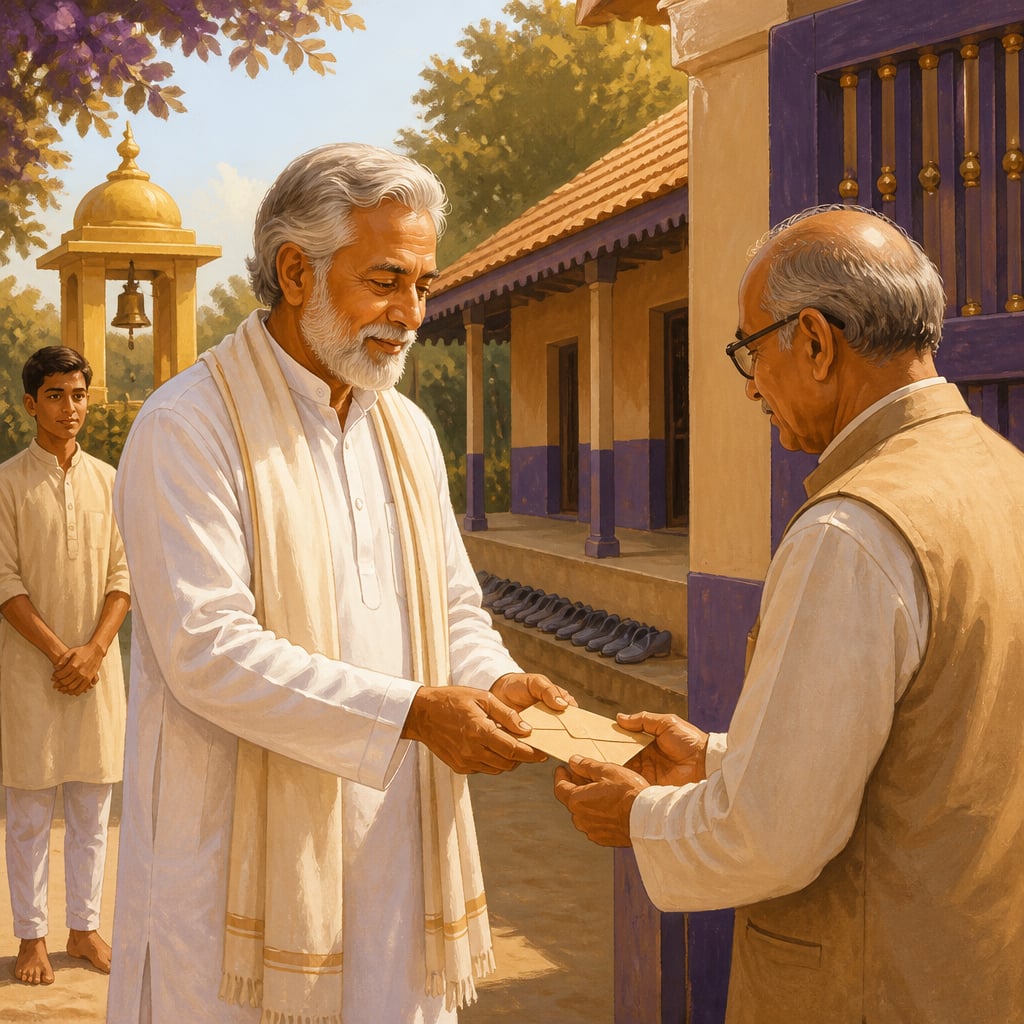
Ratan Tata never used his wealth to build monuments to himself. Yet millions called him "Shri Ratan Tata", a title he earned not through his ₹3.5 lakh crore empire, but through how he held it. When he died in October 2024, the nation mourned not a billionaire but a shrimant, one who embodied 'shri.'
The word puzzled Western journalists. "Shri" was translated variously as "Mr.," "respected," or "wealthy." But none captured its meaning. For in that single syllable lies an entire philosophy of prosperity that distinguishes Indian economic thought from all others.
The Ancient Context: What 'Shri' Actually Means
Shri is untranslatable because it describes a concept the modern West doesn't have: the unity of wealth, beauty, dignity, and sacred presence.
In the Rig Veda, 'shri' appears as a quality of the gods themselves, their radiance, majesty, and auspicious power. When humans possess 'shri,' they don't merely have money; they have a sacred glow, a dignity that inspires respect, a presence that elevates those around them.
The Amarakosha, the ancient Sanskrit thesaurus, lists the meanings of 'shri': lakshmi (prosperity), sampat (wealth), vibhuti (glory), kantih (beauty), dyutih (radiance), prabha (splendor), and shobha (excellence). A person with 'shri' possesses all of these simultaneously, their wealth manifests as beauty, their success as grace, their prosperity as blessing.
This is why Indians use 'Shri' as an honorific. When we call someone 'Shri Ramesh,' we're not just being polite. We're acknowledging that they possess, or should aspire to, this multidimensional quality of sacred flourishing.
The Principle Revealed: The Threefold Nature of Shri
The Lakshmi Sahasranama (Thousand Names of Lakshmi) reveals three dimensions of Shri:
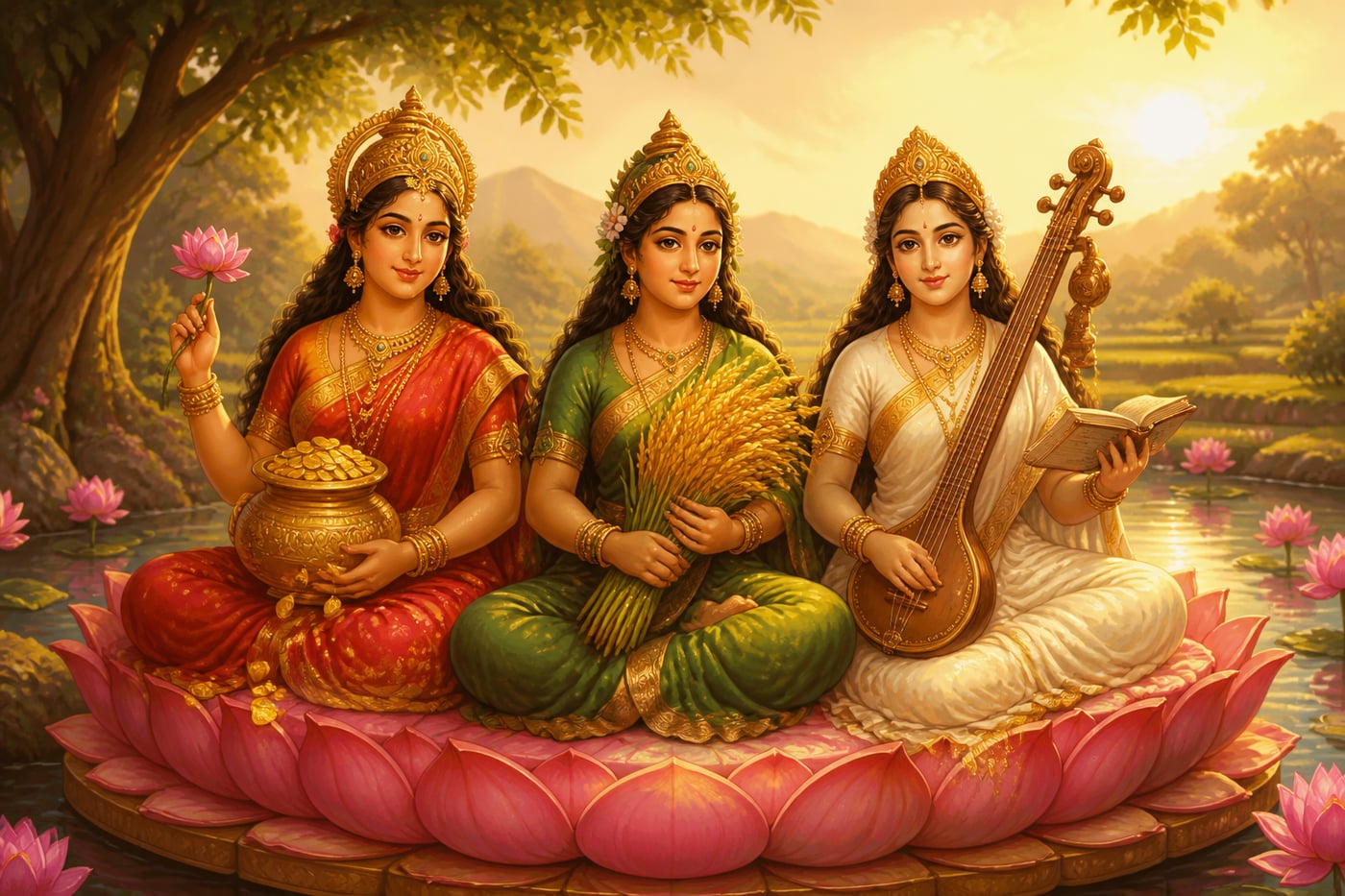
"Shrir bhumir vak cha tisro devyah"
"Shri, Bhu, and Vak are the three goddesses."
Shri-Lakshmi represents material prosperity, the wealth that sustains life and enables action.
Bhu-Devi (Earth Goddess) represents stability, groundedness, and productive capacity, the foundation that holds wealth.
Vak-Devi (Goddess of Speech/Wisdom) represents the knowledge, reputation, and eloquence that wealth should serve.
True 'shri' integrates all three. Wealth without wisdom (Shri without Vak) is vulgarity. Wealth without grounding (Shri without Bhu) is instability. Only when all three unite does authentic prosperity emerge, beautiful, stable, and wise.
The Economics of Aesthetics: Why Shri Includes Beauty
To modern economics, beauty is irrelevant to wealth. Money is money, whether earned beautifully or uglily.
The 'shri' concept disagrees. Wealth earned through exploitation, deception, or ugliness is not shri, it's merely dhana (material resources). Such wealth lacks the radiance (dyuti), the excellence (shobha), and the auspiciousness (mangala) that characterize true prosperity.
Consider two businesses with identical revenues:
Business A: Cuts costs by polluting rivers, underpaying workers, and deceiving customers. The owner lives lavishly but is reviled.
Business B: Creates beautiful products, treats stakeholders fairly, and contributes to community flourishing. The owner lives well and is respected.
Both have dhana. Only Business B has shri. And crucially, the 'shri' concept predicts that Business A's dhana will eventually dissipate (Alakshmi will enter), while Business B's shri will compound.
The Comparative Lens: Shri vs. Mammon vs. Wealth
The Western tradition has two primary frameworks for wealth:
The Biblical tradition views wealth with suspicion ("Mammon" is an idol, the rich man struggles to enter heaven). Prosperity is tolerated but spiritually dangerous.
The Enlightenment tradition treats wealth neutrally, it's just resources to be maximized. Economics becomes a science of allocation, stripped of moral content.
The 'shri' framework differs from both:
| Aspect | Mammon View | Enlightenment View | Shri View |
|---|---|---|---|
| Wealth's nature | Spiritually dangerous | Morally neutral | Sacred when dharmic |
| Beauty | Irrelevant to economics | Irrelevant to economics | Essential to true prosperity |
| Goal | Salvation despite wealth | Maximum utility | Integrated flourishing |
| Accumulation | Problematic | Positive (more is better) | Depends on quality |
The 'shri' framework allows for abundance without guilt, prosperity without vulgarity, success without spiritual compromise, but only when wealth is held with beauty, dignity, and service.
Modern Resonance: The Return of Shri in Business
Sudha Murty, philanthropist and former chairperson of Infosys Foundation, embodies 'shri' in contemporary India. Her wealth is substantial, but her public image centers on simplicity, wisdom, and service. She dresses in simple saris, tells folk tales to children, and directs her prosperity toward education and healthcare. This isn't false modesty, it's 'shri': wealth that radiates as wisdom and service rather than ostentation.
Contrast this with businesspeople who accumulate vast fortunes but inspire no respect, whose wealth appears ugly rather than beautiful, whose success diminishes rather than elevates those around them. They have dhana but lack shri, and Indian culture recognizes the difference.
Brand India itself is a shri project. When India hosts the G20 (2023) or launches Chandrayaan-3, it's not just demonstrating capability but projecting shri, national prosperity that includes beauty (the G20 logo's lotus design), wisdom (ISRO's engineering excellence), and auspiciousness (the cultural framing of achievements). This is economic messaging through the shri lens.
The Shrimant: One Who Possesses Shri
The Sanskrit term shrimant (one who possesses shri) describes the ideal outcome of dharmic prosperity. A shrimant person isn't merely rich, they're prosperous in a way that includes dignity, beauty, and sacred presence.
The characteristics of a shrimant:
- Wealth held gracefully: Not flaunted or hidden, but naturally integrated into a dignified life
- Prosperity that uplifts: Their success benefits and inspires others, not just themselves
- Beauty in business: Their work has aesthetic quality, not just commercial value
- Wisdom accompanying wealth: They're known for insight, not just income
- Auspicious presence: Being around them feels blessed, not diminished
Ratan Tata was shrimant. His wealth was vast, but his presence was gentle. His businesses were profitable, but his reputation was for ethics. He held prosperity the way the Vedas imagine it should be held, as sacred trust, beautiful in expression, wise in application.
Your Turn: Cultivating Shri
Shri isn't only for billionaires. At every level of prosperity, you can choose whether your wealth will be mere dhana or genuine shri.
Ask yourself:
- Is my work beautiful? Not in a superficial sense, but does it have quality, care, and craft that inspire respect?
- Does my success elevate others? Or does it diminish, exploit, or ignore them?
- Would I be proud to show how I earned this? Shri-wealth can be displayed because the means are as beautiful as the result.
- Do people feel blessed or depleted after interacting with me? The shrimant radiates auspiciousness.
The merchant who sells with integrity, the professional who works with excellence, the entrepreneur who builds beautifully, all are cultivating shri, regardless of their bank balance.
In the next lesson, we meet Kubera, the divine treasurer whose mythology encodes profound lessons about wealth stewardship and the responsibilities that come with abundance.
Steve Jobs famously insisted that Apple products be beautiful inside and out. Modern brand theory recognizes aesthetic value, but treats it as marketing, not essence. The shri concept goes further: beauty IS economic value, not just packaging for it.
By integrating beauty into the definition of prosperity, Indian tradition motivates aesthetic excellence intrinsically. You don't make things beautiful to sell more, you make them beautiful because ugly prosperity isn't really shri.
Companies rated highly on design (like Apple, Titan, Asian Paints) consistently outperform peers. McKinsey research shows design-led companies had 32% higher revenue growth, empirical support for 'beauty as value.'
Modern finance recognizes the need for diversification (stability/Bhu) and information (wisdom/Vak) alongside returns (wealth/Shri). The trinity anticipates portfolio theory and knowledge management.
By personifying these as goddesses who must be honored together, the tradition creates a memorable framework: neglecting Bhu (foundation) or Vak (wisdom) while pursuing Shri (wealth) is not just unwise but impious, an offense against the divine feminine.
Startups that prioritize growth (Shri) without building operational foundation (Bhu) or market wisdom (Vak) have 90% failure rates. The trinity framework predicts this: two goddesses neglected will not bless the enterprise.
Key terms
- Shri
- The integrated quality of prosperity, beauty, dignity, radiance, and auspiciousness. More than wealth, sacred flourishing that encompasses material abundance, aesthetic excellence, and spiritual grace.
- Shrimant
- One who possesses shri; a person whose prosperity includes dignity, beauty, and auspiciousness, not merely material wealth. The ideal outcome of dharmic economic activity.
- Vibhuti
- Glory, majesty, magnificent power; the aspect of shri that manifests as visible greatness and divine presence. Also refers to sacred ash worn to signify spiritual attainment.
- Kānti
- Beauty; radiance; loveliness; the luminous quality that makes something attractive. One of the essential dimensions of Shri, prosperity that is beautiful, not merely profitable.
Key figures
Bhishma Pitamaha
Mythological (Mahabharata era)
Sudha Murty
Contemporary (b. 1950)
John Ruskin
1819-1900
Case studies
Titan: Building India's Most Beautiful Business
In 1984, the Tata Group launched Titan, a watch company in a market dominated by HMT's utilitarian timepieces. The strategic bet was counterintuitive: Indians would pay premium prices for beautiful watches, not just functional ones. Xerxes Desai, Titan's founding MD, insisted that every aspect of the business embody 'shri', from product design to retail experience. Titan stores became galleries, not just shops. Packaging became art. Even the quartz movement inside was refined beyond functional necessity. When Titan launched Tanishq jewelry in 1994, the same philosophy applied: guaranteed purity (satya) combined with design excellence (kānti). The company hired goldsmiths not for speed but for artistry.
Titan's strategy was pure shri economics: prosperity through beauty, not despite it. The Amarakosha defines shri as including kānti (beauty), dyuti (radiance), and shobha (excellence), Titan systematically delivered all three. Where competitors focused on cost-cutting (maximizing dhana), Titan invested in design (cultivating shri). The result was that customers experienced buying a Titan watch or Tanishq piece as receiving a blessing, not just making a transaction. Xerxes Desai explicitly referenced Indian craft traditions: 'We're not competing with Swiss watches. We're continuing the tradition of Indian artisans who made beautiful things.' This was shri as business strategy.
By 2025, Titan is India's most valuable consumer goods company (market cap exceeding ₹3 lakh crore), larger than many global luxury brands. Tanishq became India's most trusted jewelry brand, in an industry plagued by impurity scandals, by combining satya (purity guarantee) with kānti (design excellence). Titan commands premium pricing in every category it enters (watches, jewelry, eyewear) because it sells shri, not just products. The company's gross margins consistently exceed industry averages by 5-10 percentage points.
Titan proves the shri principle at commercial scale: beauty creates economic value. By refusing to separate aesthetics from economics, Titan transformed commodities (watches, gold) into objects of desire. The company is wealthy because it is beautiful, shri in corporate form.
In a global luxury market increasingly driven by brand storytelling over product quality, Titan's approach of building beauty into every touchpoint, from product design to retail experience, has created one of the few Indian brands competing successfully against global luxury houses. The company's expansion into wearables and eyewear shows how aesthetic excellence transfers across categories.
Tanishq's revenue grew 700% in a decade (2014-2024), reaching ₹40,000+ crores, while maintaining India's highest brand trust scores in jewelry, proving that shri (beauty + trust) compounds faster than mere dhana (revenue).
Apple's Kānti Economics: When Silicon Valley Discovered Shri
In 1997, Apple was 90 days from bankruptcy. Steve Jobs returned and made a decision that seemed irrational: instead of cutting costs, he would make computers beautiful. The iMac (1998) came in translucent colors, form following feeling, not just function. Jobs obsessed over details invisible to users: the circuit board inside must be elegant, even though customers would never see it. 'Real artists ship,' he said, 'but they ship beautiful things.' By 2024, Apple became the world's most valuable company (market cap exceeding $3 trillion), commanding prices 3-4x competitors for functionally similar products.
Jobs intuitively discovered what the shri concept articulates: beauty IS economic value, not merely marketing for value. His insistence that 'design is how it works' echoes the Amarakosha's definition of shri as including shobha (excellence) and kānti (beauty). Apple products possess what Indians would call 'vibhuti', a radiant excellence that transcends mere utility. Jobs' famous attention to packaging mirrors Indian traditions of beautiful presentation (shri includes how prosperity is displayed, not just held). However, Apple's shri is incomplete by Vedic standards: the company's labor practices and planned obsolescence introduce Alakshmi elements that compromise its radiance.
Apple's gross margins (45%+) are unprecedented in hardware, a direct result of kānti creating pricing power. The company sells status and identity, not just phones. Its retail stores are architectural statements, not just distribution points. Yet Apple's incomplete shri shows in reputational challenges: factory conditions, repairability restrictions, and environmental concerns create the 'ugliness' that the shri concept warns against. Apple has dhana in abundance; its shri is contested.
Apple demonstrates that Western business can discover kānti economics, beauty as value creation, but struggles with the full shri framework. True shri requires beauty in production (how things are made), not just products (what is made). Apple's partial embrace of shri created extraordinary wealth; a fuller embrace would create extraordinary trust.
Apple's mounting scrutiny over App Store fees, labor conditions in supplier factories, and planned obsolescence reveals the limits of beauty-only economics. Companies like Patagonia and Fairphone are experimenting with models that extend aesthetic excellence to production ethics, suggesting the market is ready for full shri integration.
Apple's brand value ($500+ billion, world's highest) proves that kānti creates intangible wealth. But its Net Promoter Score, while high, lags companies like Costco that combine beauty with ethical operations, suggesting incomplete shri limits loyalty.
Historical context
Vedic through Classical Period (c. 1500 BCE - 500 CE)
The concept of shri developed as Vedic civilization became increasingly prosperous and complex. The challenge was: how to honor material success without losing spiritual values? The answer was to redefine prosperity itself, making beauty, dignity, and auspiciousness essential components rather than separate concerns. This prevented the split between 'sacred' and 'secular' that characterized other civilizations.
Greece developed a similar concept in 'kalos kagathos' (beautiful and good), but applied it to aristocratic character, not economics. The Chinese ideal of the 'junzi' (gentleman) emphasized virtue but not aesthetic abundance. Only the Indian 'shri' concept fully integrated material wealth, aesthetic beauty, and sacred presence into a single economic ideal.
The term 'Shri' appears over 150 times in the Rig Veda, more frequently than purely material terms for wealth. This frequency indicates that from the earliest Vedic period, Indians conceived of prosperity as multidimensional.
The 'shri' concept provides a criterion for evaluating prosperity beyond quantity. In a world where GDP measures everything except what makes life worthwhile, the shri framework offers an ancient answer: prosperity should be beautiful, dignified, and auspicious, or it's not true prosperity at all.
Living traditions
The shri concept influences contemporary Indian luxury, fashion, and business presentation. When Indian brands like Fabindia or Tanishq emphasize craft, heritage, and beauty alongside commerce, they're expressing shri-economics. The success of 'premiumization' in India, consumers paying more for products with dignity and beauty, reflects the shri preference.
- The 'Shri' Honorific: Indians routinely prefix names with 'Shri' (or 'Shrimati' for women), acknowledging the shri-potential in every person. This isn't merely politeness but a philosophical statement: every person deserves to flourish with dignity, beauty, and auspiciousness.
- Aesthetic Investment in Business: Indian businesses often invest heavily in aesthetic presentation, from ornate shop entrances to elaborate wedding-style inauguration ceremonies. This isn't vanity but shri-logic: beauty attracts Lakshmi, and displaying prosperity beautifully honors her presence.
- The Shrimant Standard in Business Reputation: Indian business culture still distinguishes between 'seth' (merely wealthy) and 'shrimant' (dignified wealthy). The Tata name, for instance, carries shri beyond its financial value, people trust it because the family maintained dignity across generations.
- Ajanta and Ellora Caves: These ancient caves demonstrate shri in religious art: material resources (royal patronage), technical excellence (engineering), and spiritual beauty (Buddhist/Hindu/Jain imagery) integrated perfectly. The caves are prosperity made beautiful, shri in stone.
- Tata Corporate Archives: The Tata Group's archives document how a business family maintained shri across generations, not just wealth but dignity, trust, and service. The archives offer lessons in how prosperity can include beauty and auspiciousness.
- Somnath Temple: Rebuilt seventeen times after destruction, Somnath embodies the shri principle that true prosperity includes resilience and dignity that transcends material loss. The temple's repeated reconstruction demonstrates that shri is an undying principle, it can be suppressed but always returns where dharma is honored.
- Meenakshi Amman Temple: This architectural masterpiece demonstrates shri through artistic excellence, every surface adorned with intricate sculptures, vibrant paintings, and sacred geometry. The temple economy supporting thousands of artisans, priests, and service workers shows how aesthetic investment creates community prosperity.
Reflection
- The shri concept suggests that prosperity without beauty, dignity, and auspiciousness is incomplete. Thinking about wealthy people you know or know of, can you distinguish between those who have 'dhana' (mere material resources) versus those who have 'shri' (sacred flourishing that includes dignity and radiance)? What seems to create the difference?
- Apply the 'shri audit' to your own life this week: In your work, relationships, and possessions, where do you see beauty, dignity, and auspiciousness? Where is there wealth without beauty, or activity without radiance? Identify one area where you could add 'shri', making something more beautiful, dignified, or excellent, without necessarily spending more money.