Dhana-Mangala: Vedic Prayers for Abundance

Sacred Economics Through Ritual and Intention

Explore the Vedic prayers and rituals for prosperity, understanding how ancient Indians integrated economic aspiration with spiritual practice through specific mantras, offerings, and ceremonial traditions.

The Morning of Every Merchant
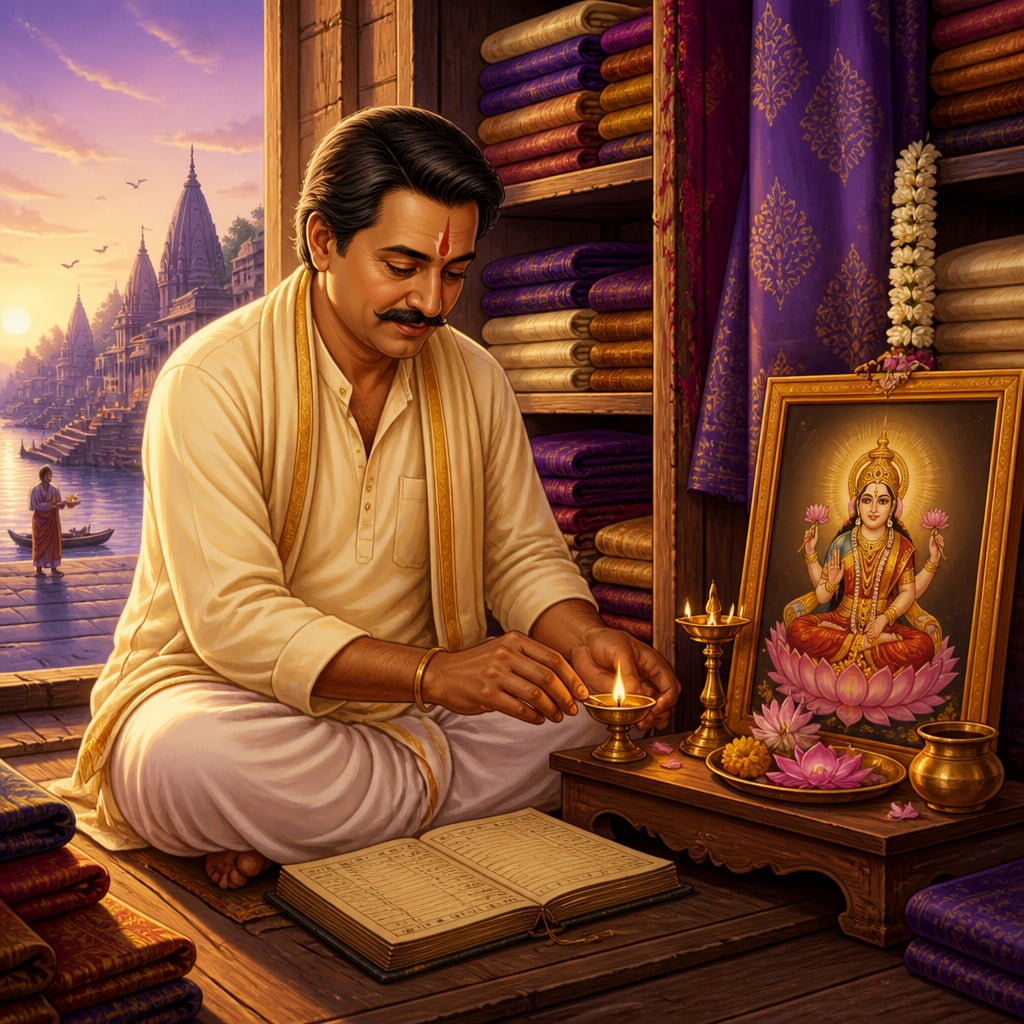
Merchant Dhanapala lighting a diya before Lakshmi at dawn

Varanasi, 500 BCE. Before the first customer arrives, before the shutters rise on his cloth shop, the merchant Dhanapala sits in his small puja room. He lights a ghee lamp, offers fresh flowers, and begins the chants his father taught him, the same chants his grandfather recited, and his grandfather's grandfather before him.

"Om Mahalakshmyai cha vidmahe, Vishnu-patnyai cha dhimahi, tanno Lakshmi prachodayat"

This isn't superstition. This is dhana-mangala, the Vedic practice of sanctifying economic activity through ritual intention. For the merchant Dhanapala, prayer doesn't replace hard work; it frames hard work within a sacred context that guides ethical conduct and attracts auspicious outcomes.

Today, in corporate boardrooms and startup garages across India, the tradition continues. The question is: what did these ancient prayers actually teach, and why do they still resonate?

The Ancient Context: Prayer as Economic Framework

The Vedic tradition never separated economics from spirituality. Every significant action, including economic ones, began with sankalpa (sacred intention) and proceeded through vidhi (proper procedure). This wasn't mere ritual; it was a technology for aligning individual action with cosmic order.

Dhana-mangala refers to prayers and rituals specifically designed to cultivate prosperity. The term combines dhana (wealth) with mangala (auspiciousness), suggesting that true prosperity isn't just material gain but auspicious abundance that benefits all.

The Shukla Yajurveda prescribes specific mantras for different economic activities: agriculture, trade, craftsmanship, and treasury management. The Atharvaveda contains entire sections dedicated to prosperity rituals. The Grihya Sutras detail household prosperity practices that continue in modified form today.

These weren't prayers begging for divine favor. They were alignment technologies, methods for harmonizing individual economic activity with the cosmic principles that govern abundance.

The Principle Revealed: The Three Dimensions of Dhana-Mangala

Vedic prosperity prayers operate on three dimensions:

1. Sankalpa: Sacred Intention Setting

Every significant action begins with sankalpa, a formal statement of intention that places the action within cosmic context:

"Shri Vishnu-preranya, shri Vishnu-prityartham..." "Inspired by Lord Vishnu, for the pleasure of Lord Vishnu..."

This isn't just words. Sankalpa serves as pre-commitment device, publicly stating what you intend to do and why. Modern behavioral economics recognizes pre-commitment as powerful for achieving goals. The Vedic tradition knew this millennia ago.

The sankalpa typically includes:

A merchant beginning a new venture would state: "I, Dhanapala, son of Sudhana, of the Vaishya varna, in the year _____, on this auspicious day, undertake this business for the prosperity of my family, the welfare of my customers, and the glory of dharma."

2. Mantra: Vibrational Alignment

Specific mantras were prescribed for different economic contexts. These weren't arbitrary sounds but carefully structured vibrations believed to resonate with cosmic prosperity forces.

A diya and palm-leaf Lakshmi Gayatri laid out at the altar

The Lakshmi Gayatri is among the most common:

"Om Mahalakshmyai cha vidmahe Vishnu-patnyai cha dhimahi Tanno Lakshmi prachodayat"

"Om, we meditate on the great Lakshmi, On the consort of Vishnu we contemplate, May that Lakshmi inspire us."

The structure follows the Gayatri pattern: knowing (vidmahe), contemplating (dhimahi), and being inspired to right action (prachodayat). This isn't passive hoping but active cultivation of prosperity consciousness.

3. Dana: Prosperity Through Giving

A merchant placing grain and coins into a mendicant's hands

Every prosperity ritual includes dana (giving). The logic seems paradoxical: to gain wealth, give it away? But the Vedic understanding is precise: prosperity is flow, not stock. By giving, you demonstrate that you're a channel for abundance, not a dam blocking it.

The Bhagavad Gita states:

"Dātavyam iti yad dānam dīyate'nupakārine Deshe kāle cha pātre cha tad dānam sāttvikam smritam"

"That gift which is given knowing 'it should be given,' to one who cannot reciprocate, at the right place and time, to a worthy recipient, that is considered sattvic giving."

Notice the sophistication: proper dana requires discernment about recipient, timing, and location. This isn't mindless charity but strategic generosity that creates positive cycles.

The Comparative Lens: Vedic Prayer vs. Prosperity Gospel

The modern "prosperity gospel" (popular in some Western Christian traditions) promises wealth as reward for faith. Critics rightly note its problems: it blames poverty on insufficient faith and reduces religion to transaction.

Vedic dhana-mangala differs in crucial ways:

Aspect Prosperity Gospel Dhana-Mangala
Mechanism God rewards faith with wealth Alignment with cosmic order attracts abundance
Ethics Wealth proves divine favor Wealth requires dharmic conduct
Giving Give to receive (transactional) Give because prosperity is flow
Failure Insufficient faith Misalignment with dharma
Goal Personal wealth Auspicious abundance serving all

Dhana-mangala doesn't promise that prayer alone brings wealth. It promises that prayer + right action + dharmic conduct + generosity creates conditions where prosperity naturally flows. The prayer is necessary but not sufficient.

Interestingly, Benjamin Franklin's approach to prosperity came closer to dhana-mangala than the prosperity gospel. Franklin combined daily intention-setting (his famous virtue tracking), industrious work, and systematic giving (he endowed libraries, hospitals, and fire companies). His maxim 'an investment in knowledge pays the best interest' echoes dana principles, and his autobiography describes prosperity as the fruit of aligned virtue, not divine reward for faith.

Modern Resonance: Dhana-Mangala in Contemporary India

The tradition continues in adapted forms:

Muhurat Trading: The Bombay Stock Exchange begins each Diwali trading session with Lakshmi puja. This isn't superstition, it's sankalpa for the trading year, setting intention for ethical, prosperous commerce.

Startup Pujas: India's tech startups routinely conduct pujas before launches. When Zerodha (now India's largest broker) began, co-founder Nithin Kamath performed traditional rituals. The company's success hasn't made him abandon the practice.

Corporate CSR as Dana: Indian companies often frame CSR (Corporate Social Responsibility) in dhana-mangala terms, not as regulatory compliance but as essential prosperity practice. The Tata tradition of giving preceded any CSR law. Infosys Foundation, established by Sudha Murty and now led by philanthropist Rohini Nilekani, demonstrates how tech wealth can be channeled through systematic dana, funding hospitals, education, and rural development with the same intentionality that built the businesses.

Morning Rituals of Business Leaders: Harsh Mariwala (Marico founder) has spoken about daily meditation and intention-setting before work. This modern version of sankalpa helps maintain dharmic focus amidst commercial pressure.

The Dhana-Mangala Framework for Daily Practice

You don't need elaborate rituals to practice dhana-mangala. The framework adapts to modern life:

Morning Sankalpa (5 minutes):

Mantric Focus (ongoing):

Daily Dana (however small):

Evening Reflection (5 minutes):

Your Turn: Beginning the Practice

Dhanapala, our Varanasi merchant, didn't pray to avoid working hard. He prayed to ensure his hard work was properly oriented, toward dharmic prosperity that would bless his family, serve his customers, and honor the cosmic order.

You can begin similarly:

  1. Tomorrow morning, before checking email or starting work, take one minute to state your intention for the day's economic activity. Why are you working? For whose benefit? According to what principles?

  2. Today, give something, money to a cause, time to someone who needs it, knowledge to someone struggling. Notice how the giving feels. Does it deplete you or energize you?

  3. This week, observe how intention-setting and generosity affect your experience of work. Is there more ease? More alignment? More unexpected opportunity?

The ancient prayers weren't magic. They were practice, repeated actions that trained the mind toward prosperity consciousness and aligned behavior with cosmic order. The practice remains available to anyone willing to try it.

In the next lesson, we explore Samriddhi-Chetana, prosperity consciousness for entrepreneurs, bridging ancient Vedic principles directly to modern business building.

Behavioral economists (Thaler, Sunstein) recognize pre-commitment as powerful for achieving goals. Edwin Locke's goal-setting theory shows that specific, stated goals dramatically improve performance. Sankalpa is ancient pre-commitment technology.

Sankalpa adds cosmic framing, you're not just committing to yourself but placing your action within universal order. This adds motivational power and ethical constraint that purely personal goals lack.

Research shows written goals are 42% more likely to be achieved than unwritten ones. Sankalpa, spoken, often in community, with cosmic framing, adds further commitment mechanisms.

Adam Grant's research ('Give and Take') shows that generous givers often achieve highest success, their giving creates networks, reputation, and reciprocity that return multiplied. The Upanishad anticipated this.

The 'shriya' framing adds psychological dimension: give from abundance consciousness, not duty or fear. This transforms giving from obligation to expression of prosperity, reinforcing the giver's identity as prosperous.

Companies with strong giving cultures (like Tata, Wipro) consistently outperform peers in employee engagement, customer loyalty, and long-term returns. Giving creates stakeholder alignment that produces returns.

Key terms

Sankalpa
Sacred intention or vow; a formal statement of purpose that places an action within cosmic context. In dhana-mangala practice, sankalpa sets the ethical and spiritual framework for economic activity.
Mangala
Auspiciousness; that which brings good fortune, welfare, and blessing. In the context of dhana-mangala, prosperity that carries positive qualities beyond mere material accumulation.
Dana
Giving; generosity; the act of sharing resources without expectation of direct return. In dhana-mangala, dana is understood as essential to prosperity, the mechanism by which wealth-flow is maintained.
Shraddhā
Faith; trust; confident conviction; the attitude of sincere dedication that makes any practice effective. In dhana-mangala, shraddhā is the essential quality that transforms ritual from empty gesture to powerful alignment.

Key figures

The Grihya Sutra Sages

c. 600-300 BCE

Azim Premji

Contemporary (b. 1945)

Norman Vincent Peale

1898-1993

Case studies

Tata Trusts: A Century of Institutional Dana

When Jamsetji Tata established the Tata Trusts in the early 1900s, he created one of history's most remarkable experiments in institutionalized giving. Today, charitable trusts hold 66% of Tata Sons, meaning the majority of India's largest conglomerate is owned by philanthropy. In 2025, Tata Trusts' cumulative giving exceeds ₹1 lakh crore ($12 billion), funding everything from India's premier scientific institutions (TIFR, IISc) to cancer hospitals, rural development, and arts. Unlike Western foundations created from personal wealth accumulation, Tata structured giving into the ownership itself, the business exists to generate resources for philanthropy, not the reverse.

Tata Trusts exemplify 'shriya deyam' (give with abundance) at institutional scale. The giving isn't from surplus after profit maximization, it's built into corporate DNA. This is dana as flow-maintenance: by making philanthropy the majority owner, Tata ensured that generosity would be structural rather than discretionary, perpetual rather than dependent on individual virtue. The trusts also demonstrate 'patre' (worthy recipient) discernment, strategic investment in education, healthcare, and institution-building rather than scattershot charity.

Tata's century-long dana experiment has produced both social transformation (institutions that shaped modern India) and business resilience. Tata companies have navigated leadership transitions, competitive pressures, and economic crises while maintaining integrity culture. The giving structure creates stakeholder trust that translates to business advantage, customers, employees, and partners prefer association with dharmic enterprise.

Institutionalizing dana removes it from individual decision-making, ensuring generosity survives leadership changes and competitive pressures. Structure shapes behavior, make giving automatic, and it becomes inexhaustible.

The 2020s debate over billionaire philanthropy, from the Giving Pledge to effective altruism's crisis, overlooks the Tata model entirely. Structuring majority ownership as philanthropic trust from inception, rather than pledging to give after accumulating, creates a fundamentally different relationship between wealth and purpose.

66% of Tata Sons is owned by Tata Trusts (2025), making it arguably the world's largest enterprise with philanthropic majority ownership. Annual charitable spending exceeds ₹3,000 crores.

Muhurat Trading: When Sankalpa Meets the Stock Market

Every Diwali, the Bombay Stock Exchange (BSE) conducts 'Muhurat Trading', a special one-hour trading session that begins the Hindu New Year on the financial calendar. Before trading opens, the exchange conducts Lakshmi puja with flowers, diyas, and mantras. In 2024's Muhurat Trading session, the Sensex gained 335 points (0.45%), continuing a remarkable pattern: of the last 15 Muhurat sessions (2010-2024), 13 closed positive. Brokerages report that many investors specifically buy shares during this session as their sankalpa for the year, symbolic purchases representing intention for prosperity.

Muhurat Trading is dhana-mangala operating at institutional scale. The Lakshmi puja before trading is collective sankalpa, the entire financial community setting intention for dharmic prosperity. The timing (shubh muhurat) connects individual economic activity to cosmic auspiciousness. Participants aren't expecting magic, they understand that their trades are economically trivial. But the ritual frames the year's trading within spiritual context, reminding participants that prosperity should be sought dharmically.

The remarkable track record (87% positive sessions) isn't mystical, it reflects the power of collective positive intention combined with traders' reluctance to sell during auspicious times. But the practice's persistence in one of Asia's most sophisticated financial markets shows that dhana-mangala traditions remain relevant even among those who understand market mechanics perfectly. Ritual and rationality coexist.

Sankalpa doesn't replace analysis or effort, it frames them. Setting intention through ritual can create psychological and social conditions that favor positive outcomes without requiring supernatural belief.

Behavioral economics research increasingly validates the role of rituals and intention-setting in decision-making. Muhurat Trading's consistent positive performance, while not supernatural, may reflect the real psychological effect of beginning with conscious purpose rather than reactive trading.

13 of the last 15 Diwali Muhurat trading sessions (2010-2024) closed positive. In 2024, BSE's Muhurat session saw ₹4,847 crores in trading volume during the single hour.

Historical context

Vedic through Sutra Period (c. 1500 BCE - 200 CE)

Dhana-mangala practices developed as Vedic society became more complex economically. The need to guide ethical economic behavior for householders led to specific rituals, mantras, and practices that sanctified commerce without requiring renunciation. This allowed India to develop sophisticated trade networks while maintaining spiritual orientation.

While other traditions developed prayers for prosperity (Jewish business blessings, Chinese ancestor offerings for wealth), the Vedic system is uniquely comprehensive, covering intention (sankalpa), ongoing practice (mantra), and reciprocity (dana) as integrated elements. The sophistication of the Gita's dana analysis has no parallel in other traditions.

Archaeological evidence of standardized weights, seals, and trade goods from the Vedic period shows that commerce was highly developed. The concurrent development of prosperity rituals suggests these weren't folk superstitions but sophisticated practices for an economically advanced society.

In an era where 'mindfulness' is applied to everything from eating to exercise, dhana-mangala offers an ancient, tested framework for mindful economics, setting intention, maintaining focus, and practicing generosity as integral to prosperity rather than optional additions.

Living traditions

The dhana-mangala framework influences contemporary Indian business culture in subtle ways: the emphasis on 'shubh muhurat' (auspicious timing) for deals, the prevalence of business pujas, the integration of charity into business identity (Tata, Wipro, Infosys Foundation), and the cultural expectation that prosperity should be shared rather than hoarded.

Reflection

More in Vedic Prosperity: Sacred Abundance

All lessons in Vedic Prosperity: Sacred Abundance · Dharmic Economics course