Vairagya-Bhoga: The Paradox of Detached Ownership
Active Engagement, Not Withdrawal
The Isha Upanishad doesn't teach world-renunciation but something more radical: engaged detachment. King Janaka ruled a kingdom while remaining inwardly free. E. Sreedharan built the Delhi Metro with total commitment yet zero personal accumulation. Marcus Aurelius governed an empire while practicing Stoic philosophy. The paradox of vairagya-bhoga: full engagement and complete freedom can coexist.
The King Whose Palace Burned
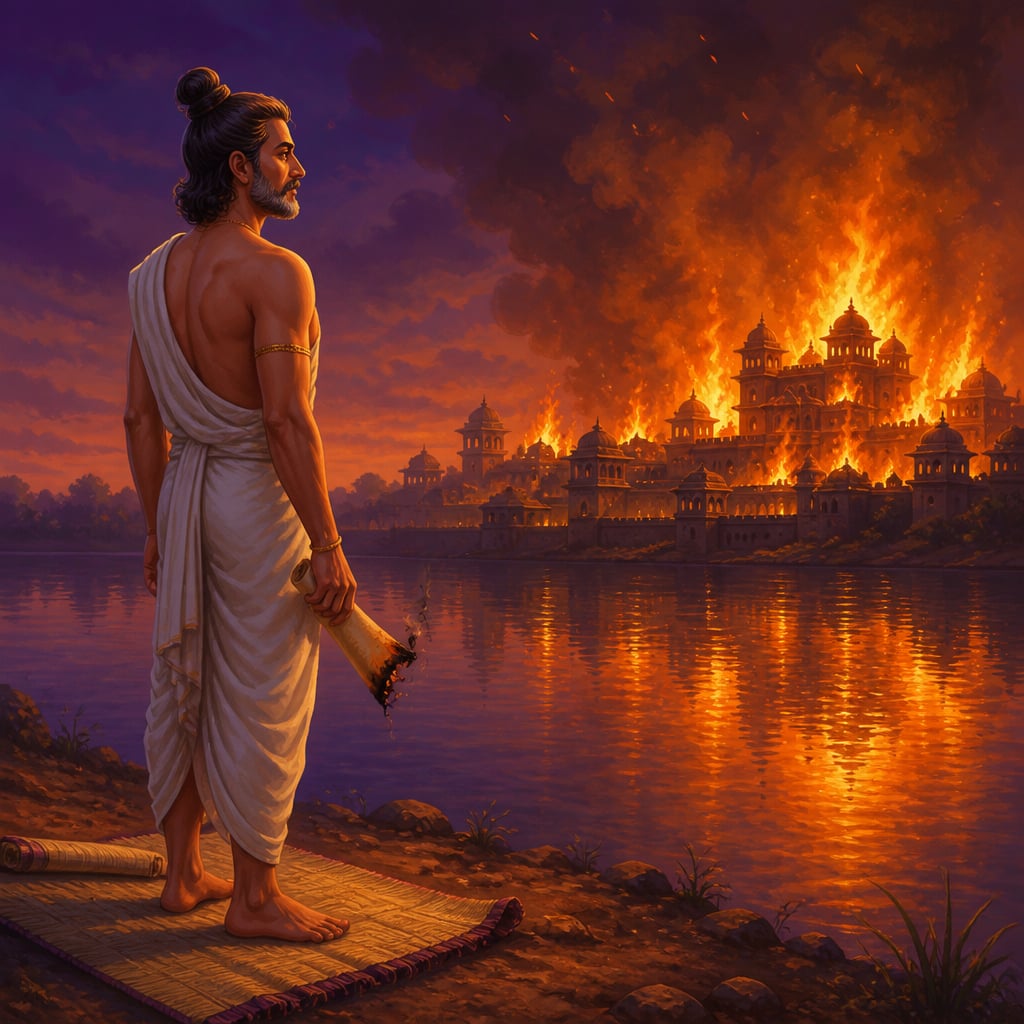
The story is famous in Indian philosophy. A young Brahmin named Shuka, son of the sage Vyasa, wanted to test whether King Janaka's liberation was genuine. How could a man surrounded by wealth, power, and pleasure truly be free?
Shuka arrived at Mithila's court with a cup of oil filled to the brim. "Walk through the palace," Janaka instructed, "and do not spill a single drop." For hours, Shuka navigated the magnificent halls, past beautiful courtesans, musicians, piles of gold, exotic animals, his entire attention fixed on not spilling the oil.
When he returned, Janaka asked: "What did you see?"
"Nothing," Shuka admitted. "I was focused only on the oil."
"That," said Janaka, "is how I live. I am in the palace, but I see nothing, because my attention is elsewhere."
But there's a second part to the story, less often told. While Shuka was walking with his cup, someone rushed in shouting: "Your Majesty, the palace is on fire!" Janaka didn't move. "Let it burn," he said. "What belongs to me that could be destroyed?"
The fire was a test. Janaka's response revealed his freedom: fully engaged with his kingdom, yet not identified with it. Ruling everything, attached to nothing.
This is vairagya-bhoga, the paradox at the heart of the Isha Upanishad's teaching.
The Paradox Explained
We tend to think of engagement and detachment as opposites. If you care about something, you're attached. If you're detached, you don't care. But the Upanishadic teaching dissolves this dichotomy.
Vairagya (वैराग्य) means dispassion, not suppressing passion but transcending it, having no compulsive pull toward or away from outcomes. Bhoga (भोग) means enjoyment, full engagement with experience, not avoidance of it.
Vairagya-bhoga combines both: engaging fully with life while remaining free from the need for specific outcomes. You play the game with everything you have, but you're not destroyed if you lose, not inflated if you win.
King Janaka ran his kingdom with full attention, building roads, adjudicating disputes, managing treasury, conducting diplomacy. He wasn't a disengaged ascetic meditating while ministers ran the state. Yet his psychological center wasn't in these activities. He could lose the kingdom and remain himself. He could keep the kingdom and remain himself.
This is radically different from both:
- Attachment: Where your identity depends on outcomes ("I am successful because my business succeeds")
- Withdrawal: Where you avoid engagement to protect yourself from loss ("I won't try so I won't fail")
Vairagya-bhoga is a third option: full engagement, zero identification.
The Videha King
Janaka was called Videha, literally "without body" or "disembodied." This didn't mean he lacked a physical form. It meant he didn't identify with it. His sense of self wasn't located in his body, his possessions, his kingdom, or his role.
The Brihadaranyaka Upanishad records his famous declaration:
मम मिथिला प्रज्वलिता न मे किंचन दह्यते
Mama Mithilā prajvalitā na me kiñcana dahyate
"Even if Mithila burns, nothing of mine is consumed."
This isn't nihilism or indifference. Janaka cared for his people, he was a just and effective ruler. But his inner peace didn't depend on external circumstances. The kingdom was his responsibility, not his identity.
Notice the precision: "nothing of mine is consumed." Janaka isn't saying the fire doesn't matter to anyone. He's saying his essential self, what's truly "his", is beyond what fire can touch.
Global Perspectives: The Stoic Emperor

Marcus Aurelius (121-180 CE), Roman Emperor for nearly two decades, governed the most powerful empire in the Western world while practicing Stoic philosophy. His private journal, later published as Meditations, reveals a mind remarkably similar to Janaka's.
Marcus wrote:
"If you are distressed by anything external, the pain is not due to the thing itself, but to your estimate of it; and this you have the power to revoke at any moment."
And:
"Never value anything as profitable that compels you to break your promise, lose your self-respect, hate any man, suspect, curse, act the hypocrite, or desire anything that needs walls or curtains."
Marcus fought wars, managed famines, survived plagues, and navigated byzantine court politics, all while reminding himself that none of it could touch his inner freedom if he didn't permit it.
The parallels with Janaka are striking:
| Janaka | Marcus Aurelius |
|---|---|
| Ruled Videha kingdom | Ruled Roman Empire |
| Called "Videha" (disembodied) | Practiced Stoic "apatheia" (non-disturbance) |
| "If Mithila burns, nothing of mine burns" | "What injures is not the thing but your judgment of it" |
| Full engagement with governance | Full engagement with empire |
| Inner freedom from outcomes | Inner citadel untouched by events |
Seneca (4 BCE-65 CE), another Stoic, was one of the wealthiest men in Rome, advisor to Emperor Nero, owner of vast estates. Yet he wrote extensively about detachment from wealth. When Nero eventually forced him to suicide, Seneca died calmly, demonstrating that his philosophy wasn't merely theoretical.
The Indian and Greco-Roman traditions converged on the same insight: engagement and freedom are compatible. The lotus floats on water without getting wet.
Modern Resonance: The Metro Man

Elattuvalapil Sreedharan was 63 years old in 1995 when the government asked him to build the Delhi Metro. Most Indians expected another infrastructure disaster, cost overruns, decades of delay, rampant corruption. The Konkan Railway, which Sreedharan had just completed, was considered a fluke.
What followed stunned the nation.
The Delhi Metro Phase 1 opened ahead of schedule and under budget, something almost unheard of in Indian public projects. Phase 2 followed the same pattern. By 2024, Delhi Metro had become the world's sixth-largest metro system, carrying 6 million passengers daily.
But what made Sreedharan truly remarkable wasn't the engineering, it was his way of being.
Here was a man who controlled billions of rupees in contracts, who could have easily extracted commissions like most infrastructure officials. Instead, he:
- Lived in a government guest house during the project years
- Returned to his simple home in Kerala after retirement
- Accepted only his IAS pension, refusing consultancy offers
- Declined a Bharat Ratna nomination, saying the award should go to those who truly need recognition
- At 92, still lives modestly with no security detail or trappings of success
When asked about his approach, Sreedharan responded in words Janaka might have recognized: "I have done my duty. I didn't do it for recognition or reward. The Metro serves the people, that's enough."
The Psychology of Vairagya-Bhoga
How does vairagya-bhoga work psychologically? Why doesn't detachment lead to apathy?
The teaching rests on a subtle distinction: identification versus engagement.
Identification is when your sense of self depends on something external:
- "I am successful because my startup succeeded"
- "I am worthy because I got the promotion"
- "I am secure because I have money in the bank"
Identification creates anxiety because these external things can be lost. You're constantly protecting, defending, maintaining.
Engagement is full participation without identification:
- "I give everything to this startup, and I'll be okay whether it succeeds or fails"
- "I pursue the promotion with full effort, and my worth doesn't depend on getting it"
- "I manage money responsibly, and my security isn't located in the bank balance"
Vairagya-bhoga is engagement without identification. You don't withdraw from life, you enter it more fully because you're not protecting a fragile ego.
Sreedharan could build the Metro with total commitment precisely because his identity didn't depend on it. He had nothing to prove, nothing to protect, nothing to lose. This freed him to make decisions based on what was right rather than what looked good or paid well.
Your Turn: The Identification Audit
Try this exercise:
List three things you're working hard on right now (a project, a relationship, a financial goal)
For each, ask: "If this fails completely, who would I be?"
Notice where your answer includes anxiety, resistance, or a sense of being diminished
Where you find resistance, you've found identification. That's where vairagya practice can be applied, not to care less, but to care from a freer place.
The Isha Upanishad isn't asking you to stop building your business, stop pursuing your career, stop caring about outcomes. It's inviting you to locate your center somewhere that outcomes can't touch, so you can engage more fully, not less.
In the next lesson, we'll explore what it means for wealth to be "divine trust" rather than personal possession, and how this frame applies to modern debates about billionaire wealth, inheritance, and economic justice.
Emotional intelligence; metacognition; decision-making under pressure
Daniel Goleman's 'emotional intelligence' emphasizes self-awareness, watching your emotional reactions before acting on them. Cognitive behavioral therapy teaches 'cognitive distancing', stepping back from thoughts. The sakshi teaching is more radical: you are not your thoughts, feelings, or actions at all.
Western approaches treat the witness position as a technique, something you do. The Upanishadic teaching says it's what you are, something you recognize. This makes it more stable: you're not trying to maintain a practice but waking up to your nature.
A 2018 study at Harvard Business School found that executives who practiced 'psychological distancing' made significantly better decisions under stress than those who were emotionally identified with outcomes. The sakshi principle appears in contemporary research as 'self-distancing.'
Intrinsic versus extrinsic motivation; process focus; growth mindset
Self-determination theory (Deci & Ryan) distinguishes intrinsic motivation (doing something for its own sake) from extrinsic motivation (doing it for rewards). Research consistently shows intrinsic motivation produces better performance, more creativity, and greater persistence. The Gita anticipated this research by 2,000 years.
Key terms
- vairāgya
- Dispassion; non-attachment; the state of being free from compulsive attraction or aversion to outcomes
- bhoga
- Enjoyment; experience; full engagement with life's offerings
- videha
- Without body; disembodied; not identified with the physical form or material possessions
- sākṣī
- Witness; the observing consciousness that watches experience without being caught in it
Key figures
King Janaka
E. Sreedharan
Marcus Aurelius
Case studies
E. Sreedharan and the Delhi Metro: Vairagya-Bhoga at Scale
In 1995, India's infrastructure sector was synonymous with delay, cost overruns, and corruption. The Delhi Metro project, an underground rail system for a chaotic megacity of 15 million, seemed destined for disaster. The government appointed a 63-year-old civil servant named E. Sreedharan to lead it. Sreedharan had already achieved the 'impossible' with the Konkan Railway, 765 km of track through Western Ghats terrain, involving 93 tunnels and 2,000 bridges, completed ahead of schedule. But Delhi Metro was larger in scale and higher in profile. His approach was distinctive from the start: **Full engagement (bhoga):** - Personally supervised construction daily, often visiting sites at 6 AM - Made every major technical decision himself - Held contractors to strict standards, terminating those who underperformed - Navigated complex politics between state and central government **Complete detachment (vairagya):** - Lived in a government guest house, not luxury accommodation - Refused all commissions and kickbacks (standard practice in Indian infrastructure) - Took no consultancy fees after retirement - Declined the Bharat Ratna, saying it should go to 'those who need recognition' - Returned to a simple home in Kerala on his IAS pension alone When asked about corruption pressure, Sreedharan was direct: 'People offered me money many times. I said no. What would I do with it? I have everything I need.'
Sreedharan embodies the Isha Upanishad's paradox: 'tena tyaktena bhunjitha', enjoy through renunciation. His 'bhunjitha' (enjoyment) was the work itself, building something excellent, serving the public, solving engineering challenges. He was fully engaged, passionate, demanding. His 'tyaktena' (renunciation) was the absence of personal accumulation. He didn't renounce the work, he renounced the fruits. The billions that flowed through his authority left nothing sticking to him. Compare this with Vijay Mallya (Lesson 3), who couldn't stop accumulating even when he had enough. Sreedharan never started. His sense of self wasn't located in wealth, so more wealth held no attraction. The contrast illuminates vairagya-bhoga in practice: - Both men controlled billions of rupees - Mallya's identification with wealth led to collapse - Sreedharan's non-identification enabled sustained excellence - The psychological difference produced opposite outcomes
The Delhi Metro became a global model: - Phase 1 (65 km): Completed 3 years ahead of schedule - Phase 2 (125 km): Completed ahead of schedule and under budget - By 2024: 390+ km of track, 6 million daily passengers - Corruption: Near-zero in an industry where corruption is assumed - Recognition: Delhi Metro won the Seoul Prize for innovation in public transport Sreedharan at 92: - Lives in a modest home in Ponnani, Kerala - No security detail, no luxury cars, no entourage - Still gives interviews about infrastructure development - Wealth: Essentially his pension and savings The man who could have become a billionaire through standard infrastructure practices chose instead to demonstrate that vairagya-bhoga works at scale.
Vairagya-bhoga isn't ancient philosophy disconnected from modern reality, it's a practical approach that produces superior results. Sreedharan's detachment from personal gain enabled the very engagement that produced excellent outcomes. The paradox resolves in practice: freedom from outcomes enables better outcomes.
India's infrastructure deficit remains enormous, with estimates of $1.4 trillion needed by 2030. Sreedharan's example shows that the bottleneck is not funding or technology but leadership quality. Every successful Indian infrastructure project, from the Mumbai coastal road to the Chenab bridge, traces back to individuals who chose duty over personal gain.
The Delhi Metro cost approximately ₹150,000 crore to build over two decades. Assuming even 1% 'leakage' (low by Indian infrastructure standards), Sreedharan could have accumulated ₹1,500 crore personally. He accumulated nothing, demonstrating that vairagya-bhoga is not theoretical.
Historical context
Upanishadic Period and Classical Age
The vairagya-bhoga ideal became central to Hindu economics. Unlike Buddhist monks who renounced worldly life, the Hindu grihastha (householder) was expected to engage fully with wealth, family, and society while cultivating inner detachment. This made Indian civilization unusual: spiritual practice didn't require withdrawal from economic life.
Greek and Roman Stoicism developed parallel insights: engage with duties, don't be attached to outcomes. Christian mysticism sometimes moved toward world-renunciation. Islam's Sufi tradition cultivated detachment within engagement. The universality of vairagya-bhoga suggests it addresses perennial human challenges, not culture-specific ones.
India remained economically prosperous (25-30% of world GDP) for centuries while developing this philosophy. The correlation suggests vairagya-bhoga doesn't inhibit economic development, it may enable it by freeing people from counterproductive attachment.
Understanding vairagya-bhoga corrects the misconception that Indian spirituality means world-rejection. The tradition's most celebrated figures, Janaka, Krishna, Arjuna, were fully engaged with power, wealth, and conflict. The teaching is not 'withdraw' but 'engage without being trapped.'
Reflection
- King Janaka said 'If Mithila burns, nothing of mine burns.' What in your life, your job, your savings, your status, would feel like 'you burning' if it were destroyed? What does this reveal about where you've located your sense of self?
- Choose one project or goal you're currently working on. For the next week, practice the witness position: do the work fully, and at the end of each day, observe: 'I did X today. I notice I feel Y about the results.' Don't try to change the feeling, just notice. What do you observe about engagement and attachment?