Ishavasyam: All Wealth Belongs to the Divine

The Sacred Pervasion of Prosperity

Before we can 'enjoy through renunciation,' we must understand why: because everything, every rupee, every asset, every market transaction, is pervaded by the Divine. The Isha Upanishad's ontological claim transforms economics from mere transaction to sacred participation.

The Woman Who Refused a Fortune
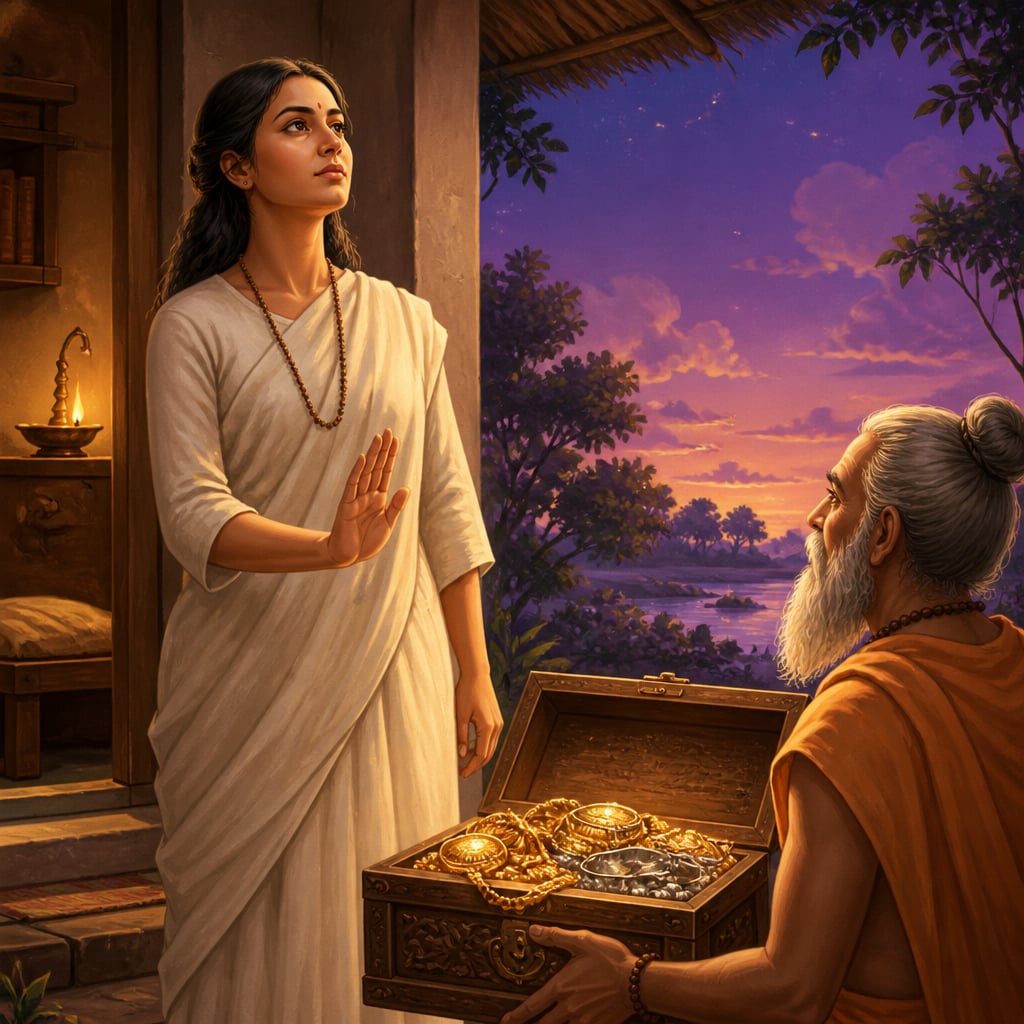
Maitreyi refusing chest of gold at threshold

Maitreyi stood at a crossroads that most people never face. Her husband, the sage Yajnavalkya, had decided to renounce worldly life and divide his considerable wealth between his two wives. Katyayani, the other wife, accepted her share gratefully.

Maitreyi did not.

"My lord," she asked, recorded in the Brihadaranyaka Upanishad, "if this whole earth filled with wealth were mine, would I become immortal thereby?"

Yajnavalkya's answer was stark: "No. Your life would be like the life of the wealthy, comfortable, secure, abundant, but there is no hope of immortality through wealth."

Maitreyi's response became one of the most celebrated lines in Indian philosophy: "Then what shall I do with that by which I do not become immortal? Tell me, my lord, what you know."

This wasn't a rejection of wealth. It was a question about wealth's nature, what is it, ultimately? Where does it come from? What can it actually give us? The answer Yajnavalkya provided would become the foundation of dharmic economics.

The Universe as Divine Body

Divine pervasion through a starlit river valley

The Isha Upanishad opens with a claim so radical that most of us slide past it without registering its implications:

ईशावास्यमिदं सर्वं यत्किञ्च जगत्यां जगत्

Ishavasyam idam sarvam yat kincha jagatyam jagat

"All this, whatever exists in this moving universe, is pervaded by Isha (the Divine)."

This isn't poetry or metaphor. It's a cosmological statement: there is nowhere that the Divine is not. Your wallet, your bank account, the stock market, the vegetable vendor's cart, the global commodity exchange, all of it is ishavasyam, clothed in and pervaded by the sacred.

What does this change?

First, it eliminates the spiritual/material divide that plagues much religious thinking. Wealth isn't "worldly" in opposition to something "spiritual." The marketplace is as much a field of divine activity as a temple.

Second, it transforms your relationship to ownership. If everything is pervaded by Isha, then nothing is exclusively "yours." You're participating in something that belongs to a larger wholeness. You're handling sacred substance, not neutral material.

Third, and this is crucial for economics, it means that wealth creation itself can be sacred work. The entrepreneur building a company, the farmer growing crops, the investor allocating capital, all are participating in the divine activity of jagat, the moving, living, dynamic universe.

Maitreyi's Insight: Wealth Cannot Save Us

Why did Maitreyi refuse wealth? Not because it was worthless, but because she understood its limits.

Yajnavalkya explained further: "You see, it is not for the sake of the husband that the husband is loved, but for the sake of the Self... It is not for the sake of wealth that wealth is loved, but for the sake of the Self."

The insight is subtle. We think we want money, but what we actually want is what money seems to promise: security, freedom, happiness, significance, ultimately, a sense of being that transcends our mortal limitations. Wealth is a vehicle, not a destination.

Once Maitreyi understood this, wealth lost its grip on her. Not because it became worthless, Yajnavalkya wasn't teaching poverty, but because it took its proper place. She could now engage with wealth (or without it) without confusion about what it could and couldn't provide.

This is the psychological liberation the Isha Upanishad offers: clarity about wealth's nature frees you to use it wisely rather than worship it blindly.

Global Perspectives on Sacred Economics

John Templeton (1912-2008), the legendary investor who founded the Templeton Growth Fund, built one of the most successful investment careers in history while insisting that "spiritual laws work in economics just as in other areas of life." Templeton began each investment meeting with prayer and titled his autobiography The Humble Approach, arguing that wealth management is a form of spiritual discipline.

Templeton's signature insight: "The investor who says 'I don't care about spiritual matters' is like a fish saying 'I don't care about water.'" Just as fish swim in water whether they acknowledge it or not, we operate within spiritual reality whether we recognize it or not.

Muhammad Yunus (1940-), the Bangladeshi economist who pioneered microfinance, built Grameen Bank on the belief that access to credit is a human right, almost a sacred entitlement. His model assumed that even the poorest person has inherent dignity and productive capacity, a view remarkably aligned with ishavasyam, the divine pervading all.

Max Weber (1864-1920) documented in The Protestant Ethic and the Spirit of Capitalism how religious belief shaped economic behavior. Calvinist theology, with its emphasis on work as divine calling, helped generate the work ethic that fueled early capitalism. Weber showed that economic systems are always downstream of spiritual assumptions.

Thinker Key Insight Ishavasyam Parallel
Templeton Spiritual laws govern economics Divine pervasion means economics operates within sacred reality
Yunus Every person has inherent dignity/potential If Isha pervades all, every person is sacred, worthy of access
Weber Religious beliefs shape economic systems Our understanding of ishavasyam determines how we build markets

The Upanishadic view differs from these Western parallels in one key way: it's not that spiritual values should guide economics, but that economics is spiritual activity, the divine manifesting through exchange, production, and distribution.

Modern Resonance: India Stack as Ishavasyam

Technocrat showing public digital infrastructure flow

Nandan Nilekani didn't use Upanishadic language when he architected India's digital public infrastructure. But the underlying vision resonates powerfully with ishavasyam.

Consider what Aadhaar, UPI, and the "India Stack" accomplished: they created universal access to identity, banking, and digital payments. By 2024, over 1.3 billion Indians had Aadhaar numbers. UPI processes over 10 billion transactions per month. The Jan Dhan-Aadhaar-Mobile (JAM) trinity brought 500 million people into the formal financial system.

This is ishavasyam in digital form: the divine principle that no one should be excluded from economic participation. If all wealth is pervaded by Isha, then systems that exclude people from that wealth violate the cosmic order. Financial inclusion becomes not just good policy but restoration of dharmic balance.

Nilekani himself speaks of this work in terms of "public goods" and "digital commons", infrastructure that belongs to everyone, that pervades the entire economy. The India Stack creates what economists call "positive externalities", benefits that flow to everyone regardless of who captures the direct value.

"We built rails," Nilekani has said, "that anyone can ride." This is trusteeship at infrastructure scale: creating systems that generate wealth for all rather than hoarding access for a few.

Your Turn: Seeing the Sacred in the Ordinary

The next time you make a transaction, swiping your card, transferring money, receiving your salary, pause for a moment. Can you see this not just as an economic event but as participation in something larger?

The Isha Upanishad isn't asking you to be mystical about money. It's asking you to be accurate. Wealth doesn't emerge from nowhere, it arises from natural resources, human creativity, social cooperation, and accumulated knowledge. All of these are pervaded by the same consciousness that animates you.

When you truly see wealth as ishavasyam, several things follow naturally:

In the next lesson, we'll explore what happens when we forget this teaching, when gridhah (covetousness) takes hold and we start seeing wealth as something to grasp rather than something to steward.

Intrinsic versus instrumental value; sacred economics

Western economics generally treats economic value as constructed by human preferences (subjective theory of value) or labor (labor theory). The Upanishadic view adds a third dimension: value as participation in divine activity. Charles Eisenstein's 'Sacred Economics' approaches this but doesn't have the metaphysical foundation.

When wealth is seen as ishavasyam, extraction without contribution becomes not just unethical but cosmologically inappropriate, like stealing from the temple. This provides a deeper foundation for sustainability and stakeholder responsibility than utilitarian calculations.

Companies with explicit 'purpose beyond profit' missions outperformed the S&P 500 by 14x over 15 years, according to a 2023 study by Raj Sisodia and colleagues at the Conscious Capitalism Institute, suggesting that recognizing deeper dimensions of economic activity correlates with superior performance.

Diminishing marginal utility of wealth; the Easterlin Paradox

Economist Richard Easterlin documented in 1974 that beyond a certain income threshold, additional wealth doesn't increase happiness, the 'Easterlin Paradox.' Daniel Kahneman and Angus Deaton found the threshold around $75,000 annually in the US. Maitreyi intuited this 3,000 years earlier.

Key terms

īśāvāsya
To be pervaded, clothed, or inhabited by Isha (the Divine Lord). The state of all existence being enveloped by sacred presence.
jagat
The moving world; the dynamic, changing universe; all that is subject to motion and transformation
ātman
The Self; the essential, unchanging core of a being; the individual expression of universal consciousness
vitta
Wealth, property, possessions; what has been acquired or found

Key figures

Maitreyi

Nandan Nilekani

John Templeton

Case studies

India Stack: Digital Infrastructure as Divine Pervasion

In 2009, India faced a challenge: hundreds of millions of citizens had no formal identity, no bank accounts, and no access to government services. They existed outside the economic system, invisible to the state, excluded from finance, unable to prove they existed. Nandan Nilekani was tasked with solving this. But rather than building a closed system that served government needs, his team designed something more ambitious: open, interoperable infrastructure that anyone could build upon. Aadhaar provided identity. The India Stack built layers on top: digital payments (UPI), consent-based data sharing (DigiLocker), and electronic signatures. By 2024, this infrastructure enabled: - 1.3 billion Aadhaar enrollments (99% of adult population) - 300+ million Jan Dhan bank accounts opened - 10+ billion monthly UPI transactions - ₹34 trillion direct benefit transfers to citizens The design principle was revolutionary: build public goods, not proprietary systems. Create rails that everyone can ride. Make inclusion the default, not exclusion.

From a conventional market perspective, the India Stack model is puzzling. Why build open infrastructure that competitors can use? Why not monetize the platform directly? The Isha Upanishad provides a framework: if all economic activity is ishavasyam, pervaded by the divine, then exclusion is cosmologically wrong. When Isha pervades everything, no one should be locked out of participation. The India Stack's design embodies this principle. It's not charity, it creates massive economic value. But the value is distributed rather than captured. UPI charges no transaction fees, yet enabled the fintech industry to flourish. Aadhaar costs the government, yet saves ₹90,000 crore annually by eliminating middlemen in benefit transfers. This is trusteeship at infrastructure scale: building systems that serve the whole, not just the builders.

The India Stack has become a global model: - **Financial inclusion**: 80% of Indians now have bank accounts (up from 35% in 2011) - **Digital payments**: India accounts for 46% of global real-time payment transactions - **Direct benefits**: ₹34 trillion transferred directly to citizens, bypassing corruption - **Global adoption**: Countries including Singapore, UAE, and multiple African nations are adopting India Stack architecture The World Bank called it 'one of the most sophisticated digital identity programs in the world.' More significantly, it demonstrated that public digital infrastructure can create more value than closed proprietary systems, the ishavasyam principle operationalized.

When infrastructure is designed as 'ishavasyam', pervading all, excluding none, it creates more value than extractive models. The India Stack proves that dharmic principles scale: serving the whole serves individuals better than serving individuals alone.

Over 40 countries have studied or begun replicating elements of India Stack. The platform's approach of building shared digital infrastructure as public good, rather than allowing private monopolies to control identity and payments, represents a governance innovation as significant as the technologies themselves.

The India Stack has saved the Indian government an estimated ₹2.2 trillion ($27 billion) in reduced leakage and improved targeting of benefits, while enabling a fintech industry worth over $150 billion, proving that public goods and private value creation reinforce rather than oppose each other.

Historical context

Upanishadic Period (c. 800-500 BCE)

The Upanishadic period coincided with the 'second urbanization' of India. Cities like Varanasi, Rajagriha, and Shravasti were flourishing commercial centers. The philosophical questioning of wealth wasn't born of poverty but of prosperity, India's thinkers were wealthy enough to ask whether wealth was enough.

While India was developing the Upanishads, Greece was emerging from its 'Dark Ages' and beginning the archaic period. The Hebrew Bible was being compiled. Chinese philosophers like Confucius (551-479 BCE) were addressing similar questions about ethics and prosperity. The Upanishadic synthesis of engaged spirituality was unique in its explicit integration of metaphysics with practical economics.

India's share of world GDP during the Upanishadic period is estimated at 25-30% (Angus Maddison). The Ganges valley alone supported one of the world's most productive agricultural systems, generating the surplus that enabled both trade and philosophical inquiry.

Understanding that the Upanishads emerged from prosperity, not poverty, corrects the misconception that Indian spirituality is about rejecting the world. Maitreyi and Yajnavalkya were not escaping material life; they were understanding it more deeply. Dharmic economics isn't anti-wealth; it's clear-eyed about wealth.

Reflection

More in Isha Upanishad: Wealth & Detachment

All lessons in Isha Upanishad: Wealth & Detachment · Dharmic Economics course