Tena Tyaktena Bhunjitha: Enjoy Through Renunciation
Everything Belongs to the Divine
The Isha Upanishad's opening verse presents humanity's most radical wealth philosophy: true enjoyment comes not from grasping but from letting go. Three thousand years before philanthropy pledges and ESG investing, Indian sages discovered that the secret to prosperity lies in trusteeship, not ownership.
The Billionaire Who Gave It All Away
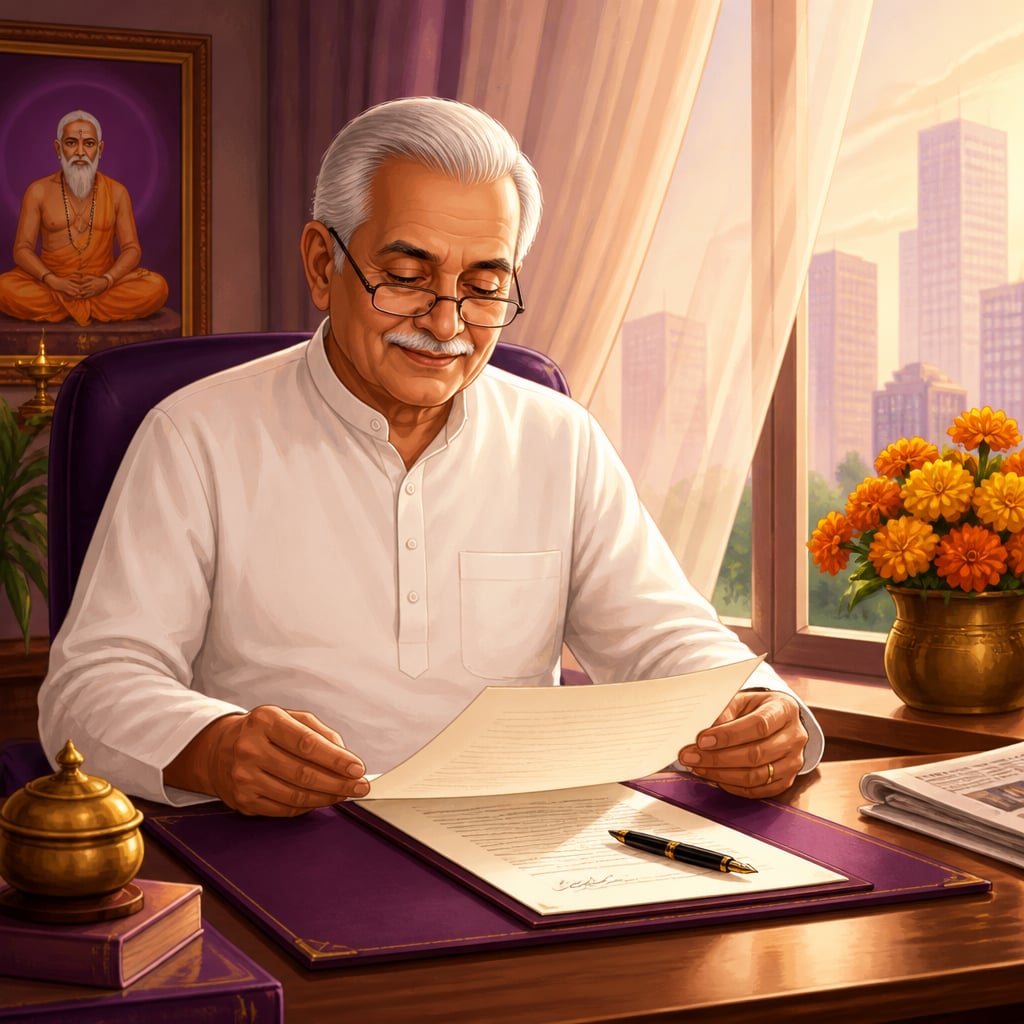
In 2019, Azim Premji made headlines around the world. The Wipro chairman had just transferred $7.5 billion worth of shares to his philanthropic foundation, bringing his total giving to over $21 billion, roughly 83% of his entire wealth. When journalists asked why, Premji quoted a verse his mother had taught him as a child in Bombay: "Tena tyaktena bhunjitha", enjoy through renunciation.
This wasn't guilt-driven charity or tax optimization. It was something stranger: a technology billionaire practicing a 3,000-year-old philosophy that says you can only truly possess what you're willing to release.
How did an ancient Upanishadic verse end up guiding one of modern India's largest acts of philanthropy? And what does this teaching offer the rest of us, those of us still building wealth, not giving it away?
A Sage and a King Walk Into a Palace
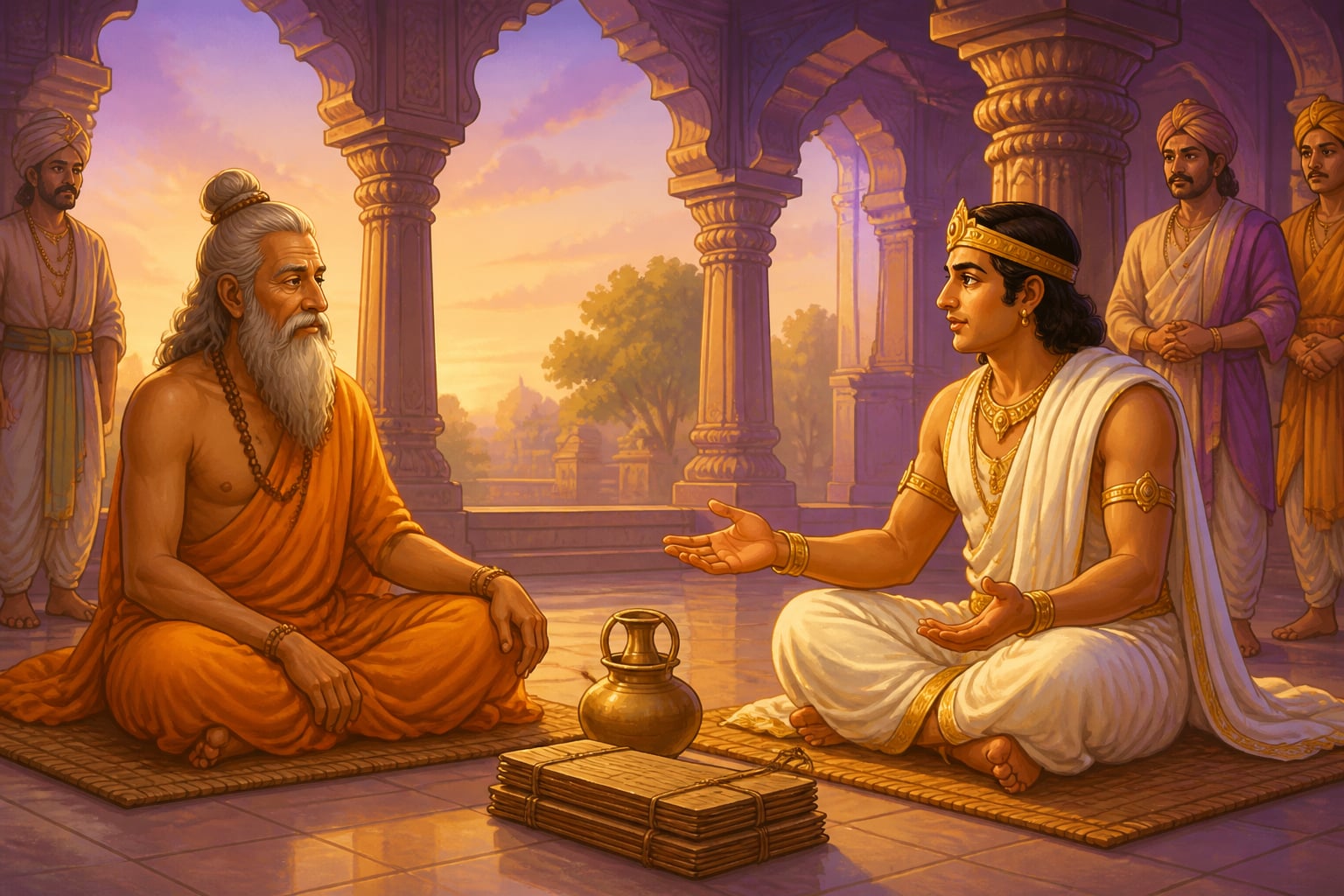
The scene is Mithila, capital of the Videha kingdom, sometime around 700 BCE. King Janaka sits in his assembly hall, surrounded by the finest minds of his age. He is fabulously wealthy, his kingdom controls the fertile Gangetic plains, his treasury overflows with gold from trade routes spanning from the Himalayas to the sea.
But Janaka has a problem. Despite his riches, he cannot find peace. He has heard of a sage named Yajnavalkya, reputed to be the greatest philosopher of his generation. Janaka summons him with a challenge: "Teach me the nature of wealth and the self."
What follows, recorded in the Brihadaranyaka Upanishad, is one of history's most remarkable dialogues. But it is in another text, the Isha Upanishad, where Yajnavalkya's tradition gives its most concentrated teaching on wealth.
The Isha Upanishad opens with eighteen verses that would influence everyone from Mahatma Gandhi to Albert Einstein. The very first shloka delivers its teaching like a thunderbolt:
ईशावास्यमिदं सर्वं यत्किञ्च जगत्यां जगत्। तेन त्यक्तेन भुञ्जीथा मा गृधः कस्यस्विद्धनम्॥
"All this, whatever exists in this changing universe, is pervaded by the Divine. Enjoy through renunciation. Do not covet anyone's wealth."
Unpacking the Paradox

At first glance, this seems contradictory. How can you enjoy through giving up? Isn't enjoyment about acquiring and possessing?
The key lies in the word tyakta (त्यक्त), renounced, released, let go. The verse doesn't say "abandon wealth" or "reject enjoyment." It says enjoy through the act of releasing.
Yajnavalkya's teaching rests on a radical claim: you cannot truly possess anything. Everything, your wealth, your home, your very body, is isha-vasyam, pervaded by and belonging to Ishvara, the divine principle underlying reality. You are not an owner but a trustee, temporarily entrusted with resources that belong to a larger whole.
Once you internalize this, something shifts. The anxiety of accumulation dissolves. The fear of loss diminishes. You can engage fully with wealth, earning it, growing it, deploying it, without the psychological burden of clutching.
King Janaka himself became the exemplar of this teaching. He ruled his kingdom with full engagement, conducting trade, collecting taxes, building infrastructure, yet remained inwardly detached. The texts call him videha, "without body-identification," meaning he acted in the world without being trapped by it.
Global Perspectives on Detached Ownership
Is this uniquely Indian wisdom? Not entirely, but the Indian framing is distinctive.
Andrew Carnegie (1835-1919), the Scottish-American steel magnate, articulated something similar in his famous essay The Gospel of Wealth (1889). Carnegie argued that the rich are merely "trustees" of their wealth, obligated to distribute it for the public good during their lifetimes. "The man who dies rich dies disgraced," he declared.
Warren Buffett (1930-) took this further. In 2006, he pledged to give away 99% of his fortune, over $130 billion, to philanthropy. Despite being one of the world's richest people, Buffett still lives in the same modest Omaha house he bought in 1958 for $31,500. He famously eats McDonald's for breakfast. "I have everything I need," he explains. "Beyond a certain point, more money has no utility for me."
Peter Singer (1946-), the Australian philosopher, has built an entire ethical framework around giving. His effective altruism movement argues that the affluent have a moral obligation to donate significant portions of their income to reduce suffering.
| Thinker | Key Insight | Isha Upanishad Parallel |
|---|---|---|
| Carnegie | Rich as trustees, not owners | Ishavasyam, all pervaded by divine |
| Buffett | Beyond sufficiency, wealth has no personal utility | Tena tyaktena bhunjitha, enjoy through release |
| Singer | Moral obligation to give | Ma gridhah, do not covet |
The Upanishadic teaching differs in one crucial respect: it's not primarily about obligation but about psychology. Tyaga (renunciation) isn't a duty imposed from outside, it's the natural response when you truly see that ownership is illusory. You give not because you should, but because holding on no longer makes sense.
Modern Resonance: The Trusteeship Revolution
Azim Premji's philanthropy wasn't just personal generosity, it was a business philosophy. Wipro, under his leadership, became known for frugality, ethical practices, and long-term thinking. Premji drove a beat-up Ford Escort while running a company worth billions. He insisted on economy class flights. Employees called him "spartan" and "almost ascetic."
Yet Wipro thrived. By 2024, Premji's Azim Premji Foundation had deployed over ₹32,000 crore (approximately $4 billion) on education, reaching 350,000 schools across India. The lesson? Detachment from wealth didn't prevent its creation, it channeled it more effectively.
This pattern repeats across India's most admired business houses. The Tata Trusts own 66% of Tata Sons, the holding company of India's largest conglomerate. This means the majority of profits from everything, from Tata Steel to TCS to Tata Motors, flow not to individual shareholders but to charitable purposes. Jamsetji Tata established this model over a century ago, citing the same Upanishadic principle: wealth held in trust, not in grip.
In 2025, as debates rage about billionaire wealth taxes and economic inequality, the Isha Upanishad offers a different frame. The question isn't whether to accumulate or redistribute, it's whether you can hold wealth without it holding you.
Your Turn: The Trusteeship Test
You don't need to be a billionaire to practice tena tyaktena bhunjitha. The teaching applies at every scale:
- The salary you earn, Do you see it as "yours" to hoard, or resources flowing through you?
- The possessions you own, Can you enjoy them fully while holding them lightly?
- The opportunities you receive, Are they for personal accumulation or to create value for others?
Try this: Pick one financial decision this week, a purchase, an investment, a donation. Before you act, ask: "Am I approaching this as an owner or a trustee?" Notice how the question changes your relationship to the choice.
In the next lesson, we'll explore the first half of the Isha Upanishad's opening verse, Ishavasyam idam sarvam, and what it means for everything to be "pervaded by the divine." If all wealth belongs to Ishvara, what does that make us?
Milton Friedman argued corporations exist solely to maximize shareholder returns. The stakeholder model (Freeman, 1984) countered that companies must serve all stakeholders, employees, customers, communities. The Upanishadic teaching goes further: the business leader is a trustee for a cosmic whole, not just identified stakeholders.
The dharmic approach addresses the psychological dimension that Western stakeholder theory misses. It's not just about who you serve but how you hold your role. The tyakta mindset prevents both the burnout of over-identification and the callousness of pure profit maximization.
Companies in India's Tata group, operating under trusteeship principles since 1892, have outlasted 99% of their Western contemporaries and built a $150 billion market cap while directing majority profits to charitable purposes.
Behavioral economics (Kahneman, Thaler) documents how emotional attachment distorts financial decisions, loss aversion, endowment effect, sunk cost fallacy. The recommendation is cognitive debiasing techniques. The Gita offers a more radical solution: cultivate a fundamentally different relationship to outcomes.
Where Western approaches try to 'fix' emotional bias through techniques, the lotus leaf model addresses the root: over-identification with outcomes. A business leader who has internalized this teaching makes clearer decisions not through suppressing emotions but through a transformed sense of self.
Research by Srini Pillay (Harvard) shows that meditation practices derived from Indian traditions reduce amygdala reactivity, the brain region responsible for fear-based financial decisions, by up to 50% with regular practice.
Key terms
- tyāga
- Renunciation, release, letting go; the act of giving up attachment without necessarily giving up the object itself
- īśāvāsya
- To be clothed/pervaded by Isha (the Lord/Divine principle); the state of all existence being enveloped by the divine
- gṛdha
- Covetousness, greed, the excessive desire for what belongs to others
- bhuñjīthā
- You should enjoy/experience; the imperative to engage with and relish life's offerings
Key figures
Yajnavalkya
Azim Premji
Warren Buffett
Case studies
Azim Premji's $21 Billion Tyaga: Trusteeship in Action
In 2001, Azim Premji established the Azim Premji Foundation with an initial endowment of $125 million. Over the next two decades, he systematically transferred his Wipro shareholding to the foundation. By March 2019, the transfer had reached $7.5 billion in a single transaction. By 2024, total transfers exceeded $21 billion, approximately 83% of his total wealth. The scale is staggering: Premji has given away more than any other Indian in history. But the *manner* is equally significant. Premji didn't wait until death to establish a legacy. He transferred wealth while actively leading Wipro, demonstrating that trusteeship isn't retirement charity but an operating philosophy. Premji's personal life reinforces the point. Despite heading a $11 billion company, he drove a modest Ford Escort for years, flew economy class on work trips, and lived in a house he'd occupied since the 1960s. When asked about this apparent contradiction, he replied: "I have all I need. The rest is not mine to keep."
From a conventional Western perspective, Premji's behavior appears irrational. Standard utility theory suggests people should maximize personal consumption. Giving away 83% of your wealth while living frugally doesn't compute. The Isha Upanishad offers a different lens: Premji isn't 'giving away' his wealth, he's recognizing that it was never 'his' in the ultimate sense. The phrase 'tena tyaktena bhunjitha' suggests that his modest lifestyle isn't sacrifice but accurate perception: beyond sufficiency, additional personal wealth has no utility because there's no separate self to enjoy it. The dharmic analysis also explains his *engagement*. Premji didn't withdraw from business, he built Wipro aggressively for decades. The lotus leaf floats on water; it doesn't levitate above it. Trusteeship enables full economic participation without the psychological distortions of personal accumulation.
The Azim Premji Foundation has become India's largest private foundation in education. By 2024, it had: - Established presence in 7 states and 1 Union Territory - Worked with 350,000+ government schools - Trained over 400,000 teachers - Founded Azim Premji University in Bengaluru - Deployed over ₹32,000 crore ($4 billion) in education initiatives Wipro itself continued to thrive under this philosophy, growing from $150 million revenue in 1999 to over $11 billion by 2024. The trusteeship model didn't inhibit wealth creation, it channeled it toward lasting impact.
Trusteeship isn't charity after wealth, it's a philosophy during wealth creation. Premji demonstrates that 'tena tyaktena bhunjitha' is a practical business model: build aggressively, hold lightly, deploy for impact. The psychological freedom of non-attachment may actually enhance wealth-building capacity.
Premji's foundation has become India's largest private philanthropic initiative in education, operating in over 7 states. As debates intensify about whether billionaire philanthropy is effective or merely tax avoidance, Premji's model of systematic wealth transfer during his lifetime, rather than posthumous pledges, sets a standard few global peers have matched.
Premji's lifetime giving of $21 billion represents 83% of his total wealth, higher than Warren Buffett's pledged 99% in absolute terms given timing, and one of the highest percentages actually transferred during a donor's lifetime globally.
Historical context
Upanishadic Period (c. 800-500 BCE)
The Upanishadic period saw India's GDP constituting approximately 25% of world output (Angus Maddison estimates). The subcontinent was economically dominant, with extensive internal and external trade. The philosophical questioning of wealth's nature emerged not from scarcity but from abundance, India's thinkers were wealthy enough to ask whether wealth itself was sufficient for human flourishing.
While India was developing sophisticated economic philosophy, Greece was in its 'Dark Ages' (c. 1100-800 BCE), and Rome had not yet been founded (753 BCE). Chinese philosophy was developing parallel traditions, but the Upanishadic synthesis of economic engagement with spiritual detachment was distinctive.
India maintained 25-33% of global GDP from approximately 1 CE to 1700 CE. The Upanishadic economic philosophy emerged during and contributed to this sustained prosperity.
The Isha Upanishad's teachings weren't abstract philosophy divorced from economic reality, they emerged from one of history's most prosperous civilizations. Understanding this context counters the misconception that dharmic economics means poverty or withdrawal. The sages taught trusteeship precisely because they lived in wealth.
Reflection
- The Isha Upanishad says everything is 'pervaded by the divine.' If this is true, what does it mean for something to be 'yours'? Consider the salary you earn, the home you live in, the phone you're reading this on, in what sense do you 'own' these things, and in what sense are you a temporary trustee?
- Think of one financial decision you'll make this week, a purchase, a bill payment, a donation decision. Before you make it, pause and ask: 'Am I approaching this as an owner or as a trustee?' How does framing yourself as a trustee change how you feel about the decision?