Dharmasya Mula: Wealth as Divine Trust
Ancient Wisdom for Modern Inequality
If all wealth is 'ishavasyam', pervaded by the Divine, then no individual can claim absolute ownership. This lesson explores how the Isha Upanishad's trusteeship philosophy, operationalized through Indian institutions from ancient raja-dharma to modern cooperatives, has produced measurably lower inequality than purely capitalist models. The data suggests dharmic economics works.
The Warrior Who Taught Economics
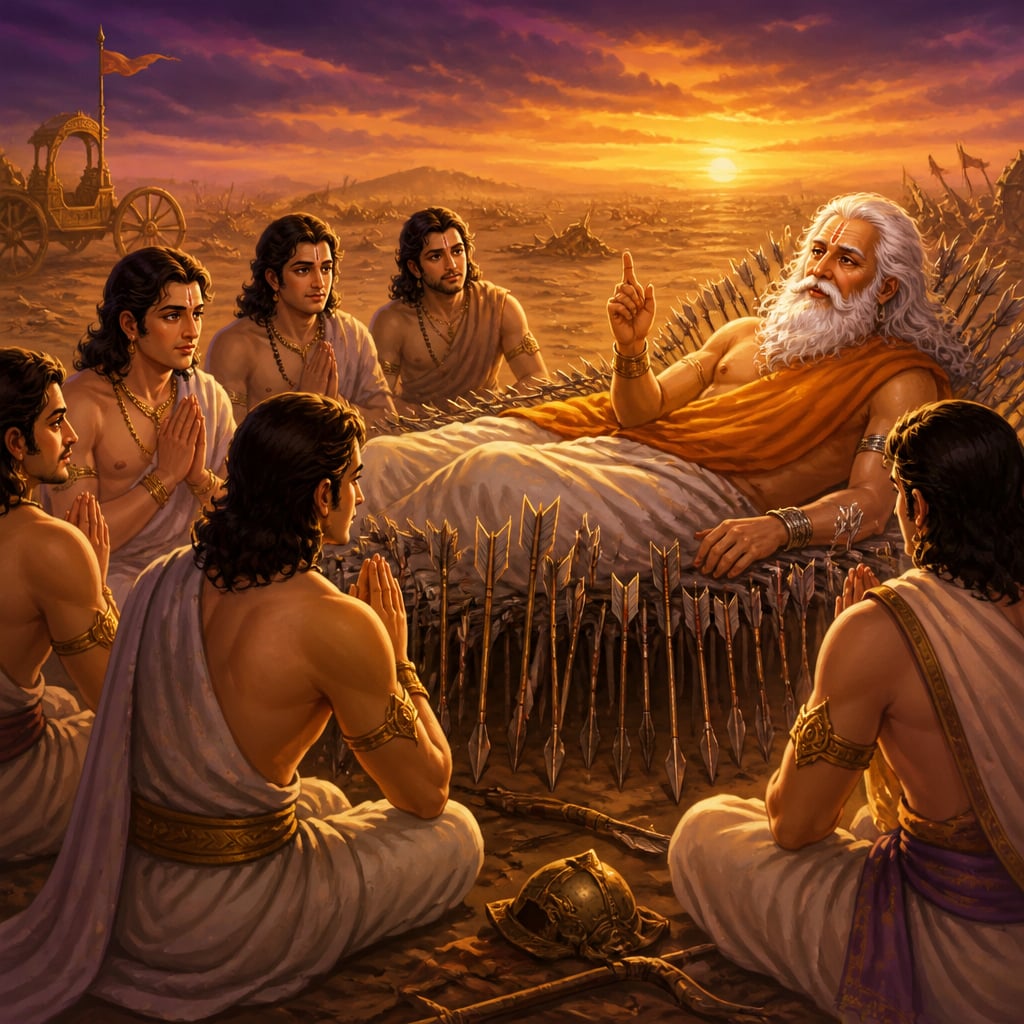
Bhishma lay on his bed of arrows, waiting to die. Pierced by countless shafts at Kurukshetra, he had chosen the moment of his death, and used his final weeks to teach.
What did the greatest warrior of the Mahabharata choose to teach in his dying hours? Not military strategy. Not personal vengeance. He taught raja-dharma, the duty of rulers, the ethics of governance, the proper relationship between wealth and power.
"The king is not the owner of his kingdom," Bhishma told Yudhishthira. "He is its trustee. The wealth that flows through his treasury belongs to the people. His duty is to multiply it and distribute it justly, not to accumulate it for himself or his family."
This teaching, recorded in the Shanti Parva of the Mahabharata, establishes a principle that would shape Indian economics for millennia: wealth is divine trust, not personal possession.
In 2025, as global debates rage about billionaire taxation, inheritance reform, and economic justice, Bhishma's ancient teaching offers a distinctive framework, one that India has been quietly implementing for decades with measurable results.
The Trusteeship Framework
The Isha Upanishad's opening verse contains an implicit economics:
ईशावास्यमिदं सर्वं, All this is pervaded by the Divine
If everything is pervaded by Isha, then no individual can claim exclusive ownership. You didn't create the natural resources your business uses. You didn't invent the social infrastructure (language, laws, trust) that makes commerce possible. You didn't choose the talents you were born with.
Wealth, in this view, arises from a cosmic collaboration. The individual contributes effort, but the ground (literally and metaphorically) was already provided. This makes all wealth a kind of cosmic commons, temporarily entrusted to individuals who have the duty to use it well.
Bhishma's raja-dharma teaching applies this to governance:
प्रजासुखे सुखं राज्ञः प्रजानां च हिते हितम्। नात्मप्रियं हितं राज्ञः प्रजानां तु प्रियं हितम्॥
"In the happiness of the people lies the king's happiness. In their welfare, his welfare. What pleases him is not his good; what pleases the people is his good."
This isn't socialism, Bhishma didn't advocate state ownership of means of production. It's trusteeship: the ruler holds power and wealth in trust for the people, and his success is measured by their flourishing, not his accumulation.
The Data: India's Quiet Achievement
Here's a fact that rarely makes headlines: India has lower wealth inequality than most major economies.
The Gini coefficient measures income inequality, where 0 is perfect equality and 100 is maximum inequality. According to World Bank data (2023):
| Country | Gini Coefficient |
|---|---|
| South Africa | 63.0 |
| Brazil | 48.9 |
| United States | 41.5 |
| China | 38.2 |
| India | 35.7 |
| Germany | 31.7 |
| Nordic average | 27.5 |
India's Gini of 35.7 places it below the US, China, and most of Latin America. How did a country with 1.4 billion people achieve this relatively egalitarian distribution?
Multiple factors contributed:
- Land reforms post-independence broke up large estates and distributed land to tillers
- Joint Hindu Family system kept wealth consolidated within families but shared among members
- Cooperative movements (Amul, SEWA) created alternative ownership structures
- Mandatory CSR (Companies Act 2013) channels corporate profits to social purposes
- Public sector dominance in key industries prevented extreme private concentration
Underlying all of these: a cultural philosophy that wealth is held in trust, not owned absolutely. The Isha Upanishad's teaching, absorbed into Indian civilization over millennia, shaped institutions that produced these outcomes.
Ela Bhatt: Trusteeship for the Informal Economy

Ela Bhatt (1933-2022) founded the Self-Employed Women's Association (SEWA) in 1972 with a radical premise: the poorest women in India's informal economy, street vendors, home-based workers, agricultural laborers, were not beneficiaries of charity but economic actors with rights.
SEWA's model operationalized trusteeship at the grassroots:
- Cooperative ownership: SEWA Bank (founded 1974) is owned by its members, poor women who were previously excluded from formal banking. By 2024, it had over 700,000 depositors.
- Collective bargaining: Street vendors organized to negotiate with municipalities, transforming their status from "encroachers" to licensed traders.
- Profit sharing: Instead of external shareholders extracting value, surplus flowed back to member-owners.
- Decision-making: Governance by the women themselves, not external "experts."
By 2024, SEWA had 2.5 million members across India and had inspired similar organizations in 15 countries.
Ela Bhatt's philosophy echoed Bhishma's teaching: "Wealth should be circulated, not accumulated. When poor women save, invest, and decide together, they become trustees of their own future."
Her approach challenged both pure capitalism (which concentrates wealth) and pure socialism (which concentrates power in the state). Trusteeship offers a third way: distributed ownership with collective responsibility.
Why Dharmic Economics Produces Lower Inequality
The Indian model's relatively egalitarian outcomes aren't accidental. They flow from philosophical assumptions embedded in the culture:
1. Wealth as temporary stewardship, not permanent possession
The Isha Upanishad's 'tena tyaktena bhunjitha' (enjoy through renunciation) creates psychological distance from wealth. When wealth isn't central to identity, there's less drive toward excessive accumulation.
2. Extended family as redistribution mechanism
The joint Hindu family system pools resources. A successful entrepreneur supports not just spouse and children but parents, siblings, cousins, and their dependents. Wealth spreads through kinship networks.
3. Dana (giving) as duty, not charity
Dharmic traditions treat giving as obligatory, not optional. The dana-dharma teachings (explored in Chapter 4 of this course) establish that wealth carries responsibility to support others.
4. Institutionalized trusteeship
From temple trusts to modern cooperative banks, India has developed legal and institutional structures for collective ownership that don't exist in purely individualist systems.
5. CSR as legal mandate
India's 2013 Companies Act requires companies above certain size to spend 2% of profits on CSR, the world's first mandatory corporate giving law. This codifies trusteeship.
Comparing Systems: A Dharmic Lens on Global Inequality
Consider three models:
American capitalism emphasizes individual property rights and minimal redistribution. Result: Gini of 41.5, with the top 1% owning 32% of all wealth.
Chinese state capitalism concentrates economic power in state-owned enterprises and politically connected firms. Result: Gini of 38.2, but with extreme concentration among Party-connected billionaires.
Indian mixed economy combines private enterprise with cooperative ownership, family redistribution, and mandatory giving. Result: Gini of 35.7, with wealth more distributed despite similar GDP per capita to other developing nations.
The dharmic lens suggests why: American capitalism lacks the trusteeship philosophy, wealth is seen as purely private property. Chinese state capitalism concentrates trusteeship in the state, which often fails to serve the people. Indian economics distributes trusteeship across families, cooperatives, and cultural institutions.
This isn't to say India has solved inequality, poverty remains massive. But the philosophical framework produces different outcomes than either unconstrained capitalism or state socialism.
Modern Debates: Wealth Taxes and Inheritance
In 2025, debates about taxing billionaire wealth intensify globally. The Isha Upanishad offers a framework:
On wealth taxes: If all wealth is 'ishavasyam,' then no individual has absolute rights to their billions. Progressive taxation is consistent with trusteeship, the wealthy are simply transferring more of what they temporarily held to the broader commons.
On inheritance: If you didn't create most of the conditions for your wealth, why should your children inherit it all? The dharmic view supports significant inheritance taxes, not confiscation, but recognition that each generation holds wealth in trust.
On billionaire philanthropy: Trusteeship doesn't mean waiting until death to give. Azim Premji gave away 83% during his lifetime. The dharmic view favors active trusteeship, continuous circulation of wealth, over posthumous bequests.
Bhishma's teaching to Yudhishthira: "What you hold, you hold in trust. What you give, returns to its rightful place."
Your Turn: The Trusteeship Inventory
Whatever your current wealth level, the trusteeship frame applies:
List your assets, income, savings, property, skills, social capital
For each, ask: "What portion of this did I create alone, and what portion came from others, family, society, nature, luck?"
Consider: "If I'm a trustee rather than absolute owner, how should I deploy these assets?"
The exercise doesn't necessarily change what you do, you might conclude that saving for retirement or funding your children's education is exactly what a good trustee would do. But it changes the frame: from "this is mine by right" to "this is mine to steward wisely."
In the next lesson, we'll explore practical applications: how to build wealth the dharmic way, achieving prosperity while maintaining trusteeship consciousness.
Stakeholder capitalism; public trust doctrine; servant leadership
Milton Friedman (1970) argued that corporate leaders' only duty is maximizing shareholder returns. The stakeholder model (Freeman, 1984) expanded this to all stakeholders. Bhishma's teaching goes further: leaders hold power in trust for all, a cosmic stewardship that includes future generations and non-human stakeholders.
The dharmic framing adds moral weight. It's not just that serving stakeholders is more effective (though it often is), it's that power itself is a sacred trust. Leaders who violate this trust aren't just ineffective; they're committing adharma.
Countries with higher trust in institutions have lower inequality (World Values Survey data). The ruler-as-trustee philosophy, internalized culturally, may contribute to India's relatively lower Gini coefficient by creating expectations of stewardship.
Cooperative economics; shared ownership; solidarity economy
Western cooperative movements (Rochdale, Mondragon) developed similar structures but often from socialist rather than spiritual premises. The dharmic framing adds that cooperative ownership isn't just economically efficient, it's cosmically appropriate, aligning human institutions with divine reality.
Key terms
- rāja-dharma
- The duty of rulers; the ethical code governing kings and leaders; the dharma appropriate to those who hold power
- prajā
- The people; subjects; citizens; those under a ruler's care
- gini sūcakāṅka
- Gini coefficient; a statistical measure of income or wealth inequality within a population
- sahakāritā
- Cooperation; the cooperative model; collective economic organization
Key figures
Bhishma
Ela Bhatt
Corrado Gini
Case studies
India's Gini Coefficient: The Quiet Achievement of Dharmic Economics
In global discussions of inequality, India rarely features as a success story. Media coverage emphasizes billionaire wealth (India has 200+ dollar billionaires), extreme poverty (nearly 230 million below the poverty line), and dramatic contrasts (Mumbai's Antilia tower overlooking slums). But the aggregate data tells a different story. India's Gini coefficient of 35.7 (World Bank, 2023) places it: - Below the United States (41.5) - Below China (38.2) - Below Russia (36.0) - Similar to Japan (32.9) and much of Europe How did a country with 1.4 billion people, recent emergence from colonial poverty, and limited per-capita income achieve relatively egalitarian distribution? **Institutional factors:** - Land reforms (1950s-70s) distributed agricultural land to tillers - Joint Hindu Family system pools wealth across extended families - Cooperative sector (800,000 cooperatives, 290 million members) - Public sector banks serving rural areas - Mandatory CSR (2% of profits for companies above threshold) **Cultural factors:** - Trusteeship philosophy embedded in business families (Tata, Birla, Bajaj) - Dana-dharma obligations for the wealthy - Extended family support reducing need for state welfare - Lower social acceptance of extreme conspicuous consumption
The Isha Upanishad's philosophy, absorbed into Indian civilization over millennia, created a cultural substrate that produced these outcomes. **Ishavasyam** (all pervaded by divine) → Land reforms justified by idea that land belongs to all, not just zamindars **Tena tyaktena bhunjitha** (enjoy through renunciation) → Business families building trusts (Tata Trusts, Premji Foundation) rather than dynasties **Ma gridhah** (do not covet) → Lower cultural tolerance for extreme accumulation; stigma attached to ostentatious wealth **Raja-dharma** (ruler's duty to people) → Post-independence emphasis on inclusive development, public sector for commanding heights These aren't coincidences. Indian economic institutions evolved within a philosophical framework that treated wealth as trust, not possession. The outcomes reflect the philosophy.
India's relatively lower inequality has real-world effects: **Social mobility**: Despite poverty, movement between income quintiles is significant. Children of farmers become engineers; children of laborers become entrepreneurs. **Political stability**: Unlike Latin America or South Africa, India hasn't experienced sustained populist movements against 'the rich', perhaps because wealth concentration is less extreme. **Economic growth**: Between 2004-2024, India's middle class grew from 50 million to over 300 million, one of the fastest expansions in history, enabled by relatively distributed growth. **Comparison with China**: Both countries started modernization around the same time. China's faster growth produced higher GDP per capita but also higher inequality (Gini 38.2 vs 35.7). India traded some growth for distribution. The dharmic economics hypothesis: institutional structures shaped by trusteeship philosophy produced these outcomes.
Philosophy shapes institutions, and institutions shape outcomes. India's relatively egalitarian distribution isn't random, it reflects millennia of trusteeship thinking embedded in family structures, business practices, and public policy. The Isha Upanishad's teaching that all wealth belongs to the divine produces measurable results.
As wealth concentration accelerates globally, with the top 1% owning more than the bottom 50% combined, India's relatively moderate inequality deserves more attention from economists. The cultural factors that restrain extreme accumulation, including joint family wealth sharing and systematic religious giving, represent social infrastructure that policy alone cannot create.
India's income share of the top 10%: 30.3% (2023). Compare: USA 45.9%, Brazil 43.1%, China 35.4%. India's distribution is closer to European social democracies than to other large emerging markets, despite lower per-capita income.
Historical context
Mahabharata Period through Modern India
India's relatively lower inequality is a product of multiple factors: land reforms, cooperative movements, family structures, and cultural attitudes toward wealth. The trusteeship philosophy provides the unifying thread, each institution reflects the idea that wealth is held for others, not owned absolutely.
Compared to pure capitalist models (US, Brazil) or state-capitalist models (China, Russia), India's mixed approach produces lower inequality despite similar development levels. The comparison suggests that cultural philosophy, not just economic policy, shapes distributional outcomes.
India's top 1% owns 40.5% of national wealth, high, but lower than Russia (58.6%), Brazil (48.9%), or the United States (35.8%). The gap between India and peer economies reflects institutional and cultural factors.
The dharmic economics hypothesis has policy implications. If trusteeship philosophy produces better outcomes, then strengthening these cultural and institutional foundations, cooperative education, CSR expansion, family support systems, may be as important as purely economic reforms.
Reflection
- Bhishma taught that 'the king's happiness lies in the people's happiness.' If you have any role of authority, at work, in family, in community, whose happiness does your position exist to serve? Is your actual practice aligned with this?
- Conduct a 'trusteeship audit' of your wealth, income, savings, skills, relationships. For each asset, estimate: what percentage came from your individual effort alone, versus family, society, luck, natural endowments? How does this analysis affect your sense of what you 'owe' others?