Ma Gridhah: The Teaching Against Covetousness

Do Not Covet Others' Wealth

The Isha Upanishad doesn't just teach trusteeship, it warns against its opposite. 'Ma gridhah kasya svid dhanam' (do not covet anyone's wealth) exposes the psychology that destroys economies from within: the zero-sum belief that your gain requires another's loss. From Duryodhana's civilizational war to modern corporate frauds, gridhah (covetousness) is the poison that turns prosperity into destruction.

The Man Who Had Half a Kingdom and Wanted It All
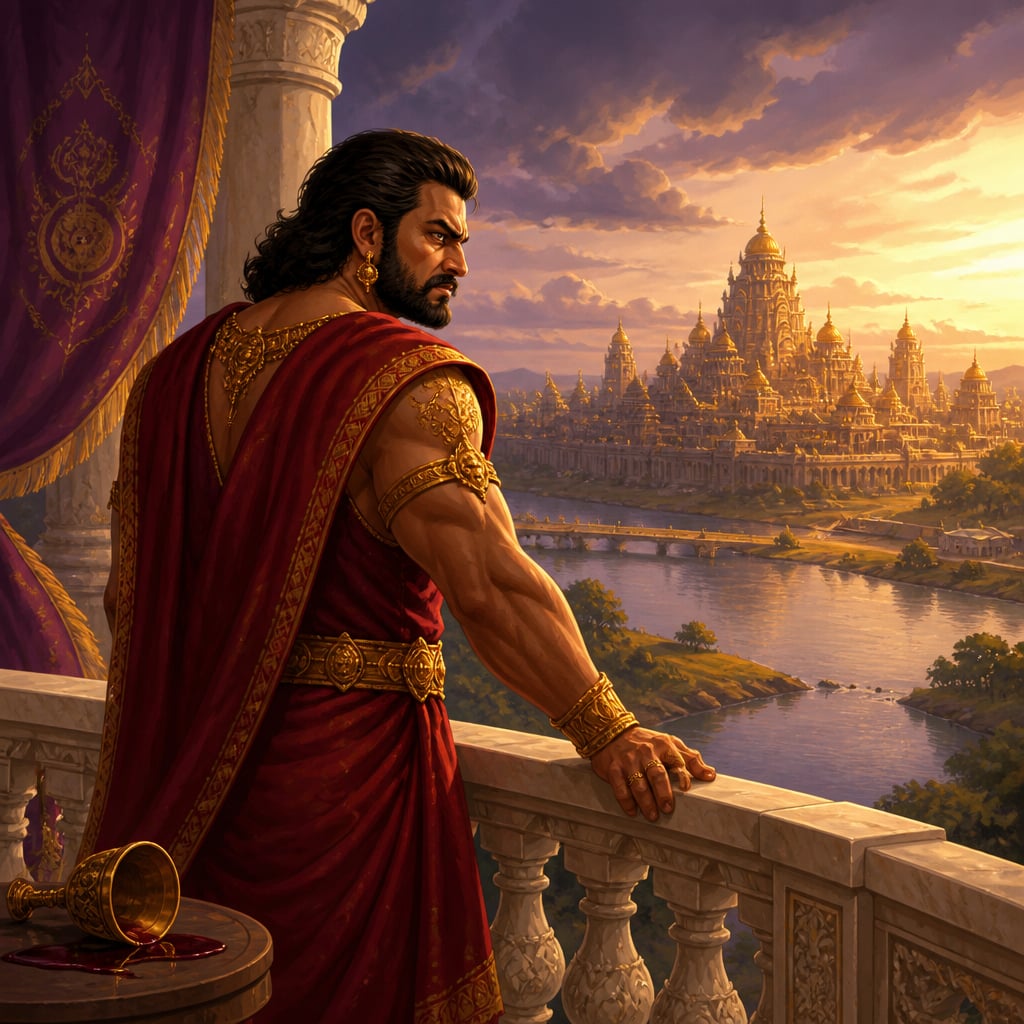
Duryodhana gazing enviously at Indraprastha from balcony

Duryodhana stood at the edge of his fate. His blind father, King Dhritarashtra, had just announced the division of the Kuru kingdom: half to the Kauravas, half to the Pandavas. By any measure, Duryodhana had won. He retained the prosperous heartland of Hastinapura while his cousins received the wilderness of Khandavaprastha.

But Duryodhana was not satisfied. He could not be satisfied.

"That half-kingdom burns me," he told his uncle Shakuni. "As long as they have anything, I have nothing."

What followed is recorded in the Mahabharata as one of history's greatest tragedies. The rigged dice game. The humiliation of Draupadi. Thirteen years of exile for the Pandavas. And then, the war that killed 1.8 million warriors in eighteen days.

All because one man who had more than enough could not stop wanting more.

The Isha Upanishad has a word for this: gridhah (गृधः), covetousness, the vulture-like grasping for what belongs to others. And its warning is stark:

मा गृधः कस्यस्विद्धनम्

Mā gṛdhaḥ kasya svid dhanam

"Do not covet anyone's wealth."

The Anatomy of Covetousness

Gridhah is not the same as wanting wealth. The Upanishads never condemn the desire for prosperity, artha is a legitimate purushartha. The problem isn't wanting more; it's wanting what belongs to someone else.

Consider the psychology. When you covet, you make a fundamental error: you assume wealth is zero-sum. If they have it, I don't. If I want more, they must have less. This assumption transforms every relationship into a competition, every transaction into a battle, every success around you into a personal failure.

Duryodhana couldn't celebrate his own kingdom because his cousins had a kingdom too. Their prosperity felt like his poverty. Their existence felt like his erasure.

This is the gridhah trap: even abundance feels like scarcity when you measure yourself against others. You could have everything and still feel impoverished because someone, somewhere, has something you don't.

The Vulture Mind

Solitary vulture circling a dusk forest clearing

The Sanskrit word gṛdhra means vulture, and the connection is instructive. The vulture doesn't hunt; it waits for others to die so it can feed on their remains. The covetous person doesn't create; they scheme to acquire what others have built.

Duryodhana never built Indraprastha, the Pandavas did, transforming wilderness into a jeweled city that made visiting kings gasp. Duryodhana's response? Not inspiration but envy. Not "How can I build something like that?" but "How can I take that from them?"

The dice game was his answer. Win by trickery what he couldn't win by creation.

This is gridhah's signature: it destroys productive energy. Instead of building, you scheme. Instead of creating, you plot acquisition. Instead of expanding the pie, you try to take others' slices.

Global Perspectives on Covetousness

Adam Smith (1723-1790) famously argued in The Wealth of Nations that self-interest, channeled through markets, produces public good, the "invisible hand." But Smith was equally concerned about what he called "rapacity", greedy behavior that extracted value rather than creating it.

Smith distinguished between productive self-interest (the baker who bakes good bread to earn a living) and destructive covetousness (the monopolist who manipulates markets to extract rents). The Upanishadic distinction between artha (legitimate wealth-seeking) and gridhah (covetous grasping) parallels this.

René Girard (1923-2015), the French philosopher, developed an entire theory of "mimetic desire", the idea that we don't want things for their own sake but because others want them. Girard argued that this imitative desire is the root of human violence: we fight not over scarce resources but over prestige objects that become valuable precisely because rivals desire them.

Duryodhana didn't want Indraprastha for its own sake, he wanted it because the Pandavas had it. The object of desire was created by the rivalry itself.

Bernie Madoff (1938-2021) represents gridhah in modern finance. His Ponzi scheme wasn't born of necessity, Madoff was already wealthy and respected. But he couldn't stop. The $65 billion fraud that destroyed thousands of families emerged from a covetousness that no amount of legitimate success could satisfy.

Figure Form of Gridhah Destruction Caused
Duryodhana Kingdom envy Civilizational war, 1.8 million dead
Madoff Wealth accumulation beyond need $65B fraud, suicides, family destruction
Girard's analysis Mimetic desire Violence emerges from rivalry, not scarcity

The Vijay Mallya Parable

Fallen tycoon at an abandoned airline boardroom

In 2005, Vijay Mallya was the "King of Good Times", owner of India's largest spirits company, an airline, an IPL cricket team, a Formula One team. His yacht parties were legendary. His wealth was estimated at $1.5 billion.

But Mallya couldn't stop acquiring. Kingfisher Airlines, launched in 2005, became a vehicle for expansion funded by debt rather than profit. Banks lent ₹9,000 crore ($1.1 billion) based on Mallya's reputation and promises.

The psychology was pure gridhah. Mallya wasn't building an airline to serve customers; he was acquiring status symbols, the largest fleet, the best routes, the premium brand, to outcompete rivals. When oil prices rose and competition intensified, Kingfisher collapsed.

But the gridhah continued even in failure. Rather than restructure honestly, Mallya allegedly diverted loan funds to personal accounts and fled India in 2016. He remains a fugitive, his assets frozen, his reputation destroyed.

The contrast with dharmic business leaders is stark. When Tata Steel acquired Corus in 2007 and struggled with debt, Ratan Tata didn't flee or manipulate, he restructured, took losses personally, and eventually stabilized the company. The difference? Tata operated from trusteeship; Mallya operated from covetousness.

The WeWork Warning

Adam Neumann offers another parable of gridhah. WeWork, his co-working company, raised $12 billion on a vision of "elevating the world's consciousness" through office space. Neumann's lifestyle became legendary: $60 million private jet, surfing trips during work hours, tequila in the office.

The company's valuation peaked at $47 billion in January 2019. By October, it had collapsed to $8 billion, the IPO was cancelled, and Neumann was forced out.

What happened? Gridhah. Neumann wasn't satisfied with building a successful real estate company, he wanted to be the next Steve Jobs, the next revolutionary. He coveted not just wealth but a certain image of wealth, a certain status among peers.

The IPO filings revealed the psychology: Neumann had structured the company to benefit himself at shareholders' expense, including a $5.9 million payment to himself for the "We" trademark. When investors finally read the documents, they saw gridhah encoded in the corporate structure itself.

The Antidote: From Gridhah to Mudita

The Buddhist tradition offers a direct antidote to gridhah: mudita, sympathetic joy, the ability to delight in others' good fortune. Where gridhah sees another's success as your failure, mudita sees another's success as cause for celebration.

This isn't sentimental niceness. It's accurate perception.

If you believe wealth is zero-sum, that there's only so much to go around, then others' gains are indeed your losses. But the Upanishadic view, that all wealth is ishavasyam (pervaded by the divine), suggests something different: wealth is generative. One person's prosperity can expand the total, not just redistribute it.

When Infosys succeeded, it didn't impoverish other Indian companies, it demonstrated what was possible and attracted investment to the entire sector. When UPI succeeded, it didn't hurt Paytm, it expanded digital payments for everyone.

Gridhah misses this. It sees a fixed pie and scrambles for slices. Trusteeship sees an expandable pie and asks how to grow it.

Your Turn: The Gridhah Test

Try this experiment: When you next see someone's success, a friend's promotion, a competitor's win, a stranger's achievement, notice your immediate reaction.

The Isha Upanishad's warning, ma gridhah, isn't moralistic finger-wagging. It's practical psychology. Covetousness makes you miserable regardless of how much you have. It turns every relationship into a competition. It redirects creative energy into scheming.

In the next lesson, we'll explore the paradox at the heart of Isha Upanishad's teaching: vairagya-bhoga, the idea that true engagement with wealth requires detachment from it. How can you be fully involved yet psychologically free? How did King Janaka rule a kingdom without being ruled by it?

Game theory distinguishes zero-sum games (where one player's gain equals another's loss) from positive-sum games (where total value can increase). Classical economics argues that voluntary exchange is positive-sum, both parties benefit. Yet behavioral economics shows people often perceive situations as zero-sum even when they're not. Gridhah is the psychological state that imposes zero-sum perception on positive-sum reality.

The Upanishadic teaching addresses the psychology, not just the structure. Even in objectively positive-sum situations, gridhah makes you experience them as zero-sum. The problem isn't 'out there' in market structure but 'in here' in mental orientation. This makes the solution internal (changing perception) rather than external (changing systems).

Research by psychologist Kathleen Vohs found that people primed with money concepts became more self-sufficient but also less helpful to others, even in situations where helping cost nothing. Merely thinking about wealth can trigger zero-sum psychology, validating the Upanishadic concern with mental states.

Escalation of commitment; sunk cost fallacy; moral hazard

Behavioral economics documents 'escalation of commitment', people doubling down on failing strategies rather than cutting losses. The greed chain explains why: initial greed creates frustration (anger) when results don't come, which intensifies desire (I must make this work), produces delusion (this will still work despite evidence), and leads to destruction (catastrophic loss). Madoff's scheme followed this arc precisely.

Western analysis focuses on cognitive biases, how we make mistakes. The Mahabharata's analysis focuses on the emotional chain, how one feeling leads to another. This is more actionable: if you can catch greed early, before it becomes anger and delusion, you can break the chain. The teaching provides a map for early intervention.

Key terms

gṛdha
Covetousness; the greedy desire for what belongs to others; vulture-like grasping
lobha
Greed; excessive desire for accumulation; the inability to be satisfied with enough
muditā
Sympathetic joy; the ability to feel happiness at others' good fortune; the opposite of envy
kasya svid
Of anyone; whoever's; belonging to whomsoever

Key figures

Duryodhana

Vijay Mallya

Bernie Madoff

Case studies

Kingfisher Airlines: The King of Good Times Falls

In 2005, Vijay Mallya was on top of the world. United Breweries dominated Indian spirits with a 60% market share. Mallya owned the Bangalore Royal Challengers (IPL), Force India (Formula One), and a yacht that hosted parties legendary for their excess. He was worth an estimated $1.5 billion. That year, he launched Kingfisher Airlines, India's first 'lifestyle' carrier. The tagline: 'Fly the good times.' Mallya's vision was to create a premium brand that would dominate Indian skies the way his beers dominated Indian bars. But the economics never worked. Aviation in India is brutally competitive, with razor-thin margins, high fuel costs, and price-sensitive customers. Kingfisher hemorrhaged money from the start. Mallya's response? Not retrenchment but expansion. He acquired Air Deccan in 2007 for ₹550 crore, adding low-cost routes that diluted the premium brand while adding losses. Banks, dazzled by Mallya's reputation and lifestyle, lent ₹9,000 crore ($1.1 billion). By 2012, the airline collapsed. Staff went unpaid for months. Aircraft were repossessed. The aviation ministry suspended Kingfisher's license. And Mallya? In 2016, he quietly boarded a flight to London, leaving behind ₹9,000 crore in bank debt. He remains a fugitive.

The Isha Upanishad's warning, ma gridhah, illuminates Mallya's trajectory. First, lobha (greed): Mallya wasn't satisfied with his successful spirits business. He coveted the status of airline magnate, not for profit but for prestige. Second, krodha (anger): When Kingfisher didn't succeed, Mallya didn't reassess. He doubled down, acquiring Air Deccan to prove competitors wrong. Third, moha (delusion): Despite mounting losses, Mallya maintained his lifestyle, the yacht, the parties, the cricket team. He seemingly believed his reputation could substitute for solvency. Fourth, nasha (destruction): The collapse destroyed not just the airline but employees' livelihoods, banks' capital, and ultimately Mallya's freedom. The contrast with dharmic leadership is stark. When Tata Motors faced losses after acquiring Jaguar Land Rover, the Tatas restructured, took pain, and eventually recovered. They operated from trusteeship, the company as responsibility, while Mallya operated from gridhah, the company as status symbol.

The aftermath continues: - ₹9,000 crore in bank loans remain unrecovered - Mallya was declared a fugitive economic offender in 2019, the first under India's new law - Multiple employees committed suicide over unpaid wages - The Ed attached ₹9,000 crore of Mallya's assets in India - UK courts approved extradition in 2018, though appeals continue - Mallya's net worth, once $1.5 billion, is now negative by most estimates The 'King of Good Times' became a cautionary tale taught in Indian business schools. His name is now synonymous with debt-fueled excess and corporate governance failure.

Gridhah doesn't stop at 'enough.' Mallya had enough, wealth, status, success in his core business. But gridhah drove him to covet the status of airline magnate, to compete with rivals in a game he didn't need to play. The Isha Upanishad's 'ma gridhah' is a warning against exactly this: the covetousness that turns plenty into poverty.

The pattern of successful entrepreneurs destroying personal wealth by expanding into unfamiliar industries persists in headlines, from Elon Musk's Twitter acquisition to crypto founders diversifying recklessly. Each case illustrates that the discipline required to build wealth in one domain does not automatically transfer to another.

Of the ₹9,000 crore Kingfisher owed banks, only ₹1,300 crore has been recovered as of 2024, a recovery rate of less than 15%. The remaining debt represents a permanent loss to Indian public sector banks and their depositors.

Historical context

Mahabharata Period and Upanishadic Era

The concept of gridhah developed in a prosperous society grappling with questions of wealth distribution, rivalry, and legitimate versus illegitimate acquisition. The Mahabharata's treatment of Duryodhana isn't about poverty, he was rich, but about the psychology of never having enough. This emerged from a culture wealthy enough to observe that abundance doesn't cure covetousness.

The Ten Commandments include 'Thou shalt not covet.' Buddhist teaching identifies craving (tanha) as the root of suffering. The universality of warnings against covetousness suggests cultures worldwide observed the same psychological pattern. The Indian contribution is the systematic analysis of how gridhah destroys, the chain from lobha to nasha.

The Kurukshetra War traditionally killed 1.8 million warriors in 18 days, nearly an entire generation. Whether historical or mythological, the number encodes the teaching: gridhah's consequences are civilizational, not just personal.

Understanding gridhah as the ancients described it, not just greed for more, but specifically coveting what others have, illuminates modern phenomena from corporate espionage to market manipulation to colonial extraction. The psychology is consistent across millennia.

Reflection

More in Isha Upanishad: Wealth & Detachment

All lessons in Isha Upanishad: Wealth & Detachment · Dharmic Economics course