Wealth Inequality Through a Dharmic Lens
When Difference Becomes Disparity
Wealth inequality is perhaps the most contested question in economics. Does dharma demand equal outcomes or equal opportunity? This lesson explores the nuanced dharmic framework: inequality from different contributions may be natural, but inequality that denies dignity or opportunity violates dharma.
The Kitchen That Feeds Two Million Children
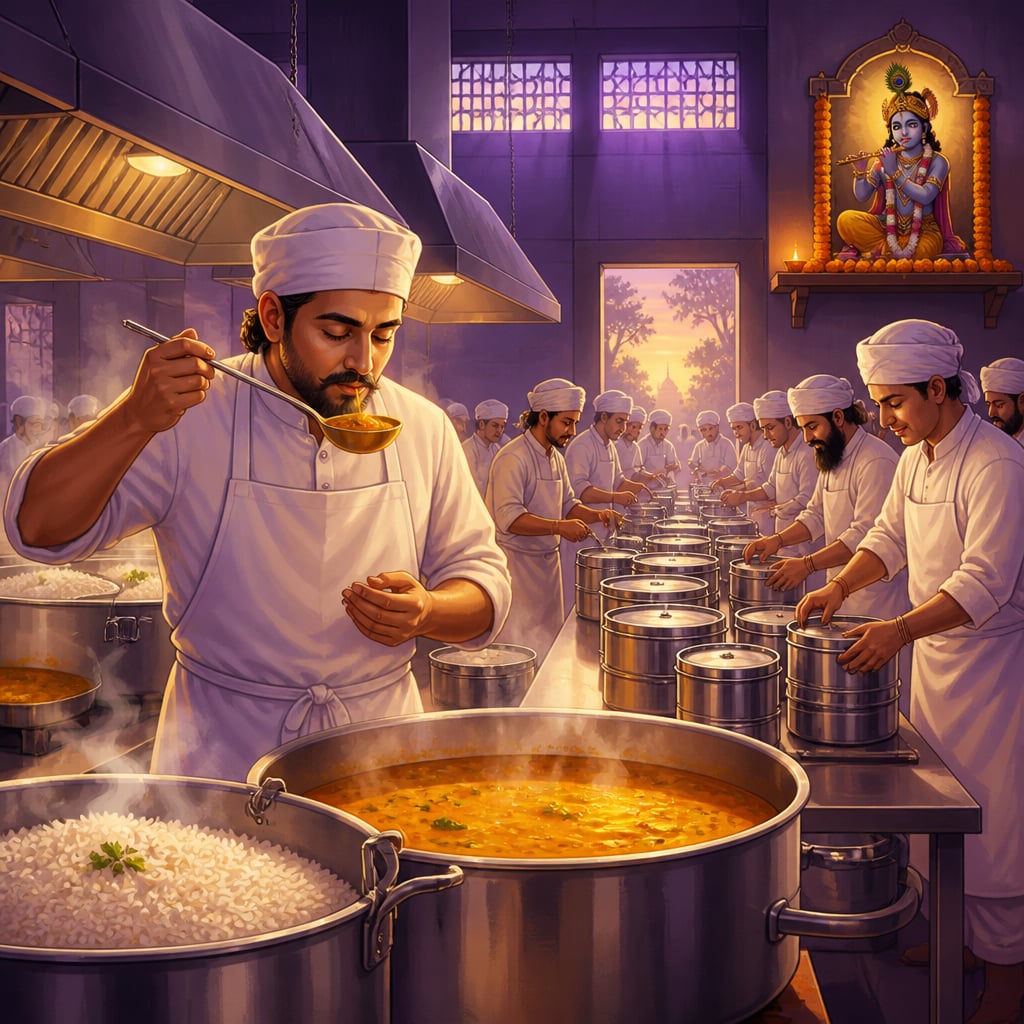
Every morning before dawn, the Akshaya Patra Foundation's kitchens roar to life. By 9 AM, they will have prepared fresh, hot meals for over 2 million children across India, the world's largest school lunch program run by a non-governmental organization.
The scale is staggering: 67 centralized kitchens, 24,000+ schools, 22 states and union territories. A single kitchen in Bengaluru produces 180,000 meals daily using assembly-line efficiency that would impress any manufacturing engineer.
But here's what makes Akshaya Patra significant for understanding wealth inequality: it addresses not just hunger but opportunity. Research shows that children who receive mid-day meals attend school more regularly, concentrate better, and achieve higher educational outcomes. A meal becomes a ladder, transforming inequality of circumstance into opportunity for advancement.
The foundation was started in 2000 by ISKCON devotees, funded initially by Infosys Foundation. Today it operates with donations from individuals, corporations, and government matching funds. Wealthy donors fund meals; children receive nourishment and opportunity. This is dharmic redistribution in action, not forced equality, but voluntary sharing that expands capability.
The Ancient Framework: Karna's Generosity
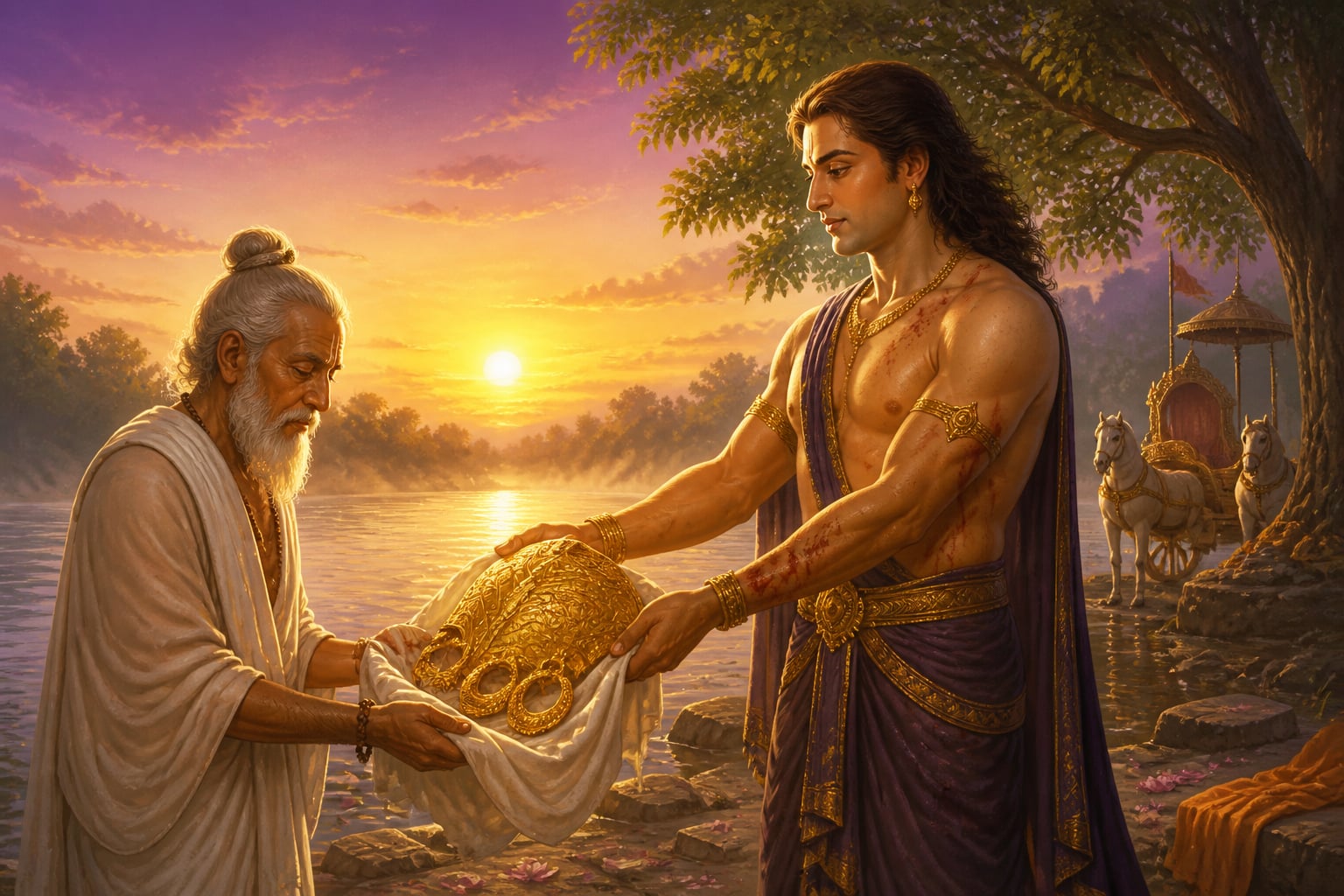
Karna in the Mahabharata embodies dharmic thinking about wealth and generosity. Born to Kunti but raised as a charioteer's son, Karna experienced inequality's sting, denied recognition, excluded from opportunities available to those of "proper" birth.
Yet Karna became legendary for dana (generosity). He was called Daanveer Karna, the hero of giving. His commitment was absolute: anyone who asked at the right time would not be refused. Even when Indra, disguised as a Brahmin, asked for Karna's divine armor (which protected his life), Karna gave it away.
The Mahabharata's teaching through Karna is nuanced:
1. Inequality of circumstance doesn't determine dharmic worth. Karna, born in humble circumstances, achieved greatness through character and action.
2. Generosity is dharma regardless of one's position. Karna gave extravagantly despite having been denied much. Giving wasn't contingent on having received.
3. True generosity gives without calculation. Karna didn't ask whether recipients "deserved" his gifts. He gave because giving was his dharma.
This framework neither demands equal outcomes nor ignores inequality's injustice. It asks: regardless of circumstances, are you fulfilling your dharmic capacity for generosity?
The Principle: Dharmic Inequality vs. Adharmic Inequality
Dharmic economics doesn't demand perfect equality, a position that would contradict the recognition of different roles, capacities, and contributions. But it sharply distinguishes between dharmic inequality and adharmic inequality:
Dharmic Inequality:
- Results from different efforts, skills, or contributions
- Doesn't deny dignity to those with less
- Maintains mobility, those who develop skills can advance
- Comes with obligations: greater wealth means greater responsibility for others
- The wealthy person remains accountable to dharma
Adharmic Inequality:
- Results from exploitation, extraction, or rigged systems
- Denies dignity or basic needs to those at the bottom
- Creates permanent barriers, birth determines destiny
- Comes with no obligations: wealth as pure entitlement
- The wealthy extract without giving back
The Mahabharata's Shanti Parva is explicit: a king (or by extension, any wealthy person) who accumulates while subjects lack basic needs violates raja-dharma. Wealth concentrated while others starve is theft, regardless of how "legally" it was acquired.
Arthasya moolam dharma "The root of wealth is dharma."
Wealth accumulated through adharma, exploitation, deception, denial of fair wages, is not legitimate wealth. And legitimate wealth carries obligations.
Global Perspectives on Inequality
Western economics has grappled with inequality through various frameworks, some converging with dharmic insights:
Amartya Sen (1933-present) developed the Capability Approach, arguing that inequality should be measured not by income alone but by people's ability to live lives they value. What matters isn't equal wealth but equal capability, access to education, health, opportunity. The dharmic parallel: Sen's framework echoes dharmic emphasis on dignity and opportunity over mere material equality. A society where all can develop their potential is more dharmic than one with mathematical equality but suppressed capabilities.
Thomas Piketty (1971-present) documented in Capital in the Twenty-First Century how wealth concentrates when returns on capital exceed economic growth (r > g). Without intervention, inequality compounds across generations. The dharmic parallel: Piketty's analysis confirms what dharmic texts warn, wealth without redistribution mechanism concentrates indefinitely. The dharmic response: dana (giving) and structural sharing (like Tata Trusts' ownership model) as counter-forces.
John Rawls (1921-2002) proposed the "veil of ignorance": just arrangements are those we'd choose not knowing our position in society. His Difference Principle allows inequality only if it benefits the least advantaged. The dharmic parallel: Rawls' thought experiment echoes dharmic recognition that karma determines birth circumstances, since we don't choose our starting point, systems should ensure dignity for all positions.
| Western Thinker | Key Insight | Dharmic Parallel |
|---|---|---|
| Amartya Sen | Capability over income equality | Dignity and opportunity as dharmic requirements |
| Thomas Piketty | Wealth concentrates without redistribution | Dana (giving) as structural necessity |
| John Rawls | Justice as fairness behind "veil of ignorance" | Karma means we don't choose birth; dharma requires dignity for all |
Modern Resonance: India's Philanthropic Revolution

Shiv Nadar, founder of HCL Technologies, exemplifies dharmic wealth stewardship. Worth over $30 billion, he has committed the majority to philanthropy through the Shiv Nadar Foundation, focusing on transformational education.
Nadar's approach is strategic: rather than scattering donations, he's built institutions, Shiv Nadar University, VidyaGyan schools for rural meritorious students, and the Shiv Nadar School chain. His philosophy: "Transformative education is the most impactful tool for addressing inequality."
What makes this dharmic:
- Structural intervention: Building institutions that outlast the founder
- Capability focus: Education creates capability, not dependency
- Long-term thinking: Investing in generations, not just immediate relief
- Personal involvement: Nadar actively engages, not just writes checks
India's broader philanthropic landscape is transforming:
- Azim Premji pledged $21 billion (83% of wealth) to his foundation, the largest philanthropic commitment in Indian history
- Rohini Nilekani funds civic infrastructure and gives unconditionally
- Tata Trusts own 66% of Tata Sons, ensuring profits serve philanthropy by structure
- India's overall giving: Growing 12-15% annually, reaching $14 billion in formal philanthropy
This isn't charity as guilt relief, it's dharmic obligation recognized and acted upon.
The Practice: What Dharma Demands at Different Wealth Levels
Dharmic economics doesn't demand identical behavior from everyone, it scales obligations with capacity:
For Those With Modest Means:
- Give what you can without harming your own stability
- Shukraniti suggests 1/10th (dashamsha) as baseline
- Non-monetary giving counts: time, skills, kindness
- Support local: your neighbor, your community
For the Middle Class:
- Build giving into financial planning, not afterthought
- Consider impact: where does your giving create most capability?
- Avoid "convenient" giving that makes you feel good but doesn't help
- Engage directly when possible, relationship matters
For the Wealthy:
- Giving is not optional, it's dharmic obligation
- Think structural: build institutions, not just fund programs
- Consider systemic issues: why does this need exist?
- Pledge formally: Giving Pledge, Daan Utsav commitments
- Involve family: create culture of giving across generations
For All:
- Don't give to feel superior, give because dharma requires it
- Receiving with dignity is also dharmic, don't humiliate recipients
- Work to change systems that create unnecessary inequality
- Remember: wealth is temporary; dharma is eternal
The Hard Questions
Dharmic economics doesn't provide easy answers to inequality's hardest questions, but it offers a framework for thinking:
Is billionaire wealth inherently adharmic? Not necessarily, if earned through genuine value creation, not extraction; and if accompanied by genuine giving and systemic contribution. A billionaire who employs thousands fairly, pays taxes, and gives substantially may be more dharmic than someone with modest wealth who hoards and exploits.
Should government force redistribution? Dharmic texts favor voluntary giving (dana) over forced taking. But they also recognize raja-dharma, the ruler's duty to ensure no one lacks basic needs. A dharmic state creates conditions for prosperity AND ensures floors below which no one falls. How to implement this involves prudential judgment, not simple prescription.
What about inherited wealth? Karma suggests we don't choose our birth circumstances, some inherit wealth, some inherit poverty. This doesn't make inheritance wrong, but it does obligate inheritors. Wealth you didn't earn carries even stronger dharmic obligations than wealth you created.
Your Turn: The Inequality Audit
Reflect on your own position in the inequality landscape:
1. How did you get here? What combination of effort, luck, inherited advantage, and systemic support created your current position? Honest assessment prevents both guilt and entitlement.
2. What's your capacity for giving? Not just money, time, skills, attention, care. Are you giving at your dharmic capacity, or finding excuses?
3. What systems do you benefit from or perpetuate? Do you employ people? Pay fair wages? Do your investments support extractive or regenerative enterprises?
4. What would satisfy dharma? Not guilt-driven excess, not self-serving minimums, what would genuinely fulfill your dharmic obligation given your specific circumstances?
Karna gave away his armor knowing it would cost his life. Most of us aren't asked for such sacrifice. But we are asked to give genuinely, proportionally, and without self-congratulation. The Gita's teaching applies: give because it should be given, not for recognition or reward.
In the final lesson, we'll synthesize this entire chapter, asking how dharmic economics applies in 2026 and beyond, as India navigates unprecedented challenges and opportunities.
Western economics often treats inequality as a single phenomenon to be measured and (perhaps) reduced. Dharmic economics distinguishes: inequality from contribution and effort may be natural; inequality from exploitation, inherited privilege, or rigged systems is adharmic.
This distinction offers nuanced policy guidance. Don't flatten all inequality, that would punish effort and innovation. But do address adharmic inequality: exploitation, discrimination, systems that trap generations in poverty. The goal isn't equal outcomes but dharmic processes.
India's wealth inequality is significant (top 10% hold 77% of wealth), but the dharmic question is: how much results from value creation vs. extraction? How much from merit vs. birth advantage? These distinctions matter for policy response.
Western philanthropy often celebrates absolute amounts (billionaire gives $100M) over proportional sacrifice (widow gives her last coins). The dharmic approach values proportional commitment, what percentage of capacity, not just what dollar amount.
The dashamansha (10%) baseline scales across income levels, making giving accessible to all. But Karna's example suggests dharmic capacity often exceeds 10%, especially for the wealthy. Azim Premji's 83% pledge approaches Karna-level giving.
Indian philanthropy is growing 12-15% annually, but giving as percentage of GDP remains below Western levels. The gap isn't capacity but commitment. Dharmic revival could unlock trillions in giving potential.
Key terms
- Dana
- Giving; generosity; the dharmic practice of sharing wealth without expectation of return
- Daanveer
- Hero of giving; one renowned for exceptional generosity
- Dashamansha
- One-tenth; the traditional baseline for charitable giving
- Samarthata
- Capability; the capacity to live a life one has reason to value
Key figures
Karna
Warrior, King of Anga, Legendary Donor
Shiv Nadar
Founder of HCL Technologies, Philanthropist, Education Visionary
Amartya Sen
Indian Economist, Nobel Laureate, Philosopher
Case studies
Akshaya Patra: Transforming Hunger into Opportunity
In 2000, ISKCON's Bangalore temple observed that children in nearby government schools were attending irregularly, often because they had no lunch. Some came hungry from morning; others worked instead of studying to earn food money. The devotees began preparing meals for 1,500 children in five schools. The hypothesis: if children received nutritious mid-day meals, attendance and learning would improve. The government's existing mid-day meal program was underfunded and poorly executed in many areas. Infosys Foundation provided initial funding. The model was revolutionary: centralized kitchens using industrial efficiency, achieving costs of Rs. 12-15 per meal while maintaining quality. ISO-certified hygiene. Menu designed by nutritionists. Delivery timed precisely to school lunch periods. The organization grew exponentially: 1,500 children in 2000 became 1 million by 2010, 1.8 million by 2020, and over 2 million by 2024. 67 kitchens now serve 24,000+ schools across 22 states.
Akshaya Patra embodies dharmic response to inequality: **Capability Focus**: Not charity for charity's sake, meals enable education, which creates capability. A child who stays in school has options a hungry child doesn't. **Structural Intervention**: Industrial-scale operations achieve sustainability and impact impossible for small charities. This is professional philanthropy meeting genuine need. **Dignity Preservation**: Meals are served to all children equally, no separation of 'poor' children. No humiliation accompanies the giving. **Multiple Stakeholders**: Government provides matching funds and infrastructure. Donors provide capital. ISKCON provides operational expertise. Children benefit. Everyone contributes according to capacity. This is Karna's unconditional giving operationalized: any child who comes receives. No means testing, no paperwork, no conditions. The meal is provided because it should be provided.
By 2024, Akshaya Patra has achieved remarkable outcomes: **Scale**: 2+ million children fed daily, making it the world's largest NGO-run school meal program. 67 kitchens, 24,000+ schools, 22 states. **Impact**: Studies show 10-30% improvement in school attendance, reduced dropout rates, improved concentration and learning outcomes in program schools. **Efficiency**: Cost per meal of Rs. 12-15, with 85%+ of funds reaching beneficiaries (vs. 60-70% for typical NGOs). **Sustainability**: Diversified funding (government, corporate, individual), professional management, replicable model. **Recognition**: Multiple awards including CNN-IBN Indian of the Year (Public Service), partnerships with state and central governments. The organization has proven that dharmic giving can operate at scale without losing soul, efficiency and compassion combined.
Dharmic response to inequality requires both heart and head. Akshaya Patra succeeds because it combines genuine compassion (no child should study hungry) with operational excellence (industrial kitchens, ISO standards, precise logistics). Scaled giving requires professional execution, but execution without dharmic intent produces bureaucracy, not transformation.
As governments worldwide struggle with school attendance and childhood nutrition, Akshaya Patra's integrated model of feeding children to keep them learning has attracted partnerships with state governments across India and international development agencies. The organization's growth from 1,500 to 2+ million daily meals demonstrates that dharmic motivation can drive operational scaling that rivals government programs.
Akshaya Patra serves 2+ million meals daily at Rs. 12-15 per meal with 85%+ efficiency, demonstrating that dharmic giving can achieve world-class operational standards while maintaining compassionate purpose.
Historical context
Mahabharata Era to Present
India has simultaneous extremes: billionaires multiplying rapidly AND millions lacking basic needs. Ancient dharmic framework recognized this tension, raja-dharma required ensuring floors below which none fell, while allowing prosperity for those who created value. Modern India is rediscovering this balance through renewed philanthropic commitment.
Western philanthropy emerged from religious tithing (Christianity) and noblesse oblige, later institutionalized through foundations (Carnegie, Rockefeller). Indian dharmic philanthropy has parallel roots (dana, dashamansha) but is now being reinstituted at scale matching or exceeding Western levels.
India's top 100 philanthropists gave Rs. 22,000 crore in 2023, growing 59% year-over-year. The philanthropic revolution is accelerating, though still below potential given India's wealth concentration.
How India addresses inequality will shape its future. Pure redistribution risks disincentivizing creation; pure laissez-faire risks permanent underclass. The dharmic framework offers a third way: celebrate value creation, obligate sharing, ensure dignity, build capability. This requires both policy and culture, government and voluntary giving working together.
Reflection
- Karna gave away his divine armor knowing it would lead to his death. Most of us aren't asked for such sacrifice. But we are asked to give at our genuine capacity. Reflect: what is your true giving capacity, not what's convenient, but what's actually possible? What holds you back from giving at that level?
- Audit your position in the inequality landscape. What advantages do you have that you didn't earn (birth circumstances, inherited resources, systemic benefits)? What disadvantages have you faced? How might you use unearned advantages to create opportunity for others facing unearned disadvantages?