Paryavaran-Dharma: ESG Through an Ancient Sustainability Lens
When Ancient Forests Taught Modern Boardrooms
Millennia before ESG ratings existed, dharmic traditions encoded sophisticated environmental and social governance principles. This lesson explores how the Vedic concept of Paryavaran-Dharma (environmental duty) anticipated modern sustainability frameworks, offering deeper philosophical grounding for today's impact investing and corporate responsibility movements.
The Dying River That Changed a Company
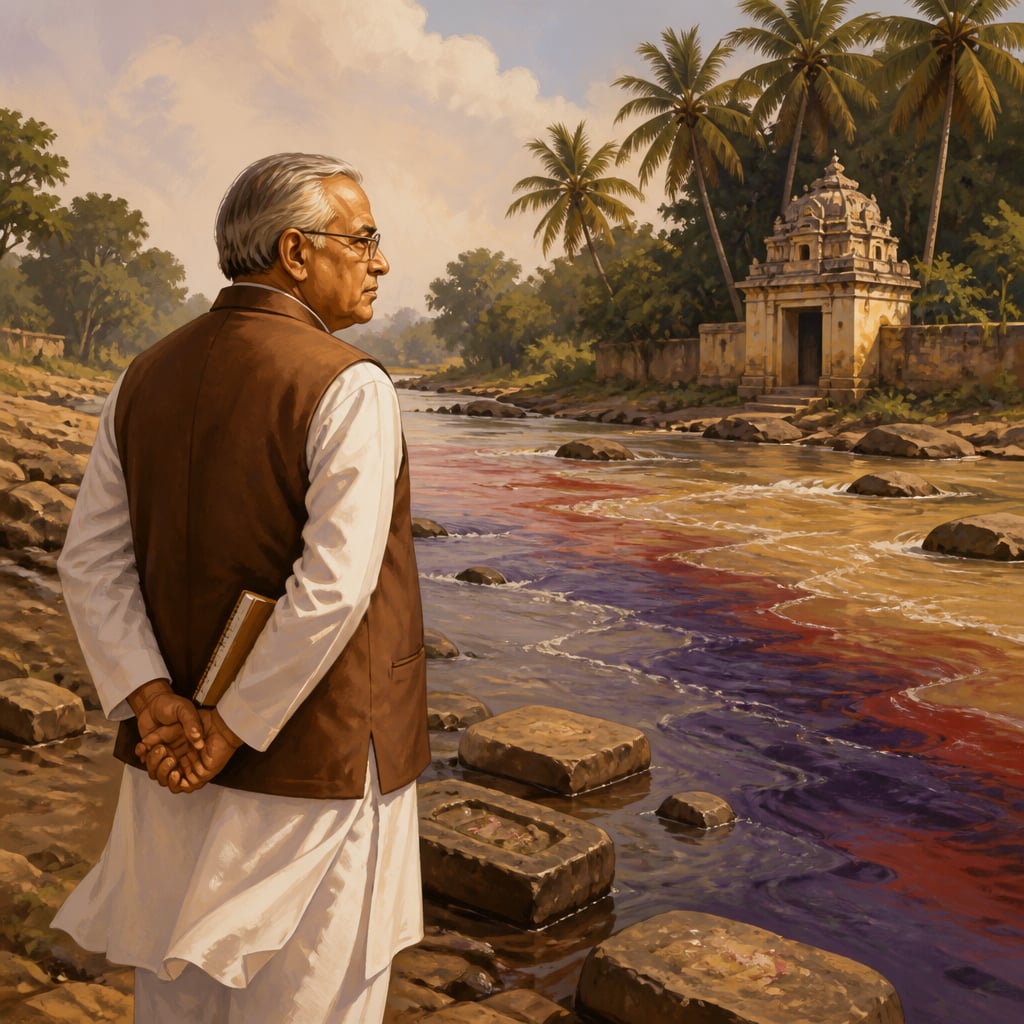
In 2002, Y.C. Deveshwar stood at the banks of the Noyyal River in Tamil Nadu, watching textile effluents poison what had once been a lifeline for 30 villages. As Chairman of ITC Limited, he could have dismissed this as someone else's problem. Instead, he asked a question that would transform one of India's largest conglomerates: What would it mean to give back more than we take?
This wasn't Western CSR thinking. Deveshwar was drawing on something far older, the dharmic principle that prosperity extracted from nature creates a debt that must be repaid. Within two decades, ITC's watershed programs would make the company water-positive, returning twice as much water to the earth as it consumed. But the wisdom enabling this transformation was written 3,000 years before the first ESG report.
The Ancient Covenant: Nature as Sacred Trust
The Rig Veda (c. 6000-1500 BCE) didn't speak of "environmental protection", it spoke of Paryavaran-Dharma, the sacred duty toward one's surroundings. The Prithvi Sukta (Atharva Veda 12.1) declares:
Mata Bhumih Putroham Prithivyah "Earth is my mother; I am her son."
This wasn't poetry, it was law. The Arthashastra (c. 300 BCE) prescribed fines of 1,000 panas for cutting sacred groves and established Abhayaranya (sanctuaries) where no creature could be harmed. Kautilya understood what modern economists call "ecosystem services", that forests prevent floods, regulate water, and sustain agriculture.
The Mahabharata's Anushasana Parva records Bhishma's teachings to Yudhishthira on governance, where he explicitly connects environmental stewardship to political legitimacy: a king who exhausts the land forfeits his moral authority to rule. This wasn't sentiment, it was statecraft.
The Principle: Yagna and the Economics of Reciprocity
The Bhagavad Gita (3.10-12) introduces a concept that anticipates modern circular economics:

Sahayajnah prajah srishtva purovaca prajapatih Anena prasavishyadhvam esha vo'stv ishtakamdhuk
"Having created humanity along with sacrifice, the Creator said: By this shall you prosper; let this be your wish-fulfilling cow."
The word yagna is usually translated as "sacrifice," but its economic meaning is closer to "reciprocal exchange." The Gita's point is precise: prosperity comes not from extraction but from contribution. The one who consumes without giving back, stena eva sa uchyate, is called a thief.
This maps directly onto ESG's three pillars:
- Environmental (E): Paryavaran-Dharma, duty to surroundings
- Social (S): Sarva-Bhuta-Hita, welfare of all beings
- Governance (G): Raja-Dharma, ethical leadership accountable to all stakeholders
Global Perspectives on Sustainability
While dharmic frameworks encoded these principles millennia ago, the modern West arrived at similar conclusions through different paths:
John Elkington (1949-present) coined the "Triple Bottom Line" in 1994, People, Planet, Profit. His insight was that companies must account for social and environmental costs, not just financial returns. The dharmic parallel: the Arthashastra's insistence that a king's treasury (kosha) must be built without depleting the realm's natural or human capital.
Rachel Carson (1907-1964) shocked America with Silent Spring (1962), exposing how pesticides cascaded through ecosystems. Her systems thinking, that harming one element harms all, echoes the Vedic concept of Rita, the cosmic order connecting all phenomena. Where Carson warned of disrupting nature's balance, the Vedas called it violating dharma.
E.F. Schumacher (1911-1977) went further in Small Is Beautiful (1973), explicitly drawing on Buddhist economics to argue that production should minimize resource consumption while maximizing human dignity. His critique of GDP growth mirrors the dharmic distinction between artha (meaningful wealth) and lobha (accumulation driven by greed).
| Western Thinker | Key Insight | Dharmic Parallel |
|---|---|---|
| John Elkington | Triple Bottom Line | Trivarga (Dharma-Artha-Kama balance) |
| Rachel Carson | Ecosystem interdependence | Rita (cosmic interconnection) |
| E.F. Schumacher | Sufficiency over growth | Aparigraha (non-hoarding) |
The dharmic advantage: these weren't new theories requiring proof, they were inherited wisdom encoded in everyday practice for millennia.
Modern Resonance: India's Green Giants
In December 2024, India's ESG-focused mutual funds crossed Rs. 12,000 crore in assets under management, a tenfold increase from 2020. But the real story isn't the numbers; it's why Indian companies are outperforming on sustainability metrics.

ITC Limited achieved carbon-positive status in 2023, sequestering twice the emissions it generates. Its watershed programs have created cumulative water harvesting potential of 52 trillion liters, benefiting over 2.1 million people across 29,000 villages. This isn't charity; it's the yagna principle operationalized. ITC sources agricultural inputs from the communities it hydrates, creating circular value chains the Arthashastra would recognize.
Tata Group's Tata Climate Finance Summit (2024) committed $15 billion to renewable energy by 2030. When asked why Tata consistently outspends competitors on sustainability, executives cite the founder's 1868 principle: "In a free enterprise, the community is not just another stakeholder, it is the very purpose of its existence." This is Sarva-Bhuta-Hita in corporate charter form.
Infosys became India's first major company to achieve carbon neutrality in 2020, a decade ahead of most global competitors. Co-founder Nandan Nilekani frames it simply: "Sustainable is the only kind of business that's actually sustainable."
Your Turn: The Dharmic Investor
Here's what separates dharmic ESG thinking from Western box-ticking: intention matters. A company that reduces emissions to avoid fines is practicing compliance. A company that reduces emissions because Paryavaran-Dharma is encoded in its culture is practicing dharma, and research shows it performs better long-term.
The next time you evaluate an investment, business decision, or career choice, ask: Does this create debt to nature and society, or does it repay? The Gita's framework is simple: takers diminish, givers multiply.
In the next lesson, we'll explore how this same principle extends to stakeholders, why dharmic economics insists that every participant in an enterprise deserves consideration, not just shareholders. The yagna of business involves everyone at the table.
Western economics traditionally treated environmental and social costs as 'externalities', real costs not reflected in prices. Only since the 1990s has mainstream economics seriously grappled with internalizing these costs through carbon taxes, pollution permits, and ESG mandates.
Dharmic economics never separated these costs. The yagna principle assumes all extraction creates debt. This prevents the externality problem at the conceptual level, you can't ignore costs you believe you're morally obligated to repay.
Companies in the top ESG quartile outperformed the bottom quartile by 4.8% annually over 20 years (MSCI research, 2023), suggesting the 'yagna premium' is real and measurable.
Stakeholder capitalism and long-term value creation
Milton Friedman's 1970 doctrine, 'the business of business is business', defined shareholder primacy for decades. Only recently has stakeholder capitalism (championed by Klaus Schwab, Larry Fink's BlackRock letters) gained mainstream acceptance.
Gandhi explicitly cited this verse as the basis for his trusteeship model. The Tata Group's 1868 founding principle, community as purpose, not just stakeholder, operationalized this millennia-old teaching. Indian businesses practicing trusteeship outperform extractive models across decades.
Key terms
- Paryavaran-Dharma
- Environmental duty; the sacred responsibility toward one's natural surroundings
- Yagna
- Sacred reciprocal exchange; contribution that creates and sustains cosmic and social order
- Abhayaranya
- Sanctuary of fearlessness; protected forest where no creature may be harmed
- Rita
- Cosmic order; the fundamental principle of natural law that connects all phenomena
Key figures
Bhishma
Grand Patriarch and Teacher of Governance
Nandan Nilekani
Co-founder of Infosys, Architect of Aadhaar, Technology Visionary
John Elkington
British Management Consultant, Author, Sustainability Pioneer
Case studies
ITC's Watershed Revolution: Making a Corporation Water-Positive
In 2001, ITC Limited faced a problem: its agricultural supply chain in drought-prone regions was increasingly unreliable. Conventional business logic suggested diversifying suppliers or investing in irrigation for contracted farmers. Instead, Chairman Y.C. Deveshwar chose a radically different path. ITC launched the Integrated Watershed Development Programme across India's most water-stressed districts. The company didn't just build check dams and percolation tanks, it partnered with 29,000+ villages, training communities in water harvesting, soil conservation, and sustainable agriculture. The investment was massive: over Rs. 2,000 crore across two decades. The results defied conventional ROI calculations. By 2023, ITC's watershed programs had created cumulative water harvesting potential of 52 trillion liters, benefiting 2.1 million people. The company achieved 'water positive' status, returning 2.3 times more water to nature than it consumes. Meanwhile, agricultural productivity in program areas increased 40-50%, securing ITC's supply chain far more effectively than any conventional procurement strategy.
ITC's approach exemplifies the yagna principle in corporate form. Rather than extracting water for its own use while ignoring community depletion, ITC invested in regenerating the resource base for all stakeholders. This is Paryavaran-Dharma operationalized: the company treated water not as an input to be purchased but as a shared trust to be replenished. Conventional Western economics would calculate ITC's watershed investment as a cost, charitable spending that reduces shareholder returns. Dharmic economics recognizes it as yagna, reciprocal contribution that generates compounding returns across stakeholders. The Arthashastra's principle applies: the king (or company) that protects water sources will find prosperity sustained; the one that depletes them courts ruin.
ITC's stock price increased 8x from 2001-2023, dramatically outperforming peers. The company consistently ranks among India's most respected corporations. More importantly, ITC's supply chain resilience now significantly exceeds competitors, while others struggle with climate-induced agricultural volatility, ITC's watershed investments have created a regenerative ecosystem. The business case is now undeniable: ITC's watershed program delivers an estimated Rs. 3 return for every Rs. 1 invested, before counting reputational value, regulatory goodwill, and long-term climate resilience.
The yagna principle isn't charity, it's superior economics. Companies that regenerate their resource base outperform those that extract and deplete. ESG isn't a constraint on profit; it's the path to durable profit.
As corporate ESG commitments face skepticism for being performative, ITC's water-positive status stands out as a measurably verified achievement. The company's model of regenerating natural resources as core business strategy, rather than offsetting damage through separate programs, offers a template for genuine corporate sustainability.
ITC returns 2.3x more water to nature than it consumes, while its agricultural supply chain shows 40-50% higher productivity than regional averages.
Historical context
Vedic to Classical Period (c. 6000 BCE - 300 BCE)
Ancient India's economy was overwhelmingly agricultural, making water, forests, and soil fertility matters of civilizational survival. The sophisticated environmental regulations in texts like the Arthashastra reflect hard-won wisdom from managing complex ecosystems across diverse climates. Sacred groves (often called 'dev vans' or 'oran') protected watersheds; village tanks (eris) enabled water management; forest reserves ensured timber and wildlife sustainability.
While ancient Mesopotamia and Egypt also developed irrigation systems, their environmental approach was largely utilitarian. The dharmic framework uniquely embedded ecological relationships in spiritual and ethical terms, creating cultural constraints on exploitation that pure utilitarianism cannot provide. Rome's Mediterranean deforestation contrasts sharply with India's preserved sacred groves.
The Arthashastra mandates that 1/6th of forest land must be preserved as Abhayaranya (protected sanctuary), a conservation ratio that modern ecologists consider near-optimal for maintaining ecosystem services.
These ancient frameworks prove that sustainability isn't a modern invention requiring external enforcement, it can be culturally embedded and self-sustaining when properly integrated with spiritual and ethical systems. Modern ESG frameworks attempt to recreate through regulation what dharmic cultures achieved through values.
Reflection
- The Gita calls one who consumes without giving back a 'thief' (stena). In what areas of your life might you be 'stealing' from nature, community, or future generations, consuming without reciprocating?
- If you applied the 'trusteeship' principle to one major asset or resource you control (money, property, authority, skills), what would you do differently this week?