Swadeshi vs Globalization: The Dharmic Balance

Self-Reliance in an Interconnected World

Dharmic economics values both swadeshi (self-reliance) and global exchange. Ancient India was simultaneously deeply rooted and globally connected, trading across continents while maintaining civilizational identity. This lesson explores the dharmic framework for balancing local resilience with global engagement.

The Baba Who Challenged Multinationals
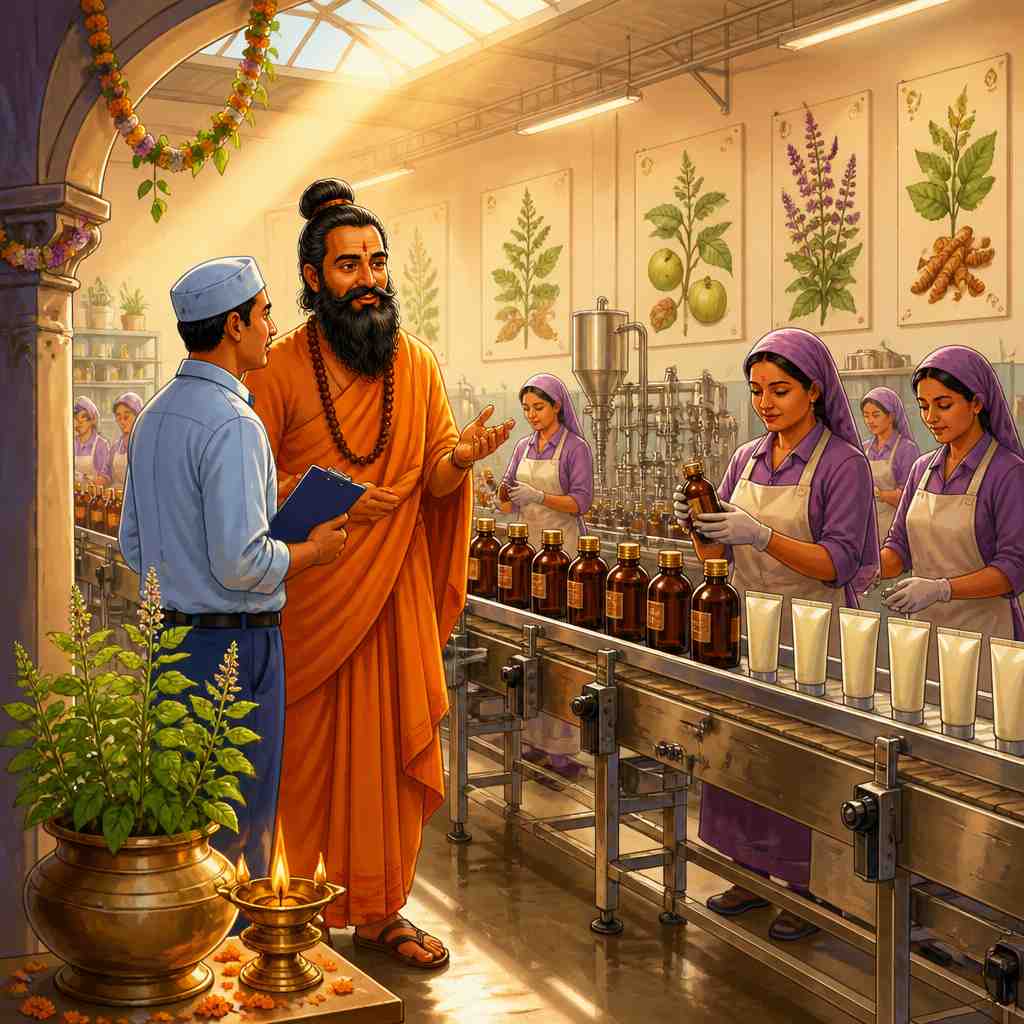
Baba Ramdev on a Patanjali manufacturing floor

In 2006, Ramdev launched Patanjali Ayurved with a simple premise: why should Indians buy foreign toothpaste when Ayurveda offered superior alternatives? The business world scoffed. How could a yoga guru with no MBA compete against Colgate, Unilever, and P&G, companies with century-old brands and billion-dollar marketing budgets?

A decade later, Patanjali had crossed Rs. 10,000 crore in revenue, becoming India's fastest-growing FMCG company. Its Dant Kanti toothpaste outsold Colgate in several states. Multinationals scrambled to launch "herbal" and "Ayurvedic" variants.

Patanjali's rise wasn't just business success, it was a cultural statement. The brand explicitly invoked swadeshi: buy Indian, support Indian enterprise, trust Indian knowledge systems. Its products claimed to embody not just quality but identity.

But the story is more complicated than swadeshi triumphalism. Patanjali sources ingredients globally, uses modern manufacturing technology, and operates supply chains that span continents. The "Indian" toothpaste contains elements from worldwide systems. This tension, between swadeshi identity and global integration, is the question dharmic economics must answer.

The Ancient Framework: Traders and Roots
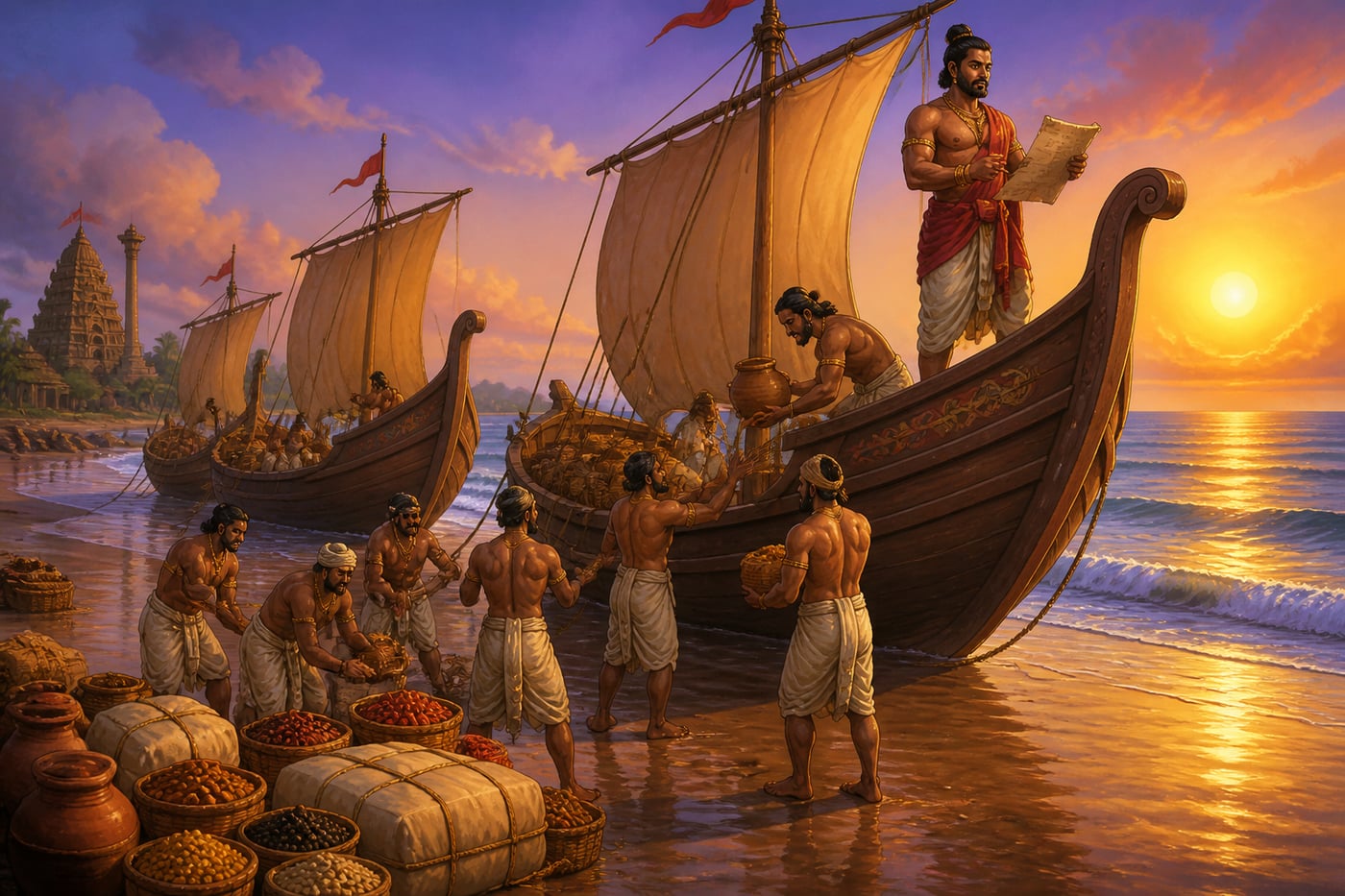
Kalingan merchants loading a trading vessel at dawn

The maritime traders of Kalinga (modern Odisha) offer a nuanced model. For over two millennia, Kalingan sadhavas (merchant-mariners) sailed to Southeast Asia, Indonesia, Sri Lanka, and beyond. They established trade colonies, spread Indian culture, and brought back goods, ideas, and wealth.

But here's what's remarkable: they never lost their roots. The annual Bali Jatra festival (celebrated to this day in Cuttack) commemorates these voyages. Traders would return to Kalinga, contribute to temples and community welfare, and maintain deep connection to their homeland even while operating across oceans.

This wasn't swadeshi as isolation. It was swadeshi as foundation, strong roots enabling global reach. The Kalingan model suggests that self-reliance and global engagement aren't opposites; they're complements.

The Arthashastra takes a similar view. Kautilya advocated for robust international trade while maintaining strategic autonomy:

Anyesham bhumipalanam labdhapurvanam ahitam "What benefits other kings but harms one's own realm should be rejected."

Kautilya wasn't protectionist, he valued trade. But he insisted on viveka (discrimination): trade that strengthens the realm is good; trade that creates dependency is dangerous. The question isn't "global or local?" but "does this exchange strengthen or weaken our foundations?"

The Principle: Swadeshi as Strength, Not Isolation

Gandhi articulated swadeshi most powerfully in the independence movement:

Swadeshi is that spirit in us which restricts us to the use and service of our immediate surroundings to the exclusion of the more remote.

But Gandhi's swadeshi was nuanced. He didn't reject all foreign goods, he rejected dependency on foreign goods, especially when it destroyed local livelihoods. The spinning wheel (charkha) symbolized not technological regression but economic self-determination.

The dharmic framework offers three principles:

1. Swaraj (Self-Rule) Precedes Exchange Before engaging globally, build domestic capacity. A nation (or community) that cannot produce essentials is vulnerable. Kautilya prioritized domestic food security before encouraging export trade.

2. Strategic Autonomy in Critical Sectors Some capabilities should never be outsourced: defense, food, energy, health, education. Dependency in critical sectors creates vulnerability that no trade advantage compensates.

3. Global Engagement from Strength Once foundations are secure, global trade creates prosperity. The Kalingan traders engaged globally because they had strong roots, not despite them.

This framework is neither protectionist nor naively globalist. It asks: in each sector, are we engaging from strength or creating dependency?

Global Perspectives on Globalization

Western economists have increasingly questioned the free-trade consensus, arriving at positions dharmic economics has always held:

Dani Rodrik (1957-present) articulates the "globalization trilemma": nations cannot simultaneously have deep economic integration, national sovereignty, and democratic politics, they must sacrifice one. His insight echoes dharmic concerns: unrestricted globalization may require surrendering swaraj (self-rule). The dharmic response: prioritize swaraj; calibrate globalization to preserve it.

Friedrich List (1789-1846) challenged free-trade orthodoxy with his "infant industry" argument: developing nations need protection to build industrial capacity before competing with established powers. Britain preached free trade only after protecting its industries for centuries. The dharmic parallel: List's argument echoes Kautilya's insistence on building domestic capacity before opening to trade. Swadeshi first, then global engagement from strength.

Ha-Joon Chang (1963-present) documents in Kicking Away the Ladder how today's rich nations used protectionism, subsidies, and state intervention to industrialize, then demanded developing nations abandon these tools. The dharmic parallel: Chang exposes the hypocrisy of "free trade" imposed by the powerful on the developing. Dharmic economics asks: whose interests does this trade arrangement serve?

Western Thinker Key Insight Dharmic Parallel
Dani Rodrik Globalization constrains sovereignty Swaraj must precede unrestricted exchange
Friedrich List Infant industries need protection Build swadeshi capacity before global competition
Ha-Joon Chang Rich nations industrialized through protection Today's "free trade" rules serve incumbents

Modern Resonance: India's Balancing Act

Anand Mahindra inside a Mahindra EV assembly bay

Anand Mahindra embodies the dharmic balance. As chairman of Mahindra Group, he champions "Make in India" while operating globally. His philosophy: build world-class Indian capabilities, then compete globally from strength. Mahindra tractors dominate India and export worldwide, swadeshi foundation, global reach.

Mahindra's approach to electric vehicles illustrates the balance. Rather than simply importing foreign EVs, Mahindra is building indigenous EV capabilities, designing in India, manufacturing in India, developing Indian supply chains. This is swadeshi for the 21st century: not rejecting global technology but ensuring India masters it rather than depending on it.

India's policy framework reflects similar thinking:

The pattern: build domestic strength in strategic sectors, then engage globally from that foundation.

The Patanjali Paradox

Patanjali's story reveals both the power and limits of swadeshi branding.

The Success: Patanjali proved that Indian brands invoking indigenous identity could compete with, and beat, global multinationals. It demonstrated latent demand for products aligned with Indian culture and Ayurvedic tradition. The company created thousands of jobs and channeled consumption toward Indian enterprise.

The Complications: Patanjali's rapid growth outpaced quality control, leading to regulatory issues. Its supply chain includes global components, the "swadeshi" identity is partly branding. Some products were "Ayurvedic" in marketing more than formulation. The company's recent struggles suggest that swadeshi sentiment alone doesn't sustain businesses; execution and quality matter.

The Lesson: Swadeshi is necessary but not sufficient. Identity-based appeal can launch a brand; only genuine quality sustains it. The dharmic framework requires both cultural alignment and excellence, not choosing between them.

Your Turn: Personal Swadeshi

Swadeshi isn't just national policy, it's personal practice. Consider your own consumption and economic engagement:

Where are you dependent? Identify products and services where you have no local alternative. Is this dependency comfortable or concerning?

Where could you choose local? For any given purchase, is there a local alternative? What would it cost (in money, convenience, quality) to choose it?

What's strategic? Which capabilities should your household, community, or nation never outsource? Food? Health knowledge? Skills?

The Kalingan model suggests a personal framework: strong roots enabling global engagement. Build local relationships, support local enterprise, maintain local skills, and engage globally where it enriches rather than depletes.

In the final core lesson, we'll address perhaps the most challenging question in economics: how should dharmic thinking approach wealth inequality? Is inequality always unjust, or does dharma recognize different roles and contributions?

Infant industry protection and strategic trade policy

Friedrich List's 'infant industry' argument, Ha-Joon Chang's historical analysis, and modern industrial policy research all support selective protection for developing industries. Every successful industrializer (Britain, US, Germany, Japan, Korea, China) used protection during development.

India's policy frameworks (PLI schemes, Atmanirbhar Bharat) align with this principle. Building domestic capacity in electronics, pharmaceuticals, and defense before fully opening these sectors follows Kautilyan wisdom. The key insight: temporary protection to build strength, not permanent isolation.

India's pharmaceutical industry, nurtured through strategic policy support, now produces 60% of global vaccine supply and 20% of global generic medicines, swadeshi foundation enabling global leadership.

Globalization from strength vs. globalization from weakness

Successful globalizers (Germany, Japan, Korea) opened to global trade after building domestic industrial strength. Failed globalizers opened prematurely, saw domestic industries destroyed by imports, and became dependent economies.

Key terms

Swadeshi
Of one's own country; the principle of preferring local production and self-reliance over dependency on foreign goods
Swaraj
Self-rule; sovereignty; the capacity to govern oneself without external control
Sadhava
Merchant-mariner; the trader-sailors of ancient Odisha who combined commerce with cultural exchange
Atmanirbharata
Self-reliance; the capacity to meet one's own needs without external dependency

Key figures

Maritime Traders of Kalinga

Merchant-Mariners of Ancient Odisha

Anand Mahindra

Chairman of Mahindra Group, Industrialist

Dani Rodrik

Turkish-American Economist, Harvard Professor

Case studies

Patanjali: Swadeshi Branding Meets Global Reality

In 2006, yoga guru Ramdev and his associate Balkrishna launched Patanjali Ayurved with a provocative premise: Indians should buy Indian products rooted in Indian knowledge systems. The brand explicitly positioned itself against multinational FMCG giants, Colgate, Unilever, P&G, framing purchase decisions as cultural statements. The timing was significant. Rising nationalism, growing interest in Ayurveda, and skepticism of "foreign" products created receptive conditions. Patanjali products, toothpaste, soap, food items, medicines, were marketed as swadeshi alternatives: Indian ownership, Indian formulations, Indian values. Growth was explosive. Revenue grew from Rs. 450 crore (2012) to Rs. 10,561 crore (2017), a 20x increase in five years. Patanjali's Dant Kanti toothpaste outsold Colgate in several markets. Multinationals scrambled to launch "Ayurvedic" and "herbal" variants. But complications followed. Rapid growth outpaced quality control; regulatory authorities flagged products for quality issues. Some "Ayurvedic" formulations were found to contain synthetic ingredients. Supply chain analysis revealed global sourcing, the "swadeshi" brand depended on international supply chains like any multinational. Revenue growth stalled after 2017, declining significantly in subsequent years.

Patanjali illustrates both the power and limits of swadeshi appeal: **The Power**: There was genuine latent demand for products aligned with Indian identity and traditional knowledge. Consumers wanted alternatives to multinational brands. Swadeshi sentiment is real and economically significant. **The Limits**: Swadeshi branding cannot substitute for product quality and operational excellence. The Gita's framework applies: sattvic enterprise requires truth (satya) in claims and genuine quality, not just cultural positioning. **The Paradox**: Any modern FMCG company, including Patanjali, operates in global supply chains. The "swadeshi" identity is partly real (Indian ownership, Indian formulations) and partly branding (global ingredients, global technology). This isn't hypocrisy; it's the reality of modern production. **The Lesson**: Swadeshi is necessary but not sufficient. Cultural alignment can launch a brand; only genuine quality sustains it. The dharmic framework requires both, identity AND excellence.

By 2024, Patanjali's trajectory offers sobering lessons: **Initial Success**: Proved massive market existed for swadeshi-positioned products. Forced multinationals to respond with Indian-oriented offerings. Created thousands of jobs and channeled consumption toward Indian enterprise. **Subsequent Challenges**: Quality issues damaged brand trust. Regulatory problems (including Supreme Court criticism of misleading medical claims in 2024) undermined credibility. Revenue growth reversed. **Current Reality**: Patanjali remains a significant player but no longer threatens multinational dominance. The brand's struggles suggest that swadeshi sentiment alone doesn't create sustainable business, execution, quality, and truthful claims matter. **Competitive Response**: Multinationals launched successful Ayurvedic brands (Lever Ayush, Dabur, etc.), capturing the market Patanjali created. The swadeshi opportunity was real; Patanjali's execution couldn't fully capture it.

Swadeshi sentiment is genuine and economically powerful. But dharmic business requires more than cultural positioning, it requires satya (truth) in claims, quality in products, and excellence in execution. A brand that trades on identity without delivering substance eventually loses both.

Patanjali's trajectory offers a cautionary lesson for the broader swadeshi and 'vocal for local' movement. Cultural identity can launch a brand, but only sustained product quality and regulatory compliance can sustain it. The 2024 Supreme Court reprimand over misleading advertising underscored that dharmic branding without dharmic practice invites both legal and reputational consequences.

Patanjali's revenue grew 20x from 2012-2017 on swadeshi appeal, then declined ~15% from peak by 2020, illustrating that cultural positioning launches brands but quality sustains them.

Historical context

Ancient to Modern (c. 300 BCE - Present)

India's relationship with global trade is ancient and complex. For millennia, India was a major exporter of textiles, spices, and knowledge. Colonial rule reversed this, India became importer of British manufactures, destroying domestic industries. Post-independence policy oscillated between protection (pre-1991) and liberalization (post-1991). Current policy (Atmanirbhar Bharat) attempts to balance: openness plus strategic self-reliance.

Every successful industrializer, Britain, US, Germany, Japan, Korea, China, used protection during development before opening to trade. The 'free trade' rules now imposed on developing nations were not followed by today's rich countries during their industrialization. This historical pattern supports calibrated swadeshi rather than unconditional openness.

In 1750, India produced 25% of world manufacturing output; by 1900, after colonial deindustrialization, this fell to 2%. India's manufacturing share has recovered to ~3% today, still below historical levels, motivating current 'Make in India' initiatives.

The swadeshi-globalization debate isn't academic, it shapes policy affecting millions. Understanding the dharmic framework (build strength before opening; engage globally from secure foundations) provides wisdom for navigating this permanent tension.

Reflection

More in Dharmic Principles for Modern Markets

All lessons in Dharmic Principles for Modern Markets · Dharmic Economics course