Sarva-Hitaya: Stakeholder Capitalism the Dharmic Way
When Everyone Has a Seat at the Table
Long before Western business schools debated shareholder vs. stakeholder primacy, dharmic texts articulated a comprehensive vision of Sarva-Bhuta-Hita, the welfare of all beings touched by economic activity. This lesson explores how ancient governance principles anticipate and enrich modern stakeholder capitalism.
The Eye Doctor Who Saw Everyone
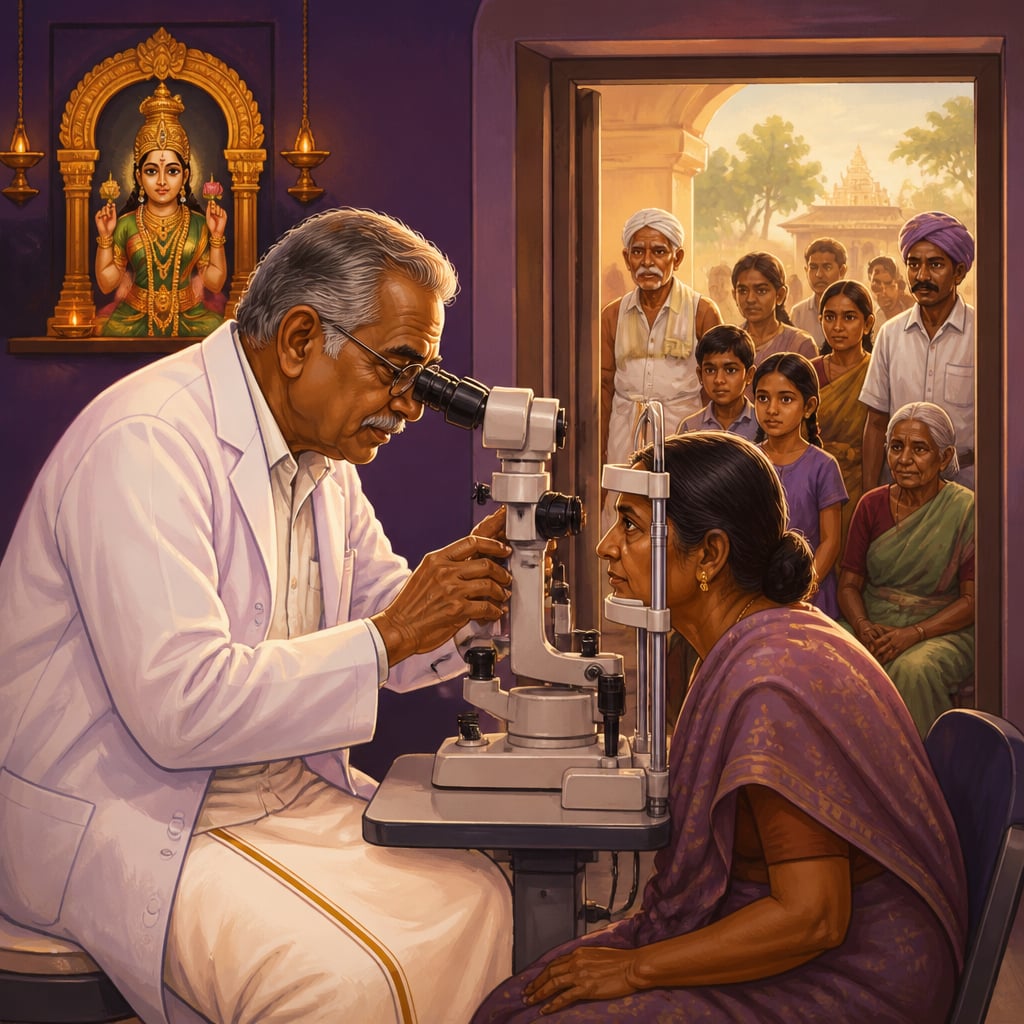
In 1976, Dr. Govindappa Venkataswamy retired from government service at 58 with an obsession: why should poor Indians go blind from cataracts when a simple surgery could restore their sight? With his personal savings and a pension loan, he opened an 11-bed clinic in Madurai. His family thought he was mad.
Five decades later, Aravind Eye Care System performs over 500,000 surgeries annually, more than any eye hospital in the world. Here's what makes it remarkable: 70% of patients pay nothing or subsidized rates, yet Aravind is profitable without donations or government subsidies. The paying 30% cross-subsidize the rest.
Dr. V, as he was known, wasn't running a charity. He was operationalizing an ancient principle: Sarva-Bhuta-Hita, the welfare of all beings. In his model, patients aren't divided into "customers" and "charity cases." Every person who walks through the door is a stakeholder deserving of world-class care.
The Ancient Framework: Governance for All Beings
The concept of Sarva-Bhuta-Hita appears throughout dharmic literature, but nowhere more systematically than in the Shukraniti, attributed to the sage Shukracharya (traditionally dated to Vedic times, compiled c. 300-800 CE). While Kautilya's Arthashastra focused on state power, Shukraniti emphasized the obligations of power.
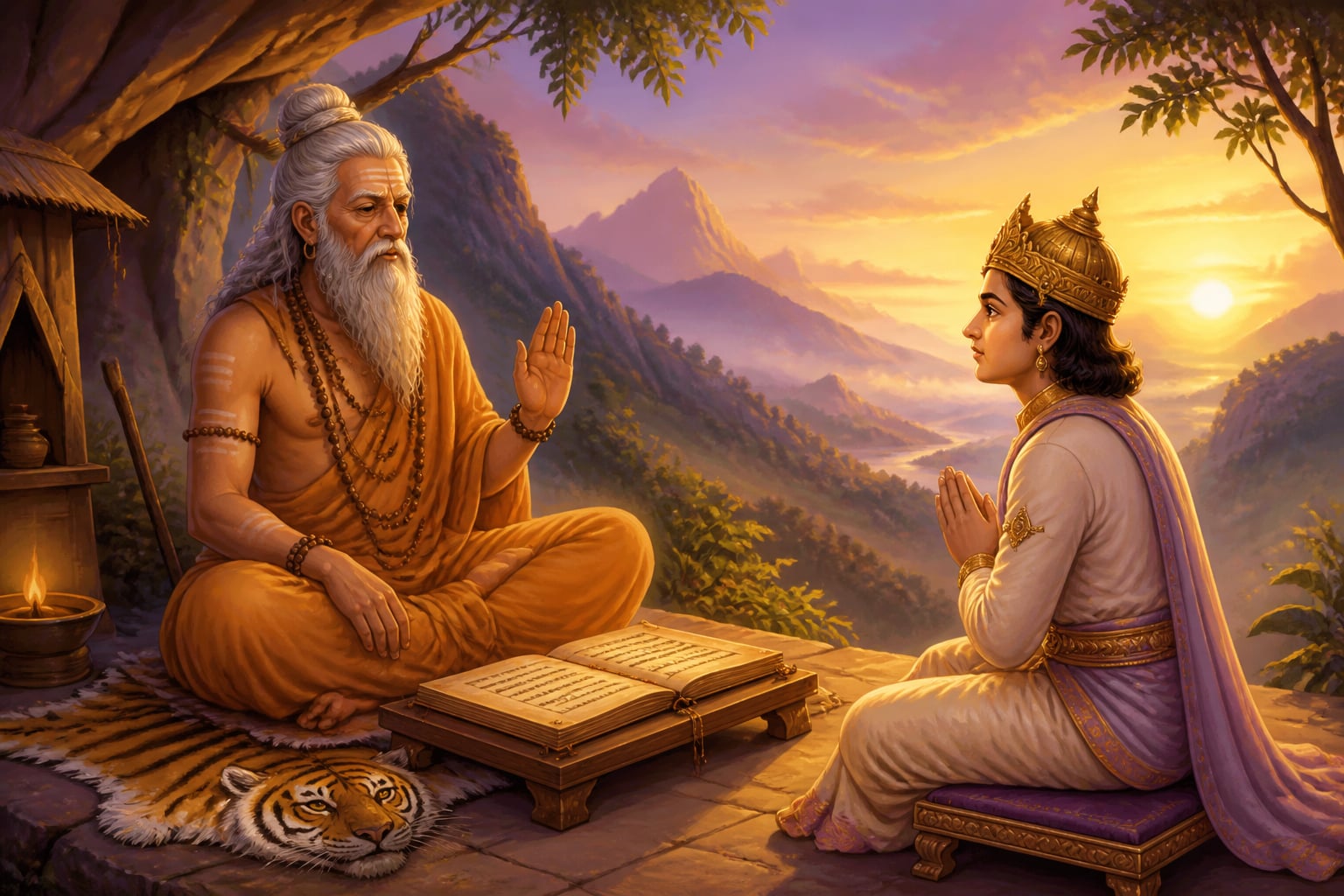
Shukracharya's teaching on governance is explicit:
Praja-sukhe sukham rajnah, praja-dukkhe dukkham rajnah "In the happiness of the people lies the king's happiness; in their suffering, his suffering."
This isn't sentimentality, it's systems thinking. Shukraniti argues that a ruler (or any leader) who optimizes only for personal or narrow interests creates instability that eventually destroys their own position. Sustainable prosperity requires attending to all participants in the system.
The Mahabharata reinforces this through Yudhishthira's coronation oath, where the new king pledges to serve Sarva-Bhuta-Hita, not just citizens, but all beings affected by his rule, including animals, forests, and future generations. This is stakeholder theory expanded to its logical conclusion.
The Principle: Who Counts as a Stakeholder?
Dharmic economics answers this question radically: everyone affected by an economic action is a stakeholder. The Bhagavad Gita's teaching on karma is precise here, every action creates ripples that affect others, and the actor bears responsibility for those ripples.
The Arthashastra (2.1) lists the Saptanga, seven limbs of the state, each representing stakeholders the king must serve:
- Swami (Sovereign/Leadership)
- Amatya (Ministers/Management)
- Janapada (Territory/Community)
- Durga (Fortifications/Infrastructure)
- Kosha (Treasury/Capital)
- Danda (Military/Enforcement)
- Mitra (Allies/Partners)
Translated to modern business, this maps to: Leadership, Employees, Communities, Physical Assets, Financial Capital, Regulatory Relations, and Business Partners. Note what's missing from Milton Friedman's model: communities and partners as essential stakeholders, not optional considerations.
Global Perspectives on Stakeholder Theory
The West has oscillated between stakeholder and shareholder models, arriving only recently at conclusions dharmic texts encoded millennia ago:
R. Edward Freeman (1951-present) formalized Stakeholder Theory in his 1984 book Strategic Management: A Stakeholder Approach. He argued that businesses must create value for all stakeholders, customers, employees, suppliers, communities, and shareholders, not just owners. The dharmic parallel: Freeman's insight echoes Shukraniti's teaching that sustainable success requires serving all affected parties. The difference: Freeman frames it as strategy; Shukracharya frames it as dharma.
Milton Friedman (1912-2006) represented the opposing view. His 1970 essay "The Social Responsibility of Business Is to Increase Its Profits" defined shareholder primacy for a generation. Friedman argued that managers using company resources for "social purposes" were effectively stealing from shareholders. The dharmic response: Friedman's framework ignores karma, the reality that actions affecting others inevitably return to affect the actor. A company that exploits communities eventually faces regulation, reputation damage, or social license revocation.
Klaus Schwab (1938-present), founder of the World Economic Forum, has championed "Stakeholder Capitalism" since the 1970s. His 2020 Davos Manifesto declared that companies must serve all stakeholders, not just shareholders. The dharmic advantage: Schwab presents stakeholder capitalism as a modern innovation; dharmic texts reveal it as rediscovered ancient wisdom.
| Thinker | Core Position | Dharmic Parallel |
|---|---|---|
| R.E. Freeman | Create value for all stakeholders | Sarva-Bhuta-Hita (welfare of all beings) |
| Milton Friedman | Maximize shareholder profit only | Adharmic, ignores karma of exploitation |
| Klaus Schwab | Stakeholder capitalism as reform | Returning to dharmic principles after deviation |
Modern Resonance: India's Stakeholder Champions

Ela Bhatt founded the Self-Employed Women's Association (SEWA) in 1972 with a radical premise: poor, self-employed women aren't beneficiaries of development, they're economic agents deserving of stakeholder status. Today, SEWA has 2.1 million members across 18 states, providing banking, insurance, healthcare, and childcare through member-owned cooperatives.
SEWA's model inverts traditional corporate structure. Members aren't customers or employees, they're owners. The organization exists to serve their interests. When SEWA Bank was established in 1974, banking regulators were skeptical that illiterate women could manage a financial institution. Five decades later, SEWA Bank has never required a bailout, while "sophisticated" banks have collapsed repeatedly.
Aravind Eye Care's stakeholder model extends beyond patients. The organization trains ophthalmologists from across the developing world, manufactures low-cost intraocular lenses (Aurolab produces 10% of the world's supply), and has helped establish eye care systems in 30+ countries. Dr. V's vision wasn't just to cure blindness in Madurai, it was to create a replicable system for eliminating preventable blindness globally. Every participant, patient, doctor, supplier, trainee, is a stakeholder in this mission.
Amul's cooperative model demonstrates stakeholder capitalism at national scale. The Gujarat Cooperative Milk Marketing Federation is owned by 3.6 million milk producer families. Farmers aren't suppliers to be squeezed, they're owners who share in profits. The result: India went from milk-deficient to the world's largest milk producer, and millions of rural families achieved economic dignity.
Your Turn: Mapping Your Stakeholders
Shareholder capitalism asks: "How do I maximize returns for owners?" Stakeholder capitalism asks: "Who is affected by my actions, and am I creating value for them?"
Consider your own economic activities, your job, your purchases, your investments. Who are your stakeholders? The obvious ones (employer, customers) are easy. But what about the less visible: supply chain workers, communities where products are made, environments affected by production, future generations who inherit your choices?
The dharmic framework doesn't ask you to sacrifice self-interest. It reveals that genuine self-interest is stakeholder interest, because karma ensures that what you create for others eventually returns to you. Aravind isn't profitable despite serving the poor; it's profitable because its stakeholder model creates loyalty, reputation, and operational excellence that extractive models cannot match.
In the next lesson, we'll explore how this stakeholder awareness extends to consumption, how Viveka-Upabhoga (mindful consumption) transforms buying from a transaction into an act with dharmic consequences.
Principal-agent alignment and sustainable value creation
Modern corporate governance struggles with 'agency problems', managers acting in self-interest rather than shareholder (let alone stakeholder) interest. Friedman's shareholder primacy attempted to solve this by aligning manager incentives with shareholder returns.
Dharmic economics dissolves the agency problem by redefining self-interest. If genuine self-interest includes stakeholder welfare (because karma ensures consequences return to the actor), then the conflict between personal and collective interest disappears. This is more fundamental than incentive alignment.
Companies ranking highest on stakeholder orientation outperformed the S&P 500 by 134% over 15 years (Firms of Endearment study, updated 2024).
Western corporate law traditionally recognizes only shareholders as owners, with other stakeholders having contractual but not ownership claims. The 'benefit corporation' movement attempts to legally broaden stakeholder consideration.
India's cooperative tradition (Amul, SEWA, milk cooperatives) demonstrates alternative ownership structures where stakeholders are literal owners. These models often prove more resilient than shareholder-owned competitors, Amul has thrived for 75 years while corporate dairy ventures have struggled.
Key terms
- Sarva-Bhuta-Hita
- The welfare of all beings; commitment to the wellbeing of every creature affected by one's actions
- Saptanga
- The seven limbs or constituents of a state/organization that must be balanced for sustainable success
- Praja
- The people; subjects; all those under the care or influence of a leader or organization
- Hita
- Welfare; benefit; that which is genuinely good for someone, as opposed to what merely pleases them
Key figures
Shukracharya
Sage, Author of Shukraniti, Preceptor of the Asuras
Ela Bhatt
Founder of SEWA (Self-Employed Women's Association), Social Entrepreneur, Gandhian
R. Edward Freeman
American Philosopher, Professor at University of Virginia Darden School of Business
Case studies
Aravind Eye Care: When 70% of Customers Pay Nothing and You're Still Profitable
In 1976, Dr. Govindappa Venkataswamy ('Dr. V') retired from government service with a disturbing statistic: India had 12 million blind people, and 80% of that blindness was preventable or curable. Cataract surgery could restore sight for most, but was unaffordable for the rural poor who needed it most. Dr. V founded Aravind Eye Hospital in Madurai with 11 beds and a radical model: anyone could receive care regardless of ability to pay. Paying patients (about 30%) would cross-subsidize the rest. Critics predicted bankruptcy within months. Instead, Aravind became the world's largest eye care provider. The organization now operates 13 hospitals, performs 500,000+ surgeries annually, and has restored sight to over 7.8 million people. It runs at approximately one-fiftieth the cost of UK hospitals while maintaining comparable quality outcomes. To control costs, Aravind created Aurolab, which manufactures intraocular lenses at $2 instead of the global standard $200, now supplying 10% of global demand.
Aravind's model is Sarva-Bhuta-Hita made operational. Dr. V didn't ask 'How do we serve paying customers and then maybe help some poor people?' He asked: 'How do we eliminate blindness for everyone?' This reframing changes everything. When everyone is a stakeholder deserving of care, you innovate differently. Aravind developed assembly-line efficiency (inspired by McDonald's!) that allows surgeons to perform 2,000+ surgeries annually vs. the Indian average of 300. They trained ophthalmic technicians to handle everything except the surgery itself, maximizing expensive surgeon time. Conventional economics would predict that serving non-paying customers destroys profitability. But Aravind's stakeholder model creates loyalty, reputation, and volume that extractive models cannot match. The organization's mission attracts top talent who could earn more elsewhere but choose purpose over premium.
By 2024, Aravind has restored sight to over 7.8 million people, trained 1,600+ ophthalmologists from 80 countries, and helped establish eye care systems across the developing world. The organization remains profitable without donations or government subsidies. More significantly, Aravind has proven that stakeholder capitalism isn't charity, it's superior business design. By treating every patient as a stakeholder deserving world-class care, the organization achieved economies of scale, process innovations, and quality improvements that profit-maximizing hospitals never reached. Dr. V's vision extended beyond Madurai: 'I want Aravind to be like McDonald's, excellent quality, low cost, everywhere.' That vision is being realized through LAICO (Lions Aravind Institute of Community Ophthalmology), which has helped replicate the model in 30+ countries.
Stakeholder capitalism isn't about sacrificing profit for social good, it's about recognizing that inclusive models often outperform extractive ones. When you treat all affected parties as stakeholders, you innovate differently, attract better talent, and build reputation that compounds over decades.
Aravind's model has been replicated in cardiac care (Narayana Health), dental care (Dental Council programs), and maternal health across South Asia and Africa. The underlying principle, that designing for the poorest patient produces innovations benefiting all patients, has influenced how global health organizations think about scaling medical access.
Aravind performs cataract surgery at approximately $25 total cost with outcomes matching $3,000 Western surgeries, a 120x efficiency advantage achieved through stakeholder-driven innovation.
Historical context
Classical Period (c. 300 BCE - 800 CE)
Ancient Indian governance texts consistently emphasize stakeholder welfare, not as charity but as the foundation of stable rule. The Mauryan Empire (322-185 BCE) implemented these principles at scale, with the Arthashastra serving as its policy manual. Rulers understood that extraction beyond sustainable levels created rebellions that cost more than the extracted resources.
Western economic thought oscillated between mercantilism (state interest), classical liberalism (individual interest), and socialism (worker interest), each privileging one stakeholder. Indian texts more consistently held all stakeholders simultaneously, recognizing interdependence rather than competition between interests.
The Mauryan Empire sustained a population of approximately 50-60 million, larger than the contemporary Roman Republic, suggesting that stakeholder governance scaled effectively to complex civilizations.
The current global debate between shareholder and stakeholder capitalism recapitulates ancient dharmic insights. Understanding that stakeholder welfare has been successfully practiced at civilizational scale provides confidence that it's not utopian idealism but proven governance technology.
Reflection
- Shukraniti teaches that a leader's genuine happiness is inseparable from stakeholder welfare. Where in your life have you experienced this truth, that serving others' genuine interest also served your own? Where have you experienced the opposite, pursuing narrow self-interest that ultimately harmed you?
- Map the stakeholders in your primary economic role (job, business, studies). List everyone affected by your activities. For each, identify: are you creating value for them, extracting value, or neutral? What's one change you could make this month to shift an extraction toward creation?