Viveka-Upabhoga: Conscious Consumerism and Mindful Spending
The Art of Buying With Awareness
Every rupee spent is a vote for the world you want to create. This lesson explores Viveka-Upabhoga, discriminating consumption, the dharmic practice of buying with full awareness of impact. From ancient teachings on detached enjoyment to modern conscious consumerism, discover how mindful spending transforms shopping from transaction to transformation.
The Farmer Who Made Tulsi Famous

In 1997, Bharat Mitra stood in a dusty field in Lucknow, watching farmers burn their tulsi (holy basil) crop. International buyers had cancelled orders. The plants, sacred in Hindu homes, but commercially worthless that year, were worth more as ash.
Mitra, an American-born seeker who had spent years in Indian ashrams, saw something the market missed: these farmers weren't just growing a crop. They were practicing puja through agriculture, tending sacred plants with devotion. What if consumers could participate in that devotion through their purchases?
Today, Organic India works with 2,500+ small farmers across 16,000 acres, all organic. The company's tulsi tea sells globally, but its real innovation isn't the product, it's the relationship. Every purchase connects a consumer to a farmer practicing sacred agriculture. The company's tagline captures it: "Healthy Conscious Living."
This is Viveka-Upabhoga, consumption with discrimination, awareness, consciousness. Not ascetic rejection of material goods, but wise engagement with the material world.
The Philosophy: Janaka's Paradox
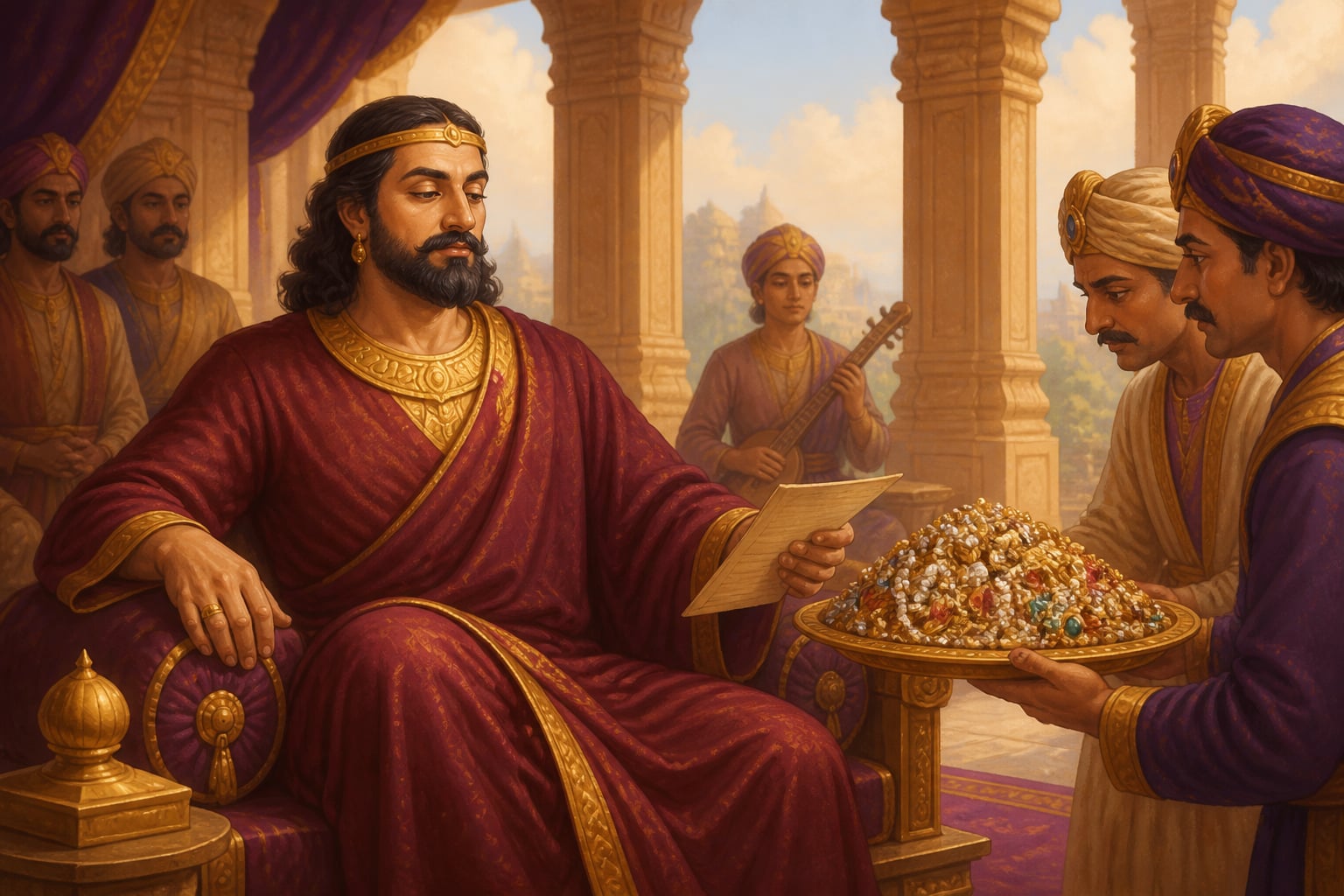
King Janaka of Mithila presents a puzzle in dharmic literature. He was phenomenally wealthy, his kingdom was prosperous, his court magnificent. Yet sages declared him a jivanmukta, a liberated being. How could someone surrounded by luxury achieve what renunciates in caves struggled for?
The answer lies in Viveka, discrimination. The Ashtavakra Gita records Janaka's realization:
Yatha tatha upapanneshu gatam me bhayam "However things come to me, my fear has departed."
Janaka consumed, richly, but without attachment. He enjoyed wealth without being owned by it. He purchased without identifying his self-worth with possessions. This is not the rejection of consumption but its transformation.
The Isha Upanishad's opening verse applies directly:
Tena tyaktena bhunjitha "Enjoy through renunciation."
The paradox resolves: you can enjoy material goods most fully when you're not clinging to them. The person who needs the latest iPhone to feel adequate suffers both in pursuit and in possession. The person who appreciates a good phone without needing it for identity enjoys it more freely.
The Principle: Three Modes of Consumption

The Bhagavad Gita (Chapter 17) analyzes consumption through the lens of the three gunas, qualities that shape how we engage with material reality:
Sattvic Consumption (verses 8-10):
- Food, goods, and experiences that nourish life, health, clarity, and joy
- Chosen with awareness of impact on self, others, and environment
- "Food that promotes longevity, intelligence, strength, health, happiness"
- Modern equivalent: Organic, fair-trade, sustainable purchases; experiences over accumulation
Rajasic Consumption (verses 9):
- Driven by craving for stimulation, status, or excitement
- "Bitter, sour, salty, very hot, pungent, dry, burning"
- Creates temporary pleasure followed by agitation and more craving
- Modern equivalent: Impulse buying, retail therapy, status purchases, fast fashion
Tamasic Consumption (verses 10):
- Unconscious, habitual, driven by inertia rather than choice
- "Stale, tasteless, putrid, leftover, impure"
- Dulls awareness and perpetuates unconsciousness
- Modern equivalent: Mindless scrolling and purchasing, hoarding, addiction-driven consumption
Viveka-Upabhoga isn't about consuming less, it's about consuming consciously. A sattvic consumer might spend more on high-quality goods that last decades, while a rajasic consumer spends more total on cheap goods constantly replaced.
Global Perspectives on Consumption
Western economists have increasingly questioned the consumption-driven growth model that dharmic traditions always viewed with skepticism:
Thorstein Veblen (1857-1929) introduced "conspicuous consumption" in The Theory of the Leisure Class (1899). He observed that much consumption serves social signaling rather than genuine utility, people buy to display status, not to meet needs. The dharmic parallel: Veblen describes rajasic consumption driven by ego rather than viveka. His insight was sociological; the Gita's insight is psychological and spiritual.
Juliet Schor (1955-present), economist and author of The Overspent American and True Wealth, documents how consumer culture creates a "work-and-spend cycle" that undermines wellbeing. Her research shows that Americans who voluntarily simplify their consumption report higher life satisfaction. The dharmic parallel: Schor empirically confirms what texts like the Isha Upanishad taught, that attachment-driven consumption reduces rather than increases genuine happiness.
Tim Jackson (1957-present) challenges the growth imperative in Prosperity Without Growth (2009). He argues that endless consumption growth is ecologically impossible and psychologically unfulfilling. The dharmic parallel: Jackson rediscovers what dharmic economics always knew, that artha (meaningful wealth) is not identical with accumulation, and that genuine prosperity involves sufficiency, not maximization.
| Western Thinker | Key Insight | Dharmic Parallel |
|---|---|---|
| Thorstein Veblen | Conspicuous consumption for status | Rajasic consumption driven by ego |
| Juliet Schor | Voluntary simplicity increases wellbeing | Aparigraha (non-hoarding) leads to contentment |
| Tim Jackson | Prosperity without endless growth | Artha as sufficiency, not maximization |
Modern Resonance: The Conscious Consumer Movement
Anand Mahindra, chairman of Mahindra Group, exemplifies conscious consumption in corporate India. Despite leading a $20 billion conglomerate, he's known for personal frugality and mindful choices. His social media presence celebrates craftsmanship, sustainability, and local innovation over status displays. When he shares a viral video of a street vendor's ingenious solution, he's practicing viveka, discriminating between genuine value and mere price.
The conscious consumer movement is accelerating in India:
- Organic food market: Growing 25%+ annually, expected to reach Rs. 75,000 crore by 2025
- Sustainable fashion: Brands like Doodlage, No Nasties, and Upasana proving profitability of ethical fashion
- Zero-waste stores: Bare Necessities, Adrish, and similar shops spreading across metros
- Local-first purchasing: "Vocal for Local" campaign driving preference for Indian artisans and manufacturers
This isn't Western import, it's dharmic revival. When consumers choose Organic India's tulsi tea over mass-market alternatives, they're participating in a tradition older than market economics.
The Practice: Viveka Before Purchase
The dharmic approach to consumption isn't complicated, but it requires viveka, discrimination. Before any significant purchase, consider:
1. Need vs. Want vs. Craving
- Need: Essential for wellbeing (food, shelter, health, genuine connection)
- Want: Would enhance life without being essential (better tools, experiences, quality goods)
- Craving: Driven by ego, comparison, or emotional void (status symbols, retail therapy)
2. Impact Awareness
- Who made this? Under what conditions?
- What resources were consumed in production?
- Where will it end up when I'm done with it?
- What world does my purchase vote for?
3. The Janaka Test
- Would I enjoy this equally whether or not anyone saw me with it?
- If this disappeared tomorrow, would my sense of self remain intact?
- Am I purchasing this, or is craving purchasing me?
Your Turn: The Consumption Audit
This week, try the dharmic consumption audit:
For every purchase above Rs. 500, pause and ask:
- Is this sattvic (nourishing), rajasic (stimulating), or tamasic (numbing)?
- Am I buying this with viveka (discrimination) or on autopilot?
- What ripples does this purchase create, for workers, environment, my own psychology?
You may find that conscious consumption often means buying better rather than buying more. A single well-made garment from an ethical brand may cost more than five fast-fashion alternatives but last longer, look better, and carry no karmic burden of exploitation.
King Janaka's secret wasn't avoiding wealth, it was enjoying wealth without being imprisoned by it. Viveka-Upabhoga invites you to the same freedom: full participation in the material world, fully awake.
In the next lesson, we'll apply these principles to investing, how Dharmic Investing transforms capital allocation from extraction to regeneration.
Behavioral economics documents the 'hedonic treadmill', consumption upgrades provide temporary satisfaction before becoming the new baseline, requiring further upgrades. This describes rajasic consumption's endless cycle perfectly.
The three-guna framework explains why the treadmill operates (rajasic consumption creates craving, not satisfaction) and offers an alternative (sattvic consumption that genuinely nourishes). Western economics describes the trap; dharmic economics shows the exit.
Research shows that experiential purchases (often sattvic) create more lasting satisfaction than material purchases (often rajasic), empirically confirming the Gita's framework 2,500 years later.
Consumer psychology shows that 'psychological ownership', the feeling that possessions are part of one's identity, increases both attachment and anxiety. Losing possessions feels like losing self.
Janaka's model offers freedom from psychological ownership while allowing full engagement with material goods. You can use things without being used by them. This is healthier consumption than either ascetic rejection or materialist attachment.
Studies show that people who define themselves less by possessions report higher life satisfaction and lower anxiety, empirically confirming Janaka's wisdom.
Key terms
- Viveka
- Discrimination; the capacity to distinguish between what truly serves wellbeing and what merely appears to
- Upabhoga
- Consumption; enjoyment; the act of using or experiencing material goods
- Sattvic
- Of the quality of sattva; that which promotes clarity, harmony, balance, and genuine nourishment
- Aparigraha
- Non-possessiveness; non-hoarding; holding material goods lightly without excessive accumulation
Key figures
King Janaka
King of Mithila, Father of Sita, Philosopher-King
Anand Mahindra
Chairman of Mahindra Group, Industrialist, Thought Leader
Thorstein Veblen
American Economist and Sociologist
Case studies
Organic India: When Buying Tea Becomes Sacred Practice
In 1997, Bharat Mitra and his partners founded Organic India in Lucknow with a seemingly impossible mission: create a profitable business that would regenerate Indian agriculture, support small farmers, revive sacred plants, and promote conscious consumption globally. The challenge was immense. Indian farmers were locked in cycles of chemical agriculture, debt, and degraded soil. Consumers saw organic as expensive luxury. International markets were skeptical of Indian supply chains. Organic India started with tulsi, holy basil, sacred in Hindu homes but commercially marginal. They partnered with small farmers, guaranteeing purchase prices and providing organic certification support. The company's approach treated farming as sacred practice: tulsi fields weren't just crops but living temples tended with devotion. The business model embedded conscious consumption at every level. Farmers practiced sustainable agriculture as spiritual discipline. The company operated as a benefit corporation prioritizing social and environmental impact. Consumers weren't just buying tea, they were participating in a chain of conscious choices from seed to cup.
Organic India operationalizes Viveka-Upabhoga by making consciousness visible throughout the supply chain. When a consumer chooses Organic India's tulsi tea over conventional alternatives, they're making a sattvic choice: supporting organic farmers, regenerative agriculture, and sacred plant traditions. This transforms consumption from transaction to participation. The Gita's teaching applies: sattvic consumption 'promotes life, clarity, strength, health, happiness.' Organic India's products do this directly (through quality) and indirectly (through the consciousness embedded in their production). Conventional economics would predict that higher costs (organic certification, fair farmer payments, sustainable practices) would make Organic India uncompetitive. But the company has grown to Rs. 500+ crore revenue precisely because conscious consumers exist, and they're willing to pay premium for products aligned with their values.
By 2024, Organic India works with 2,500+ small farmers across 16,000 acres of certified organic land. The company has helped transition thousands of acres from chemical to organic agriculture, improving soil health and farmer wellbeing. Financially, Organic India has achieved consistent profitability while maintaining B-Corp certification. The company sells in 40+ countries, proving that conscious consumption scales globally. Most significantly, Organic India has demonstrated that business can be designed for consciousness. Every purchase connects consumer to farmer, creating awareness of the chain of relationships that conventional consumption hides. This is viveka made practical, and profitable.
Conscious consumption isn't just individual choice, it can be built into business models. When companies make the impact of purchases visible, they enable viveka at scale. Consumers who understand where their money goes can make sattvic choices; companies that enable this understanding create loyal communities rather than anonymous transactions.
The global organic food market, projected to reach $500 billion by 2030, increasingly validates the bet that consumers will pay more for products that align with their values. Organic India's integration of farmer welfare, environmental regeneration, and brand premium shows that conscious capitalism can create shared value across the entire supply chain.
Organic India farmers report 40% higher net income than conventional farmers in the same regions, while transitioning 16,000+ acres to chemical-free cultivation.
Historical context
Upanishadic and Classical Period (c. 800 BCE - 500 CE)
Ancient Indian society developed sophisticated frameworks for consumption ethics long before 'consumer culture' existed as a concept. The varnashrama system included consumption guidelines appropriate to life stage: students practiced austerity; householders enjoyed material goods within dharmic bounds; later stages emphasized renunciation. This lifecycle approach balanced enjoyment with wisdom.
Greek philosophy (Stoicism, Epicureanism) addressed consumption ethics but less systematically. Roman culture embraced conspicuous consumption without philosophical counterweight. Only in the 19th-20th centuries did Western thought seriously question consumption-driven models, questions Indian traditions engaged millennia earlier.
Ancient Indian texts recommend spending approximately 1/4 of income on daily needs, 1/4 saved, 1/4 on dharmic activities, 1/4 on celebrations/enjoyment, a balanced allocation modern financial advisors would recognize.
Today's consumer culture creates unprecedented pressure toward unconscious consumption. Dharmic frameworks offer time-tested alternatives: enjoy material goods fully while holding them lightly; discriminate between genuine needs and manufactured cravings; consume consciously rather than compulsively.
Reflection
- King Janaka achieved liberation while ruling a wealthy kingdom because his identity didn't depend on possessions. Which of your possessions do you identify with most strongly, items whose loss would feel like losing part of yourself? What does this attachment reveal about where you locate your sense of self?
- Review your last month's discretionary purchases (beyond necessities). Classify each as sattvic (genuinely nourishing), rajasic (status-driven or stimulation-seeking), or tamasic (unconscious/habitual). What patterns emerge? What's one specific change you could make this month to shift toward more sattvic consumption?