Reshmi Parampara: The Heritage of Indian Silk

From Kautilya's silk ledger to Harsha's Prayaga almsgiving to the living looms of Varanasi, Sualkuchi, and Kanchipuram, the story of how a caterpillar's thread became India's most sacred fabric.

In the spring of 643 CE, the Chinese monk Xuanzang stood at the riverside field of Prayaga and watched Emperor Harsha give away every silk robe in his treasury to monks, Brahmins, and the poor. By that day, silk had already been woven in India for more than a thousand years. Kautilya had catalogued it in the Arthashastra. Kabir would later weave theology into it. Rome had drained its gold for it. The British had tried to break it. This lesson walks the long heritage of Indian silk: four worms, four regions, one unbroken thread that runs from the Mauryan treasury to the Sualkuchi loom running today.

A Monk at Prayaga
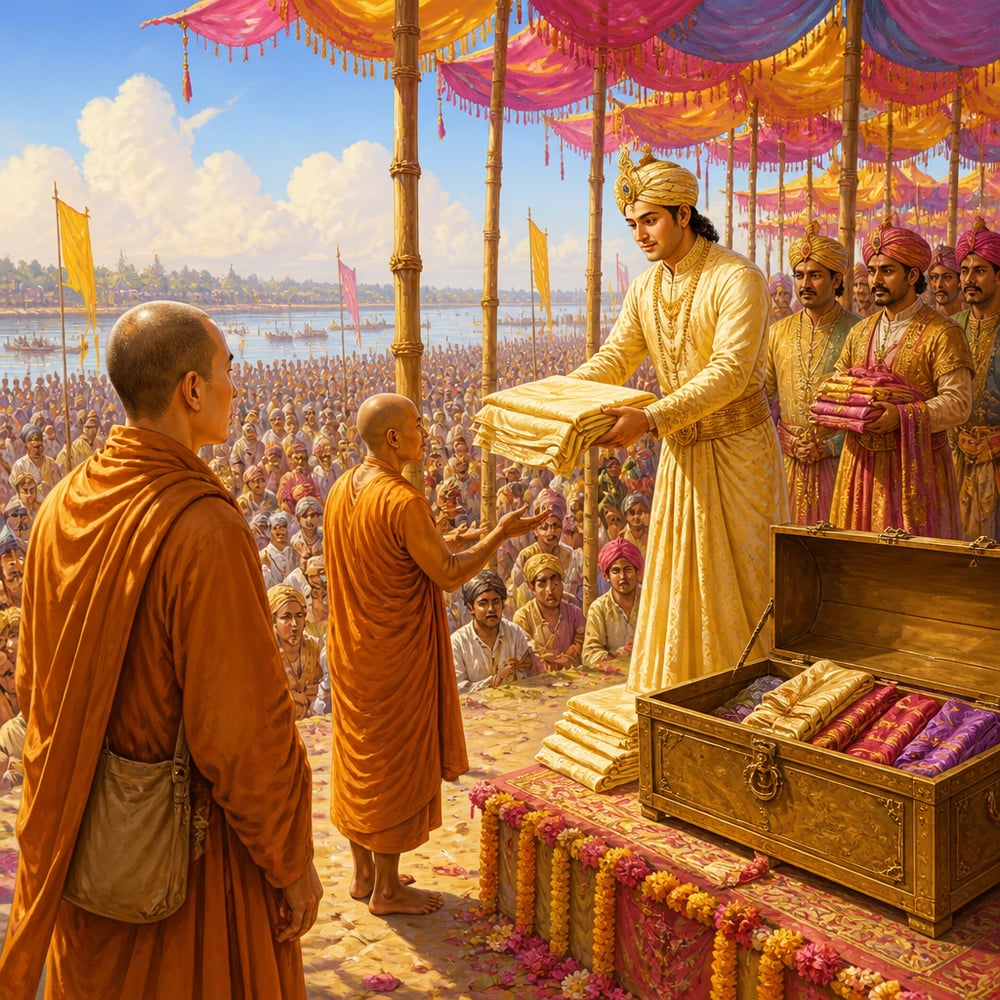
Xuanzang watching Harsha distribute silk robes at Prayaga in 643 CE

In the spring of 643 CE, at the sacred meeting place of the Ganga and the Yamuna, a Chinese monk named Xuanzang stood in a vast crowd and watched an Indian emperor give away his own clothes.

The emperor was Harshavardhana of Kanauj, the last great king of northern India before the Turk invasions. Every five years, Harsha held a public almsgiving at Prayaga (today's Prayagraj). He brought every treasure the state had collected in that half-decade. Gold. Jewels. Elephants. Horses. And silk. Mountains of silk. Blue, red, gold, and saffron bolts stacked in the open field for seventy-five days of giving. Monks first. Then Brahmins. Then the sick. Then the poor.

Xuanzang was there because he had walked from China. He had crossed deserts, the Pamir passes, and sixteen years of Indian kingdoms to collect Buddhist scriptures. On the last day of the assembly, he watched Harsha take off his own royal robe and hand it to a beggar. The king stood in a plain cloth lent to him by his sister. The treasury was empty. The silk was gone. The point had been made.

A Chinese monk, at Prayaga, watching an Indian king use silk to buy merit. The ironies stack quickly. Silk was, after all, China's gift to the world. Sericulture, the raising of silkworms on mulberry leaves, had been a Chinese state secret for two thousand years. And yet by the time Xuanzang arrived, India already had silk traditions old enough that Kautilya had listed them nine centuries before Harsha was born. What follows is the story of how a cloth made from insect saliva became the most sacred, the most political, and the most stubborn fabric in the subcontinent.

Four Regions, One Fabric

Long before Xuanzang set foot in India, the Mauryan minister Kautilya had already written down where Indian silk came from. In the chapter on the Superintendent of Weaving, Book 2 Chapter 11 of the Arthashastra, he names four silk-producing regions under state inventory. Magadha. Pundra. Suvarnakudya. Kashi.

Two of those four regions are still weaving silk today, twenty-three centuries later. Pundra sat in what is now eastern Bengal and lower Assam, where wild forest silks still grow on tree leaves. Kashi is Varanasi, the city where Banarasi brocade looms never stopped. The other two have faded. The craft has not.

Kautilya also listed the kinds of silk the state taxed:

The fact that a separate word existed for Chinese silk tells us the rest. Indian silk was its own thing. It had its own worms, its own trees, its own dyes, its own weavers, and its own buyers. It was not a copy of China. It was a sibling.

The Worm, The Tree, The Thread

A silk thread begins inside a caterpillar's mouth. The caterpillar chews leaves. It spits out a liquid protein. The protein meets the air and hardens into a single filament. The caterpillar winds this filament around itself, round and round, until it sits inside a closed cocoon. Inside, it plans to become a moth.

That is where sericulture steps in. Before the moth can chew its way out and break the thread, the farmer drops the cocoon in hot water. The moth dies. The glue softens. One end of the filament lifts free. A worker finds it and begins to unwind. A single cocoon gives between six hundred and nine hundred metres of continuous silk. The thread is finer than a human hair. By weight, it is stronger than steel.

Four Indian silkworm cocoons with their feeding leaves laid out

India grows four kinds of silkworm. Each one eats a different tree.

Silk Worm Feed tree Home state
Mulberry Bombyx mori Mulberry Karnataka, Tamil Nadu, West Bengal
Tasar Antheraea mylitta Sal and Arjuna Jharkhand, Odisha, Chhattisgarh
Eri Samia ricini Castor Assam, Meghalaya, Nagaland
Muga Antheraea assamensis Som and Soalu Assam only

Muga is the rarest of the four. The Antheraea assamensis worm lives nowhere else on earth. Its thread comes out pale gold, grows shinier with every wash, and lasts a century. An Ahom queen's Muga chador from the seventeenth century can still be worn today. That is why Assam calls it the 'golden thread of Assam'. It is also why the village of Sualkuchi, now called the Manchester of the East, is built around this one worm.

A Cloth For The Gods

Silk in India was never only a trade good. It was ritual wear.

The old Dharmashastra texts said silk was pure in a way cotton was not. It was never trampled in a field. It was never soiled by dust in a market. A kauseya dhoti could therefore be worn into the temple sanctum. A pattavastra (a silk cloth) was the right offering for the image of Vishnu. A bride wore silk at her wedding because silk was thought to carry mangalya, auspiciousness, into the new house. A corpse was wrapped in silk before the pyre, because silk was considered fit for the final journey too. Silk crossed the whole human life: born in it, married in it, offered in it, burned in it.

The weaver Kabir, working a pit loom in Varanasi around 1480, turned this sacred cloth into one of India's most famous poems. He wrote about a chadariya, a thin woven shawl, and he meant the human body the soul wears for a lifetime.

झीनी झीनी बीनी चदरिया। काहे के ताना काहे के भरनी, कौन तार से बीनी चदरिया॥

jhīnī jhīnī binī cadariyā kāhe ke tānā kāhe ke bharanī, kaun tāra se binī cadariyā

So fine, so fine the woven shawl. What is the warp, what is the weft, with what thread is the shawl woven?

Kabir, chadariya doha (c. 1480)

A Muslim weaver in a Hindu city wrote that song while sitting at his loom. He meant: the soul weaves the body the way I weave this cloth. He also meant: handle the cloth carefully, because you have to return it clean. No Indian poem in any language captures the weaver's dignity better. And the loom it was written at is older than the poem.

Silk On The World Road

By the first century of the common era, Indian silk was already global. Roman senators had a problem. Their wives wanted Indian silk. So did their daughters. And the silk had to be paid for in gold.

Roman ships unloading Indian silk as gold flows back the other way

The historian Pliny the Elder, writing around 77 CE, complained in his Naturalis Historia that Rome was losing one hundred million sesterces every year to India and Arabia. Half of that went for silk, pearls, and fine cotton from Bengal. 'Such is the price,' Pliny wrote sourly, 'that our luxuries and our women cost us.' Archaeologists digging at the ancient port of Muziris in Kerala still find Roman coin hoards buried in clay jars. The silk went out. The gold came in. A whole arm of the ancient spice route ran on Indian looms.

Seventeen centuries later, the British saw the same opportunity and made the opposite choice. Instead of buying Indian silk, they broke it. In the 1770s, the East India Company's Commercial Residents forced Bengal silk reelers into company filatures, paid them less than cost, and shipped raw silk to Spitalfields in London. The village sericulture economy of Bengal collapsed in one generation. The looms survived only where local kings protected them (Banaras, Kanchipuram, Mysore) or where the geography was too remote for British inspectors to reach (the Muga forests of upper Assam).

The Looms That Would Not Die

When India became independent in 1947, most of its great silk centres were still standing. Tired. Shrunken. But standing. The twentieth century became the story of their slow recovery.

The Central Silk Board, set up by the Indian government in 1948, became the quiet spine for this recovery. India is now the world's second largest silk producer after China. It is also the world's largest silk consumer. And it is the only country in the world that still produces all four commercial silk varieties (mulberry, tasar, eri, and muga) at scale.

Modern Echoes

The loom is also a political fight. In 2009, after a long legal battle, Banarasi silk was granted a Geographical Indication tag. A saree sold as 'Banarasi' now had to come from the nine traditional districts around Varanasi. It had to be woven on a handloom. The weaver had to be registered. The ruling was not just paperwork. It was a line drawn in the sand against the Chinese jacquard copies and the Surat powerloom fakes that had been cutting the real weavers out of their own market. By 2020, GI protection had been extended to Muga silk, Kanchipuram silk, and Paithani sarees as well.

Designer Sabyasachi Mukherjee, from 2016 onwards, took the same fight into couture. He commissioned handloom Banarasi pieces for his bridal collection and put them on international runways. Within a few years his orders alone were keeping thousands of Varanasi looms running. A bride in Mumbai buying a Sabyasachi Banarasi today pays five lakh rupees or more, and most of that money goes to the weavers, not the designer. The old cloth had found new money.

The economist Arvind Subramanian once called India's traditional crafts the country's 'invisible export'. Silk is the most visible part of that invisible export. Every time a bride wears Kanchipuram, a grandmother gifts a Paithani, or a diplomat drapes a Muga chador, a thread runs from the present back to Kautilya's chapter and Xuanzang's field at Prayaga. The thread has not broken. It has only changed hands.

Back At Prayaga

Seventy-five days after Harsha began giving away silk, the field at Prayaga was bare. The monk Xuanzang went back to China carrying six hundred and fifty-seven Buddhist texts and, in his journal, a careful note that Indian kings wore finer cloth than Chinese ones. He did not know that thirteen centuries later, some of the same villages he had passed on his walk would still be at the loom. The king emptied his treasury. The looms did not.

In the lessons that follow, we walk into those villages one by one. Varanasi first, where Kabir sang at his loom, and where the chadariya is still being woven today.

Key figures

Xuanzang

A Chinese Buddhist monk of the Tang dynasty who walked from Chang'an to India, spent sixteen years travelling across the subcontinent, and returned in 645 CE with six hundred and fifty-seven Buddhist texts. His travel journal, the Da Tang Xiyu Ji (Great Tang Records on the Western Regions), is the single most detailed eyewitness account of 7th-century India. It also records the five-yearly almsgiving of Emperor Harsha at Prayaga, where the imperial silk treasury was distributed in public.

Harshavardhana of Kanauj

The Emperor of northern India from 606 to 647 CE, and the last great sovereign to hold most of the Gangetic plain before the Turk invasions. Harsha built his capital at Kanauj, patronised Buddhism and the Shaivite tradition in equal measure, and held a five-yearly public almsgiving at Prayaga (the confluence of the Ganga and the Yamuna) where the treasury was emptied in public over seventy-five days.

Kautilya (Chanakya)

The Mauryan minister and author of the Arthashastra. In Book 2 Chapter 11, the chapter on the Sutradhyaksha (Superintendent of Weaving), he catalogued the four silk-producing regions of the Mauryan state (Magadha, Pundra, Suvarnakudya, and Kashi) and the three recognised varieties of silk (kauseya, patrorna, chinapatta).

Case studies

The Roman Gold Drain

Around 77 CE, the Roman historian Pliny the Elder sat down in his study in Misenum on the Bay of Naples and complained, in Book VI of his Naturalis Historia, that the Roman Empire was losing one hundred million sesterces every year to India and Arabia. Half of that money, he wrote, went for silk, pearls, and fine cotton. Roman senators' wives wanted Indian silk. Their daughters wanted Indian silk. And the silk had to be paid for in gold. Pliny's line is bitter: 'Such is the price that our luxuries and our women cost us.' Archaeologists digging at the ancient port of Muziris in Kerala, where the silk trade came ashore, still find Roman coin hoards buried in clay jars two thousand years after the ships sailed.

For India, the Roman trade was not a surprise. Kautilya's Arthashastra had already, three and a half centuries before Pliny, set up the Sutradhyaksha office to regulate silk production and tax silk exports. When Roman ships began arriving at Muziris and Arikamedu in the first century CE, the Indian silk economy was ready for them. It had supply (kauseya from Bengal, patrorna from the eastern forests, handloom brocades from Kashi), it had pricing (tax-regulated rates administered by the state), and it had logistics (the Silk and Spice route's southern maritime arm). Rome bled gold because India had organised silk as a state-regulated export two thousand years before anyone else built a comparable system.

Between roughly 30 BCE and 200 CE, India absorbed an estimated five to ten percent of the Roman Empire's silver and gold output, most of it in exchange for silk, pepper, and pearls. The Roman coin hoards in Kerala and Tamil Nadu are still today among the richest finds of Roman money anywhere in the world. The Roman elite complained loudly but kept buying. Rome eventually tried to restrict silk imports by sumptuary law, and failed. The trade held for more than two centuries, until the fall of the Western Roman Empire interrupted it from the other end.

When a civilisation has both the organised supply of a luxury good and the legal framework to tax it, it can sustain a global trade position for centuries. Pliny's Rome could not stop buying Indian silk because the Roman state had no alternative supplier and the Roman consumer had no alternative desire. Kautilya's Mauryan state, and its Gupta and medieval successors, had built a silk economy capable of feeding a global market. The heritage of Indian silk is, among other things, the heritage of the first Indian export of value.

India's present-day position as the world's second largest silk producer, the world's largest silk consumer, and the holder of several Geographical Indication-protected silk traditions, is the modern form of the same pattern Pliny complained about. A Kanchipuram saree worn by an Indian diaspora bride in London or New Jersey is the 21st-century descendant of the Muziris silk the Roman senators' wives wore. The export has changed currencies and platforms, but the underlying craft economy is the same one Kautilya's Sutradhyaksha set up.

Pliny the Elder's Naturalis Historia records the one hundred million sesterces figure for the annual Roman gold drain to India and Arabia, split roughly half between silks, pearls, and fine cotton. In modern terms the sum is difficult to convert, but by any reasonable comparison it represents a major share of the imperial trade deficit. Roman coin hoards found at Muziris, Arikamedu, Madurai, and Karur in South India together contain thousands of denarii and aurei dating from the first two centuries CE.

The 2009 Banarasi GI Registration

Between 2000 and 2009, Dr. Rajni Kant, the founder of the Human Welfare Association in Varanasi, led a ten-year effort to get legal protection for the Banaras weaving tradition. Before 2009, anyone could call any silk saree a Banarasi. Polyester imitations from Surat, jacquard copies from China, and machine-woven fakes from Bangkok were all sold in Indian markets under the Banarasi name. The real Ansari weavers of Varanasi, working kadhwa pit looms in Madanpura and Alaipura, had no legal protection. If they complained, nobody listened. Dr. Rajni Kant filed the Geographical Indication application under the Indian GI Act of 1999. The Surat powerloom industry fought the application hard. The case dragged for years.

A Geographical Indication is a modern legal form of a very old dharmic idea: a community has the right to name and protect the work it does. The Banaras weavers' unbroken teaching lineage, running from the 15th-century Julaha community of Kabir through the Mughal karkhanas and the colonial collapse into the present day, is what the GI registration was meant to protect. Without that unbroken lineage there would have been no defined technique to register. Without the registration, the defined technique had no legal defence against imitation. The weavers held the craft. The law finally held the name.

On 25 September 2009, the Geographical Indications Registry in Chennai formally granted the registration. It covers Varanasi and eight nearby districts: Mirzapur, Bhadohi, Chandauli, Jaunpur, Sant Ravidas Nagar, Azamgarh, Ghazipur, and Kaushambi. Since then, the word 'Banarasi' has had a legal meaning in India: handloom production, inside this geography, using the specified kadhwa and fekua weaving techniques. Enforcement is still partial. Powerloom imitations still dominate the mass market. But the name can now be defended in Indian courts. And the people with the right to defend it are the weavers themselves. By 2020, GI protection had been extended to Muga silk, Kanchipuram silk, and Paithani sarees as well.

Giving a craft tradition a legal name is not a bureaucratic afterthought. It is the foundation of everything else. Before the name has a defined geography and a defined technique, the craft has no shield against imitation. After it has both, the weavers hold the name. The 2009 Banarasi GI registration has since become the model playbook for protecting Indian handloom heritage: document the technique, organise the weavers, file the application, pursue enforcement. It is being applied, one craft at a time, to the full heritage of Indian silk.

Dr. Rajni Kant and the Human Welfare Association have been directly involved in several of the later Indian silk GI filings. The legal framework they built in Varanasi is now the standard infrastructure by which Indian silk heritage is being defended in Indian courts. Every GI filing is a small act of handing the name of a craft back to the community that makes it.

The Banarasi GI registration (2009) was one of the earliest Indian handloom GIs after the 1999 Act. By 2024, more than six hundred Indian craft products have been registered under the GI framework, including Muga Silk of Assam, Kanchipuram Silk Saree, Paithani Saree, Pochampally Ikat, Dharmavaram Handloom, Arani Pattu, and Chanderi Saree. Approximately seventeen Indian silks have received GI protection.

Sabyasachi and the Couture Revival of Banarasi

In 2016, the Indian couturier Sabyasachi Mukherjee began placing direct commissioning orders for handloom Banarasi silks at pit-loom workshops in Varanasi. At the time, the Banarasi handloom economy was in a quiet crisis. The 2009 GI tag had given the name legal protection, but market demand was shifting away from heavy traditional bridal wear towards lighter mass-market polyester copies. Master kadhwa weavers were earning less each year. Several lanes in Madanpura had begun to empty as younger weavers left for powerloom jobs in Surat or construction work in the Gulf. Sabyasachi's studio in Mumbai needed bridal couture pieces that could stand on an international runway. The handloom Banarasi was, in every technical sense, exactly the cloth he needed. But the supply chain was fragile.

The Sabyasachi commissions pay for kadhwa Banarasi sarees at their true cost: the cost of a master weaver's six to twelve months of work, plus the cost of real zari from Surat, plus a premium that allows the weaver to train an apprentice. The couture market absorbs these prices because its buyers pay for story and origin, not only for cloth. For the weavers, this is the first time in several decades that the economics of the pit loom have matched the actual labour that goes into the saree. For the couture market, this is the first time since the Mughal karkhanas that the Banaras weaving tradition is being commissioned at anything close to its historical value.

By 2020, Sabyasachi's bridal commissions alone were keeping an estimated one thousand to two thousand Varanasi pit looms running. His bridal sarees retail between three and five lakh rupees each, and the majority of that value (by Sabyasachi's own public statements) goes to the weavers and the raw zari supply chain, not to the studio. Other designers, including Ritu Kumar, Raw Mango, and Tarun Tahiliani, have followed the model at various price points. Sualkuchi Muga weavers and Kanchipuram silk weavers have begun to see similar designer commissions. A small but real couture-driven revival is now underway across several Indian silk traditions.

A craft tradition can survive on either of two economic bases: mass market or top market. The mass market for Banarasi silk was lost to powerloom imitation in the late 20th century. The top market was almost forgotten. Sabyasachi's commissions rebuilt it by treating the handloom saree as a couture object rather than a consumer product. This is not the only answer to the craft's future. But it is a working one. When the mass market cannot pay the real cost of handmade work, the top market sometimes can.

The Sabyasachi-Banarasi partnership is now the most visible case of couture-driven craft revival in India. It is studied at design schools (NIFT, NID, Pearl Academy) as a working model for how Indian designers can directly commission and support living handloom traditions. The model has also begun to be applied to non-silk crafts, including handloom Ajrakh, Pochampally ikat, and Channapatna toys. The underlying lesson (pay the real cost of the real cloth) applies across all of them.

By 2023, the Sabyasachi studio was commissioning handloom Banarasi and Muga silk pieces at a reported rate of several hundred bridal sarees per year. A single kadhwa bridal Banarasi from his studio can retail between three and five lakh rupees, and in exceptional cases up to fifteen lakhs. At the high end, the cost of raw zari alone can run to one lakh rupees per saree.

Historical context

The heritage of Indian silk runs from the Mauryan period (c. 4th century BCE), where Kautilya first catalogues it in the Arthashastra, through the Roman trade of the first century CE, through the Gupta and Harsha-era classical silk economy (4th to 7th centuries CE), through the medieval weavers of Kashi and the Ahom kingdom, through the colonial collapse of the 18th and 19th centuries, and into the 20th and 21st-century recovery under the Central Silk Board and the Geographical Indication framework.

India's silk traditions are unusually many-centred and unusually old. Unlike China, where sericulture was concentrated under imperial supervision from the Han dynasty onwards, Indian silk grew up in several regions at once, each with its own worm, its own tree, and its own weaving style. Mulberry silk took root in the south (Karnataka, Tamil Nadu) and in Bengal. Wild silks (tasar, eri, muga) anchored the eastern forests of Jharkhand, Odisha, Chhattisgarh, and Assam. Brocade weaving centred on Varanasi (Kashi), Paithan, and Kanchipuram. This regional plurality is why Indian silk survived the centuries better than most craft traditions in the world: when one centre collapsed, others were still weaving.

China invented sericulture at least two thousand years before the common era, and guarded it as a state secret under the Han and Tang dynasties. India, by contrast, developed multiple independent silk economies: domestic mulberry silk in the south and in Bengal, wild patrorna silks in the eastern forests, and high-end brocade in the north. Italian silk at Lucca, Venice, and Genoa, Ottoman silk at Bursa, and Safavid silk at Isfahan all flourished from the medieval period onwards, and each influenced Indian silk through trade. But India is the only country in the world that still produces all four major commercial silk varieties (mulberry, tasar, eri, and muga) at scale in the present day. Muga silk itself, from the worm Antheraea assamensis, exists nowhere else on earth.

India is the world's second largest producer of silk after China and the world's largest consumer. Karnataka alone produces about seventy percent of India's raw mulberry silk, drawn almost entirely from the worm lineage that Tipu Sultan imported from Bengal in 1785. The state of Assam is the only place on the planet where the wild golden silk of Muga (Antheraea assamensis) is produced. A single silkworm cocoon yields between six hundred and nine hundred metres of continuous silk filament. By weight, silk thread is stronger than steel.

Indian silk is the clearest example of a craft heritage that survived by regional plurality. When one centre of silk weaving collapsed under colonial pressure, others were still weaving. When Bengal lost its village sericulture in the late 18th century, Mysore was just founding its own. When powerloom imitations threatened Banarasi in the 20th century, Sualkuchi was still at the Muga loom. The thread has passed hand to hand across empires, invasions, taxes, and market collapses. It has not broken. The story of Indian silk is also the story of how a traditional Indian craft can be studied as a working example of cultural and economic resilience, not as a museum piece.

Living traditions

The Central Silk Board, founded in 1948, coordinates research, breeding, farmer extension, and market infrastructure for all four Indian silk varieties. Since 2009, several Indian silks have received Geographical Indication protection: Banarasi Brocades and Sarees (2009), Muga Silk of Assam (2007), Kanchipuram Silk (2005), Paithani Sarees (2010), Pochampally Ikat, and Dharmavaram Sarees. These legal protections are backed by weavers' cooperatives, designer partnerships (Sabyasachi Mukherjee, Ritu Kumar, Raw Mango), and growing consumer awareness around handloom authenticity. India's silk export and domestic market is supported by e-commerce platforms such as Amazon Karigar and government schemes like the India Handloom Brand seal.

Reflection

More in Tantuvaya (तंतुवाय) - Silk Weaving

All lessons in Tantuvaya (तंतुवाय) - Silk Weaving · Traditional Crafts & Textiles course