Banarasi Brocades: Threads of Gold from Varanasi

From Kabir's loom in the 15th century to the legal victory of 2009, the story of Banarasi silk and the weavers who kept it alive.

In the 15th century, a Muslim weaver called Kabir sat at a loom in Banaras. He sang songs about weaving while he worked. One of his songs said that the cloth on a loom is like a human life. It is given to us clean. We must return it clean. Six hundred years later, the weavers of Banaras are still at their looms, still singing Kabir's songs. This lesson follows their story: the Mughal court that shaped their patterns, the British mills that broke their market, the legal victory of 2009 that finally gave their craft a defended name, and the question Kabir first asked of his cloth. Can it be returned clean?

A Stone Room in Kashi
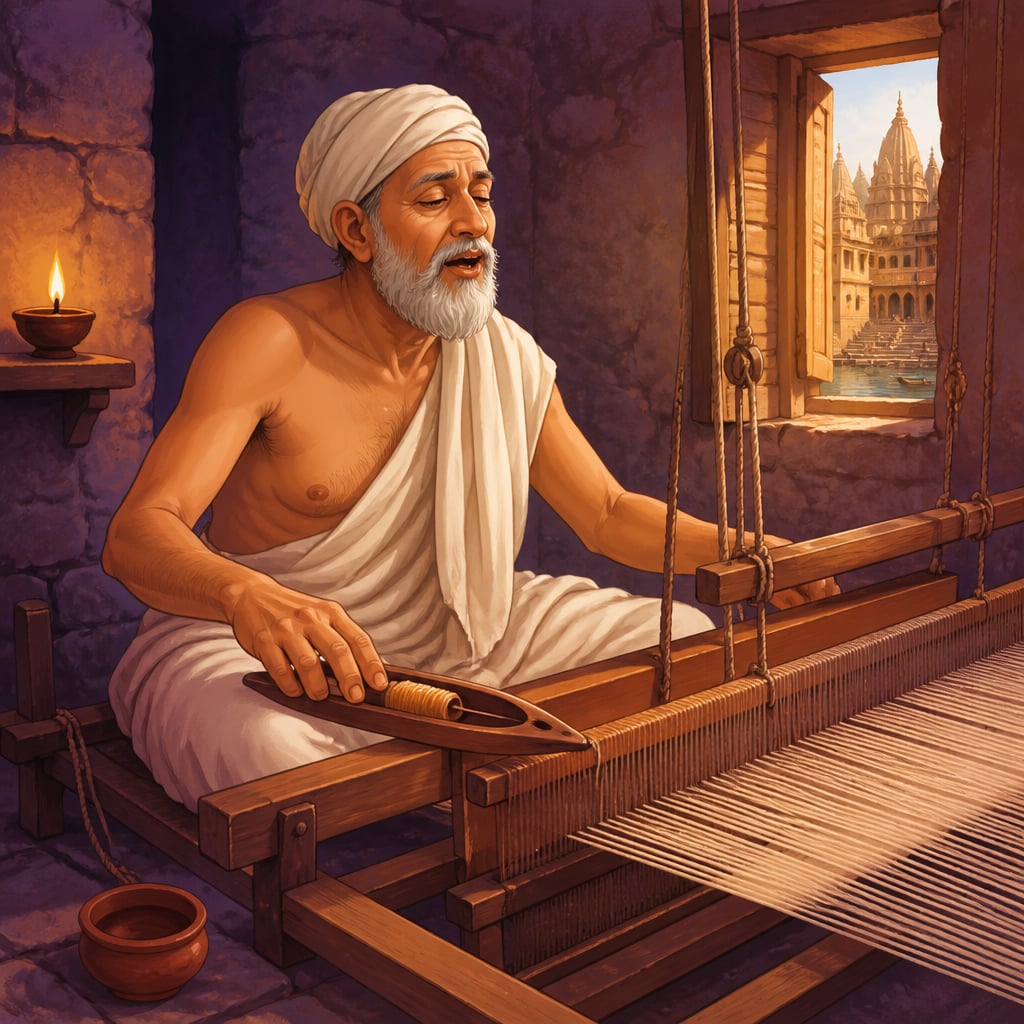
Kabir the weaver-saint singing at his pit loom in Kashi

In a small stone room a few lanes from the river Ganga, in the city of Kashi (now called Varanasi), a Muslim weaver sits at his loom. The year is about 1480. His loom is a wooden frame with a shuttle and a few hundred cotton threads. His hands throw the shuttle. His feet press the pedals. As he works, he sings.

The weaver's name is Kabir. He was born in the Julaha caste, the weavers of Banaras. A poor Muslim couple, Niru and Nima, raised him. He went to no school. He joined no formal religion. But he sang while he worked. And his songs are still being sung today, by both Hindus and Muslims, six hundred years later.

One of his songs begins with the sound of his own loom:

झीनी झीनी बीनी चदरिया। काहे के ताना काहे के भरनी, कौन तार से बीनी चदरिया॥

jhīnī jhīnī binī cadariyā kāhe ke tānā kāhe ke bharanī, kauna tāra se binī cadariyā

Fine, fine, is woven the cloth. What thread forms its warp? What thread its weft? With which thread is this chadariya being woven?

Kabir, chadariya doha (c. 1480)

For Kabir, the cloth on his loom is not really a cloth. It is a human life. The threads are the body. The weaver is God. The loom is the body. The cloth is given to us clean. We must return it clean. That is his whole teaching.

Six hundred years later, the weavers of Banaras are still sitting at pit looms near the same river. About three hundred thousand of them, by current estimates. They still weave silk and gold. Some of their sarees are real handloom silk with real gold-coated silver thread. Some are machine-made copies with plastic thread, sold as the real thing. The weavers know the difference. Most buyers do not. Kabir's question, the one he asked of his own cloth, is the question this tradition still asks itself. Can the chadariya be returned clean?

The Persian Wedding

Persian master weavers teaching Banarasi weavers at Akbar's karkhana

In the 1570s, the Mughal emperor Akbar built his capital at Fatehpur Sikri. He later moved it to Lahore. At each capital, he set up imperial workshops called karkhanas. He brought master weavers to the karkhanas from Persian cities: Yazd, Kashan, Herat, and Samarkand. These weavers knew how to weave gold and silver wire into silk. They knew how to paint with thread.

Indian weavers already knew silk. They had been weaving it for Indian kings and temples for more than a thousand years. But from the Persian masters, they learned something new. They learned how to draw a silver wire fine enough to pass through a silk warp without tearing the cloth. They learned how to spread a single design across thousands of threads without repeating it.

The Persian weavers also brought names for every kind of pattern. A Banarasi weaver still uses these names today:

About a hundred years after Akbar, the emperor Aurangzeb stopped supporting silk weaving at his court. He had religious reasons. But by then, the weavers of Banaras did not need the court. They had learned the full vocabulary. They had become its keepers. The court designs now lived in their own looms.

What Zari Is

The word zari comes from the Persian word for gold. Real zari is not actually gold thread, as many people think. It is a thin flat strip of silver wire. The wire is drawn through smaller and smaller holes in a steel plate until it is as fine as a human hair. Then it is coated with a thin layer of pure gold. Then the coated wire is wound around a silk thread, so a shuttle can carry it through the loom.

A single heavy old-style Banarasi saree could hold a whole kilometre of this silver-and-gold wire wound around silk. The saree was genuinely heavy. A bride lifted it and felt the metal in her hands. If you tapped such a saree with your fingernail, it gave off a small ringing sound, like a tiny bell. The ringing is still one of the tests real weavers use to check if a saree is genuine.

The wire for real zari was made for centuries in the city of Surat. The wire-drawers of Surat were a different craft family from the weavers in Banaras. But the two cities were linked. The wire travelled from Surat to Banaras constantly, and the weavers depended on that supply.

Today, most sarees sold as Banarasi do not have real zari at all. They have a plastic film with a thin metal coating. Some have copper wire with a tiny amount of gold. Some have no metal at all. The weavers know the difference, and the best buyers know it too. Learning to tell the two apart takes only a few minutes. Here is what the weavers look for:

Real Handloom Banarasi Powerloom Imitation
Heavy, with genuine metal weight in the hand Light, feels like polyester
Warm to the touch, a little rough Cool to the touch, slick
Rings softly when tapped with a fingernail Silent when tapped
Clean, carefully finished back Messy back with loose threads
50,000 rupees to several lakhs 1,500 to 10,000 rupees

Most buyers are never taught these tests. The price gap between a real handloom Banarasi and a powerloom copy can be thirty times.

The Mill Century

Between 1815 and 1947, something terrible happened to Indian handloom weavers. The cotton and silk mills of Manchester and Lancashire in England learned to copy Indian designs. They made cheap machine cloth and flooded the Indian market with it. British colonial policy also helped the mills. Handloom cloth was taxed. Mill cloth was not.

The weavers of Banaras, like handloom weavers across India, lost their buyers. Rich courts stopped ordering expensive silks. Ordinary families started buying cheaper mill cotton. The weavers began to sell their sarees on credit, at prices that did not even cover the cost of the silk. Some of them starved. Many left the craft.

But some of them did not leave. What they saved was not the market. The market was gone. What they saved was the knowledge. The pit loom. The kadhwa technique. The names of the motifs. The zari supply chain. They kept weaving, at a loss, for a hundred and thirty years. And they did one more thing. They kept teaching their children how to weave, even when there was no income in it.

They did this because the alternative was worse. If they stopped teaching, the technique would die in one generation. The weavers were poor. But they were not willing to be the ones who let it die.

The GI Fight

For two hundred years, anyone could sell anything under the name Banarasi. A polyester saree from a factory in Surat could be called a Banarasi. A machine-made saree from Bangkok could be called a Banarasi. The real weavers of Banaras had no legal protection. If they complained, nobody listened.

In the early 2000s, a man named Dr. Rajni Kant began working to change this. He was the founder of an organisation called the Human Welfare Association in Varanasi. He wanted to get a legal protection called a Geographical Indication, or GI, for Banarasi sarees. A GI is a kind of trademark tied to a place. Only products that come from the right place, and that are made in the right way, can use the name.

Getting the GI was hard. Dr. Rajni Kant spent years walking through the weaving villages. He documented the traditional techniques. He helped the weavers form collectives. He filed an application with the Geographical Indications Registry in Chennai. The powerloom industry in Surat and other places fought the application. They did not want to lose the right to sell their cheap copies as Banarasi.

On 25 September 2009, the registration was finally granted. The word Banarasi now had a legal meaning. It could only be used for handloom sarees made in nine specific districts of eastern Uttar Pradesh. These are Varanasi, Mirzapur, Chandauli, Bhadohi, Jaunpur, Sant Ravidas Nagar, Azamgarh, Ghazipur, and Kaushambi. After two centuries of being stolen, the name finally belonged to the people who made the thing.

The GI did not solve every problem. Powerloom copies are still everywhere. Tourists are still sold plastic as gold. But now, when a real weaver sees a fake Banarasi in the market, she has a law to stand behind her. Before 2009, she did not.

Madanpura, Now

An Ansari weaver in Madanpura continuing the Banarasi tradition

If you walk into the Madanpura neighbourhood of Varanasi on any morning, you can still hear the looms working. There are three or four dozen looms to a lane. Most of them are in single ground-floor rooms. The pit is dug into the floor. The harness hangs from the ceiling. The weaver sits at the edge of the pit, feet on the treadles, hands throwing the shuttle.

The weavers are mostly from one community, the Ansari Muslims. Most come from families that have been weaving for five generations or more. Most are now in their forties and fifties. The next generation is harder to find.

Why? A pit-loom weaver earns about two to six hundred rupees a day. That is less than many daily-wage workers in a city. But the skill the work requires is as deep as a concert violinist's. The children of weaver families are leaving for easier work. Some move to the powerloom sector. Some go to the Gulf for construction jobs. Some leave the craft entirely.

The sarees that still come off these looms travel far. A buyer from Kolkata might commission one. The saree is packed in a plastic sheet inside a cardboard box. It travels by train. It is unpacked, labelled, and sold in a city shop. The weaver never sees the bride who will wear it. The design is probably one her grandfather knew. The zari may be real or fake. The silk was probably bought from Bangalore. But the hands that made the saree belong to a lineage that has not been broken since Kabir's time.

In the years since 2017, a new kind of patronage has appeared. Sabyasachi Mukherjee, the Kolkata designer, now works directly with Varanasi master weavers on his bridal brocades. The red Banarasi saree he wove for Anushka Sharma's wedding that year became a photograph seen by tens of millions. His atelier supports over three thousand craftspeople across Bengal and Uttar Pradesh, and the orders he places keep hundreds of looms in Madanpura and Lohta running week by week. The old chadariya has found a new buyer in the very market that once walked past it.

At the end of his song, Kabir said the chadariya must be returned clean. The saree on a Madanpura loom is also, in a way, a chadariya. It too is given out to be worn, and asked to be passed on carefully. What the Banaras tradition has carried for six hundred years is not just beautiful cloth. It is the answer to Kabir's question, worked out slowly at the loom. The weavers have carried that answer through many eras. Through Mughal emperors. Through British mills. Through polyester fakes. Through legal registries. Through the slow loss of the next generation. The chadariya is still being woven. Whether it comes back clean depends on who picks it up next.

Key figures

Kabir

A 15th-century weaver and poet of Banaras. Kabir was born into the Julaha caste, the weavers of the city. He wrote hundreds of dohas (songs) in Sant-bhasha, a mixed language of several North Indian dialects. His songs speak to both Hindu and Muslim listeners. They are still sung today in temples, mosques, and weaver households across North India.

Jalal ud-din Muhammad Akbar

The third Mughal emperor. He ruled from 1556 to 1605. Akbar set up imperial workshops called karkhanas at his capital Fatehpur Sikri and later at Lahore. He brought master weavers to these workshops from Persian cities. The result was the mix of Persian design and Indian silk technique that created the Banarasi brocade style.

Dr. Rajni Kant

The founder of the Human Welfare Association in Varanasi. He led the effort to get legal protection for Banarasi sarees, and he filed the Geographical Indication application that was granted on 25 September 2009.

Case studies

The 2009 GI Fight

Between 2000 and 2009, Dr. Rajni Kant, the founder of the Human Welfare Association in Varanasi, led a ten-year effort to get legal protection for the Banaras weaving tradition. The application had to document the traditional techniques (the pit loom, the kadhwa weft work, the real-zari kalabattu thread). It had to identify the specific weaver community (the Ansari Muslims of Varanasi and the nearby districts). It had to draw the exact geography to be covered (nine districts in eastern Uttar Pradesh). And it had to survive strong opposition from the powerloom industry in Surat and other places, which had been freely selling machine-made copies under the Banarasi name for years. The application was filed with the Geographical Indications Registry in Chennai under the Indian GI Act of 1999.

The GI fight is a modern legal version of a very old dharmic idea: a community has the right to name and protect the work it does. The Banaras weavers' teaching lineage, which had carried the craft hand to hand from Kabir's time through the Mughal karkhanas and the colonial collapse, was the real substance the GI registration needed to protect. Without the unbroken teaching tradition, there would have been no defined technique to register. Without the registration, the defined technique had no protection against imitation. The weavers held the craft. The law finally held the name.

On 25 September 2009, the registration was formally granted. It covers Varanasi and eight nearby districts: Mirzapur, Bhadohi, Chandauli, Jaunpur, Sant Ravidas Nagar, Azamgarh, Ghazipur, and Kaushambi. Since then, the word 'Banarasi' has had a legal meaning in India: handloom production, inside this geography, using the specified techniques. Enforcement is still partial. Powerloom imitations still dominate the mass market. But the name can now be defended in Indian courts. And the people who have the right to defend it are the weavers themselves.

Giving a craft tradition a legal name is not a bureaucratic afterthought. It is the foundation of everything else. Before the name has a defined geography and a defined technique, the craft has no shield against imitation. After it has both, the weavers hold the name. What made the 2009 registration possible was the unbroken teaching lineage that had preserved the technique through the previous two centuries of market collapse.

Dr. Rajni Kant and the Human Welfare Association have been directly involved in several of the later Indian craft GI filings. The Banarasi approach (document the technique, build the weavers' collective, file the application, pursue enforcement in court) has become the standard playbook for protecting Indian handloom heritage.

The Banarasi GI was one of the earliest Indian handloom crafts to be protected under the 1999 Act. It is now the model for later GI filings for Pochampally ikat, Kanchipuram saree, Chanderi, Mysore silk, Bidriware, Channapatna toys, and many others.

The Authentic vs Fake Test

Imagine you are walking through the lanes behind Kashi Vishwanath in Varanasi, looking for a Banarasi saree for a wedding. A shop owner shows you two sarees that look almost the same: both gold-on-red with classic jangla floral pallus. One costs fifteen thousand rupees. The other costs seventy-five thousand. The shop owner tells you that both are 'real Banarasi'. You want to know how to tell the difference, without being a weaver yourself.

Real Banaras weavers rely on four tests that anyone can learn. First, weight. A real handloom Banarasi with real silver-gilt zari is noticeably heavier than a polyester powerloom copy, because the silver content is real. Second, touch. Real silk is warm to the hand and a little rough between the fingers. Polyester is cool and slick. Third, sound. Tap the fabric with the back of your fingernail. Real zari gives a small bell-like ring that plastic film does not. Fourth, the reverse side. A real handloom kadhwa Banarasi has a clean, carefully finished back where each motif has been worked by hand. A powerloom imitation has a messy back with loose threads and machine-cut patterns.

You hold both sarees in your hands. The heavier one is warmer to the touch, rings lightly when you tap it, and has a clean back. The lighter one is cool and slick, silent under the fingernail, and its back is knotted. The seventy-five thousand saree is the real handloom Banarasi with real zari. The fifteen thousand saree is a powerloom imitation with plastic film. You buy the real one. You have just paid for about seventy days of a pit-loom weaver's work.

Telling real from fake is not a mystery once you know the tests. The four tests are simple, old, and can be done in under a minute. The reason most buyers cannot tell the difference is not that telling is hard. It is that nobody ever taught them. The GI tag exists partly to protect buyers who cannot run the tests themselves, by giving them a legal claim. But the tests still work, and any reader who might buy a Banarasi in her life should learn them.

Several weavers' cooperatives and the Banaras Bunkar Samiti now issue authentication tags on verified handloom sarees. Government schemes like the India Handloom Brand seal, and online platforms such as Amazon Karigar, try to extend these authentication tests to online shopping. But the underlying touch, weight, and sound tests are still the most reliable check a buyer can do in person.

By industry estimates, most of the sarees sold as 'Banarasi' in Indian retail today are powerloom imitations or polyester blends. The price gap with a real handloom Banarasi can be as much as thirty times. A real-zari kadhwa bridal saree may represent six to twelve months of a single weaver's work.

The Mid-Century Collapse and the Apprenticeship That Saved It

Between 1820 and 1950, a Banaras weaving family of four generations might have lived through one of the longest craft declines in Indian economic history. The grandfather in 1830 wove real-zari brocades for a nawab of Lucknow who paid in gold coin for a single saree. His son in 1870 wove for petty traders in Bombay at a quarter of that price, under rising pressure from Manchester cotton-cloth imports. His grandson in 1910 wove at a loss, paid only by a moneylender's credit, because Lancashire silk mills were flooding the Indian market with machine-made copies. His great-grandson in 1940, working under Gandhi's khadi movement and wartime cloth rationing, wove in obscurity, taught by his father a technique whose market had almost vanished.

Through four generations of market collapse, the family preserved the craft not by chasing customers, but by the one thing the colonial market could not take from them: the teaching relationship. Every generation taught the next, at a loss, when there was barely food in the house. Because if they stopped teaching, the technique would die in one generation. The pit loom, the kadhwa, the zari chain, the floral vocabulary, all of it passed through hands that were poorer every year than the hands that had taught them. The apprenticeship was not an economic decision. It was a dharmic one.

When Indian independence came in 1947, the Banaras weaving tradition was alive, though very poor. It was alive because the four mid-century generations had refused to let it die, even when the market gave them no reason to keep it. The post-independence Khadi and Village Industries Commission of the 1950s, the All India Handicrafts Board, the designer partnerships of the 2000s, and finally the 2009 GI registration all stand on the foundation of that hundred-and-thirty-year unpaid apprenticeship.

Craft traditions are saved by teachers, not by markets. When the market for a tradition collapses, the only thing that keeps it alive is the decision of the older generation to teach the younger one anyway, for reasons that have nothing to do with income. The Banaras weavers made that decision across four generations of the colonial century. The tradition survived because they did. Whatever revival has come since is built on the unpaid apprenticeship work they did when nobody was buying.

The pattern of preserving a craft through unpaid apprenticeship when its market has collapsed is now recognised by scholars of intangible cultural heritage as one of the main ways that Indian handloom traditions survived the colonial century. The Banaras brocade tradition is studied as one of the clearest examples. The teaching lineage can be traced through the colonial decline even without a supportive market. And the post-independence revival would not have been possible without it.

At the lowest point in the late 19th century, the Banaras handloom economy had shrunk to a small fraction of its early-Mughal output. But the technique itself was not lost. Every major pattern and weft technique later documented in the 2009 GI registration can be traced, through unbroken teaching lines, back to pre-colonial Banaras.

Historical context

The Banaras weaving story runs from the 15th-century bhakti songs of Kabir, through the 16th and 17th-century Mughal karkhana workshops, through the 19th and 20th-century colonial collapse, and into the 21st-century legal revival under the 2009 Geographical Indication registration.

Silk weaving in India is much older than the Banarasi style. Indian weavers had been weaving silk for Gupta emperors, Pallava temples, and Chalukya kings for a thousand years before the Mughal period. The Banarasi style itself took shape in the 16th and 17th centuries, when Akbar's karkhanas brought Persian master weavers to India. Their floral, hunting, and geometric designs mixed with the older Indian silk craft. The Ansari Muslim weaver community of eastern Uttar Pradesh has carried this combined tradition from that time until today. The weavers are concentrated in the mohallas (neighbourhoods) of Madanpura, Alaipura, Lallapura, and Bajardiha in Varanasi, and in the nearby weaving towns of Mirzapur, Bhadohi, Chandauli, Jaunpur, Sant Ravidas Nagar, and Azamgarh.

The Banarasi brocade's late-Mughal flourishing happened at the same time as Safavid silk production at Isfahan, Ottoman brocades at Bursa, and Italian velvets from Venice and Genoa. The colonial-era Indian decline is a parallel story to the near-extinction of the Lyon silk trade in France under the same kind of mill pressure. The 2009 GI registration follows the model of French and Italian protected food and wine names. But it is the first Indian handloom protection that the weavers' own collectives have actively defended in court.

About three hundred thousand weavers in eastern Uttar Pradesh still practise the Banaras handloom tradition today, across nine GI-protected districts. A single heavy old-style handloom saree could contain a whole kilometre of silver-gilt wire wound around silk. The price gap between a real handloom Banarasi and a powerloom imitation can be as much as thirty times.

Banarasi brocade is the clearest example of an Indian craft tradition that survived the colonial century by sheer apprenticeship. The weavers passed the skill from teachers to students even when nobody was paying for the work, for more than a hundred years. It is also one of the first Indian crafts to recover legal protection under the Geographical Indication law of 1999. The story of Banarasi is the story of whether Indian craft can survive powerloom imitation and polyester fakes in a global market.

Living traditions

The 2009 Geographical Indication registration secured legal protection for handloom Banaras brocades. It allows the 'Banarasi' name to be used only for handloom sarees made in the nine specified districts. The Human Welfare Association, the Banaras Bunkar Samiti, central Textiles Ministry schemes, and modern designer partnerships (Sabyasachi, Ritu Kumar, Raw Mango, and others) are now working together to keep the tradition alive. The India Handloom Brand seal and online platforms such as Amazon Karigar try to extend authentication to online buyers. But powerloom imitations still dominate the mass market.

Reflection

More in Tantuvaya (तंतुवाय) - Silk Weaving

All lessons in Tantuvaya (तंतुवाय) - Silk Weaving · Traditional Crafts & Textiles course