Muga & Eri: The Wild Silks of Assam

In 1554, the saint Sankaradeva commissioned a sixty-foot Muga silk tapestry called the Vrindavani Vastra. Five centuries later, the golden thread still glows. But the worm that makes it is now in trouble.

Around 1554, in a weaver village near the Brahmaputra, the Assamese saint Sankaradeva designed a sixty-foot tapestry showing the life of Krishna. He chose a golden wild silk called Muga, a thread that can only be grown in Assam. The cloth was woven under his instruction and given to the Koch king. A large fragment of it hangs today behind glass in the British Museum in London. Its golden threads still glow. This lesson tells the story of Muga and its non-violent cousin Eri: how the Ahom kings made Muga the royal silk of Assam, how the mekhela chador became the quiet flag of Assamese identity, how climate change is now killing the trees the worm feeds on, and how a second wild silk called Eri, woven without killing the worm, is quietly going global as the world's only real ahimsa silk.

A Village by the Brahmaputra
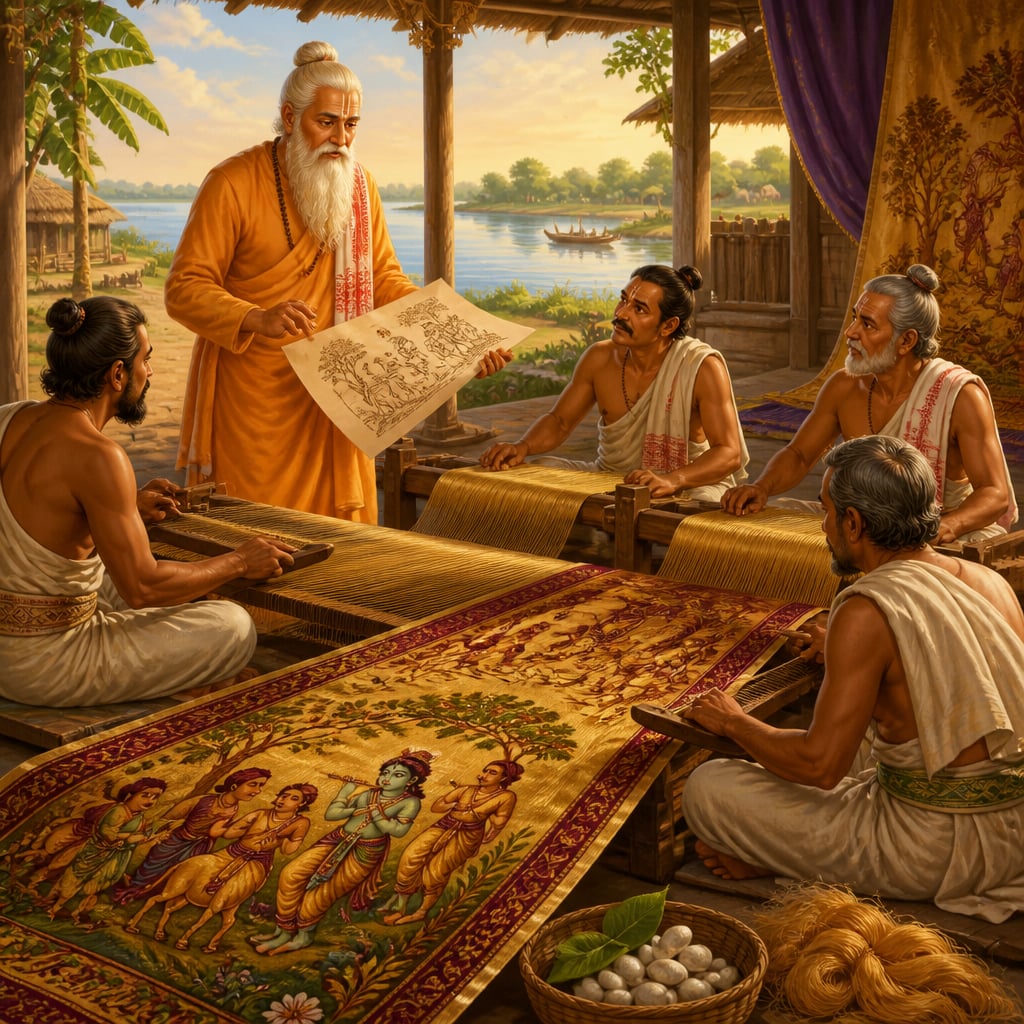
Sankaradeva directing the weaving of the Vrindavani Vastra in 1554

In the weaver village of Tantikuchi, a few miles from the Brahmaputra, in the year 1554, a man in saffron robes stood over a row of strange cocoons. The cocoons were pale tan, the colour of old honey. They had been brought in that morning from a grove of Som trees by a farmer's son. The man in robes was Srimanta Sankaradeva, poet, playwright, and founder of the Ekasarana faith of Assam. He was an old man by this time, long past ninety by traditional Assamese reckoning. And he had an idea for a cloth that had never been woven before.

Sankaradeva wanted a single tapestry that would carry the whole of Krishna's childhood in Vrindavan. The cloth would be more than sixty feet long. It would show scenes the farm children already knew by heart: Krishna dancing on the hood of the serpent Kaliya, Krishna lifting the Govardhana hill on one finger, Krishna playing the flute under a Kadamba tree. The tapestry would be woven from the golden wild silk of Assam, a thread no other land on earth could produce. A group of village weavers at Tantikuchi would do the work. They would be supervised by his disciple Madhavdeva. The weaving would take roughly six months.

The thread he chose was Muga (pronounced mooga). The cocoons on the ground were the shells of Antheraea assamensis, a semi-wild silk moth that lives nowhere else on earth. Its larvae feed on only two trees, Som and Soalu, that grow in a few lowland districts of Assam and nowhere else at scale. The raw silk reeled off these cocoons is a natural golden yellow from the very first moment. And then something unusual happens to it. Every time the cloth is washed, the gold becomes brighter. A Muga mekhela chador woven for a grandmother in 1900 glows richer in 2026 than the day it was made.

The cloth Sankaradeva designed was finished around 1555. It became known as the Vrindavani Vastra, the cloth of Vrindavan. It was given to Naranarayana, the Koch king who ruled this region at the time. Over the centuries the tapestry travelled. It went from the Koch court into Tibet, where Buddhist monks kept it for almost three hundred years. From a Tibetan monastery a British collector bought a large fragment of it in 1904. Today that fragment hangs behind glass in the British Museum in London, in the South Asia galleries. Its golden threads still catch the light the way they caught it in the Koch court. The Som trees of the Brahmaputra valley are the only reason that colour exists.

This lesson is about the two wild silks of the Brahmaputra valley: Muga, the golden thread Sankaradeva chose for his tapestry, and Eri, a second wild silk with a very different life. Together they make up one of the oldest and most distinct silk economies in the world. And today, almost five centuries after Sankaradeva drew his design, both silks are under a threat he could not have imagined.

Two Silks, Two Lives

Indian silk has four main kinds. The most familiar is mulberry silk, reeled from the cultivated Bombyx mori worm, which made Banaras and Kanchipuram famous. The other three are called vanya (wild) silks: Muga, Eri, and Tasar. Assam is the only place on earth that produces all three. Muga and Eri, in particular, belong almost entirely to the Northeast.

Muga (Antheraea assamensis) is the jewel of the group. The moth is semi-wild. The farmer cannot pen it indoors. The larvae must be released into a grove of Som or Soalu trees and watched over while they eat. They spin cocoons on the branches. The cocoons are collected by hand, boiled briefly in soapy water, and reeled onto wooden frames. A single Muga saree takes between one and two months to weave. A real handloom Muga mekhela chador, with hand-woven motifs, can cost between twenty thousand and a lakh rupees. Muga received a Geographical Indication tag in 2007. It was the first non-agricultural product from the Northeast to win GI protection.

Eri (Samia ricini) has a completely different life. The name comes from era, the Assamese word for the castor plant. The worms feed on the leaves of the common castor bush that grows in kitchen gardens all over Assam. The truly unusual thing about Eri is what happens at the end. With mulberry silk and Muga silk, the worm is killed inside the cocoon so the filament can be reeled out in one long strand. With Eri, the weavers wait. They let the moth chew its way out of the cocoon and fly away. Only then is the empty cocoon collected, torn open, and spun (not reeled) into a short-fibre yarn. This is why Eri is called Ahimsa silk: non-violent silk, woven without killing the worm.

Eri cloth is warm and slightly wool-like, closer to a cashmere stole than to a Banarasi saree in the hand. It is the everyday winter textile of the Bodo, Mising, Rabha, Garo, and Khasi communities of the Northeast. An Eri shawl kept carefully can last three or four generations.

Muga Eri
Golden yellow, gets brighter with every wash Off-white or cream, naturally dyed
Smooth and lustrous, like mulberry silk Warm and wool-like, close to cashmere
Reeled (continuous filament) Spun (short fibres, like cotton)
Worm killed for the cocoon Worm released alive (ahimsa silk)
Mekhela chador, wedding wear, heirloom Daily shawls, winter wraps, stoles
Endemic to Assam, GI 2007 Assam, Meghalaya, Manipur, Nagaland

The Ahoms and the Royal Thread

The Muga tradition is older than the Vrindavani Vastra, but it was the Ahom dynasty that turned it into a royal craft. The Ahoms were a Tai-speaking people who crossed the Patkai hills from upper Burma in 1228 CE under their first king, Sukaphaa. They ruled upper Assam for almost six hundred years. It was the longest single dynasty in Indian history. From the thirteenth century onward, they supported silk weaving in the villages along the Brahmaputra.

Under Ahom rule, Muga became the cloth of the court. A commoner wore cotton. A nobleman wore Muga. A Swargadeo (the Ahom king, literally lord of heaven) wore Muga brocaded with gold thread. The small town of Sualkuchi, on a bend of the Brahmaputra thirty-five kilometres from modern Guwahati, was designated a royal weaving centre. Skilled weavers were brought in and settled there. Their descendants still work the same lanes.

One Ahom ruler stands out. Phuleswari Kunwari, known as the Bar Raja (the Great Queen), ruled Assam from 1722 to 1731. She was the first and only queen of the dynasty to govern in her own name. Before her marriage to the Swargadeo, she had been a temple dancer. As ruler, she strengthened the royal weaving workshops and commissioned Muga and Pat silks for temple rituals and court ceremonies. The weaving economy of Sualkuchi today traces a straight line back to her patronage.

Sualkuchi is now called the Manchester of the East. Recent estimates count around twenty-five thousand weavers in this one small town. Almost every house has at least one loom. A family's day begins with the sound of the shuttle and ends with it. The same looms that wove court silks for Phuleswari Kunwari three hundred years ago are weaving mekhela chadors today for Bihu brides in Guwahati, Dibrugarh, and Silchar.

The Mekhela Chador and the Assamese Self

The finished Muga cloth becomes a mekhela chador, the two-piece wrap that Assamese women have worn for at least a thousand years. The mekhela is the lower cylinder, stepped into and folded at the waist. The chador is the upper length, draped over the left shoulder and tucked at the hip. A full Muga mekhela chador is worn at Bihu, at weddings, at the first rice-feeding of a baby, and at the funerals of elders.

The garment is more than dress. In Assam it is identity. During the Assam Movement of 1979 to 1985, when Assamese students campaigned for the protection of their language and land, the mekhela chador became a quiet flag. Young women wore it to rallies. Photographs of the movement show lines of Muga-yellow against the grey of Guwahati pavements. The cloth carried a statement no legal document could make: we are from this river, and this thread comes from nowhere else on earth.

An Assamese bride in a golden Muga mekhela chador

A bridal mekhela chador carries motifs woven by hand. The kingkhap is a diamond lattice. The gosa is a flower cluster. The miri is a geometric band borrowed from the Mising people. Each district of Assam has its preferred combinations. A buyer who knows how to read a chador can often tell where the bride is from just by looking at her saree.

The Crisis on the Som Trees

For all its seven centuries of continuity, the Muga tradition is now in serious trouble. The problem is not the market. Authenticated Muga sells better than it has in decades. The problem is the worm.

Muga silkworms are picky eaters. They can only live on Som (Persea bombycina) and Soalu (Litsaea polyantha) leaves. They cannot tolerate temperatures much above twenty-eight degrees Celsius or much below thirteen. The Brahmaputra valley, where they have lived for millennia, has been warming steadily since the 1980s. Summer highs now regularly cross thirty-two. The Som groves have also been shrinking for decades, cleared for tea gardens, rice paddies, and housing.

On top of the heat, the silkworms face industrial pollution. A 2018 study by the Central Silk Board and Assam Agricultural University found that Som leaves within a ten-kilometre radius of the Numaligarh and Guwahati refineries show raised sulphur and heavy-metal content. Worms fed on these leaves die at higher rates. Muga cocoon production in parts of Nagaon and Jorhat districts has fallen to roughly a third of its 1990 level. Some grove owners have given up on Muga and shifted to Eri, which is less fussy about its food.

The Central Muga Eri Research and Training Institute at Lahdoigarh, near Jorhat, is trying to breed heat-tolerant strains of the worm and healthier grafts of the Som tree. But it is a slow fight. A cloth that has glowed for seven centuries is thinning because the trees the worm eats no longer like the air they grow in.

The Peace Silk Goes Global

The Eri story is moving in the opposite direction. For centuries, Eri was a local winter cloth. It was woven by Bodo, Mising, and Rabha women in their own homes, worn by their families, and occasionally bartered between villages. Outside Assam almost nobody had heard of it.

That began to change in the 2000s. Bibi Russell, a Bangladeshi designer and former fashion model who came back to Dhaka to work with handloom weavers, began sourcing Eri yarn from cooperatives in Assam for her Bibi Productions label. She showed Eri shawls and stoles at fashion weeks in Paris, Milan, and Tokyo. Eri, marketed as the world's only real ahimsa silk, spoke directly to a global audience already worried about animal welfare and sustainability. Vegetarian and Buddhist buyers in Japan and Europe became regular customers.

The Bodo Eri women's cooperative weaving Eri shawls in Kokrajhar

Today the Bodo Eri cooperative in Kokrajhar, the Mising women of Majuli, and NGOs in Meghalaya and Nagaland ship Eri shawls to buyers in Berlin, Melbourne, and New York. A silk once so local it was traded in village bundles is now one of the Northeast's cleanest export lines. And the worm, alone among commercial silks, still flies free at the end of its life.

Modern Echoes

The Vrindavani Vastra that Sankaradeva commissioned in 1554 hangs behind glass in London. But its thread is still being spun on wooden reels in Sualkuchi, and its non-violent cousin is still being combed by Bodo women in Kokrajhar. Both silks are now speaking to concerns the sixteenth century could not have named. The Ashoka Trust for Research in Ecology and the Environment (ATREE) has published field studies on Som tree decline that read like a warning label on the future of Muga. The 2019 UN Environment report on sustainable fashion named Eri among the cleanest natural fibres in global use. The Assamese designer Sanjukta Dutta showed a full Muga and Eri collection at India Runway Week in 2019, and her mekhela chadors have since been worn by Bollywood actors at Cannes.

The trees that feed the golden worm are fewer each year. The river warms. The grove around Lahdoigarh is half what it was in 1980. But the loom in Sualkuchi is still running. Somewhere on it, a young woman is weaving a Muga chador that will outlast her.

Back in Tantikuchi in 1554, Sankaradeva watched a handful of weavers begin a cloth that would still be glowing five centuries later. The tapestry did what he asked of it. Whether the thread itself lasts another five centuries now depends on the trees, the refineries, and the weavers of Sualkuchi, Kokrajhar, and Majuli, who are still holding a loom the Ahom queens once patronised and Sankaradeva once designed upon.

Key figures

Srimanta Sankaradeva

A fifteenth and sixteenth century saint, poet, playwright, and social reformer of Assam. Sankaradeva founded the Ekasarana faith, a devotional movement built around the worship of Krishna through song, story, and community singing. He translated parts of the Bhagavata Purana into Assamese, wrote a large body of devotional songs called borgeets, and created the first Assamese plays. Around 1554, at an advanced age, he designed the Vrindavani Vastra, a sixty-foot Muga silk tapestry depicting the life of Krishna.

Phuleswari Kunwari

The first and only reigning queen of the Ahom dynasty of Assam. She was given the title Bar Raja, meaning the Great Queen, and ruled from 1722 to 1731. Before her marriage to the Swargadeo Siva Singha, she had been a temple dancer. As ruler, she strengthened the royal weaving workshops of the Ahom court, commissioned Muga and Pat silks for temple rituals and court ceremonies, and continued the settlement of master weavers at Sualkuchi.

Bibi Russell

A Bangladeshi designer and former international fashion model. Born in Chittagong in 1950 and trained at the London College of Fashion, she modelled for Vogue, Harper's Bazaar, and Cosmopolitan in the 1970s and 1980s. In 1994 she returned to Dhaka and founded Bibi Productions, a label built around traditional handloom weaving from the Bengal and Northeast region. In the 2000s she began sourcing Eri silk yarn from Assamese cooperatives and showing Eri shawls and stoles at fashion weeks in Paris, Milan, and Tokyo.

Case studies

The Ahom Royal Thread

The Ahom dynasty ruled upper Assam from 1228 CE under their first king Sukaphaa until 1826 under the Treaty of Yandabo with the British. For almost six hundred years, the Ahom court supported and then directly organised the silk weaving economy of the Brahmaputra valley. Muga silk, a wild golden thread produced only in Assam, became the royal cloth. A commoner wore cotton. A nobleman wore Muga. A Swargadeo, the Ahom king, wore Muga brocaded with gold. Master weavers were brought in and settled in the town of Sualkuchi, thirty-five kilometres west of modern Guwahati. The most decisive royal patron came late in the dynasty: Phuleswari Kunwari, known as the Bar Raja, ruled in her own name from 1722 to 1731 and strengthened the royal weaving workshops for temple rituals and court ceremonies.

In the dharmic understanding of craft, royal patronage is not only an economic transaction. It is a covenant. The king provides money, prestige, protection, and demand. The craft community provides skill, apprenticeship, and continuity. Each generation of weavers trains the next, knowing that the king's house and the temples will need the cloth. The Ahoms did this for almost six centuries. Even after their dynasty fell in 1826 under British pressure, the weaving tradition they had built at Sualkuchi survived, because the craft community by then held the skill themselves. Phuleswari Kunwari's particular contribution, strengthening the workshops as a woman ruler, also gave Assamese women a direct royal model for holding Muga silk as a public identity.

Today Sualkuchi has roughly twenty-five thousand active handloom weavers in a single small town. The town is often called the Manchester of the East. Almost every household owns at least one loom. The families who weave today are the direct descendants of the weavers the Ahom court settled there centuries ago. The motifs (kingkhap, gosa, miri) and the royal Muga-with-gold techniques are still practised on the same looms. The mekhela chador worn at every Assamese wedding today is the living inheritance of the six-hundred-year Ahom patronage, and of Phuleswari Kunwari's nine years as Bar Raja in particular.

Royal patronage alone does not save a craft. A hundred Indian crafts had royal patronage and did not survive the colonial century. What saved Sualkuchi was that the Ahoms gave the craft community enough time, money, and prestige to build an unbroken teaching lineage across many generations. Once the lineage existed, it outlasted the dynasty itself. When you are supporting a craft today, the question to ask is the same: are you giving the community enough time and demand to train the next generation, or only enough to finish this one order?

The Assam government's Muga Silkworm Seed Organisation, the Central Silk Board, and the Assam Silk Outreach Mission are the modern versions of Phuleswari Kunwari's royal weaving workshops. They exist because a living tradition still needs an institution behind it that can guarantee continuity across generations, exactly as the Ahom court did. Modern patrons (state governments, designer houses, co-operative banks) are playing the role the Swargadeo once played.

The Ahom dynasty ruled for almost six hundred years, longer than any other single dynasty in Indian history. Phuleswari Kunwari ruled as Bar Raja from 1722 to 1731. Sualkuchi today has around twenty-five thousand working handloom weavers in a town of modest size.

The Quiet Flag: Mekhela Chador as Assamese Identity

Between 1979 and 1985, the Assam Movement (Asom Andolan) was one of the largest language and identity movements in independent India. It was led by the All Assam Students Union and the All Assam Gana Sangram Parishad. The central demand was protection of Assamese language, land, and cultural identity against what the movement called uncontrolled in-migration. The movement was largely non-violent, though it had tragic moments, and it ended with the Assam Accord of 1985. Through those six years, an unexpected visual element kept appearing in the protest photographs: young women at rallies in Guwahati and across the valley, wearing bright Muga-yellow mekhela chadors.

A garment that is woven from a thread that grows in only one valley carries a particular kind of identity. It cannot be imitated without being imported from that same valley. In the Assamese understanding, the mekhela chador is not only beautiful dress. It is a statement of belonging: this cloth comes from this river, and so do I. The Ahoms made it the royal wear. Sankaradeva tied it to the devotional life of the region. Phuleswari Kunwari secured its royal weaving workshops. By the 1980s, four centuries of that layered meaning made the Muga mekhela chador the single most efficient visual flag of Assamese identity that existed. No slogan was needed. The cloth itself said everything.

The Assam Movement ended with the Assam Accord of 15 August 1985. The accord addressed questions of citizenship, land rights, and political representation. Beyond the legal outcomes, something else happened. The mekhela chador, and especially the Muga one, became permanently attached in public memory to the idea of Assamese self-assertion. After 1985, any Bihu festival, any wedding, any political meeting in Assam featured women in Muga-yellow in a way that now seemed explicit rather than traditional. The cloth has remained a quiet flag of identity ever since.

Identity is often carried more effectively by objects than by arguments. A cloth that is woven from a thread that only grows in one valley is a more convincing statement of belonging than any amount of text. When a community wants to say who it is, it usually reaches for something physical that cannot be counterfeited. For Assam, that object was the Muga mekhela chador. For other communities it might be a particular cuisine, a song, a handshake, a festival. The lesson is that preserving the physical thing preserves the identity more reliably than preserving the words about it.

Today the mekhela chador continues to carry this role. It is worn at Bihu, at weddings, at university convocations, at political rallies, and increasingly in the Assamese diaspora in Bengaluru, Delhi, the Gulf, and North America. Bollywood actors with Assamese roots have begun wearing Muga chadors on international red carpets. The cloth has turned into one of the most recognisable regional identity markers anywhere in India, alongside the Kanjeevaram saree of Tamil Nadu and the Banarasi of Uttar Pradesh.

The Assam Movement ran from 1979 to 1985 and ended with the Assam Accord of 15 August 1985. In the same decade, sales of hand-woven Muga mekhela chadors in Guwahati grew significantly, both as ceremonial wear and as a form of public identification with the movement's cultural goals.

The Thinning Thread: Muga and the Climate Crisis

Between 1990 and 2025, Muga silk production in Assam has come under unprecedented pressure, not from the market but from the environment. The Muga silkworm can only survive on Som (Persea bombycina) and Soalu (Litsaea polyantha) trees. It cannot tolerate temperatures much above twenty-eight degrees Celsius. The Brahmaputra valley, where the worm has lived for millennia, has been warming steadily since the 1980s. Summer highs now regularly cross thirty-two. On top of the heat, the Som groves have been shrinking due to clearance for tea, rice, and housing, and the leaves themselves are contaminated by sulphur and heavy metal deposits from the Numaligarh and Guwahati refineries. A 2018 study by the Central Silk Board and Assam Agricultural University documented elevated worm mortality on refinery-adjacent groves.

In the dharmic understanding of craft, the workshop and the forest are not two separate things. They are the same thing. Muga silk is not produced in a factory. It is produced in a grove. The grove is part of the tradition in exactly the same way the loom is. When the grove fails, the loom is still there, but the thread is not. The Ahoms understood this. Their royal patronage of Sualkuchi always included support for Som plantations and for the rearers who watched the worms on the branches. The modern Indian state has been slower to see the connection. A Geographical Indication tag protects the name, not the ecology that underlies the name.

Muga cocoon production in parts of Nagaon and Jorhat districts has fallen to roughly a third of its 1990 level. Some grove owners have given up on Muga and shifted to Eri, which is less fussy about food and temperature. The Central Muga Eri Research and Training Institute at Lahdoigarh, near Jorhat, is now breeding heat-tolerant strains of the Muga worm and experimenting with healthier Som grafts. The Assam Silk Outreach Mission is planting new Som groves on protected land. But the crisis is still growing faster than the response. Real handloom Muga mekhela chadors are increasingly rare and correspondingly expensive. A bridal piece can now cost a lakh rupees or more.

Every craft tradition we want to preserve rests on an ecological ground that we usually do not see until it starts to fail. The technique can be taught. The loom can be rebuilt. The motifs can be copied from a book. But the tree, the worm, the river, the soil, the micro-climate, these cannot be re-created from blueprints. When we plan craft preservation, we must also plan ecological preservation in the same breath. Muga is the clearest example in India of a craft that is being threatened not by its competitors but by the air around its trees.

Muga is being studied by climate and craft researchers as a test case for the question of whether the world's most place-rooted crafts can survive industrial pollution and rising temperatures. The Ashoka Trust for Research in Ecology and the Environment (ATREE) has published field studies on Som tree decline that have become key references. The question the Muga tradition is now asking is the same question every traditional craft will eventually have to ask: what happens to a tradition whose raw material is no longer being produced by the land around it?

Muga silkworms cannot tolerate temperatures much above twenty-eight degrees Celsius. Summer highs in the Brahmaputra valley now regularly exceed thirty-two. Cocoon production in parts of Nagaon and Jorhat has fallen to roughly one-third of 1990 levels. The Central Muga Eri Research and Training Institute is the main government research centre working on heat-tolerant strains.

From Kitchen Loom to Global Runway: Bibi Russell and Eri Silk

Bibi Russell was born in Chittagong in 1950, trained at the London College of Fashion in the 1970s, and became one of the first South Asian models to appear in Vogue, Harper's Bazaar, and Cosmopolitan. In 1994, at the height of her international career, she returned to Dhaka and founded Bibi Productions, a label built entirely around traditional South Asian handloom weaving. From the early 2000s onward, she began sourcing Eri yarn from cooperatives in Assam. At the time, Eri silk was essentially unknown outside the Northeast. It was a local winter cloth, woven by Bodo, Mising, Rabha, Garo, and Khasi women in their own kitchens, mostly for their own families. Russell began showing Eri shawls and stoles at fashion weeks in Paris, Milan, and Tokyo, and marketing the cloth as the world's only real ahimsa silk, since the moth is allowed to emerge alive from the cocoon before the silk is spun.

In the dharmic understanding of craft, the reason a technique exists at all is often invisible to the people who practise it. The Bodo and Mising weavers did not develop Eri as an explicit ethical statement. They developed it because releasing the moth alive was simply how their grandmothers had done it, and it worked. That unplanned non-violence turned out to carry a meaning far beyond the valley it came from. Buddhism, Jainism, vegetarian ethics, and the modern global concern for animal welfare all pointed toward a textile that could be produced without killing the worm. Eri was quietly waiting. All it needed was someone to carry it to the world. Bibi Russell was one of the first to do it.

Today the Bodo Eri cooperative in Kokrajhar, the Mising women's groups of Majuli, and NGOs across Meghalaya, Manipur, and Nagaland ship Eri shawls and stoles to customers in Berlin, Melbourne, New York, Tokyo, and Kyoto. Eri has been featured in UN Environment reports on sustainable fashion. Several European and Japanese buyers now commission Eri pieces directly from village cooperatives. For the weavers, the income is transformative. A Bodo woman who once spun Eri only for her own family can now earn steady monthly income from orders placed by Tokyo and Berlin. The worm still flies free at the end of its life.

A craft that looks small, local, and invisible can carry a meaning that the whole world turns out to need. The Bodo and Mising weavers did not have to change what they were doing. They only had to be seen doing it. Bibi Russell's work was not to redesign Eri. It was to carry Eri to a stage where the rest of the world could meet it. The lesson is that many traditional crafts already hold the answer to modern problems. The work is not to invent new techniques but to find the courier who can walk the old technique into the new market without distorting it.

The Bibi Russell model, carrying a village craft onto a global runway as it actually is, has since been followed by many other designers working with Indian handloom. Sanjukta Dutta has done similar work for Muga. Ritu Kumar and Raw Mango have worked with Banarasi and Chanderi. Aneeth Arora of Pero works with Kota and Maheshwar. In every case, the underlying move is the same: the village craft is not modernised into something else. It is translated into a new market without losing its original grammar. Eri was one of the first successful examples of this model.

Eri is the only commercial silk in the world whose worm is allowed to emerge alive from the cocoon. Bibi Russell founded Bibi Productions in Dhaka in 1994. The Bodo Eri cooperative in Kokrajhar now exports to customers in Germany, Australia, the United States, and Japan.

Historical context

The Muga and Eri story runs from the early medieval Kamarupi kingdoms of Assam (roughly the seventh to twelfth centuries), through the six-hundred-year Ahom dynasty (1228 to 1826), through the sixteenth-century bhakti flowering of Srimanta Sankaradeva, through the colonial and post-independence handloom revival, and into the twenty-first century global sustainable-fashion market and the 2007 Geographical Indication registration for Muga silk.

Silk weaving in Assam is older than the Ahom arrival. The Kamarupi inscriptions of the early medieval period already mention silk cloth as part of temple gifts and royal tribute. When the Ahoms crossed the Patkai hills from upper Burma in 1228 CE under Sukaphaa, they found an existing silk tradition and built it into their court economy. Sankaradeva's bhakti movement in the sixteenth century, centred in the Koch kingdom to the west, tied Muga silk to the devotional life of the region through the Vrindavani Vastra. Queen Phuleswari Kunwari in the early eighteenth century gave Sualkuchi its status as the royal weaving centre. The colonial century disrupted but did not destroy the craft, and the post-independence handloom board protected it. In 2007, Muga silk became the first non-agricultural product from Northeast India to receive a Geographical Indication tag.

Muga is one of only a handful of silks in the world that cannot be produced anywhere outside its native ecological range, alongside Japanese tussah from the oaks of Honshu and Chinese wild tussah from the Shandong hills. Eri, as the only commercial non-violent silk, has no real global counterpart. The Ahom patronage of Sualkuchi in the eighteenth century runs roughly parallel to the Safavid silk patronage of Isfahan and the Ottoman silk production at Bursa. The 2007 GI registration for Muga follows the French and Italian model of protected place-names, and its 1554 Vrindavani Vastra tapestry in the British Museum is one of the earliest pieces of protected-origin Indian silk anywhere in a global museum collection.

Muga silkworms cannot survive long above twenty-eight degrees Celsius. Summer highs in the Brahmaputra valley now regularly cross thirty-two. Muga cocoon production in parts of Nagaon and Jorhat districts has fallen to roughly a third of its 1990 level. Sualkuchi today has roughly twenty-five thousand working handloom weavers. A real hand-woven Muga mekhela chador with bridal motifs can take one to two months to make and sells for between twenty thousand and a lakh rupees.

Muga is the clearest example anywhere in the world of a silk that belongs to one place and cannot be moved. It cannot be grown on a factory floor in Surat or a farm in Sichuan. If the Som trees of the Brahmaputra valley fail, the thread ends. That makes Muga a test case for whether India's most place-rooted crafts can survive industrial pollution and climate change. Eri, meanwhile, is a test case of the opposite question: whether a craft that was invisible for a thousand years can enter the global market on its own moral strength, as the only real non-violent silk on earth. Together they are the two futures of Indian wild silk, and both are currently being decided in the villages of the Northeast.

Living traditions

The 2007 Geographical Indication registration defined Muga silk as a protected craft of Assam. The Assam Silk Outreach Mission, the Central Silk Board, and the CMERTI research centre at Lahdoigarh are working on heat-tolerant strains and Som tree grafts in response to climate change and industrial pollution. On the Eri side, the Bodo Eri cooperative in Kokrajhar and the Mising women's groups of Majuli are growing the export market for non-violent silk. Designer partnerships with Bibi Russell (Dhaka), Sanjukta Dutta (Guwahati), and Rina Dhaka (Delhi) have brought Muga and Eri to national and international runways. Bollywood actors have worn mekhela chadors at Cannes. But rising temperatures and refinery pollution remain the biggest threats to the Muga worm itself.

Reflection

More in Tantuvaya (तंतुवाय) - Silk Weaving

All lessons in Tantuvaya (तंतुवाय) - Silk Weaving · Traditional Crafts & Textiles course