Kanchipuram & Dharmavaram: Temple Silks of the South
From Krishnadevaraya's weavers in 1520 to the 2005 GI registration, the story of a saree built like a Dravidian temple.
Around 1520, Emperor Krishnadevaraya of Vijayanagara ordered his Telugu Devanga and Saliyar weavers to move south and dress the queens and deities of his Tamil territories. They came, and they stayed. Their descendants still sit at pit looms in the Pillayarpalayam lanes of Kanchipuram, weaving silk sarees for Chennai wedding halls and for the daily garlanding of Lord Balaji at Tirumala. This lesson walks into one of those workshops. It asks why a Kanchipuram saree is built in three parts locked together at the seams, why a real one weighs over a kilogram and cannot be torn with bare hands, and how in 1928 a single shop on Nageswara Rao Road in Chennai turned the urban Tamil bride into the patron who saved a five-century-old craft.
Before Dawn in Pillayarpalayam
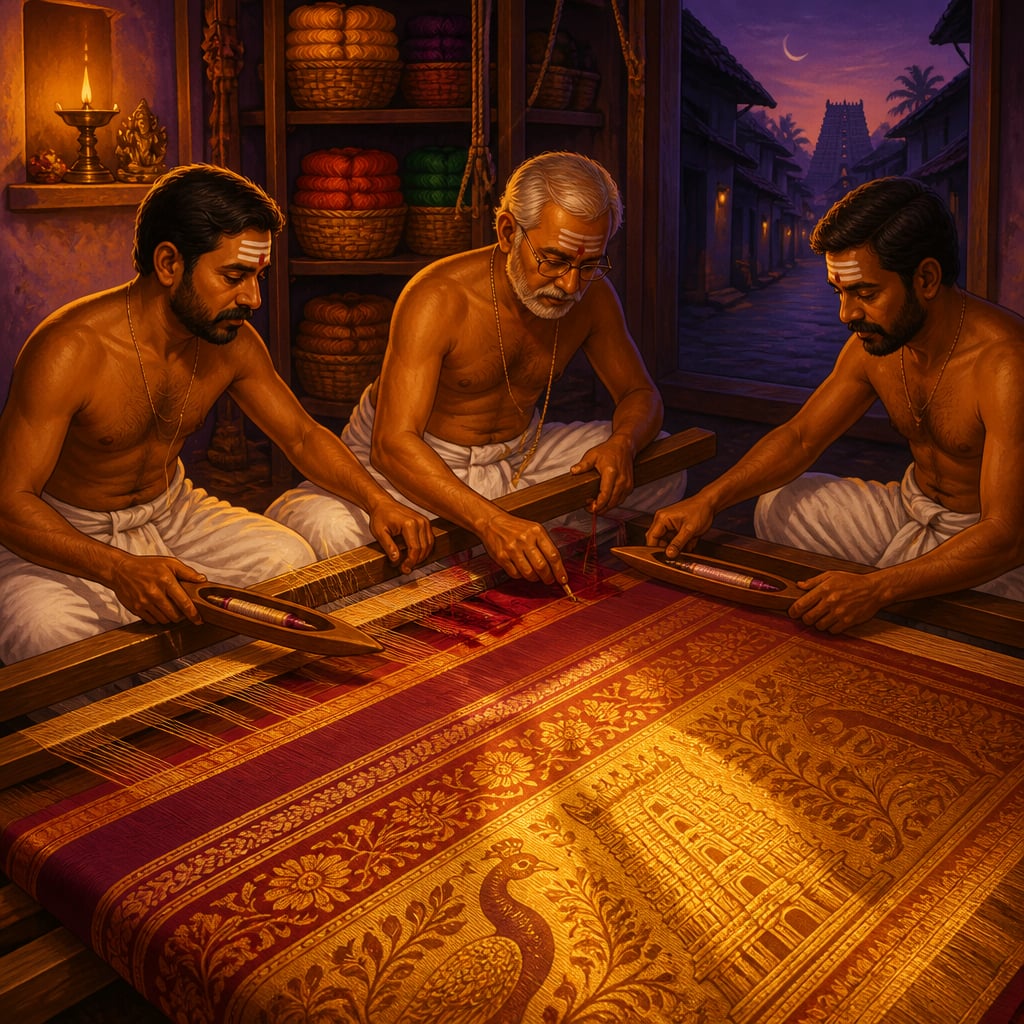
It is 4:30 in the morning in Pillayarpalayam, the weaving neighbourhood at the back of Kanchipuram city. Through a small window that opens onto a stone courtyard, you can hear three sounds: a temple conch from the Ekambareshwarar precinct a kilometre away, a cock in the next lane, and the slow wooden knock of a pit-loom treadle. The treadle belongs to a weaver we can call Devanathan, a composite drawn from the old Devanga master weavers who still sit at pit looms in this neighbourhood. He is fifty-eight years old. He is the fifth generation in his family to weave silk. One of his ancestors, eight generations back, came down from the Godavari country to Kanchipuram in about 1520, under an order from Krishnadevaraya of Vijayanagara. That ancestor came with a loom and a wife. Devanathan's house still stands on the same lane.
This morning he is finishing a bridal saree. A wedding has been booked for three days later at the Kapaleeshwarar temple in Mylapore, Chennai. The saree is nine yards of arakku maroon silk with a parrot-green border and a pallu woven in the annapakshi (swan) motif. The pallu is finished. The body is finished. What he is working on now is the last few inches of the korvai join, the place where the maroon body and the green border lock into each other.
Korvai cannot be done by one weaver. The body uses one set of warp threads. The border uses a different set, dyed in a different colour. The two weavers sit next to each other at the same loom. When the weft shuttle reaches the edge of the body, Devanathan's son Karthikeyan, twenty-six years old and the sixth generation, passes a second shuttle loaded with green weft back through the border warp. A third shuttle joins them at the exact point where the two colours lock. For about twenty seconds, three hands are working on the same saree at the same instant. This is why a real Kanchipuram is sometimes called a three-shuttle saree.
But why? Why build a saree out of three separate cloths welded together at the edges? Why not weave it in one continuous piece, as the Banaras weavers do? The answer does not live in the loom. It lives in the temples.
A Small Temple Worn on a Body
Kanchipuram is said to have a thousand temples. Its two most famous are Ekambareshwarar (the Shiva shrine) and Varadaraja Perumal (the Vishnu shrine). The deities of both temples are dressed each morning. In the iconography of a South Indian temple, the garment of the deity is built on the architecture of the temple itself. The body of the cloth corresponds to the garbhagriha, the sanctum. The border running all around the cloth corresponds to the prakara, the pillared corridor that walks around the sanctum. The pallu, the decorated end that falls over the shoulder, corresponds to the vimana, the tall tower that rises over the sanctum.
A Kanchipuram saree is not shaped like a single piece of cloth because a Dravidian temple is not a single room. It is a sanctum surrounded by a corridor and crowned by a tower. The korvai technique builds the saree the same way a Chola temple is built: in three distinct parts, locked into each other at the seams. When a Tamil bride puts on a Kanchipuram silk, she is not only wearing a beautiful dress. She is wearing a small temple. The Devanga and Saliyar weavers who came south under Krishnadevaraya five centuries ago came because his queens needed to be dressed this way. Their descendants are still here. They are still weaving the same three-part cloth, because the same brides still need it.

The Weight of Three-Ply Silk
Pick up a real Kanchipuram bridal saree and the first thing you notice is the weight. It can weigh from eight hundred grams to one and a quarter kilograms. A Banarasi bridal saree, for comparison, is often lighter. Why is a Kanchi so heavy?
The reason is the silk itself. Kanchipuram uses what weavers call moondru pattu, three-ply silk. Each thread is not one strand of mulberry silk. It is three strands twisted together before they enter the warp. Some bridal sarees use four-ply. The result is a cloth where even the plain body has the density of brocade. A common test in a Kanchipuram shop is to pinch a small edge of the saree and try to tear it. A real three-ply Kanchi will not tear by hand. A powerloom two-ply imitation will rip in your fingers.
The zari is also unlike the Banaras kind. A real Kanchi zari is a twisted cord of silver wire wound around a red silk core, not a white one. If you look at a thread of real Kanchi zari under good light, you can see the red silk underneath the silver. The cord is gold-plated, then wound around the core, then carried by the third shuttle through the border. Real Kanchi zari is still made by wire-drawers in Surat, the same city that supplies the Banaras weavers, and sent south by train to the Kanchipuram cooperatives. Most sarees sold as Kanchipuram in Indian retail today use polyester silk and plastic-film zari. The price gap between a real handloom Kanchi and its powerloom imitation can be fifteen to twenty times.
Dharmavaram, Up the Coast
Two hundred kilometres north of Kanchipuram, across the Tamil Nadu border into Andhra Pradesh, is a small town called Dharmavaram. It is a silk town of a different kind. Kanchipuram is a temple city. Dharmavaram is a railway town. It grew up on the old Bombay-Madras line in the late nineteenth century as a weaving centre for the Madras Presidency, founded by a local landowner and philanthropist called Dharmavaram Kodanda Rama Setty, who brought weaver families from the surrounding villages and settled them around his own household.
A Dharmavaram saree is lighter and simpler than a Kanchi. The body is often single-ply silk. The zari is narrower. The pallu is large, often carrying an elephant, a chariot, or a temple gopuram motif. The colours lean towards jewel tones: deep blue, wine red, emerald. What Dharmavaram shares with Kanchipuram is the temple economy. The Dharmavaram weavers supply silk vastrams, the sacred cloths, to the Tirumala Balaji temple of Tirupati, the richest Hindu shrine in the world. The daily garlanding of the Balaji deity at Tirumala uses Dharmavaram silk. So does the annual Brahmotsavam procession. The temple administration, the Tirumala Tirupati Devasthanams, places standing orders every year with the weavers' cooperative. When the orders come, the weaver eats. This is the same arrangement Kanchipuram has with Ekambareshwarar and Varadaraja Perumal. The temple has been the anchor client for a thousand years, and it still is.
What Nalli Did in 1928
By the early twentieth century, the temples alone could not keep the silk towns alive. The colonial Madras economy had moved to mill cloth. The royal courts that once bought hundreds of sarees a year were gone. The Devanga weavers of Kanchipuram were facing the same collapse the Banaras Ansari weavers were facing in the same years.

In 1928, a man named Nalli Chinnasami Chetty, himself born into a Kanchipuram weaver family, opened a small silk shop on Nageswara Rao Road in Panagal Park, T. Nagar, in the city of Madras (now Chennai). For years before that he had walked the weaving lanes of Kanchipuram, buying sarees on credit from the pit-loom weavers, carrying them back by bus to Madras, and selling them to urban Tamil brides whose families could not travel the two hours to Kanchipuram themselves. The shop was his attempt to turn that informal trade into a permanent pipeline.
It worked. Through the 1940s and 1950s, Nalli kept buying from the same weaver families, paying advances before each wedding season. By the 1970s, Nalli's was one of the largest silk retailers in South India, and other shops followed the same model. Kumaran Silks. Pothys. Sundari Silks. Rasi. Each shop maintained its own supply chain into Pillayarpalayam and the surrounding weaving lanes. By the 2000s, the urban Tamil bridal market was keeping several hundred Kanchipuram weaver households in steady work. What the Mughal karkhana had been to Banaras in the sixteenth century, the Chennai silk shop became to Kanchipuram in the twentieth. A commercial patron large enough to carry the craft through the decades when the temple economy alone could not.
The 2005 Shield
In 2005, the Geographical Indications Registry in Chennai granted protection for the Kanchipuram silk saree. The application was filed by Co-optex, the Tamil Nadu Handloom Weavers Cooperative Society, together with the Kancheepuram Silk Weavers Cooperative. The registration came four years before the Banarasi one, and it followed a similar logic. Only sarees woven in Kanchipuram district, using three-ply mulberry silk, real silver-gilt zari, and the korvai join technique, could legally be called Kanchipuram. Four years later, in 2009, Dharmavaram received its own GI registration as the Dharmavaram Handloom Pattu Saree.
The legal shield did not stop the fakes. The powerloom mills of Surat, Salem, and Arani still produce lakhs of sarees sold as Kanchipuram in wedding halls and online stores across India. What the shield did do was give the weavers' collectives the right to file a complaint. Several have been filed. Enforcement is slow. Buyers are usually too rushed before a wedding to run the weight, touch, and tear tests on a saree. But the right is real. When a fake Kanchipuram is seized in a court order, there is a specific clause of a specific Indian law making the seizure. Before 2005, there was not.
The Lane Behind Ekambareshwarar
Walk into Pillayarpalayam on any weekday morning and you will hear the sound of pit-loom treadles as often as the temple bells. The weavers are awake from four. The light comes through a single window. The pit is dug into the floor. The warp is stretched from the front of the loom to the back wall. Three shuttles rest in wooden holders at the side.
The weavers are almost all men. The women of the household prepare the silk and wind the pirns of zari before it reaches the loom. A boy of ten or eleven learns to throw the shuttle from his father and grandfather before he learns to write. The loom is in the same room where the family cooks and sleeps. A bride in Chennai will come for the finished saree six weeks from now. The silk cost eighty thousand rupees. The weaver earns about twelve thousand rupees for the month's labour at the loom. The shop will sell the finished saree for one lakh sixty thousand. This is the economics that still holds the craft up, and it is not a fair economics. But it is the one still working, and it has been working in some form since Krishnadevaraya's weavers came south in 1520.
The market that holds the Devanga weaver up has its own modern architecture. Nalli Kuppusami Chetty, head of the Nalli silk house his grandfather opened in 1928, was awarded the Padma Shri in 2003 for building the urban market for handloom Kanchipuram across India. Kanchipuram silk received its Geographical Indication protection in 2005, which means the name can now be used legally only for sarees woven in the cluster with real mulberry silk and real zari. The korvai join, where the contrast border is interlocked into the body strand by strand, is the technical fingerprint the GI protects. A powerloom cannot fake it.
The saree on Devanathan's loom is, at its core, the same cloth it was then. A sanctum. A corridor. A tower. Locked together at the seams. Worn on a body. Carried to a temple for a wedding. Returned to a cupboard to wait for the next bride. The temple has been patron. The urban shop has been patron. The law is now a shield. The teaching lineage is still unbroken. Every one of these is the reason a Devanga weaver in Pillayarpalayam can still sit at a pit loom this morning and finish one more korvai join on a wedding saree that will travel to Mylapore in three days.
Key figures
Krishnadevaraya
The Tuluva emperor of Vijayanagara, who ruled from 1509 to 1529. Krishnadevaraya was the greatest patron of Dravidian temple culture in the early sixteenth century. He rebuilt and endowed temples across his empire, commissioned the Amukta Malyada in Telugu, and issued an imperial order moving Telugu-origin weaver communities (Devanga and Saliyar) from the Godavari delta to the Tamil weaving towns of Kanchipuram, Thanjavur, and their surrounding villages. The Kanchipuram silk tradition as it exists today is a direct result of that migration.
Nalli Chinnasami Chetty
A weaver's son from Kanchipuram who, in 1928, opened a small silk shop on Nageswara Rao Road in Panagal Park, T. Nagar, Madras (now Chennai). For years before the shop opened he had walked the weaving lanes of Kanchipuram, buying finished sarees on credit from pit-loom weavers and carrying them back to Madras by bus to sell to urban Tamil brides. The shop turned that informal trade into a permanent commercial pipeline between the Kanchipuram looms and the urban wedding market.
Dharmavaram Kodanda Rama Setty
A nineteenth-century landowner and philanthropist in the Anantapur district of what is now Andhra Pradesh. He brought weaver families from the surrounding villages and settled them around his own household in the town that is named after him, Dharmavaram. His initiative gave the Dharmavaram silk tradition its modern shape and linked it to the railway-era Madras Presidency market. His descendants continued the patronage through the late nineteenth and early twentieth centuries.
Case studies
Nalli Chinnasami Chetty and the 1928 Shop on Nageswara Rao Road
In the 1920s, the Devanga silk weavers of Kanchipuram were facing a slow collapse. The royal court market had disappeared. The colonial economy had moved to mill cloth. The temples were still ordering vastrams, but the orders alone were not enough to feed a weaving family through the year. A weaver's son named Nalli Chinnasami Chetty had been walking the weaving lanes of Kanchipuram for several years by this point, buying finished sarees on credit from specific pit-loom families, carrying them back to Madras by bus, and selling them directly to urban Tamil brides whose families could not travel to Kanchipuram themselves. The margins were thin. The trade was informal. But it was working. In 1928, he decided to turn that informal trade into a permanent shop and opened a small silk outlet on Nageswara Rao Road in Panagal Park, T. Nagar, Madras.
What Nalli Chinnasami Chetty did in 1928 is a dharmic act of patronage in disguise. The Kanchipuram tradition had always been carried by two anchor clients: the temple that bought the daily vastrams, and the royal court that bought the wedding sarees. When the second client disappeared under the colonial economy, the tradition was one generation away from breaking. What Nalli did was simply find a new second client: not a king, but the urban Tamil bride. The bridal silk market he built in Madras was not a new craft. It was the old craft with a new patron. The Kanchipuram weavers kept their technique, their community, their lineage, and their temple orders. What changed was who was paying for the bridal commissions.
Through the 1940s and 1950s, the shop kept buying from the same weaver families in Pillayarpalayam, paying advances before each wedding season. By the 1970s, Nalli Silks was one of the largest silk retailers in South India. Other shops followed the same model. Kumaran Silks, Pothys, Sundari Silks, and Rasi Silks each built their own supply chain into the Kanchipuram weaving lanes. By the 2000s, several hundred Kanchipuram weaver households were in steady work because of the urban Tamil bridal market that these shops served. When the Kanchipuram GI registration was granted in 2005, the commercial pipeline that made the registration economically meaningful was the pipeline Nalli had started in 1928.
A craft does not survive by finding a better market. It survives by finding a second patron who is different enough from the first that a shock to the first does not also destroy the second. Nalli Chinnasami Chetty did not try to save the royal court market. It was gone. He built a new anchor client alongside the old temple economy. The bridal retail shop and the temple vastram orders now run in parallel, and the Kanchipuram tradition is held up by both. This is the pattern that other South Indian craft traditions have since tried to copy.
The Nalli model is now the standard commercial structure for South Indian handloom silk. Nearly every major silk retailer in Chennai, Bangalore, Hyderabad, Madurai, and Coimbatore maintains a direct supply chain into the Kanchipuram weaving lanes, and many have adopted the advance-commission system for bridal orders. When a Tamil bride buys a kalyana pattu today, she is buying into a patronage system that was formally built in 1928 and is still the reason the weavers have steady work.
Nalli Silks has operated continuously on Nageswara Rao Road in T. Nagar, Chennai, from 1928 to today, almost one hundred years without a break. By the 2000s, the combined urban Tamil silk retail market was estimated to buy from between three hundred and five hundred weaver households in the Kanchipuram weaving belt, and several thousand more were indirectly supplied through the Co-optex cooperative network.
Dharmavaram and the Tirumala Tirupati Devasthanams Vastram Order
The town of Dharmavaram in Anantapur district, Andhra Pradesh, was founded as a silk weaving centre in the late nineteenth century by a local landowner and philanthropist, Dharmavaram Kodanda Rama Setty, who brought weaver families from the surrounding villages and settled them around his own household. From the beginning, the Dharmavaram weavers had a close relationship with the nearby Tirumala Balaji temple of Tirupati. The silk vastrams used in the daily garlanding of the Balaji deity, and in the annual Brahmotsavam procession, were supplied by the Dharmavaram cooperative workshops. This arrangement continues today, with the Tirumala Tirupati Devasthanams (TTD) placing standing annual orders for tens of thousands of metres of silk.
In South Indian temple economics, the relationship between a weaving town and its anchor temple is older than most of the surrounding politics. A temple that has been drawing pilgrims for a thousand years needs silk every morning of every year. The weaving community attached to it eats because the deity is being dressed. The relationship is not a commercial contract in the modern sense. It is a liturgical arrangement that has acquired a commercial form. The cooperative sells the cloth and the temple pays. But the underlying structure is still the ancient idea that the weaver is an anga, a limb, of the god, and that the god feeds the limb that feeds him. The Dharmavaram-Tirumala connection is one of the clearest surviving examples of this relationship in a modern cooperative form.
Throughout the twentieth century, the TTD vastram order was the baseline income that held the Dharmavaram weaving cooperative together, even when the retail silk market weakened. The Dharmavaram silk saree received its own Geographical Indication registration in 2009, protecting the name for handloom cloth woven in Anantapur district using the traditional techniques. The Tirumala temple continues to receive Dharmavaram silk every year for the daily garlanding of Balaji and for the Brahmotsavam procession, along with silk supplied from a few other temple-linked weaving centres.
A craft that is rooted in a liturgical service can survive long after the surrounding commercial economy has moved on, because the liturgical calendar does not move on. The temple that has been dressing its deity for a thousand years will keep dressing the deity for the next hundred. The weaving community attached to that temple has a floor it cannot fall below as long as the worship continues. Dharmavaram is held up by the Tirumala orders the same way Banaras was held up by its apprenticeship lineage. Both are non-market forces that carry a craft through economic weather.
The Dharmavaram-Tirumala relationship is now a model for temple-backed craft patronage. Several other Hindu temple administrations, including the Somnath temple in Gujarat, the Sabarimala Ayyappa temple in Kerala, and a few of the Jagannath temple supply chains in Puri, have looked at the TTD system when thinking about how to underwrite nearby craft communities through standing liturgical orders. In an era when the commercial market for handloom is fragile, the temple remains the most reliable long-term client for many South Indian silk traditions.
The Tirumala Tirupati Devasthanams is the largest temple administration in the Hindu world, managing one of the richest shrines anywhere. Tens of thousands of pilgrims visit Tirumala every day, and the deity is ritually dressed multiple times a day. The annual silk requirement runs to tens of thousands of metres of woven vastram, supplied primarily by the Dharmavaram weavers' cooperative and a small number of other approved sources.
The Powerloom Counterfeit Raid at a Chennai Wedding Mall
Imagine that in 2022, a Kanchipuram weavers' cooperative receives a tip-off that a large wedding-wear retailer in a Chennai suburb is openly selling Surat-powerloom polyester sarees as 'pure Kanchipuram silk'. The tag on each saree reads 'Kanchipuram Silk Special' and the shop has displayed a fake GI certificate at the front of the store. A cooperative officer visits the shop, buys two sarees at fifteen thousand rupees each, and takes them to a government textile testing laboratory in Chennai. The lab tests confirm that the silk is polyester blended with some cotton, that the zari is plastic film coated with a thin metal, and that the weight is four hundred grams instead of the eight hundred to one thousand two hundred grams expected of a real bridal Kanchi. The cooperative now has evidence. The question is: what happens next under the Indian GI Act of 1999?
The GI Act gives the legally registered collective, not the individual weavers, the right to act on behalf of the whole tradition. This is a deliberate design choice. Individual weavers in Pillayarpalayam have no time to walk into a courtroom, no lawyers, and often no literacy in legal Tamil. The cooperative is their shield. When the cooperative files a complaint, it is not speaking for one family's loss. It is speaking for the entire GI-registered weaver community of Kanchipuram district. This mirrors the older temple-village model, in which the weavers collectively provided the vastrams for the shrine and collectively received the orders. The individual weaver worked at the loom. The collective carried the relationship. The GI Act has simply translated that older village structure into modern commercial law.
The cooperative files a complaint under Section 21 of the GI Act with the Chennai police, attaching the lab test results, the photographs of the shop's fake GI certificate, and the receipt for the two sarees purchased. The police raid the shop under a search warrant issued by a magistrate. A consignment of about two hundred sarees is seized and held in a warehouse as evidence. The retailer is charged with passing off non-GI goods under a GI name, a criminal offence under the Act. The case slowly moves through the magistrate's court. Enforcement is partial. Many similar shops across Chennai continue to sell powerloom sarees under the Kanchipuram name. But the one shop that was raided will not be the last one. Each raid makes the next one easier.
A GI registration only works if the community behind it is willing to enforce it. Paper alone does not stop imitation. The weavers of Kanchipuram, the weavers of Dharmavaram, and the collectives that represent them are the only ones who can walk into a court and defend the name. When they do, the law works. When they do not, the powerloom mills win by default. The lesson the Kanchipuram tradition is still learning is that enforcement is a discipline, not an event. It has to be repeated against a new shop every month, for years, before the imitation economy begins to contract.
The case shape above mirrors real enforcement actions that have been filed by the Co-optex cooperative and by the Tamil Nadu Handloom Weavers Cooperative Society against retailers selling powerloom sarees under protected GI names. The Banarasi Bunkar Samiti has filed similar actions in the north. GI enforcement is still the weak link in Indian handloom protection, but each successful raid sets a precedent that future actions can build on.
By industry estimates, more than seventy percent of the sarees sold as 'Kanchipuram silk' in Indian retail today are powerloom or polyester imitations produced primarily in Surat, Salem, and Arani. The price gap with a real handloom Kanchipuram is typically fifteen to twenty times. Only a small number of GI enforcement cases have been filed against such retailers, compared with the thousands of shops that sell imitation Kanchipuram stock.
Historical context
The Kanchipuram and Dharmavaram silk story runs from the Pallava and Chola temple endowments of the seventh to eleventh centuries, through the Vijayanagara migration of the early sixteenth century under Krishnadevaraya, through the founding of Dharmavaram as a silk town in the late nineteenth century, through the founding of Nalli Silks in Madras in 1928, and into the 2005 Geographical Indication registration for Kanchipuram and the 2009 registration for Dharmavaram.
Silk weaving in the Dravidian south is as old as the Sangam age. The Silappadikaram, composed around the fifth century, already describes silk as a traded commodity in the Tamil port cities. But the Kanchipuram tradition as it is practised today was given its final shape by two events. First, the Vijayanagara-era migration of Telugu Devanga and Saliyar weavers into the Tamil country around 1520, under an imperial order from Krishnadevaraya, who wanted his Andhra weavers to dress the deities and queens of his newly consolidated Tamil territories. Second, the commercial pivot of 1928, when Nalli Chinnasami Chetty opened his shop in T. Nagar, Madras, and turned the urban Tamil bride into the new anchor client for the Pillayarpalayam weavers. The tradition today is still carried by the direct descendants of the Vijayanagara-era migrants, now protected under a Geographical Indication and supplied by a retail network that grew out of Nalli's 1928 experiment.
The Kanchipuram silk weaving tradition is contemporary with the Safavid silk workshops of Isfahan, the Ottoman brocades of Bursa, the Italian velvets of Venice and Genoa, and later with the Lyon silk industry of France. Unlike the European silk centres, which were mostly destroyed or transformed by nineteenth-century mechanisation and twentieth-century world wars, Kanchipuram survived by keeping its pit-loom technique intact and by finding a new commercial patron in the urban Indian bride. The 2005 GI registration is modelled on the European geographical indication framework used for protected foods and wines such as Champagne and Parmigiano Reggiano, adapted for Indian craft.
About five thousand handloom weaver families are still active in the Kanchipuram weaving belt today, producing roughly one bridal saree every five to eight weeks per two-weaver loom. A real Kanchipuram bridal saree can weigh from eight hundred grams to one and a quarter kilograms. The price gap between a real handloom Kanchipuram and a powerloom imitation is typically fifteen to twenty times.
The Kanchipuram saree is the clearest surviving example of a South Indian craft tradition that turned two separate patronage systems into a continuous lifeline. The temple underwrote the craft from the Pallava period to the present, through its daily vastram orders. The urban retail shop, beginning with Nalli in 1928, underwrote the craft through the colonial and post-colonial centuries, through its bridal commissions. When one system weakened, the other carried the weight. Kanchipuram's dual patronage is the reason the tradition is still alive, and it is the model that several other South Indian craft traditions have since tried to copy.
Living traditions
The 2005 Kanchipuram Silk Saree GI and the 2009 Dharmavaram Handloom Pattu Saree GI are now the legal shields for both traditions. Co-optex, the Tamil Nadu Handloom Weavers Cooperative Society, is the government-backed retail channel that authenticates and sells real handloom Kanchipuram sarees through its showrooms. The large Tamil silk retailers (Nalli Silks, Kumaran Silks, Pothys, Sundari Silks, Rasi Silks) continue the advance commission model that Nalli Chinnasami Chetty started in 1928. Designer collaborations by Sabyasachi Mukherjee, Anita Dongre, and others have introduced the Kanchipuram silk to a new global audience. The India Handloom Brand seal and online platforms such as Amazon Karigar and Co-optex Online attempt to extend authentication to buyers who can no longer test the weight, touch, and tear of a saree in person.
- Two-weaver korvai weaving at the pit loom: Kanchipuram weavers sit at wooden pit looms set into the floor of a single ground-floor room. A bridal korvai saree is woven by two weavers working at the same loom at the same time. When the weft shuttle carrying the body colour reaches the edge of the body warp, the second weaver passes a third shuttle with the contrasting border weft back through the border warp, and the two colours lock at exactly the right thread. A full bridal saree takes six to eight weeks of this two-hand work to complete. The technique cannot be reproduced on a powerloom, and it is explicitly named in the 2005 GI registration as a defining production method.
- Daily vastram service to the temple deity: The temples of Kanchipuram and Tirumala place standing orders with the local weaver cooperatives for the silk vastrams used in the daily dressing of the deity and in the annual procession festivals. The Tirumala Tirupati Devasthanams buys Dharmavaram silk for the daily garlanding of Balaji and for the Brahmotsavam procession every year. The Varadaraja Perumal and Ekambareshwarar temples of Kanchipuram have had similar arrangements since the Pallava and Chola periods. These orders form a baseline income for the weaver families, independent of the wedding market.
- Advance commission for a bridal kalyana pattu: A Kanchipuram bridal saree, called a kalyana pattu, is almost always commissioned months in advance of the wedding date. The bride's family chooses the colour, the border, and the pallu motif at a shop in Chennai, Madurai, Bangalore, or abroad. The shop passes the commission through to a specific weaver family in Pillayarpalayam, with an advance payment that the weaver uses to buy the three-ply silk and the silver-gilt zari. Six to eight weeks later, the finished saree travels back to the shop in a plastic sheet inside a cardboard box, and from there to the bride. The weaver often never meets the bride.
Reflection
- Is there a Kanchipuram or Dharmavaram silk saree in your own family, or in the family of someone you know? Think of a specific saree you can picture. Who wore it first? Was it woven for a wedding, a temple visit, or a festival? How old is it now? If it is still in the household, who will wear it next? If no such saree exists in your family, what does it tell you about the route through which your family arrived at its current wardrobe?
- The Kanchipuram silk tradition survived because it had two unrelated anchor clients running in parallel: the temple and the bridal retail shop. Think about your own livelihood, or the livelihood of someone close to you. What is the first anchor? Is there a second, genuinely different one? If there is not, what would it take to begin building one, without replacing the first?
- The korvai technique makes a Kanchipuram saree in three parts because a Dravidian temple is built in three parts. Look at something you make or write or build every week. Ask: does the form of this thing follow the meaning of this thing, or is the form a default you inherited without examining it? If the form does not follow the meaning, what would the Kanchipuram answer to that question look like in your work?