Paithani & Mysore: Western & Southern Treasures
From the Godavari looms of Paithan to the Mysore Silk Weaving Factory of 1912, the story of two silk traditions that stayed honest about silk and gold.
In 1912, the Maharaja of Mysore signed an order that set up a public silk weaving factory in Bangalore. He promised that every saree leaving the factory would use real mulberry silk and real gold zari. More than a hundred years later, the same promise is still on the label. A much older promise, the one carried by the weavers of Paithan on the Godavari since the first century CE, had been kept even longer. This lesson follows both traditions. It tells how the Holkar queen Ahilyabai sent Paithani sarees to the temples she rebuilt, how Krishnaraja Wadiyar IV and Sir M. Visvesvaraya built a state silk industry from scratch, how the weavers of Yeola revived Paithani after it nearly died in the twentieth century, and how two Geographical Indication tags, won in 2005 and 2010, finally gave the real weavers a law to stand behind.
A Writing Room at the Mysore Palace
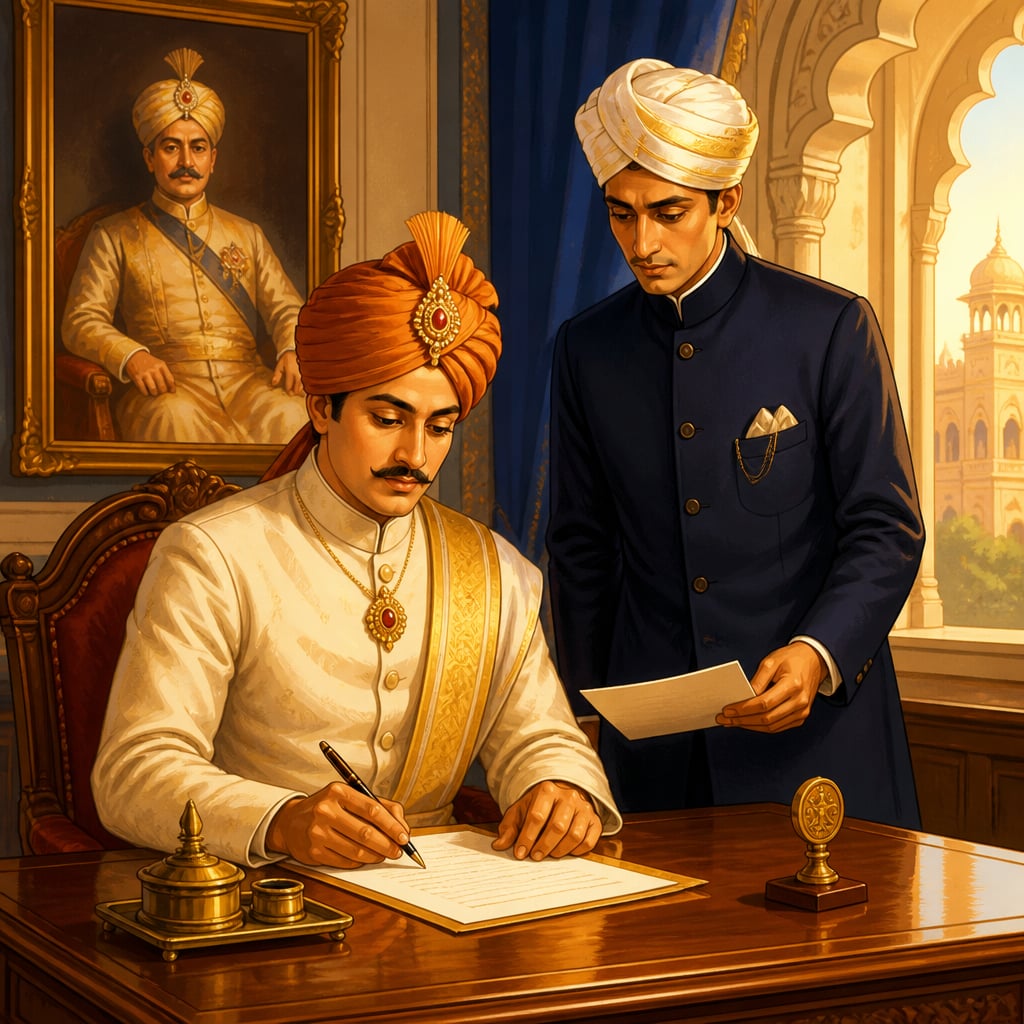
It is the summer of 1912. In a cool writing room at the Mysore Palace, with the first monsoon rain hitting the teak shutters, the Maharaja of Mysore, Krishnaraja Wadiyar IV, is reading a proposal from his new Dewan, Sir M. Visvesvaraya. The document is a few pages of English typescript on thin cream paper. It asks the royal treasury to release a sum of money to set up a silk weaving factory in Bangalore. Not a court workshop for royal use. Not a Mughal-style karkhana. A public factory, owned by the Mysore state, open to anyone who could buy a saree from it.
The idea has risks. Indian silk has been losing ground to cheap British mill cloth for almost a century. Handloom weavers in Karnataka are already abandoning the craft for easier work. If the factory fails, the treasury will have spent its money on nothing. If the cheap imitators copy its designs, the real sarees will be undersold. Wadiyar is thirty-eight years old. Visvesvaraya is fifty-two. The two of them are about to try something no other Indian state is trying.
Wadiyar signs the order. The Mysore Silk Weaving Factory opens later that year in Bangalore. It starts with a small group of handloom weavers, a few Jacquard looms ordered from France, and one simple promise. Every saree that leaves the factory will be woven from pure mulberry silk. The gold thread in it will be actual gold. No cotton core dressed up with plastic film. No cheap imitations. One hundred and fourteen years later, the factory is still running. The company that grew out of it still uses pure gold zari. A single Mysore Silk crepe saree still contains around sixty-five grams of gold, about the weight of a small bridal necklace, spread across the body of the cloth.
This lesson is about Wadiyar's experiment, and about another silk tradition, much older than his, that had already been working in a town on the Godavari for almost two thousand years when he signed the order. Its name is Paithani.
Before the Factory: Paithan on the Godavari
Paithan is a small town in today's Aurangabad district of Maharashtra, on the banks of the Godavari. In the first century CE, it was not called Paithan. It was called Pratishthana. It was the capital of the Satavahana kings and one of the richest trading cities of early India. Roman sailors knew it. A Greek merchant's handbook written around 60 CE, the Periplus of the Erythraean Sea, lists Pratishthana as a source of fine cotton and silk cloth that was sent down the Godavari to the western coast, then loaded onto ships bound for Alexandria and Rome.
The weavers of Paithan kept weaving as the Satavahanas fell and new kingdoms rose. By the seventeenth century, the town was under Mughal rule. In the eighteenth, it passed to the Marathas. The best-documented patron of Paithani cloth from that period is the Holkar queen Ahilyabai, who ruled Malwa from 1767 to 1795. She was a deeply religious woman. In 1780 she rebuilt the Kashi Vishwanath temple at Varanasi, which Aurangzeb had torn down a century earlier. She also rebuilt temples at Somnath, Rameshwaram, Haridwar, Ujjain, Gaya, and many other places. To each of them, she sent offerings. Some of those offerings were Paithani sarees, woven at Paithan, to be draped on the idols or wrapped around the temple flagstaffs.
A Paithani saree is slow cloth. The warp is silk, usually a deep single colour (peacock blue, parrot green, aubergine, pomegranate red). The weft is silk. And, in the pallu and the border, pure zari. But the thing that makes a Paithani a Paithani is the technique used for the borders and the pallu. It is called tapestry weaving, or in some workshops, interlocked weft. The weaver does not throw a shuttle all the way across the cloth. Instead, each colour in the border or the pallu is carried only across the width of that colour, picked out by hand with small bobbins, and interlocked with the neighbouring colours thread by thread. The reverse side of a true Paithani is almost as clean as the front.
What Makes a Paithani
A good Paithani takes between six months and two years to finish. A master weaver on a pit loom can complete roughly one to three inches of the pallu per day when the pattern is dense. When Ahilyabai wanted a saree in time for a temple festival, she sent the commission years in advance.
The motifs on a Paithani are a fixed vocabulary, each one with a name every weaver in Paithan or Yeola still knows:

- Morbangadi: a peacock set within a bangle, the most famous Paithani motif, almost always on the pallu
- Asavali: a flowering vine or creeper, usually running along the border
- Narali: a small coconut motif, often repeated along the edge
- Bangadi Mor: peacocks in pairs, facing each other across a small shrine
- Kuyri: a mango or paisley shape, set into the body of the saree
The weaver who is working the pallu does not use a paper chart. She keeps the pattern in her head. She has watched her mother or her aunt or her teacher weave it since she was a child. The muscle memory goes into the bobbin. The pattern comes out of the loom.
The silk in a traditional Paithani came from Karnataka, from the mulberry farms around the old kingdom of Mysore. The zari came from Surat, where master wire-drawers pulled silver through smaller and smaller holes until it was as thin as a human hair, then coated it with gold, then wound it around a silk core. Two separate crafts, in two separate states, feeding a third craft in a third state. Paithani has always been a cloth built by a network.
Mysore Silk: A Kingdom's Experiment
Back to Wadiyar's factory in Bangalore. In the first twenty years, the Mysore Silk Weaving Factory survived on royal orders, a small export trade, and the personal reputation of the Maharaja. Visvesvaraya handled the business side. He sent engineers to Japan to study improved silk reeling techniques. He set up cocoon-buying stations in villages around Mysore and Kolar, so that farmers had a steady market for their silk. He negotiated with British officials to keep Indian silk out of the harshest tariffs.
When Wadiyar died in 1940, his factory was still running. After Indian independence, it was folded into a public-sector company, the Karnataka Silk Industries Corporation, or KSIC. KSIC is still state-owned. Its flagship sarees are still woven on looms in Bangalore. They still use pure mulberry silk. They still use real gold zari. The zari alone in a premium KSIC crepe silk saree uses around sixty-five grams of pure gold.
KSIC's biggest problem, for decades, has been counterfeiting. Any factory in the country can weave a polyester saree, call it Mysore Silk, and put it in a shop window in Chennai or Delhi. Most tourists cannot tell the difference at a glance. The real KSIC saree is heavier. It is warmer to the touch. It glows differently when held up to the light. But the name is the name. It could be stolen. In 2005, after years of paperwork, KSIC won a Geographical Indication (GI) registration for Mysore Silk. The GI tied the name legally to sarees woven in Karnataka under KSIC production. It did not stop the fakes entirely. But it gave the real weavers a law to stand behind, where before they had none.
Yeola, Bangalore, and the Work of Keeping Them Alive
The town of Paithan is not, today, the main Paithani weaving centre. That honour belongs to Yeola, a smaller town in Nashik district of Maharashtra, about 250 kilometres from Paithan. Yeola's weavers took up the tradition in the nineteenth century and kept it going through the worst decades of colonial decline. In 2010, Paithani too received a GI tag, registered jointly for Paithan, Yeola, and a few other villages in Maharashtra.
By the early 2000s, the Yeola weavers were in trouble. A powerloom copy of a Paithani can be sold for a tenth of the handloom price. Children of weaving families were leaving for the factories of Pune and Mumbai. The co-operative societies in Yeola responded in two ways. First, they pushed for GI protection. Second, they started connecting directly with urban buyers and designer houses, cutting out the middlemen who had been taking most of the margin for decades. A weaver who earned three hundred rupees a day weaving for a trader could now earn eight hundred or a thousand rupees a day weaving to a direct commission. Some of the children who had left came back.

At the KSIC showroom in Bangalore today, you can still watch weavers at work. The looms are larger than Paithan's pit looms. The work is faster. But the logic is the same. The silk has to be real. The gold has to be real. The hands have to know what they are doing.
Modern Echoes
The design economist Ritu Kumar, who has spent more than fifty years reviving Indian handloom traditions, has said in several interviews that the one thing India still has that nobody else can imitate is its craft lineages. Factories can copy machines. They cannot copy ten generations of memory. Paithani and Mysore Silk are both proof of this, from two very different directions. Wadiyar took a new idea (a state-owned silk factory) and built it on top of old knowledge (Karnataka's mulberry farms). The Yeola co-operatives took an old idea (hand-picked tapestry weaving) and built new market channels around it. Both worked. Both are still working. Both needed a law, a GI tag, to protect them from a market that, left to itself, would sell plastic as gold.
The promise has picked up new hands. Shantilal Bhangde, the Yeola master weaver, has won two National Awards for his Paithani work, the most recent being the Sant Kabir Award, the highest honour the Government of India gives to a handloom master craftsman. In Mysore, KSIC (Karnataka Silk Industries Corporation), the modern descendant of the workshops Wadiyar chartered in 1912, is the only silk saree producer in India whose zari is hallmarked for pure gold content. A buyer walking into the KSIC Mysore showroom today can ask for the gold assay certificate before she asks the price.
The gold in a KSIC saree is not jewellery. It is carried on the body, close to the skin. The peacocks on a Paithani pallu are not decoration. They were first woven for gods, and first given to temples. These two cloths were, for most of their long lives, a way of tying the wearer to a lineage, a place, and an act of devotion. They still are, if you know what you are holding.
Somewhere in Bangalore tonight, a loom at KSIC is finishing a saree whose gold will leave the factory tomorrow and be folded into a bride's trousseau by the end of the week. Somewhere in Yeola, a pit loom is halfway through a peacock pallu that will not be finished for another year. Both sarees are part of the promise Wadiyar signed in 1912, and of the older promise Ahilyabai renewed in 1780. The silk must be real. The gold must be real. The hands must know what they are doing.
Key figures
Krishnaraja Wadiyar IV
Maharaja of Mysore (1894 to 1940). He ruled as one of the most admired Indian princes of his era and built the modern industrial base of the Mysore state. He signed the order in 1912 that set up the Mysore Silk Weaving Factory in Bangalore, which grew into the Karnataka Silk Industries Corporation (KSIC). He insisted from the beginning that every saree leaving the factory would use pure mulberry silk and real gold zari. That rule is still followed today.
Sir M. Visvesvaraya
Engineer, statesman, and Dewan of Mysore from 1912 to 1918. He was the technical and administrative architect of Mysore's early industrial policy. He pushed for the Mysore Silk Weaving Factory, sent engineers to Japan to study modern silk reeling, set up cocoon-buying stations across Mysore and Kolar to give farmers a reliable market, and built the foundations that KSIC would later grow on. He was awarded the Bharat Ratna in 1955. His birthday, 15 September, is still celebrated in India as Engineer's Day.
Ahilyabai Holkar
Queen of the Holkar state of Malwa from 1767 to 1795. A Maratha ruler known across India for her deep religious commitment, her personal simplicity, and her restoration of Hindu temples that had been damaged or destroyed under earlier regimes. In 1780 she rebuilt the Kashi Vishwanath temple at Varanasi. She also rebuilt temples at Somnath, Rameshwaram, Haridwar, Ujjain, Gaya, and many other places. She was one of the most important royal patrons of Paithani cloth in the eighteenth century, commissioning sarees at Paithan to be sent as offerings to the temples she was restoring.
Case studies
Ahilyabai Holkar's Temple Paithanis (1770s and 1780s)
In the 1770s and 1780s, the Holkar queen Ahilyabai ruled Malwa from her fort at Maheshwar on the Narmada. She was one of the most religiously committed rulers India has ever seen. She rebuilt temples across the subcontinent that had been damaged or destroyed under earlier regimes: Kashi Vishwanath at Varanasi (1780), Somnath, Rameshwaram, Haridwar, Ujjain, Gaya, and more. For each of these restorations, she sent silk sarees, commissioned from the weavers of Paithan on the Godavari, to be draped on the deities and used in temple rituals. A commission from her treasury could take eighteen months to two years to complete. Her emissaries travelled between Maheshwar and Paithan with orders, payments, and finished cloth. Paithan's weaving economy in this period ran largely on her patronage.
The traditional Indian view is that a craft survives because a patron treats it as a sacred act. Ahilyabai did not see her Paithani commissions as a luxury expense. She saw them as part of her dharma, her duty as a ruler to protect and restore the religious life of her people. A saree woven for a deity at Kashi Vishwanath was, in this view, the same kind of offering as a gold pot or a stone wall. It carried a share of the temple's sacred presence. The slow pace of the craft was not a problem to be solved. It was a feature of the gift. A hurried saree could not carry what a slow saree could carry.
The Paithani tradition of the eighteenth century survived the century largely because rulers like Ahilyabai kept ordering and kept waiting. Weavers at Paithan had steady, long-scheduled work. The motifs, the techniques, and the skill network were kept alive. When British mill cloth began to crush other handloom centres in the nineteenth century, Paithani survived in part because the temple and royal commission market had not been replaced by a mass consumer market. It had stayed embedded in a ritual economy that did not respond to the price of cotton shirts in Manchester.
A craft that serves devotion is more resilient than a craft that serves fashion. Fashion markets can collapse overnight. Devotional markets move slowly, and they tolerate long production times, because the thing being produced is not intended for the next season. It is intended for the god.
The lesson still applies. Every time a modern bride orders a Paithani eighteen months before her wedding, or a temple trust commissions a saree for a festival idol, she is playing Ahilyabai's role. The weaver can only afford to weave the real thing if there are still buyers willing to treat the cloth as sacred and wait for it on its own schedule.
Ahilyabai's treasury is known to have funded temple restoration and offerings across at least sixty pilgrimage sites during her rule (1767 to 1795). Her most famous single restoration, Kashi Vishwanath at Varanasi in 1780, is still the standing temple that pilgrims visit today.
Wadiyar IV and Visvesvaraya Found Mysore Silk (1912)
In 1912, the Maharaja of Mysore, Krishnaraja Wadiyar IV, had a decision to make. His Dewan, Sir M. Visvesvaraya, had just submitted a proposal asking the royal treasury to set up a public silk weaving factory in Bangalore. The proposal was ambitious. Visvesvaraya wanted to import Jacquard looms from France, train weavers in modern reeling techniques, buy cocoons directly from farmers, and set the factory up as a state-owned enterprise whose sarees would be sold to any buyer. The risks were real. Indian silk was losing ground to British mill cloth. The treasury had other calls on it (Visvesvaraya was also planning dams and railways). The princely-state model itself was under question as British power in India tightened. Wadiyar signed the order. The Mysore Silk Weaving Factory opened later that year in Bangalore with a handful of handlooms and an unshakeable promise: pure mulberry silk, real gold zari, no exceptions.
In the traditional Indian view of kingship, a ruler's role is not only to defend and to tax. It is also to create institutions that will outlive him. Wadiyar is remembered as a Rajarshi, a philosopher-king, because he built institutions (the silk factory, the University of Mysore, the hydroelectric projects) that were designed to survive his own reign. The Arthashastra tradition is explicit: the best ruler is the one who leaves behind working public systems, not only a well-stocked treasury. The silk factory was an Arthashastra-style institution. Its job was to hold an industrial standard in place for generations.
The factory survived Wadiyar himself (he died in 1940), survived Indian independence (1947), survived the merger of Mysore into the Indian union, survived the rise of polyester, and in 1980 was folded into the Karnataka Silk Industries Corporation (KSIC). It is still running today. It still uses pure mulberry silk. It still uses real gold zari. A hundred and fourteen years after the founding order, the promise Wadiyar and Visvesvaraya made has not been broken.
An institution built on an honest standard, and protected by people willing to keep defending that standard, can outlast almost any political or economic shift. What matters is not the technology of the institution. It is the clarity of the standard and the stubbornness of the people guarding it.
Any modern institution that wants to outlive its founders (a company, a school, a nonprofit) faces the same problem Wadiyar faced. The standard must be simple enough to remember, strict enough to matter, and defended by people who will refuse to break it when breaking it would be cheaper. The details change. The pattern does not.
KSIC today produces around fifty thousand silk sarees a year and employs more than a thousand people across its weaving, dyeing, finishing, and showroom operations. Its flagship crepe silk saree still contains approximately 65 grams of pure gold in the zari.
KSIC Defends Mysore Silk With the 2005 GI Tag
By the late 1990s, the Karnataka Silk Industries Corporation (KSIC) was in an impossible situation. Any factory anywhere in India could weave a polyester saree, print 'Mysore Silk' on the label, and sell it in Chennai or Delhi or Mumbai. Tourists could not tell the difference at a glance. Traders bought the cheap copies wholesale and passed them off as real. KSIC lost sales. More importantly, it lost trust. When a buyer was burnt by a fake 'Mysore Silk' once, she stopped believing that even the real one was real. The name was being hollowed out in slow motion. KSIC decided to fight. Over several years, it documented the factory's production history, its mulberry supply chain, its gold zari sourcing, and the specific districts of Karnataka where its weavers worked. In 2005, the Geographical Indications Registry in Chennai granted Mysore Silk a GI tag. The name Mysore Silk was now legally tied to sarees produced under KSIC's process in Karnataka. Using it on anything else became a trademark violation.
The idea that a name belongs to a place, and that using it on something from another place is a kind of theft, is not a modern Western invention. It is an ancient Indian idea too. A Kashi shawl, a Paithani saree, a Varanasi sandalwood carving, a Tirupati laddu: these names were always place-names first. To sell something under one of these names that did not come from the place was, in traditional terms, a form of lying with a place's reputation. The GI law simply codifies what Indian buyers had always understood at the village level.
The GI tag did not end counterfeiting. Fake 'Mysore Silk' sarees are still sold in roadside shops in tourist towns. But KSIC now has a legal weapon. When a particularly blatant fake operation is uncovered, KSIC can sue. More importantly, serious buyers can now verify authenticity. Every genuine KSIC Mysore Silk saree today carries a hologram and a GI tag. A buyer who cares can check. And the weavers who work to Wadiyar's original standard now have a law that names them, and that punishes the people who try to profit by impersonating them.
A real name is an asset that can be stolen. Protecting a name is as important as protecting any other asset. Laws, holograms, GI tags, authentication certificates: these are the twenty-first century version of a royal seal. They matter because, without them, an honest producer is always at the mercy of a dishonest one.
The GI fight continues. Every Indian craft that depends on a place-name for its reputation has the same problem Mysore Silk had. A law is the starting point. Real protection depends on producers, consumers, and the state all paying attention to what is being sold under a name, and being willing to call out the fakes.
Mysore Silk received its GI registration on 20 December 2005. Paithani followed in 2010. As of today, more than 400 Indian products have been registered under the GI Act of 1999, including Darjeeling tea, Kanchipuram silk, Chanderi, Muga silk, Pochampally ikat, and Bidriware.
Yeola's Paithani Cooperative Revival (2000s to 2020s)
By the early 2000s, the handloom Paithani weavers of Yeola in Nashik district of Maharashtra were in serious trouble. A powerloom copy of a Paithani could be sold for a tenth of the handloom price. Children of weaving families were leaving for factories in Pune and Mumbai. The traders who bought sarees from Yeola weavers and sold them on in Mumbai and Delhi were taking most of the margin. A weaver was earning three hundred rupees a day, less than a daily-wage construction worker. The tradition was about one generation away from collapsing. The weaver co-operative societies in Yeola responded in two ways. First, they pushed for a Geographical Indication (GI) tag for Paithani, which was finally granted in 2010. Second, and more importantly, they started connecting directly with urban buyers and with a handful of designer houses. Urban brides could now commission a Paithani directly from a named weaver, often eighteen months to two years in advance. The middlemen who had been taking most of the money were cut out of the chain.
The guru-shishya parampara of the Paithani weavers is not maintained by rules alone. It is maintained by economics. If the children of weaver families cannot earn a living at the loom, the lineage dies in one generation. Traditional Indian thinking on craft was clear about this: a patron's job is not charity. It is to make sure that the craftspeople who hold a lineage can afford to teach it to their own children. Ahilyabai did this in the eighteenth century by sending her commissions. The Yeola co-operatives are doing it in the twenty-first by opening direct sales channels.
The revival is real but still fragile. A Yeola weaver who earned three hundred rupees a day from a trader can now earn eight hundred to a thousand rupees a day on a direct co-operative commission. Some of the children who had left for city work have come back. The Yeola cluster now has roughly three thousand registered handloom weavers, producing a few thousand sarees a year. Urban buyers are beginning to understand that a Paithani is commissioned, not bought off a shelf. The number of weavers is still smaller than it was a century ago, but it is growing again for the first time in decades.
Reviving a handloom craft is possible, but it requires three things in combination. First, a legal protection (the GI tag) so that the name cannot be stolen. Second, a direct market channel so that the weaver is paid more than the middleman. Third, a buyer willing to wait. Remove any one of these three and the revival collapses.
Any urban buyer in India who wants to own a real Paithani can today commission one directly through a Yeola co-operative or a verified designer collaboration. The buyer's willingness to wait eighteen months, and to pay a weaver what the weaver's time is worth, is part of what keeps the tradition alive. A craft does not survive only because its practitioners refuse to quit. It survives because, somewhere, there are buyers who refuse to take the cheap copy.
Paithani received its GI registration in 2010, covering weavers in Paithan, Yeola, and a few other villages in Maharashtra. The Yeola handloom cluster today has around 3,000 registered weavers. A single handloom Paithani can sell for anything between 25,000 rupees (basic) and over 5,00,000 rupees (master-woven, heavy zari). The equivalent powerloom imitation sells for 2,000 to 10,000 rupees.
Historical context
First century CE to the early twentieth century. The Paithani tradition is attested as a trade good as early as the first century CE under the Satavahanas, with its best-documented royal patronage in the late eighteenth century under Ahilyabai Holkar. The Mysore Silk tradition begins in 1912 with the founding of the Mysore Silk Weaving Factory by Maharaja Krishnaraja Wadiyar IV and Sir M. Visvesvaraya.
Paithani weaving at Paithan on the Godavari was part of a very old trade network that linked peninsular India to the Roman world and to the ports of Southeast Asia. It was supported by successive kingdoms: the Satavahanas, the Chalukyas, the Yadavas of Devagiri, the Bahmanis, the Mughals, and the Marathas. The Holkar queen Ahilyabai's commissions are the best-documented eighteenth-century example of royal patronage. The Mysore Silk Weaving Factory, founded in 1912, grew out of a very different tradition. It was a princely-state experiment in industrial policy, built by a reformist Maharaja and a trained engineer at a moment when Indian handloom weavers were being crushed by British mill cloth. Both traditions responded to colonial pressure in different ways. Paithani survived through royal and temple patronage. Mysore Silk survived by building a modern state-owned factory.
The closest European parallel to the Mysore Silk Weaving Factory is the silk industry of Lyon in France, which from the seventeenth century onward was the object of heavy state support, technical training, and royal patronage. Lyon, like Bangalore, built its reputation on a promise: the silk would be real, the dye would be real, the designs would be honest. Visvesvaraya knew the Lyon model and deliberately modelled some of Mysore's arrangements on it. The Paithani tradition, by contrast, has a closer parallel in the silk weaving centres of China (Suzhou, Hangzhou), which also supplied imperial courts and temples with slow hand-woven cloth over many centuries, built on lineages of master weavers, and survived several cycles of political collapse and revival.
A premium KSIC Mysore Silk crepe saree contains approximately 65 grams of pure gold in the zari alone, spread across the body and the pallu. That is roughly the weight of a small bridal necklace, carried across the surface of the cloth. A full hand-woven Paithani can take between six months and two years to complete. At the peak of the Yeola handloom decline in the early 2000s, a traditional weaver earned about three hundred rupees a day from a trader. After direct-sale channels were set up by the local co-operatives, the same weaver could earn eight hundred to a thousand rupees a day on a direct commission.
Paithani and Mysore Silk are both proof that a handloom tradition can survive industrial competition if someone (a queen, an engineer, a co-operative) is willing to keep the standard honest. The Paithani tradition survived for almost two thousand years because royal and temple patrons were willing to commission a saree two years in advance. The Mysore Silk tradition survived for more than a century because a princely state was willing to tie its reputation to a public promise about silk and gold. Both stories show that craft survival is never automatic. Someone, at every stage, has to refuse the easier, cheaper, faster path.
Living traditions
KSIC sells Mysore Silk sarees through a small network of official showrooms across Indian cities. Every genuine saree carries a hologram and a GI tag. Yeola Paithani sarees are now also sold through direct co-operative channels and designer collaborations, and a growing number of urban brides in Maharashtra are ordering their wedding saree directly from a named weaver one to two years in advance. A handful of contemporary designers (Anita Dongre, Sanjay Garg of Raw Mango, and others) have built collections that explicitly showcase Paithani and Mysore Silk to younger buyers. Both traditions are also taught in craft-training programs run by state handloom departments and by NGOs such as Dastkar and the Crafts Council of India.
Reflection
- Wadiyar's rule was simple. The silk must be real and the gold must be real. What is the equivalent rule for your own work, the standard you will not cross even when cutting it would be cheaper, faster, or easier to explain away?
- Why do you think Ahilyabai Holkar treated the commissioning of a Paithani as a religious act, not just a purchase? What does this reveal about how traditional Indian culture understood the relationship between craftsperson, object, and buyer?
- The Paithani weaver waits two years to finish a saree. The Yeola buyer waits two years to receive it. What is the relationship between the capacity to wait and the broader Dharmic principle of tapas, and what does a society lose when nobody is willing to wait for anything?