Suchi Vastra: The Language of Stitches

From the bone needles of Mohenjo-daro to a Rabari woman threading a torana in Kutch, the four-thousand-year story of Indian embroidery.

In a low-roofed mud house in the village of Bhadroi in Kutch, a Rabari woman named Pabiben Rabari sits with a white cotton cloth in her lap, a brass needle in her right hand, and a skein of red silk thread in her left. The cloth will become a torana, a doorway hanging, for her cousin's wedding next month. She has been stitching since she was seven. Her mother taught her. Her mother's mother taught her mother. Her torana carries twelve different stitches and three mirror sizes, and every motif on it means something her family has known for at least four hundred years. This lesson walks the four-thousand-year heritage of Indian embroidery, from the bone and copper needles dug up at Mohenjo-daro, through the Mughal karkhanas of Lahore and Agra, through the Chamba court's miniature-painter embroideries, through the Partition refugee trunks carrying Phulkari shawls across the border, and into the 21st century revival led by Shrujan, Kala Raksha, Chanakya School of Craft, and the 20,000 Chikankari women of Lucknow.

The Needle Catches Light
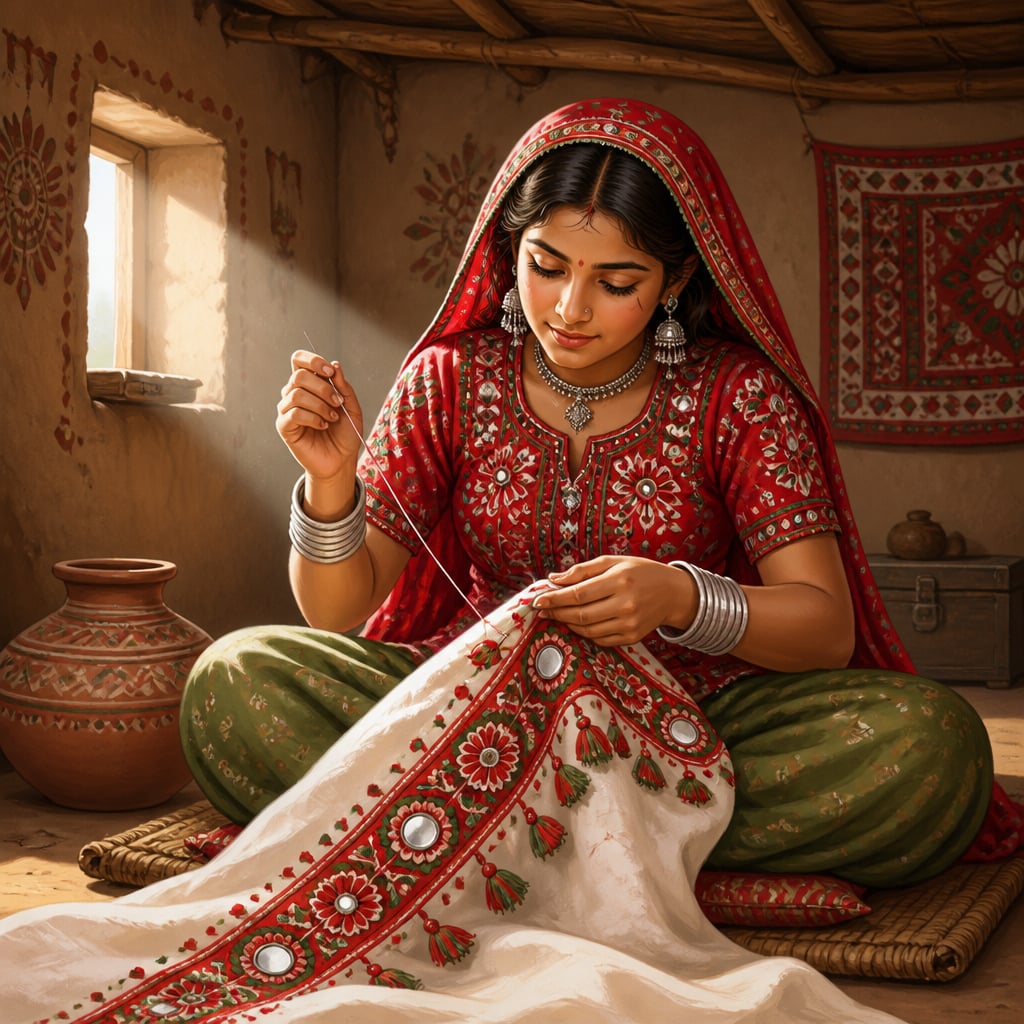
Pabiben Rabari stitching a torana wedding hanging in her Bhadroi mud house

In the village of Bhadroi in the Anjar district of Kutch, Gujarat, in a low-roofed mud house with a single open window, a Rabari woman named Pabiben Rabari sits cross-legged on the floor. In her lap is a length of white cotton cloth. In her right hand is a thin brass needle, about the size of a matchstick. In her left is a skein of fine red silk thread. It is early morning. The window light falls across the cloth at a low angle, and the needle catches it each time she draws the thread up.

The cloth will become a torana, a doorway hanging, for her cousin's wedding next month. A Rabari torana is embroidered with peacocks, elephants, parrots, small dancing figures, and a border of red triangles called kangra. Each figure is made by layering twelve different stitches on top of each other, anchored with small round mirrors the size of a fingernail. Pabiben has been stitching since she was seven years old. Her mother taught her. Her mother's mother taught her mother. Every motif on this torana means something her community has known for at least four hundred years. The peacock is for beauty. The elephant is for strength. The parrot is for the bride's new husband. The red triangles at the border are to keep the evil eye away from the bridal threshold.

When the torana is finished, it will be stitched to a wooden frame and hung above the door of the wedding house. The bride will walk under it on the morning of her wedding, and the embroidery Pabiben is making this week will frame the first step the bride takes into her married life. The whole thing is still being made exactly the way a Rabari woman would have made it in the year 1625.

This is suchi kala. Suchi is the Sanskrit word for needle. Kala is art. Suchi kala is the art of the needle. And suchi vastra, the embroidered cloth, is one of the oldest and most regionally diverse crafts in the Indian subcontinent. It has at least seven great traditions, each with its own community, its own stitch vocabulary, its own colour palette, and its own set of meanings. This lesson is the map.

The Oldest Needles

A 1920s excavation lifting a bone needle from a Mohenjo-daro trench

The oldest Indian needles ever found were dug out of the ground at Mohenjo-daro in the 1920s. Some were carved from bone, some were cast in bronze, some were drawn in copper. They were four to eight centimetres long, with a small eye at one end for the thread. The same excavation turned up spindle whorls for spinning cotton, wooden shuttles for weaving, and a few scraps of dyed cotton itself. Put together, the finds describe a complete 2500 BCE textile workshop. Needles included. At the same time the first Indus Valley cotton was being grown, spun, woven, and dyed, somebody was also stitching it. Embroidery is as old in India as cotton itself.

The Word In The Texts

The Sanskrit word suchi appears in the Rig Veda as one of the metaphors the Rishi uses for piercing insight. Sucikara, the needle-worker, appears in later Dharmashastra texts as one of the recognised craft occupations. Kautilya's Arthashastra (4th century BCE) places textile finishers alongside spinners and weavers in the Sutradhyaksha (Superintendent of Weaving) chapter. By the time of the Kamasutra (3rd century CE), embroidery is listed as one of the sixty-four kalas that a well-brought-up woman of Vatsyayana's era was expected to know. The craft was already a named, recognised, taught art when the earliest classical Sanskrit texts were being composed.

Seven Great Families Of Indian Stitch

Indian embroidery splits into at least seven great regional families, each with its own community and its own cloth.

Beyond the seven, there are smaller but precious traditions. The Chamba rumal of Himachal Pradesh. The Toda pulikuli of the Nilgiris, carried by a tribe of about eleven hundred people. The Lambadi mirror-work of the Banjara community. The Nakshi Kantha of Bangladesh, kin to Bengali Kantha. The Pipli applique of Odisha. Each of these guards a stitch vocabulary nobody else holds.

The Chamba Court

A Pahari painter and a Chamba royal embroiderer collaborating on a rumal

In the 18th century, in the hill kingdom of Chamba in what is now Himachal Pradesh, a very unusual collaboration began. The Chamba court painters, who had trained in the Basohli and Kangra miniature painting traditions, started drawing designs directly onto fine muslin cloth. The women of the royal household then embroidered the drawings in untwisted silk floss, using a stitch called do-rukha (double-sided) that produced the same image on both sides of the cloth. The finished object was a small square handkerchief called a Chamba rumal. They were used as ceremonial gift-wrappers for sweets, jewellery, and betel leaves exchanged at weddings and court functions.

The most famous Chamba rumals were commissioned under Raja Raj Singh (reigned 1764 to 1794), a late patron of Pahari miniature painting. Under his court, the rumals reached a level of technical refinement that has never been surpassed. A single rumal could depict the entire Ras Lila of Krishna, or the Mahabharata's Kurukshetra battle, in polychrome embroidery no larger than a modern dinner plate. The Chamba rumal received its Geographical Indication tag in 2007.

What The Colonial Century Took

By the middle of the 19th century, every one of the seven great Indian embroidery traditions was in decline. The colonial mill economy had killed the hand-spun cotton base. The Mughal court economy had collapsed, taking most of the Zardozi karkhanas with it. The Chamba kingdom had been absorbed into British India and the rumal patronage had ended. Phulkari shawls were still being made in Punjab villages for dowries, but no longer in the numbers the earlier generations had produced.

And then in 1947, Partition cut the Phulkari tradition in half. Punjabi women fleeing east across the new border carried their family Phulkari shawls in refugee trunks. Punjabi women fleeing west carried theirs. Some of the shawls survive in museums on both sides of the border today. For many of those women, the embroidered cloth was the single most valuable thing they managed to bring across.

The Revival Women

The 20th century recovery of Indian embroidery was led almost entirely by women. Kamaladevi Chattopadhyay (1903 to 1988), the freedom fighter and founder of the All India Handicrafts Board in 1952, was the institutional architect of the whole revival. Chanda Shroff (1933 to 2016) founded Shrujan in the Kutch drought of 1969 and built the first large cooperative that paid Kutch Rabari, Ahir, and Jat embroiderers directly for their work. She received the Rolex Award for Enterprise and the Padma Shri in 2006. Judy Frater, an American textile scholar who settled in Kutch in the 1980s, co-founded Kala Raksha in 1993 and the Kala Raksha Vidhyalaya (the first design school for traditional artisans in India) in 2005. Laila Tyabji founded Dastkar in 1981. Karishma Swali (with her mother Monica Shah) founded the Chanakya School of Craft in Mumbai in 2016, which has trained more than one thousand women in Zardozi, Aari, and classical Indian embroidery, and is the workshop behind couture pieces sold by Dior, Gucci, and Louis Vuitton.

No male name appears in the first line of the revival. The craft was kept alive, in living memory, by the women who refused to let it die.

Modern Echoes

Three working institutions carry Indian embroidery forward into the 21st century. Shrujan in Kutch now supports over 3,500 women embroiderers across 120 villages and runs the Living and Learning Design Centre at Ajrakhpur, the largest single archive of Kutch embroidery heritage in the world. The Chanakya School of Craft in Mumbai trains women in karkhana-grade Zardozi and supplies couture houses worldwide at price points that pay the full cost of the skilled work. And the SEWA Lucknow cooperative, founded in 1984 under the Self Employed Women's Association umbrella started by Ela Bhatt, organises more than twenty thousand Chikankari women in the Lucknow cluster into a fair-wage direct-sale model that cuts out the middleman and pays the embroiderer what the cloth is actually worth.

All three are women-led. All three are direct-from-maker. All three have made the same basic argument: the way to save a stitch tradition is to make sure the stitcher is paid the real price of the stitch.

Back At The Doorway

In Bhadroi, Pabiben has finished the border of red triangles on the torana. The peacocks and elephants are next. She will stitch by day and rest by evening. The torana will be ready two days before her cousin's wedding, and when it is hung above the door of the wedding house, the first person to walk under it will be the bride herself.

The needle is four thousand years old. The cloth is a few weeks old. The stitcher has known the motifs since she was seven. The bride has known them since her own mother's wedding. The cousin sitting next to Pabiben is already learning the red triangle border by watching.

The chapters that follow walk into the great regional traditions in turn: first the Kutchi mirrors of the Rabari and Ahir and Jat, then the Chikankari and Zardozi of the old Mughal cities, then the Kantha of Bengal, and finally the smaller but equally rich traditions of Kasuti, Lambadi, and Toda. Every one of these chapters comes back to the opening picture. A human hand. A single needle. A thread catching light in a window. And a cloth that is about to mean something to a family that has been making it this way for a very long time.

Key figures

Chanda Shroff

Indian social entrepreneur and textile revivalist, born 1933, founder of the Shrujan Trust in Kutch in 1969 during the severe drought in the region. She began by commissioning hand embroidery from the Rabari, Ahir, Jat, and Meghwal women of drought-struck Kutch villages as emergency income during the famine, and over the next four decades turned Shrujan into the largest Kutch embroidery cooperative in the world, supporting more than 3,500 women embroiderers across 120 villages. She co-founded the Living and Learning Design Centre (LLDC) museum at Ajrakhpur, the most comprehensive archive of Kutch embroidery traditions anywhere, and received the Rolex Award for Enterprise in 2006 and the Padma Shri in 2006. She passed away in 2016.

Kamaladevi Chattopadhyay

Indian freedom fighter, social reformer, and craft revivalist (1903 to 1988), and the architect of the entire post-independence institutional framework for Indian handicrafts. She founded the All India Handicrafts Board in 1952, the Central Cottage Industries Emporium in 1948, the Crafts Council of India, and the National School of Drama. Under her leadership, the Government of India organised its first national surveys of regional embroidery traditions, including Kutch, Phulkari, Kantha, Chikankari, Zardozi, Kasuti, and Kashida, and set up the first state-supported training and marketing schemes for embroiderer communities. She received the Padma Vibhushan in 1987.

Raja Raj Singh of Chamba

Raja of the hill kingdom of Chamba in what is now Himachal Pradesh, who reigned from 1764 to 1794. Under his court, the Chamba rumal tradition (fine silk-floss embroidery worked on muslin by the women of the royal household, with designs drawn directly onto the cloth by the court's Basohli and Kangra miniature painters) reached its technical peak. Rumals made under his patronage depicted the entire Ras Lila of Krishna, the Mahabharata Kurukshetra battle, and Shiva-Parvati scenes, rendered in intricate polychrome do-rukha (double-sided) embroidery on squares no larger than a modern dinner plate.

Case studies

The Bone Needles At Mohenjo-daro: The Oldest Stitching In The Subcontinent

In the 1920s and early 1930s, the excavators of Mohenjo-daro in Sindh, led by John Marshall and Ernest Mackay, catalogued several small tools made of bone, bronze, and copper that had been carefully carved, ground, or hammered into thin pointed shapes with a small eye drilled or pierced at one end. They were four to eight centimetres long. They were unambiguously sewing needles. Similar needles were later found at Harappa, Chanhu-daro, Dholavira, and several smaller Indus Valley sites. The same excavations also turned up spindle whorls for spinning cotton, wooden shuttles and weaving combs, and scraps of dyed and plain cotton cloth. When these finds are assembled together, they describe a complete Bronze Age Indus Valley textile workshop: raw cotton was grown, spun, woven, dyed, and then stitched into finished cloth objects. The stitching is datable to around 2500 BCE, making the Indus Valley needles one of the earliest bone-and-metal sewing tool assemblies ever found in South Asia, and one of the earliest in the world.

Indian craft tradition has always claimed that the art of the needle is as old as the art of the loom. The Sanskrit term suchi kala (the art of the needle) is used in the Kamasutra alongside dance, music, painting, and cooking as one of the sixty-four classical kalas. The Rig Veda uses weaving as its most sustained metaphor for cosmic creation. The Mohenjo-daro needles are the physical archaeological proof that the claim is literally correct. At the same moment that the first Indus Valley cotton was being spun, woven, and dyed, somebody was also stitching it. Embroidery is therefore not a late refinement added to Indian textile tradition. It is an original and foundational member of the same family. The needle and the loom are siblings, not parent and child.

The Indus Valley needles are now held in the National Museum in Delhi and in the Mohenjo-daro and Harappa site museums in Pakistan. They are the standard archaeological reference for the age of Indian stitching technology, and are cited in almost every serious academic work on the history of South Asian textiles. The broader Indus Valley textile assemblage (needles, spindle whorls, shuttles, dyed cotton) has extended the documented history of Indian hand-textile production in continuous lineage from roughly 2500 BCE to the present day. No other region of the world can claim a longer continuous embroidery tradition.

When a modern reader looks at a Chikankari kurta, a Kantha bedcover, a Phulkari shawl, or a Kutch torana, it is easy to forget that the tool behind these objects is older than writing itself. The Indus Valley needles are the reminder. Indian embroidery is not a medieval craft, and not a Mughal-era luxury, and not a colonial-era revival. It is a Bronze Age technology that has been continuously refined and transmitted, without interruption, for more than four thousand years. When you buy a hand-stitched Indian cloth, you are not buying a quaint folk object. You are buying the latest surviving example of the oldest hand-stitching tradition on Earth.

The Mohenjo-daro needles are cited as the foundational reference by almost every Indian craft advocacy organisation, every Geographical Indication application for Indian embroidery traditions, and every academic paper on the history of hand-textile production in South Asia. For the reader who wants one single piece of archaeological evidence to understand why Indian embroidery deserves the protection and the price that it does, the bone needles at Mohenjo-daro are the piece. They are the proof that the craft is older than almost anything else that human beings still make by hand.

The bone, bronze, and copper sewing needles recovered from Mohenjo-daro are dated to approximately 2500 BCE. Similar needles have been found at Harappa, Chanhu-daro, Dholavira, and several other Indus Valley sites, confirming that stitched textile production was widespread across the civilisation. The cotton plant (Gossypium arboreum) was independently domesticated in the Indian subcontinent at least seven thousand years ago, making the Indus Valley one of the earliest centres of cotton textile production anywhere in the world.

Raja Raj Singh And The Chamba Rumal: A Partnership Between Painter And Embroiderer

In the second half of the 18th century, in the hill kingdom of Chamba in what is now Himachal Pradesh, a very unusual collaboration developed under the patronage of Raja Raj Singh (reigned 1764 to 1794). The Chamba court employed several miniature painters trained in the Basohli and Kangra Pahari traditions. These painters had been painting religious and courtly miniatures on paper and wood for generations. Raja Raj Singh's court began commissioning them to draw designs not onto paper or wood, but directly onto fine white muslin cloth. The women of the royal household (queens, princesses, and noblewomen) then embroidered the drawn designs in untwisted silk floss, using a stitch called do-rukha (double-sided running and darning stitch) that produced exactly the same image on both sides of the muslin. The finished objects were small square handkerchiefs called Chamba rumals. They were used as ceremonial gift-wrappers to cover sweets, jewellery, and betel leaves exchanged at weddings, treaty signings, and court functions. A single fine Chamba rumal could depict the entire Ras Lila of Krishna, the Mahabharata's Kurukshetra battle, or a Shiva-Parvati wedding scene, in intricate polychrome embroidery no larger than a modern dinner plate. The collaboration between the male Pahari painters and the female royal embroiderers is one of the clearest historical examples of a structured painter-embroiderer partnership in any Indian craft tradition.

The Chamba rumal tradition is a surviving example of what the Vishnudharmottara Chitrasutra would have called a full chitra kala, an art of the picture, worked at the highest available standard of craft for a small royal patronage. The male painter brought the Pahari miniature tradition's mastery of the line, the proportion, and the narrative composition. The female embroiderer brought the Indian household tradition's mastery of the stitch, the thread, and the silk floss. Neither half of the partnership could have produced the finished rumal alone. The cloth is therefore a record of the moment when two gendered craft traditions, the male-led court painting tradition and the female-led household embroidery tradition, worked together as equal collaborators on a single object. Very few Indian crafts carry this kind of cross-gender partnership in such a visible form.

The finest Chamba rumals surviving today are held in the Bhuri Singh Museum in Chamba, the National Museum in Delhi, the Calico Museum of Textiles in Ahmedabad, the Victoria and Albert Museum in London, the Philadelphia Museum of Art, and several private collections. The Chamba Rumal received its Geographical Indication tag in 2007. Contemporary revival work is being carried by the Delhi Crafts Council, which has organised training programmes for Chamba household women since the 1990s, and by a small number of surviving Chamba painter-embroiderer households that have kept the collaboration alive. A single modern revival Chamba rumal now retails between twenty thousand and one lakh rupees, reflecting the extraordinary labour intensity of the work.

A craft that lives through a structured partnership between two different skilled communities is both more fragile and more powerful than a craft carried by a single community. When the painters or the embroiderers weaken, the whole tradition weakens. But when both sides are strong, the finished object can reach a level of refinement that neither community could have reached alone. The Chamba rumal is the purest surviving Indian example of this kind of partnership. The lesson for modern readers is that the finest craft traditions are often built on structured collaborations across what look like separate disciplines: painter and embroiderer, carpenter and carver, poet and calligrapher, weaver and dyer. When you are trying to rebuild or support a tradition, look for the partnership first, not the single community.

The Chamba rumal is regularly cited in craft heritage discourse as the single clearest Indian example of a cross-gender, cross-community craft partnership, and is used as a case study in design schools and heritage programmes to illustrate the fragility and power of collaborative craft traditions. The Delhi Crafts Council's Chamba rumal revival programme, carried out over several decades in collaboration with Chamba household women, is one of the longest-running targeted craft revival initiatives in India, and has kept the tradition alive through a period when it could easily have disappeared entirely.

Raja Raj Singh of Chamba reigned from 1764 to 1794, a period of thirty years during which the Chamba rumal reached its artistic peak. The Bhuri Singh Museum in Chamba, founded in 1908 by Raja Bhuri Singh, holds the finest in-situ collection of Chamba rumals from this period. The Chamba Rumal GI tag was granted in 2007. A single revival Chamba rumal of modern manufacture retails between twenty thousand and one lakh rupees, reflecting the several months of skilled labour that each piece requires from both painter and embroiderer.

Chanakya School Of Craft: Karkhana Training For Women In The 21st Century

In 2016, the Mumbai-based couture atelier Chanakya, run by Monica Shah and her daughter Karishma Swali, founded the Chanakya School of Craft as a non-profit training institution for women in classical Indian metal-thread embroidery. Chanakya itself had been supplying couture-grade embroidery to Indian and international fashion houses (Sabyasachi, Tarun Tahiliani, Dior, Valentino, Gucci, Louis Vuitton, Alexander McQueen) for several decades, building a reputation as one of the finest karkhana-grade embroidery ateliers in the world. The problem the school addressed was that the Indian Zardozi and Aari tradition had historically been carried almost entirely by men in organised workshops, which meant that women who might want to learn the craft had no traditional entry point. Karishma Swali and Monica Shah set up the school in Mumbai with a classical karkhana-style training programme (multi-year apprenticeship, ustad-shagird teaching relationship, live commissioned work as part of the curriculum) but with an all-female student body. By 2024, the school had trained more than one thousand women in karkhana-grade Zardozi, Aari, mukaish, and classical hand-embroidery techniques, many of whom now work directly on couture commissions from Dior, Valentino, Gucci, and Louis Vuitton through the Chanakya atelier.

Indian embroidery has always carried a gender division of labour. The village traditions (Kutch, Phulkari, Kantha, Kasuti, Chikankari, Chamba rumal) were worked almost entirely by women in domestic settings. The karkhana traditions (Zardozi, Kamdani, Kashida in Kashmir) were worked almost entirely by men in organised workshops. The two halves rarely met. What Chanakya School has done is move the karkhana tradition into women's hands without dismantling its technical structure. The apprenticeship is still ustad-shagird. The hours are still long. The standard is still karkhana-grade. What has changed is who is sitting at the embroidery frame. This is one of the most significant structural shifts in the Indian embroidery economy in the last fifty years, and it has been done entirely within the logic of the traditional karkhana model.

By 2024, the Chanakya School of Craft had trained more than one thousand women in classical metal-thread embroidery. Graduates of the school now form a significant part of the Chanakya atelier's production capacity, and the atelier's work is visible on couture pieces by Dior, Valentino, Gucci, Louis Vuitton, Alexander McQueen, and several other international fashion houses, as well as on Indian couture by Sabyasachi Mukherjee, Tarun Tahiliani, Abu Jani Sandeep Khosla, and Ritu Kumar. Karishma Swali has become one of the most prominent public voices for the argument that Indian traditional embroidery belongs at the very top of the global luxury market, not in the souvenir aisle. Chanakya's couture work has won several international design awards and is regularly featured in museum retrospectives of Indian craft.

A traditional craft that has historically excluded half the population can sometimes be opened to that half without losing its technical quality, if the structural apprenticeship model is kept intact and the standard is not compromised. Chanakya School shows that the karkhana model itself is not inherently male. It was only the history of access that was male. When the access is opened, the craft continues at exactly the same level, and in some respects it gets stronger, because it suddenly draws on twice the available talent pool. The lesson for modern readers is that traditional craft and structural reform are not opposed. A well-run school can carry the full technical depth of a tradition while also fixing the historical exclusions around its entry.

The Chanakya School of Craft is now regularly cited in Indian design schools, craft advocacy organisations, and international design journals as a working template for how to preserve a traditional karkhana craft while simultaneously opening it to women. The Costume Institute at the Metropolitan Museum of Art in New York featured Chanakya's work prominently in the 2023 Met Gala exhibition In America: A Lexicon of Fashion. Karishma Swali is widely cited as one of the most important young voices in Indian craft advocacy, and the Chanakya model has become one of the three or four most studied contemporary Indian craft institutions.

The Chanakya School of Craft has trained more than one thousand women since 2016. The Chanakya atelier supplies couture embroidery to more than twenty international and Indian fashion houses, including Dior, Valentino, Gucci, Louis Vuitton, Sabyasachi Mukherjee, and Tarun Tahiliani. A single couture gown worked with Chanakya karkhana-grade Zardozi can take several hundred hours of skilled hand labour to complete, and can retail internationally at a price equivalent to several lakh Indian rupees, most of which reflects the labour cost of the embroidery.

SEWA Lucknow: Twenty Thousand Women And One Fair-Wage Channel For Chikankari

In 1984, SEWA Lucknow was founded as a local chapter of the Self Employed Women's Association (SEWA), the pioneering Indian women's cooperative founded by Ela Bhatt in 1972 in Ahmedabad. SEWA Lucknow's specific mission was to organise the Chikankari embroiderer women of the Lucknow cluster, who at the time were working in an extraordinarily exploitative middleman chain in which a stitcher typically received less than a tenth of the eventual retail price of her cloth. SEWA Lucknow set up a direct commissioning model, a fair-wage payment structure, and a training programme for the full range of Chikankari stitches. Over the next four decades, the cooperative grew to include more than 20,000 women in and around the old city of Lucknow, making it one of the largest women-led craft cooperatives in India. SEWA Lucknow commissions white-on-white muslin Chikankari directly from the stitchers, pays them at a fixed fair-wage rate per stitch type, and sells the finished product through its own retail channel at Chowk in Lucknow, through mail order, and through craft fairs across India. The cooperative also runs literacy, health, and financial inclusion programmes for its members.

The Chikankari tradition has always been a women's craft, taught mother to daughter in the households of the old city of Lucknow. But for most of the 20th century, the stitchers were separated from the buyers by a middleman chain that captured most of the value of the cloth. The colonial-era emergence of the urban wholesale market, and the 20th century expansion of mass-market Chikankari, deepened this problem. The SEWA Lucknow model is a direct revival of the pre-colonial direct-from-maker channel, updated for the modern urban economy. It is not a 20th century innovation in any fundamental sense. It is a restoration of the natural shape of the craft's own economy, in which the stitcher and the buyer are in direct commercial contact with each other. The middleman layer is the distortion. SEWA Lucknow simply removes it.

By 2024, SEWA Lucknow had grown to more than 20,000 member-stitchers, making it by some measures the largest women's embroidery cooperative in the world. Its model has been adapted by several other Indian craft cooperatives, including Kala Raksha in Kutch, the Dastkari Haat Samiti across several states, and the Crafts Council of India's regional chapters. SEWA as a whole, under Ela Bhatt's founding leadership, has become one of the most internationally recognised women's cooperative movements of the 20th and 21st centuries. Ela Bhatt received the Right Livelihood Award, the Padma Vibhushan, and the Ramon Magsaysay Award for her work on women's self-employment.

A craft revival works when the stitcher is put in direct contact with the buyer, and when the stitcher is paid the real price of the stitch. Every layer of middleman that is removed adds to the stitcher's income, and every hour of direct conversation between a stitcher and a buyer adds to the buyer's willingness to pay the real price. SEWA Lucknow shows that this direct-from-maker channel works at scale, and that it can be built from within the craft community itself rather than imposed from outside. The lesson for modern readers is that buying Chikankari (or any Indian embroidery) from a SEWA-style direct-from-maker cooperative is not a more expensive version of buying it from a retailer. It is a different transaction entirely, in which a much larger share of the payment reaches the woman who made the cloth.

The SEWA Lucknow model is now the standard reference for women-led craft cooperatives in India, and is studied at design schools, business schools, and development programmes worldwide. The cooperative's Chikankari retail channel in Chowk, Lucknow, is accessible to visitors and is one of the most direct ways for an urban buyer to purchase genuine Lucknow Chikankari at a price that reaches the stitcher. For any modern reader who wants to support Indian embroidery revival through a single direct channel, buying one piece from SEWA Lucknow (in person at Chowk or through the cooperative's mail order network) is one of the most concrete options available.

SEWA Lucknow organises more than 20,000 Chikankari women in the Lucknow cluster, making it one of the largest women-led craft cooperatives in India. The Lucknow Chikankari industry as a whole is estimated to support more than 250,000 artisans across the city and its surrounding districts. Lucknow Chikankari received its Geographical Indication tag in 2008. The SEWA umbrella, founded by Ela Bhatt in 1972 in Ahmedabad, has a total membership of more than two million self-employed women across India as of 2024, making it one of the largest trade unions of self-employed women anywhere in the world.

Historical context

The heritage of Indian embroidery runs from the Indus Valley period (bone and copper needles at Mohenjo-daro, c. 2500 BCE), through the Mauryan state workshops described in Kautilya's Arthashastra (c. 4th century BCE), through the Kamasutra's listing of embroidery among the sixty-four kalas (c. 3rd century CE), through the Mughal karkhana economy of the 16th and 17th centuries that raised Zardozi and Chikankari to their peak, through the 18th century Chamba court's rumal tradition under Raja Raj Singh, through the 19th century colonial mill collapse that eroded the hand-spun cotton base of most village embroidery, through the 1947 Partition that cut the Phulkari tradition in half, and into the 20th and 21st century revival led by Kamaladevi Chattopadhyay (from 1952), Chanda Shroff's Shrujan (from 1969), Laila Tyabji's Dastkar (from 1981), the SEWA Lucknow Chikankari cooperative (from 1984), Judy Frater's Kala Raksha (from 1993), and Karishma Swali's Chanakya School of Craft (from 2016).

India's embroidery traditions grew up in almost every region of the subcontinent at once, each with its own community, its own cloth, its own palette, and its own stitch vocabulary. The Rabari, Ahir, Jat, Sodha, Meghwal, and other Kutchi communities carried the Kutch traditions in Gujarat. The Punjabi women of the rural Malwa, Doaba, and Majha regions carried Phulkari and Bagh. The Bengali women of West Bengal and what is now Bangladesh carried Kantha. The urban Muslim women of Lucknow carried Chikankari, introduced to the Mughal court by Queen Noor Jahan in the early 17th century. The Mughal karkhana workshops of Lahore, Agra, Delhi, Hyderabad, Bhopal, and later Lucknow carried Zardozi and Kamdani, traditionally worked by men. The women of Karnataka carried Kasuti. The men of Kashmir carried Kashida. The women of the royal household at Chamba carried the Chamba rumal, in collaboration with the male Pahari painters of the court. The Banjara women carried Lambadi mirror-work. The Toda tribe of the Nilgiris carried pulikuli on coarse cotton shawls. The regional plurality is one of the reasons the heritage survived the colonial century. When one tradition collapsed, others were still working.

Embroidery is a universal human craft, found in every continent and every culture. Chinese silk embroidery (Su, Shu, Yue, and Xiang schools) is technically the closest cousin of Indian metal-thread Zardozi in terms of refinement, and the two traditions influenced each other through centuries of Silk Road exchange. Persian saf-duzi and kashida embroidery are the direct ancestors of Indian Kashmiri Kashida and Lucknow Chikankari, both of which carry the Persian vocabulary in their very names. European ecclesiastical embroidery (opus anglicanum in medieval England, the French Bayeux tapestry, the Italian Florentine bargello stitch) is a separate family with separate techniques. But no other region in the world carries as many distinct regional embroidery traditions in simultaneous active practice as India does. Seven major regional families, a dozen smaller named traditions, each with its own community and its own stitch vocabulary, all still in daily production in the 21st century. India is the only country on Earth where you can still walk into seven different villages on seven different weekends and see seven completely different embroidery traditions being worked in real time.

Indian embroidery supports an estimated two million artisans across the country, the overwhelming majority of whom are women. India now holds Geographical Indication tags for Chikankari of Lucknow (2008), Kashmir Kashida Sozni (2008), Chamba Rumal (2007), Kutch Embroidery (2013), Phulkari (2010), Kasuti (2006), Toda Embroidery (2013), Pipli Applique of Odisha (2008), and several other traditions. The SEWA Lucknow cooperative alone organises more than 20,000 Chikankari women in the Lucknow cluster. The Shrujan Trust in Kutch supports more than 3,500 women embroiderers across 120 villages. The Chanakya School of Craft in Mumbai has trained more than 1,000 women in karkhana-grade Zardozi and Aari embroidery since 2016.

Indian embroidery is the clearest example in the world of a hand-stitched textile heritage that has survived, in unbroken chain, across four and a half thousand years, three empires, a colonial mill century, a Partition, and a series of droughts and famines. Every one of the major traditions is still being worked by living communities today. Every one of them carries a teaching relationship (mother to daughter, elder to apprentice, ustad to shagird) that has not been broken. The chapter that opens here is the most direct way to see that every later lesson in the textbook of Indian suchi kala is a variation on one simple picture. A human hand. A single needle. A thread catching light in a window. And a cloth that means something to a family that has been making it this way for a very long time.

Living traditions

The Indian embroidery traditions now sit inside a developed framework of state protection, cooperative organisation, and couture-channel revival. Geographical Indication tags have been granted to Kutch Embroidery, Chikankari, Kashmir Kashida Sozni, Chamba Rumal, Phulkari, Kasuti, Toda Embroidery, Pipli Applique, and more than a dozen other traditions. The Development Commissioner (Handicrafts) runs training, subsidy, and marketing schemes. The Shrujan Trust (Chanda Shroff, 1969), Kala Raksha (Judy Frater, 1993), the Kala Raksha Vidhyalaya (2005), Dastkar (Laila Tyabji, 1981), SEWA Lucknow (1984), and the Chanakya School of Craft (Karishma Swali and Monica Shah, 2016) are the six most important organisational pillars of the living revival. Designer channels are carried by Sabyasachi Mukherjee, Ritu Kumar, Tarun Tahiliani, Abraham and Thakore, Raw Mango, and Good Earth, all of whom commission directly from embroiderer cooperatives and karkhanas.

Reflection

More in Suchi Kala (सूचि कला) - Embroidery

All lessons in Suchi Kala (सूचि कला) - Embroidery · Traditional Crafts & Textiles course