Chikankari & Zardozi: Lucknow & Agra's Thread Arts
From the white-on-white muslin shawls Empress Nur Jahan brought to Jahangir's court in the early seventeenth century to the wooden adda frames of Lucknow's old city where thirty-six distinct stitches still live in the hands of women working by morning light, the story of two Mughal-era embroidery crafts that dressed emperors and then were nearly crushed by the middlemen who inherited the emperors' markets.
Chikankari is white cotton thread embroidered on white muslin in thirty-six distinct stitches, each with its own name, its own wrist motion, and its own ritual place on the body of a kurta or saree. Zardozi is gold and silver thread couched on silk or velvet with a hooked ari needle, stretched across a wooden adda frame, on commissions that once filled the wardrobes of the Mughal court and now fill the shelves of couture houses in Delhi, Mumbai, and Dubai. Both crafts came to India with the Mughal court from Persia and Central Asia in the seventeenth century. Both were kept alive by the women and men of Lucknow and Agra through three centuries of court patronage, colonial indifference, post-independence near-extinction, and a slow, patient late-twentieth-century revival led by two cooperatives, two master ustads, and a handful of designer labels willing to pay fair prices. This lesson walks into the Chowk quarter of old Lucknow at seven in the morning, where a grandmother is finishing the last bakhiya shadow stitches on a kurta commissioned through the Ada label for a Lucknow girl marrying into a Delhi family, and asks what it takes to keep thirty-six stitches alive through an entire century of indifference.
A Morning in Old Lucknow
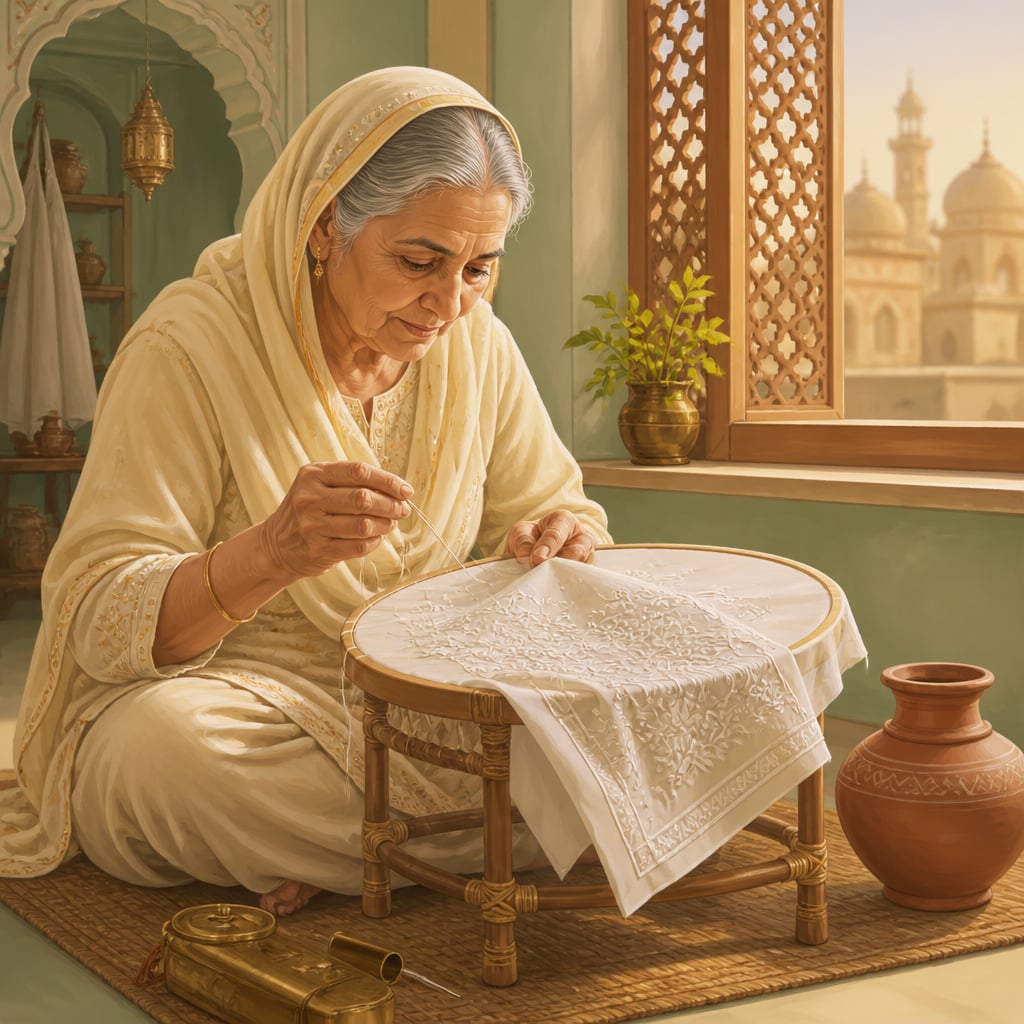
It is a quarter past seven in the morning in the Chowk quarter of old Lucknow, a few lanes from the Rumi Darwaza and the Bara Imambara. The winter sun has just cleared the rooftops of the old city. In a first-floor veranda above a small jewellery shop on a narrow lane called Nakkhas, a woman we will call Zareena Begum, a composite drawn from the older generation of women embroiderers who still live and work in the Chowk and Bakshi ka Talaab neighbourhoods, sits cross-legged on a thin cotton dari with her back against a whitewashed wall. Her hair is grey. Her glasses are thick. In her lap is a folded length of Lucknow mulmul cotton, pulled taut across her thigh with a small wooden hoop. In her right hand is a fine steel needle. In her left is a spool of untwisted white cotton thread she holds the way a calligrapher holds a pen.
She is finishing the last of the bakhiya shadow stitches on the hem of a kurta. The kurta has been on her lap on and off for twenty-three days. Her daughter-in-law Sabiha did the taipchi running stitches that laid out the pattern across the yoke. Her granddaughter Safia did the phanda knot work on the neckline and the cuffs. Zareena has been doing the bakhiya, the hardest of the thirty-six stitches and the one that requires the steadiest hand. The kurta was commissioned by a Lucknow woman named Farah, who is marrying into a Delhi family next month. The order came through Ada, a label that runs a showroom on Hazratganj and a website that takes orders from Delhi, Mumbai, and the Indian diaspora in London and New York.
Ada will pay Zareena's family a little over eleven hundred rupees for this kurta. That is roughly three times what a traditional middleman would have paid her twenty years ago. It is still a fraction of what the kurta will sell for in the Hazratganj showroom, but it is a fraction that allows Zareena's family to buy food, pay the electricity bill, and send Safia to college. This lesson is about the thread that runs from Nur Jahan's Persian embroiderers in the court of Jahangir four hundred years ago to the eleven hundred rupees that will reach Zareena's household on Friday.
The Word and the Two Crafts
Chikankari is Persian. Chikan means a kind of white-on-white embroidery. Kari means craftsmanship. Zardozi is also Persian. Zar means gold. Dozi means embroidery. The two crafts share a common ancestor in the Safavid and Timurid courts of Iran and Central Asia, arrived in India through the same channel (the Mughal emperors of the sixteenth and seventeenth centuries), and settled in the same two cities (Lucknow and Agra). But they are technically very different.
Chikankari is done on fine cotton or muslin, by women, in the home or in small household workshops, using only a plain needle and untwisted cotton thread. The pattern is first printed on the cloth in wash-out ink by a male block printer called a chhapa, and the embroiderer then stitches over each printed line in one of the thirty-six traditional stitches. When the stitching is finished, the cloth is soaked and washed, the ink dissolves, and only the white thread remains on the white cloth. A finished chikan piece is read more by touch than by sight. The raised knot and shadow stitches catch the light at different angles depending on how the garment moves.
Zardozi is done on silk, velvet, or heavy cotton, traditionally by men, in a workshop called a karkhana on a long wooden frame called an adda. The embroiderer sits on a low stool with the adda between his knees, the cloth stretched tight, and uses a small hooked needle called an ari to couch gold or silver thread on the surface. Metal spangles, sequins, and coiled wires (salma, sitara, gota, dapka) are couched alongside the gold thread to build up a three-dimensional relief. A full-length Mughal-era zardozi robe could weigh several kilograms, most of it gold.
The two crafts often meet on the same garment. A classical Lucknow wedding kurta from the eighteenth or nineteenth century might carry chikan on the muslin body and a zardozi border on the collar and cuffs, made in two different workshops by two different communities and combined by a master tailor in a third.
Nur Jahan and the Mughal Arrival

The most widely told story attaches the arrival of chikankari to Nur Jahan, the favourite wife of Emperor Jahangir, whom he married in 1611 and who effectively co-ruled the empire from 1611 until his death in 1627. Nur Jahan was born Mehr-un-Nissa in Kandahar in 1577 to a Persian noble family, and she brought to the Mughal court a Persian sensibility in textiles, perfume, and cuisine that is still visible in Lucknow culture four centuries later.
The story is that Nur Jahan, who designed her own garments, introduced the Persian white-on-white technique to her tailors and then to the court embroidery workshop, and that the technique spread from the court to the artisan households of Awadh over the following century. By the time the Nawabs of Awadh moved their capital to Lucknow in 1775 under Asaf-ud-Daula, chikankari had become the signature white-muslin embroidery of the Awadh court. Nur Jahan's role is almost certainly simplified. The technique probably arrived through multiple Persian and Central Asian channels over several generations. But the symbolic attachment remains central to how the Lucknow community tells its own history.
Zardozi is attested in Mughal court records from the time of Akbar (reigned 1556 to 1605). The Ain-i-Akbari, Abul Fazl's account of Akbar's administration, lists gold-thread embroidery workshops among the imperial karkhanas and records the wages and materials of the royal embroiderers. By the time of Shah Jahan (reigned 1628 to 1658), the Agra karkhanas were producing ceremonial robes, saddle cloths, canopies, and cushion covers for the entire imperial household, and the court's demand for gold thread was so great that the imperial treasury employed a dedicated department to oversee the supply of spun-gold wire.
The Thirty-Six Stitches
The technical heart of chikankari is the catalogue of thirty-six stitches, each with its own name, wrist motion, and traditional usage. A simple kurta uses seven or eight. A masterpiece saree could use all of them. The names are as important as the motions: taipchi (running stitch), pechni (cross-pulled stitch), bakhiya (shadow stitch, the hallmark of Lucknow), phanda (grain knot), murri (rice-grain knot), jaali (net openwork), hool (eyelet), rahet (stem stitch), khatua (chain stitch), and the long list of regional variants that make up the remaining twenty-six. A senior Lucknow ustad can identify the stitch, the village of origin, and often the individual embroiderer's hand from a few inches of finished work.
The signature stitch, bakhiya, is worked on the reverse side of the cloth with a double-herringbone motion that produces, on the right side, a slightly raised pattern that casts a faint grey shadow under the translucent muslin. A well-made bakhiya border is almost invisible in direct light and comes alive when the garment moves. It is the most delicate of the thirty-six, the slowest to work, and the one that requires the steadiest hand. Zareena Begum is one of several dozen women in the old city who can still execute it at the level senior ustads consider authentic.
The stitches are not learned in school. They are learned by sitting next to a mother or a grandmother, from the age of six or seven, practising each stitch on scrap cloth for years. By sixteen, a young woman can handle the simpler stitches on a commissioned kurta. By twenty-five, she should know the full catalogue. By forty, with daily practice, she is a master. There is no certificate. The work itself is the certificate.
Zardozi: Gold in a Wooden Frame

A zardozi karkhana is usually a single large room in a Muslim artisan neighbourhood of Lucknow, Agra, or Bareilly, with six to twelve men seated around long adda frames. The cloth, usually a heavy silk or velvet in deep burgundy, royal blue, or emerald green, is stretched and pinned to the frame. The master draws the design in fine chalk from a paper template called a khaka, and the others begin couching the gold thread along the chalk lines with their ari hooks, working from the top downwards.
The gold thread itself is a silk or cotton core wrapped in fine gold or silver-gilt wire, produced historically in Surat and Bareilly. A full-scale zardozi wedding sherwani can take a team of six embroiderers three to six weeks of continuous work and may use several kilograms of gold and silver thread combined. The piece is heavy enough that the wearer sometimes has to be supported by an attendant during the wedding procession.
The technique peaked under Shah Jahan in the mid-seventeenth century, when the Agra karkhanas were producing robes, canopies, and ceremonial furniture for the building of the Taj Mahal complex. After Aurangzeb cut the court's textile budget in the 1660s in favour of a simpler Islamic dress code, the karkhanas began a long decline that continued through the nineteenth century and nearly ended the tradition altogether in the first half of the twentieth. What saved it was Bollywood. After Partition in 1947, skilled Muslim embroiderer families migrated into Lucknow, Bareilly, and Mumbai, where Hindi film production in the 1950s and 1960s discovered them, bought their work, and gave them a new patronage base that replaced the Mughal court nearly three hundred years after Aurangzeb had let the old one lapse.
The Women Behind the Cloth
The modern chikankari economy is a women's economy built on top of a male-dominated commercial structure. The women who stitch the cloth are almost entirely Muslim and Hindu women of the old Lucknow neighbourhoods and the villages of Bakshi ka Talaab, Malihabad, and Kakori. They work from home, between cooking and childcare, with their daughters and daughters-in-law learning the stitches by watching. The men who receive the orders from retailers, distribute the printed cloth to the women, and take back the finished pieces are called mahajans, and for most of the twentieth century they absorbed between fifty and seventy percent of the retail price of every chikan kurta.
The single most important intervention in the modern economy was the founding, in 1984, of SEWA Lucknow, the Self-Employed Women's Association of Lucknow, by a Kolkata-born social worker named Runa Banerjee. SEWA began by registering a few hundred women embroiderers, offering them direct commissions at fair prices, and cutting out the mahajan middle layer. By 2010, its rolls had crossed ten thousand women. SEWA Lucknow now runs its own showroom on the Qaiserbagh road, a training centre, a design cell, and a welfare programme that pays for the children's schooling of the women on its rolls. It is the reason a Lucknow grandmother like Zareena can receive eleven hundred rupees for a kurta rather than three hundred.
In 2008, Lucknow Chikankari received its Geographical Indication registration from the GI Registry in Chennai, legally protecting the name and the technique as originating in the Lucknow district and the surrounding villages of Uttar Pradesh. The registration has not ended the problem of machine-made imitations from Surat and Ahmedabad, but it has given the cooperative a framework for challenging counterfeit work sold under the Lucknow name.
Living Centres and Honest Commerce
The living centres today are scattered across old Lucknow, with important satellite clusters in Bakshi ka Talaab, Malihabad, Kakori, Bareilly (for zardozi), and Agra (for zardozi). The principal retail and cooperative institutions are SEWA Lucknow, the Fabindia sourcing programme (which has been buying chikan from artisan cooperatives since the 1970s), and the newer Ada label (founded in Lucknow in 2012), which ships GI-tagged Lucknow chikan to diaspora buyers in London, Toronto, Dubai, and New York.
Zareena Begum finishes the last bakhiya stitch on the hem of Farah's kurta. She pulls the thread through, cuts it close to the cloth with a small pair of scissors that her mother-in-law used before her, and folds the kurta carefully into a cotton pouch. Her granddaughter Safia will take the pouch to the Ada showroom on Hazratganj this afternoon on her way to college. The kurta will hang on a mannequin in the window for a day or two before Farah collects it for the wedding in Delhi. The shadow border Zareena finished this morning will be almost invisible when the kurta is hanging still. When Farah walks down the aisle of the reception hall under the soft lights, the shadow will come alive and the raised pattern of the bakhiya will move with her. Four hundred years ago, Nur Jahan walked the same way in the court of Jahangir with the same stitch hidden in the hem of her own muslin. The needle has not changed. The thread has not changed. The shadow is the same shadow. Only the names of the women who carry it have been added, generation by generation, to a list that nobody has ever written down.
Key figures
Empress Nur Jahan
The twentieth and most influential wife of Mughal Emperor Jahangir, born Mehr-un-Nissa in Kandahar in 1577 to a Persian noble family of the Mirza Ghiyas Beg household. She was married to Jahangir in 1611 after the death of her first husband and effectively co-ruled the Mughal Empire with Jahangir from 1611 until his death in 1627. Nur Jahan was unusual among Mughal empresses in the range of her personal authority: coins were struck in her name, imperial farmans were issued under her seal, and she personally designed textiles, perfumes, jewellery, and court costumes.
Runa Banerjee
A Kolkata-born social worker who moved to Lucknow in the late 1970s and began documenting the wage gap between what chikan embroiderers were paid by middlemen (mahajans) and what their work was finally sold for in the Hazratganj and Aminabad retail markets. Runa Banerjee co-founded SEWA Lucknow (the Self-Employed Women's Association of Lucknow) in 1984 together with a group of Lucknow women embroiderers who had been working the mahajan system for generations.
Ustad Faiyaz Khan of Lucknow
A senior chikankari master embroiderer of the old Lucknow ustad lineage, born into a family of court-associated chikan craftsmen, who spent decades training apprentices, developing new stitch applications, and preserving the full catalogue of the thirty-six traditional stitches through the difficult middle decades of the twentieth century when the tradition was contracting under the pressure of middleman exploitation, machine-made imitations, and the loss of court patronage. Faiyaz Khan received the Shilp Guru award, the highest national honour given to Indian master artisans by the Development Commissioner for Handicrafts.
Case studies
Runa Banerjee and the Founding of SEWA Lucknow in 1984
In the early 1980s, a Kolkata-born social worker named Runa Banerjee had been living in Lucknow and working in the Chowk neighbourhoods for several years. She had been watching the chikankari trade at close range. The women embroiderers of the old city and the surrounding villages were producing some of the finest hand embroidery in India. They were being paid, on average, three to five rupees per garment by the local middlemen known as mahajans. The same garment was being sold in the Hazratganj and Aminabad retail shops for forty to sixty rupees. The mahajans, who supplied the printed cloth to the women, collected the finished pieces, and carried them to the retailers, were absorbing seventy percent of the retail value. The women and their families were living in chronic poverty while their own hands were producing a luxury product that sold in Delhi and Mumbai at ten times what they were paid for it. Banerjee had documented this wage gap in notebook after notebook. She knew the mahajan system was the problem. She also knew that no single family could break it alone. In 1984, together with a group of Lucknow women embroiderers who had been stitching under the mahajan system for a generation, she founded the Self-Employed Women's Association of Lucknow, registered under the Indian Trade Unions Act, and began offering the registered members direct commissions at fair per-piece rates that cut out the mahajan middle layer entirely.
The founding of SEWA Lucknow was a direct implementation of the classical Indian guild (shreni) logic in a modern legal form. The shreni structure of the classical and medieval Indian craft economy had always been built around the pooling of scattered individual makers into a single negotiating unit that could deal directly with royal courts, temple administrations, and long-distance traders on behalf of all its members. The mahajan middleman structure that had dominated chikan sales through the twentieth century was in effect a colonial and post-colonial distortion of the older direct-patronage model: it inserted a non-producing layer between the maker and the buyer and allowed that layer to absorb most of the value. What Banerjee and her collaborators did was simply to re-establish the shreni structure in a new legal form appropriate to modern conditions. The dharmic framing is that a craft community is entitled to a fair share of the retail value of its own work, and that collective bargaining is the legitimate mechanism by which that entitlement is enforced.
SEWA Lucknow began with a few hundred registered women embroiderers in 1984 and grew to more than five thousand by 1990 and more than ten thousand by 2010. It opened its own retail showroom on the Qaiserbagh road, its own training centre, its own design cell, and a welfare programme that pays for the education of the children of the women on its rolls. By the mid-2000s, SEWA Lucknow was the single largest direct-wage women's handicraft employer in India. In 2008, the cooperative was the primary institutional voice in the successful application for the Geographical Indication registration of Lucknow Chikankari, which gave the cooperative and its legal partners a formal framework for challenging counterfeit work sold under the Lucknow name. Per-piece payments to the embroiderers under SEWA Lucknow's direct-wage system are now between three and five times the rates that prevailed under the mahajan system, and the cooperative's showroom sells GI-tagged Lucknow chikan at prices that cover the full cost of production plus a fair margin for both the embroiderers and the cooperative's own operations.
The founding of SEWA Lucknow is one of the clearest modern demonstrations that the problem with an exploitative craft economy is usually structural rather than individual, and that the correct response is structural change rather than charity. Before SEWA Lucknow, several well-meaning charitable programmes had tried to help the chikan embroiderers through donations and subsidised material supply. None had had a lasting effect, because none had changed the mahajan middleman structure that was absorbing most of the value. Banerjee's cooperative succeeded because it addressed the structure directly: by registering the women as cooperative members and offering them direct commissions at fair rates, it removed the middleman layer and let the women keep most of what they had always been producing. The lesson for anyone working on an exploitative economy is that the first question is always about the structure, and the first intervention is always structural. Charity that leaves the exploitative structure in place is a subsidy to the exploiters.
The SEWA Lucknow model has become the standard reference case in Indian craft preservation scholarship for cooperative-led structural reform of exploitative traditional economies. Similar cooperative structures have been built, with varying success, for Banarasi silk weavers, Kanchipuram silk weavers, Pochampally ikat weavers, Chanderi weavers, and Kutch embroiderers. The underlying insight, that the correct response to an exploitative middleman structure is structural change rather than charity, is now one of the most important organising principles in Indian craft policy. Runa Banerjee's personal legacy continues through the cooperative's ongoing operations and through the generations of women embroiderers whose livelihoods have been stabilised by the institution she helped to found.
SEWA Lucknow was founded in 1984 by Runa Banerjee and a group of Lucknow women chikan embroiderers. It now has more than ten thousand registered women on its rolls, runs a retail showroom on the Qaiserbagh road, a training centre, a design cell, and a welfare programme. Per-piece payments to embroiderers under SEWA Lucknow's direct-wage system are between three and five times the rates that prevailed under the mahajan middleman system of the pre-1984 era.
Ustad Faiyaz Khan and the Preservation of the Thirty-Six Stitches
Through the 1950s, 1960s, and 1970s, the chikankari tradition of Lucknow was in a state of quiet decline. The Nawabi court patronage that had sustained the peak of the craft in the nineteenth century was long gone. The colonial administration had paid no attention to the tradition through most of the twentieth century. The mahajan middleman structure had been absorbing most of the retail value of every garment for generations, and the women embroiderers were being paid at rates that made it difficult to justify the time required to execute the more complex of the thirty-six traditional stitches. Several of the rarer stitches were being simplified or dropped altogether by younger embroiderers who could not afford the slow work that the full catalogue required. In the middle of this decline, a small number of senior Lucknow ustads of the old court-associated families were quietly holding the full thirty-six-stitch catalogue in their heads and in the working practice of their own households. One of them was Ustad Faiyaz Khan, a master chikan embroiderer of the old Chowk lineage, who had learned the stitches from his father and grandfather and was still executing every one of them on commissioned work even when the market would not pay for the extra time.
The traditional understanding of the chikan ustad's role is that he is a custodian, not an innovator. His job is not to invent new stitches or new patterns. His job is to preserve the full catalogue of existing stitches and patterns exactly as they have been handed down through the teaching lineage, and to pass them on to the next generation of apprentices in the same form. The analogy the old ustads draw is to the classical Indian memorisation traditions of the Vedic Samhitas: the job of the reciter is not to improve the text but to transmit it without error. When market pressure begins to simplify a stitch or to drop it from the working repertoire, the ustad's dharmic obligation is to keep executing the full stitch correctly on his own work, to teach it correctly to his own apprentices, and to refuse to let the simplification become the new standard. Faiyaz Khan and a small number of his senior peers held this position through the lean decades of the mid-twentieth century, when there was almost no market reward for doing so.
When the revival of Lucknow chikankari began in earnest in the 1980s with the founding of SEWA Lucknow and accelerated in the 2000s with the GI registration process and the arrival of direct-to-consumer labels, the full thirty-six-stitch catalogue was still available to be taught to younger embroiderers because the old ustads had kept it alive in their own daily practice through the lean decades. Faiyaz Khan's household was one of several dozen across Lucknow that became training nodes for the revival. Apprentices working under SEWA Lucknow's training programmes were sent to sit with him and watch his hands execute the rarer stitches. His working notebooks and his teaching sessions were documented by textile researchers from the Indian Institute of Crafts and Design in Jaipur and from independent design schools. Faiyaz Khan received the Shilp Guru award from the Development Commissioner for Handicrafts for his lifetime contribution to the preservation of Lucknow chikankari. His work is now cited as one of the reasons the thirty-six stitches survived into the era of cooperative and direct-to-consumer retail rather than contracting to fifteen or twenty stitches as several other regional embroidery traditions have done under similar market pressure.
The preservation of a complex traditional vocabulary through a lean period depends almost entirely on the patience of a small number of senior practitioners who refuse to let the vocabulary contract under market pressure. The chikan community's thirty-six stitches survived the twentieth century because a small number of ustads like Faiyaz Khan kept executing every one of them on their own work even when the market would not pay for the extra time. The lesson for any complex traditional practice is that the full vocabulary will contract under market pressure unless specific practitioners make a conscious decision to hold it against the pressure, usually at personal economic cost. The decision to hold is not glamorous. It looks like stubbornness from the outside. From the inside, it is an act of dharmic custodianship that is the only reason the tradition is still available to the next generation.
The Faiyaz Khan case is now a standard reference in Indian craft scholarship for the role of individual master practitioners in the preservation of complex traditional vocabularies through periods of market contraction. Similar custodianship patterns have been documented in other Indian traditions, including Banarasi silk weaving (where a small number of master weavers preserved the full zari pattern vocabulary through the lean decades of the mid-twentieth century), Pattachitra painting (where master families in Raghurajpur kept the full iconographic vocabulary alive), and Kathakali dance (where senior gurus kept the full repertoire of mudras alive during the early twentieth century when the form was close to extinction). In every case the pattern is the same: the tradition contracts under market pressure unless specific senior practitioners hold the line at personal cost, and the revival that follows depends on what they preserved.
Lucknow chikankari has thirty-six distinct traditional stitches, each with its own name and its own technical definition. All thirty-six are still being executed today somewhere in the community, though some of the rarer stitches are practised by only a few dozen women each. The survival of the full catalogue is attributed in community memory to the patient custodianship of a small number of senior ustads like Faiyaz Khan who held the vocabulary through the lean decades of the mid-twentieth century.
Fabindia and the Long-Term Lucknow Sourcing Programme
Fabindia was founded in 1960 in Delhi by an American named John Bissell, who had come to India in 1958 on a Ford Foundation grant to advise the Central Cottage Industries Corporation on the export of handloom textiles. Bissell's original idea was simple: to buy handwoven Indian textiles directly from village weavers and retail them to urban Indian and international buyers at prices that reflected the real cost of the work. From the late 1960s and through the 1970s, Fabindia began building direct sourcing relationships with specific traditional textile communities across India, including the chikankari embroiderers of Lucknow. The Fabindia Lucknow sourcing programme began with a small group of women embroiderers in the old city and their mahajan intermediaries, and gradually expanded over the next several decades to include several hundred embroiderers working through cooperative structures. By the 2000s, Fabindia's Lucknow chikan range was one of its most recognisable product categories, and the company's sourcing practice had become a model for long-term corporate-artisan partnerships in the Indian craft economy.
The Fabindia Lucknow sourcing model is a modern implementation of the classical Indian patronage relationship in which a large institutional buyer commits to a continuing supply relationship with a specific artisan community for a sustained period of time. In the classical and medieval periods, this role was filled by royal courts, temple administrations, and long-distance merchant guilds. In the twentieth century it collapsed under the pressure of colonial trade disruption and was replaced by the mahajan middleman structure, which provided no long-term commitment to the artisan community and no stable demand signal that would allow planning, apprenticeship, or investment. The dharmic logic of long-term patronage is that an artisan community cannot plan its own reproduction (its own training of the next generation, its own investment in new blocks or new designs, its own scheduling of commissioned work) unless there is a reliable demand signal from a committed buyer. Fabindia's sustained Lucknow sourcing partnership reintroduced this reliable demand signal after a long period of its absence, and the chikan community's recovery over the past five decades is partly a consequence of the reintroduction.
The Fabindia Lucknow chikan sourcing programme has been in continuous operation since the 1970s and now supports several hundred women embroiderers through cooperative structures associated with its Lucknow sourcing office. Fabindia pays rates that are substantially higher than the old mahajan rates (though not as high as some of the newer direct-to-consumer labels) and provides a reliable demand signal that has allowed partner cooperatives to plan apprentice training, material supply, and seasonal production schedules. The programme has been one of several institutional pillars (alongside SEWA Lucknow, the GI registration, and the newer Ada label) that have collectively stabilised the chikan economy over the past forty years. Fabindia's Lucknow range continues to be one of its most commercially successful product categories, and the company's sustained commitment to the sourcing relationship has been cited as a model by other Indian retail brands entering similar artisan partnerships. The Bissell family's continued association with Fabindia through the second generation has been an important factor in the persistence of the long-term sourcing model even as the company has expanded into other product categories.
A large retail buyer who commits to a sustained, long-term sourcing relationship with a specific artisan community can do more for the community's survival than a much larger one-time intervention. Fabindia's Lucknow sourcing programme has lasted more than fifty years across two generations of ownership. The stability of the demand signal it provides has allowed the partner cooperatives to plan their own reproduction in ways that would be impossible with short-term or spot-market buyers. The lesson for any large institutional buyer of traditional craft is that the value of commitment compounds over time, and that the most important thing a buyer can offer an artisan community is not a higher price on a single transaction but a reliable multi-decade demand signal. The most important thing the artisan community offers the buyer in return is not cheap labour but the full quality vocabulary of a tradition that has been preserved across generations and that cannot be acquired any other way.
The Fabindia Lucknow sourcing model is now the standard reference case in Indian craft scholarship for long-term corporate-artisan partnerships. Similar sustained sourcing relationships have been built by other Indian retail brands including Cottons by Jaya, Anokhi, and more recently Good Earth and Nicobar, each with its own specific artisan community partnerships. The underlying insight, that the stability of the demand signal matters more than the price of any single transaction, is now widely accepted in Indian craft preservation discourse. Fabindia's willingness to sustain the Lucknow relationship across more than fifty years and two generations of ownership is cited as the principal reason its partnership has outlasted most other retail-artisan relationships in the Indian market.
Fabindia was founded in 1960 in Delhi by John Bissell. Its Lucknow chikankari sourcing programme has been in continuous operation since the 1970s and currently supports several hundred women embroiderers through cooperative structures. The Lucknow chikan range is one of Fabindia's most recognisable product categories and has been sustained across two generations of company ownership.
Ada Lucknow and the Direct-to-Consumer Chikan Model
In 2012, a Lucknow-based entrepreneur founded a chikankari label called Ada, with a specific commitment to sourcing directly from a network of Lucknow embroiderer households and retailing GI-tagged Lucknow chikan to urban Indian and diaspora buyers through a single showroom on the Hazratganj road and through a website that shipped globally. Ada's founding insight was that the existing chikan retail channels were still leaving too much of the retail value in intermediary hands, even after the interventions of SEWA Lucknow and the Fabindia sourcing programme of earlier decades. A pure direct-to-consumer label, built with the internet as its primary distribution channel, could shorten the chain even further and return a larger share of the retail price to the embroiderer households. Ada began by registering approximately fifty embroiderer households from the Chowk, Bakshi ka Talaab, and Malihabad areas, hiring a small in-house design team, and building a website that allowed customers in Delhi, Mumbai, London, and New York to order chikan garments directly from a Lucknow supplier.
The Ada direct-to-consumer model is the latest step in a long series of structural experiments aimed at progressively shortening the distance between the chikan embroiderer and the urban or diaspora buyer. The classical Mughal court patronage structure was in effect direct-to-consumer at the top of the market (the emperor ordered directly from the royal karkhana) and indirect at the bottom. The colonial-era mahajan system was uniformly indirect. The 1984 founding of SEWA Lucknow reintroduced a cooperative intermediary that paid the embroiderer directly. The 1970s Fabindia sourcing programme added a long-term retailer committed to fair pricing. The 2012 founding of Ada added a pure digital direct-to-consumer channel with no physical retail footprint outside a single Hazratganj showroom. Each step shortens the distance between maker and buyer a little further, and each step returns a larger share of the retail price to the maker. The dharmic logic is that the value of a handmade object should flow predominantly to the hands that made it, and that the intermediate layers through which it passes should be as thin as is practically possible.
Ada has grown from a small initial network of approximately fifty embroiderer households in 2012 to a current network of more than fifteen hundred embroiderer families across the Lucknow district and the surrounding villages. The label retails GI-tagged Lucknow chikankari through its single Hazratganj showroom and its website, which ships to Indian diaspora buyers in London, Toronto, Dubai, New York, and elsewhere. Per-piece payments to the embroiderer households are substantially higher than the rates prevailing at either Fabindia or the older mahajan structures, and typically include small additional welfare payments for children's schooling and family health care. The label has become one of the most visible examples of the direct-to-consumer model in the Indian traditional craft economy and has been studied as a case study in design schools and craft preservation courses. Its commercial success has demonstrated that the direct-to-consumer channel can coexist with, rather than cannibalise, the older cooperative and sustained-sourcing channels, and the three channels together now form the institutional backbone of the modern Lucknow chikan economy.
The direct-to-consumer model is not a replacement for cooperatives or for long-term retail sourcing partnerships. It is an additional channel that complements them, and the three channels together cover different segments of the market that no single channel can serve alone. Cooperatives like SEWA Lucknow serve the mass market at fair wages. Sustained sourcing partnerships like Fabindia's Lucknow programme serve the middle market at reliable prices. Direct-to-consumer labels like Ada serve the urban and diaspora market at premium prices that return the largest share of the retail value to the embroiderer households. A healthy traditional craft economy almost always needs all three channels operating simultaneously. The lesson is that channel diversity is one of the most important structural features of a resilient craft economy, and that adding a new channel is almost always more valuable than trying to shift all production into an existing one.
The Ada case is now one of the standard references for the direct-to-consumer model in Indian traditional craft scholarship. Similar direct-to-consumer labels have been launched in other craft traditions, including Tilfi for Banarasi silk, Sujata Biswas for Bengal weaving, Ethicus for Tamil Nadu organic cotton, and Okhai for Kutch embroidery. The underlying insight, that the internet makes possible a degree of disintermediation in the craft economy that was not possible in the pre-digital era, is one of the most important structural changes in the Indian traditional craft economy of the past two decades. The diversity of channels represented by SEWA Lucknow, Fabindia, and Ada in the Lucknow chikan economy is now cited as a model for other traditional craft regions in India seeking to build resilient multi-channel retail structures.
Ada was founded in Lucknow in 2012 and now works with more than fifteen hundred embroiderer families across the Lucknow district and the surrounding villages. The label retails GI-tagged Lucknow chikan through its Hazratganj showroom and its website, which ships to Indian diaspora buyers worldwide. Per-piece payments to the embroiderer households under Ada's direct-to-consumer model are substantially higher than the rates prevailing under the older mahajan or cooperative structures.
Historical context
The chikankari and zardozi story runs from the arrival of Empress Nur Jahan at the Mughal court of Jahangir in 1611 and the consolidation of the imperial embroidery karkhanas under Akbar, Jahangir, and Shah Jahan in the sixteenth and seventeenth centuries, through the long decline of both crafts under Aurangzeb's austerity in the late seventeenth century and the subsequent British colonial period, through the near-extinction of both traditions in the first half of the twentieth century, through the 1947 partition-driven migration of skilled Muslim embroiderer families into new urban centres, through the post-independence Bollywood-driven revival of zardozi, through the 1984 founding of SEWA Lucknow by Runa Banerjee, through the 2008 Geographical Indication registration of Lucknow Chikankari, and into the present-day direct-to-consumer era represented by the Ada label, the Fabindia sourcing programme, and the couture use of both crafts by designer labels working in Delhi, Mumbai, and Dubai.
Chikankari and zardozi are the two principal living embroidery traditions of the old Mughal cities of the north Indian plain. Both arrived in India through the Persian-speaking Mughal court of the sixteenth and seventeenth centuries, and both settled primarily in Lucknow, Agra, Bareilly, Hyderabad, and Delhi. Their combined artisan community today includes between fifty thousand and one hundred thousand active practitioners, most of them Muslim and Hindu women and men of the old artisan neighbourhoods of these cities and their surrounding villages. Both crafts have received Geographical Indication registrations under the Indian GI Act of 1999: Lucknow Chikankari in 2008, Zardozi of Lucknow and Zardozi of Bhopal in the years following. The two traditions sit alongside the other major Mughal-era textile arts of the region, including the kamkhab silk brocade of Banaras and the naqshi embroidery traditions of Kashmir, in a shared aesthetic and technical vocabulary that traces its deep roots to the Safavid and Timurid courts of Iran and Central Asia.
Chikankari belongs to a small global category of white-on-white fine cotton or muslin embroidery traditions that includes the Ayrshire whitework of Scotland, the broderie anglaise of France and England, the Mountmellick embroidery of Ireland, and the drawn-thread work of the Aegean islands. All of these traditions share the visual effect of a raised white pattern on a white ground and use a similar vocabulary of running stitches, satin stitches, and shadow stitches, but each developed independently in its own region and none has the specific thirty-six-stitch catalogue that distinguishes Lucknow chikan. Zardozi belongs to the global family of metal-thread couching traditions that includes the goldwork embroidery of European ecclesiastical vestments, the Japanese koma-nui gold couching of Noh costumes, the Uzbek tilla-duzi of the Bukhara and Samarkand courts, and the Ottoman serasers of Istanbul. Among all of these, zardozi is distinctive in the survival of the adda wooden frame as the working platform and in the continuity of its karkhana organisational structure from the Mughal court to the present day.
The Lucknow chikankari artisan community today is estimated at between fifty thousand and one hundred thousand women embroiderers, spread across the old city of Lucknow and the surrounding villages of Bakshi ka Talaab, Malihabad, Kakori, and the adjoining countryside. SEWA Lucknow alone has more than ten thousand registered women embroiderers on its rolls. The thirty-six traditional chikan stitches are all still being executed somewhere in the community, though some of the rarer stitches are practised by only a few dozen women each. Lucknow Chikankari received its Geographical Indication registration from the Indian GI Registry in Chennai in 2008. Zardozi of Lucknow received its own GI registration in 2013.
Chikankari and zardozi are the clearest living examples in India of how a Mughal court art can move from royal patronage through colonial collapse into modern cooperative survival without losing its technical vocabulary. The thirty-six stitches of Lucknow chikan and the adda-based couching technique of zardozi are still practised today by the great-great-grandchildren of the families who served Shah Jahan and Jahangir. The bridge between the court and the modern cooperative was built by a small number of master ustads and organisers like Runa Banerjee who were willing to do the patient, unglamorous work of preservation during the decades when nobody else was paying attention. The lesson for modern craft preservation is that the continuity of a tradition depends less on the glamour of its peak patrons than on the patience of its intermediate generations.
Living traditions
Lucknow Chikankari received its Geographical Indication registration from the Indian GI Registry in Chennai in 2008, and Lucknow Zardozi received its own registration in 2013, legally protecting both names and techniques from imitation. SEWA Lucknow, founded by Runa Banerjee in 1984, is the single largest women's cooperative in the Indian handicraft economy and has more than ten thousand registered chikan embroiderers on its rolls. The Fabindia sourcing programme has been buying chikankari directly from Lucknow artisan cooperatives since the 1970s and currently employs several hundred embroiderers through its cooperative structure. The newer direct-to-consumer label Ada, founded in Lucknow in 2012, runs a Hazratganj showroom and a website that ships GI-tagged Lucknow chikan to Indian diaspora buyers worldwide. Couture designers including Abu Jani and Sandeep Khosla, Ritu Kumar, Tarun Tahiliani, and Manish Malhotra have all built major chikankari and zardozi collections that have extended the traditions into contemporary wedding couture and Bollywood costume. The Shilp Guru awards given by the Development Commissioner for Handicrafts have recognised several senior chikan ustads of Lucknow, ensuring that the full thirty-six-stitch catalogue continues to be taught to younger embroiderers.
- Household chikan embroidery for SEWA Lucknow and direct-to-consumer labels: The primary living practice of chikankari is household embroidery done by women, on their verandas, in between cooking and childcare, using a plain needle and untwisted fine cotton thread on pre-printed fine muslin cloth supplied by a cooperative or a retailer. A household of two to four women embroiderers, usually across three generations, will typically work on a commissioned kurta or saree for two to four weeks, with different women handling different stitches according to their skill and experience. The finished piece is returned to the cooperative or retailer, inspected for quality, washed to remove the printing ink, and sent on to the showroom or the customer. The cooperative or retailer pays the household a negotiated rate per piece, which is now, thanks to SEWA Lucknow and the newer direct-to-consumer labels, substantially higher than the rates that prevailed under the old mahajan middleman system.
- Zardozi karkhana production for wedding couture and Bollywood film costume: The living zardozi karkhanas of Agra and Lucknow produce most of their output for two primary markets: wedding couture and Bollywood film costume. A typical karkhana has six to twelve adda frames, with one male embroiderer at each, working under the supervision of a master ustad who draws the design from paper templates (khaka) and oversees the couching of the gold and silver thread, the placement of the salma coils, and the scatter of sitara spangles. A full-size wedding sherwani for a high-end commission can take a team of six embroiderers between three and six weeks of continuous work and will use several kilograms of metal-wrapped silk thread and tens of thousands of individual ornaments combined. The finished garment is delivered to the designer or directly to the customer, often with the final fitting done in the karkhana itself.
- Cooperative retail, designer sourcing, and GI-protected direct-to-consumer sales: The modern retail and sales practice for both chikankari and zardozi is built around three institutional forms: cooperative retail through organisations like SEWA Lucknow, designer-sourcing partnerships in which couture labels source directly from Lucknow and Agra karkhanas for their own collections, and GI-protected direct-to-consumer retail through labels like Ada (which runs a Hazratganj showroom and a website that ships Lucknow chikan to the Indian diaspora worldwide) and through the Fabindia sourcing programme (which has been buying directly from Lucknow artisan cooperatives since the 1970s). Each of these channels handles a different segment of the market: cooperative retail for mass-market chikan at fair wages, designer sourcing for high-end couture, and direct-to-consumer for middle-market urban and diaspora buyers.
Reflection
- Think about the handmade objects in your own home: clothes, bedding, embroidered linens, jewellery, any piece that was made by a human hand rather than a machine. Who made them? Were they mostly made by women or by men? Were those women paid fairly for their work? How would you know?
- Think of a traditional skill in your own family or community that has been passed down through several generations: a recipe, a ritual, a way of speaking, a craft technique. Does the skill still have specific names for its components? If yes, who in your family still uses the names, and when? If no, how recently were the names lost, and is there still anyone who remembers them?
- Is there work you are doing today that feels as if it will not be seen, appreciated, or valued for a long time, perhaps not in your own lifetime? If yes, what keeps you doing it? And what would change if you knew for certain that a revival would arrive fifty years after you had stopped, and that the work you were doing now would be the substrate on which that revival stood?