Kasuti, Lambani & Toda: Southern Embroidery Treasures

Three South Indian embroideries worked by three very different communities, all counted by hand without a printed pattern, all saved from extinction in the same generation, all now carrying GI tags within seven years of one another.

In the Nilgiri hills, a Toda woman counts threads on the back of a cotton shawl and remembers a pattern her grandmother never wrote down. Two hundred kilometres north, a Banjara woman at Sandur stitches mirrors and cowries onto a bright red skirt. Another hundred kilometres west, a Kasuti embroiderer in Dharwad counts cross-stitches across an Ilkal saree and builds a temple chariot out of pure counted thread. Three communities, three landscapes, three needles. But all three traditions are counted thread work, memorised by the embroiderer, worked without a printed pattern, carrying identity that another woman in the same community can read at a glance. And all three almost disappeared in the same colonial century, and were saved by the same small coalition of royal patrons, obsessive documenters, cooperative workshops, and the women themselves refusing to drop the needle.

A Morning in the Nilgiris
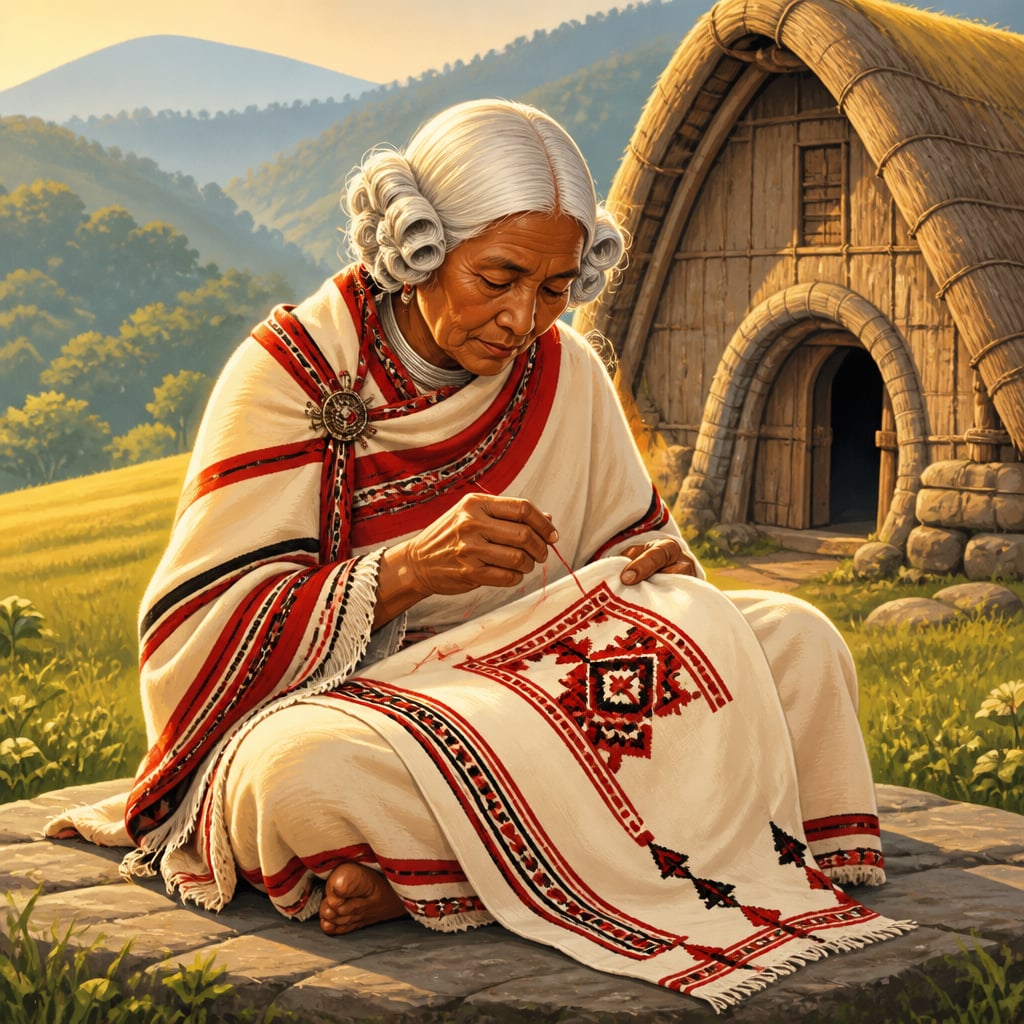
A Toda elder embroidering the putkuli shawl in the Nilgiri grasslands

Muthanad Mund, in the Nilgiri hills of Tamil Nadu, one morning in the early 2000s. Vasamalli Kuttan sits on a low wooden stool outside a barrel-vaulted Toda hut, a piece of thick cream-white handloom cotton stretched across her knees. Her right hand moves a needle loaded with bright red wool in and out of the cloth. Her left hand counts threads. She is not looking at a printed pattern. There is no pattern to look at. She is counting threads on the reverse of the cloth and remembering, by heart, a geometric grid that her mother taught her and that her grandmother taught her mother. The cloth will become a putkuli, the traditional Toda shawl. It will wrap the next baby born in Muthanad Mund. It will wrap that same girl at her wedding. And if the Toda still keep the old funeral, one like it will wrap her one last time on the pyre. Vasamalli is the first Toda woman to finish a doctorate. She also carries the full counted-thread vocabulary of Toda embroidery in her head, without any written notes. The two facts are not separate.

The Toda are a small pastoral tribe of about 1,500 people whose whole religion revolves around sacred buffalo dairies, and whose whole art form is one extraordinary shawl. Two hundred kilometres north of them, in the plateau villages around Sandur in Karnataka, Banjara women are stitching mirrors and cowrie shells onto bright red skirts. Another hundred kilometres west, in the old temple towns of Dharwad, Hubli, and Bijapur, Kasuti embroiderers are counting cross-stitches across Ilkal saree pallus. Three traditions. Three completely different communities. One idea runs through all of them: the cloth is a language, and the stitch is its alphabet.

The Thread That Holds Everything

In the Bhagavad Gita, Krishna tells Arjuna in one of the most beautiful verses of the text:

मत्तः परतरं नान्यत्किञ्चिदस्ति धनञ्जय। मयि सर्वमिदं प्रोतं सूत्रे मणिगणा इव॥

mattaḥ parataraṁ nānyat kiñcid asti dhanañjaya mayi sarvam idaṁ protaṁ sūtre maṇi-gaṇā iva

There is nothing higher than Me, O Dhananjaya. All this is strung upon Me, as pearls upon a thread.

Bhagavad Gita 7.7

For Krishna, the verse is a statement about cosmology. For an embroiderer, it is also an exact description of her work. A sutra, a thread, holds everything together. The mirrors on a Lambani choli, the red wool on a Toda putkuli, and the counted cross-stitches on a Kasuti pallu are all strung upon a single invisible thread that runs from the first knot to the last. When the embroiderer ties off her work, she is quietly enacting the verse: her whole pattern, all its beads, all its mirrors, all its remembered motifs, hangs on a thread the viewer no longer sees.

Kasuti: Counted Threads of Karnataka

A Kasuti master embroiderer building a temple gopuram on an Ilkal saree

Kasuti is the counted-thread embroidery of northern Karnataka. Its earliest documented period is the Kalyana Chalukya court of the eleventh and twelfth centuries, where Chalukya queens wore Ilkal cotton sarees embroidered with Kasuti as temple and festival wear. Kasuti was counted as one of a woman's sixteen traditional adornments, the solah shringar. The Vijayanagara kings, who came later, gave the craft a second home in the same region. By the Mughal and Maratha period, Kasuti had moved from court workshops into domestic life. Mothers in Dharwad, Hubli, Bijapur, Belgaum, and Gadag embroidered their daughters' wedding sarees at home, on long strips of Ilkal cotton, before marriage.

Kasuti uses only four stitches. All four are counted directly on the threads of the cloth. There is no tracing. There is no printed pattern. The embroiderer counts up two threads, across three threads, and across again, working entirely from memory. The four stitches are:

From these four stitches alone, a Kasuti embroiderer builds the whole iconography of a Karnataka temple town: the seven-storeyed gopuram, the wooden chariot (rath), the palanquin, the conch, the oil lamp, the tulasi plant, the peacock, the parrot, the elephant, and Basava the Nandi bull. A full Kasuti saree pallu can carry dozens of these motifs in a single panel. The other rule the embroiderer is taught early is that Kasuti must never be knotted at the back. The reverse of the cloth must be almost as clean as the front, because an Ilkal saree is draped both ways and the inside becomes the outside at every fold.

Kasuti almost died in the twentieth century. When she founded the All India Handicrafts Board in 1952, Kamaladevi Chattopadhyay sent field workers into the North Karnataka villages to document what was left. She set up the first Kasuti cooperatives in Dharwad and Hubli. In 2006, Kasuti embroidery received a Geographical Indication tag, the first of the three embroideries in this lesson to do so.

Lambani: A Needlework That Came on the Caravan

A Lambani Banjara woman stitching mirrors on her phetiya at Sandur

The Lambani women, also called Banjara and Lambadi, belong to a nomadic community whose historical work was carrying long caravans of salt, grain, and cattle across India. Their origin is widely traced to Rajasthan. Mughal armies depended on Banjara bullock-cart trains for supplies. Maratha and later British armies did the same. Over several centuries, Banjara groups settled along the caravan routes in the Deccan, in what is now Telangana, northern Karnataka, southern Maharashtra, Andhra, and parts of Madhya Pradesh. Wherever the caravans rested, the women embroidered.

A Lambani phetiya (skirt) and kanchali (choli blouse) is a wearable archive. Onto a base of heavy cotton or khadi, the women stitch mirrors (abhla), cowrie shells, brass coins, pom-poms, and thick geometric cross-stitching in red, yellow, white, green, and pink. The patterns carry caravan memories: the bullock-cart wheel, the sun disc, the pomegranate flower, the protective eye. A married woman's jewelry and her skirt, taken together, are her clan's passport and her own biography. An elder Banjara can read another woman's cloth and tell which region, which sub-group, and which stage of life she belongs to, before either of them speaks.

The single most important institution for Lambani embroidery today is the Sandur Kushala Kala Kendra in the Bellary district of Karnataka. It was founded in 1986 by the Ghorpade royal family of the former princely state of Sandur, and its stated mission was to give Banjara women a workshop, a design archive, and a steady market for their embroidery. The Kendra now employs several hundred Banjara women from the surrounding villages. In 2010, Sandur Lambani Embroidery received a Geographical Indication tag in the name of the Kendra. The Bengaluru-based craft label Kaisori, founded in the early 2000s, has put Lambani embroidery onto contemporary dresses, jackets, and bags, working directly with Banjara women at Sandur and in nearby villages. Kaisori's clothes carry the caravan stitch into spaces where a full traditional phetiya would never be worn.

Toda: The Shawl That Wraps a Life

The Toda are a small pastoral tribe of about 1,500 people who live in the high grasslands of the Nilgiris in Tamil Nadu. Their religion is built around sacred buffalo dairies, their hamlets are called munds, and their priests are called palol. They have almost no painted or carved art. What they have is one extraordinary textile.

The putkuli is a thick cream-white hand-loomed cotton shawl, about two and a half metres long, embroidered in bold geometric patterns in red and black wool. Only Toda women embroider putkulis. The technique is counted-thread darning, worked on the reverse of the cloth, so that the pattern appears identical on both sides. A putkuli is fully reversible. The motifs carry Toda names: the buffalo horn, the mountain peak, the sacred dairy, the bee, the sun, the rainbow. Each name ties the cloth directly back into Toda cosmology.

A Toda child is wrapped in a putkuli at naming. A Toda girl wears one at her first menstruation ceremony and at her marriage. In the old funeral, which some Toda clans still keep, the body is cremated wrapped in a putkuli. The shawl therefore carries a Toda person from the first breath to the last. No other Indian textile does quite this. It is not a garment. It is a biography in thread.

In 2013, Toda embroidery received its Geographical Indication tag. The field documentation that made the application possible came mostly from a Coimbatore pediatrician named Dr. Tarun Chhabra, who first came to the Nilgiris as a young doctor in the 1980s. Over the next thirty years he lived with the Toda, learned their language, mapped their dairy-temple calendar, and recorded the name of every surviving putkuli motif. In 1991 he founded the Edhkwehlynawd Botanical Refuge, an NGO that restores the sacred shola forests and grasslands the Toda depend on. His 2015 book, The Toda Landscape, is now the standard reference on all things Toda. The Toda Embroidery Cooperative, supported by the Keystone Foundation in Kotagiri, now pays about four hundred Toda women for their putkulis. The shawls sell in Kotagiri, Coonoor, and at craft fairs across South India. Every piece is counted thread by thread, by hand, in exactly the way Vasamalli Kuttan was counting threads at the beginning of this lesson.

Three Needles, One Sutra

Kasuti, Lambani, and Toda belong to three completely different communities. A Chalukya queen, a Banjara caravan woman, and a Toda pastoralist would not have recognised each other's cloth if their paths had crossed on a Deccan road five hundred years ago. The traditions use different stitches, different base cloths, different colour palettes, and different motifs. What they share is older than any of them.

All three traditions treat embroidery as counted thread, memorised by the embroiderer, worked without a printed pattern, and carrying identity that another woman in the same community can read at a glance. All three are made by women and taught to daughters. All three almost disappeared within the same colonial and early post-colonial century. And all three were saved by the same small coalition of forces: a handful of obsessive documenters, a few royal or NGO patrons, a cooperative model that paid the women directly, and the women themselves refusing to let the needle drop. All three now carry Geographical Indication tags within seven years of each other (Kasuti 2006, Sandur Lambani 2010, Toda 2013), which is not a coincidence.

The Bhagavad Gita verse at the start of this lesson said that the whole world is strung on a sutra. Each of these three embroidery traditions is its own sutra. The mirrors on a Lambani choli, the cross-stitches on a Kasuti pallu, and the counted wool on a Toda putkuli are all pearls strung on a thread older than the women who still work the needle. When you hold a piece of any of these three cloths, you are looking at the visible pearls. The thread itself is invisible. But it is still there, carried from woman to woman across centuries. And it is the thing you are really buying when you buy the cloth.

Key figures

Kamaladevi Chattopadhyay

Indian freedom fighter, socialist, feminist, and craft revivalist. Born in 1903, died in 1988. She was one of the first Indian women to run for a legislative seat, a leading voice in the Quit India movement, and after Independence the founder of the All India Handicrafts Board (1952), the Crafts Council of India, the Central Cottage Industries Emporium network, and the National School of Drama.

Yeshwantrao Hanmantrao Ghorpade

The last ruling raja of the princely state of Sandur (now in the Bellary district of Karnataka), and the patron under whose family the Sandur Kushala Kala Kendra was founded in 1986. The Ghorpade royal family set up the Kendra as a social initiative to give Banjara women in the Sandur region a workshop, a design archive, and a steady market for their embroidery.

Dr. Tarun Chhabra

A Coimbatore-trained pediatrician who first came to the Nilgiris in the 1980s, began visiting Toda villages on weekends, and over the next three decades became the most thorough ethnographer the Toda people have ever had. He learned the Toda language, mapped their dairy-temple calendar, documented every surviving putkuli embroidery motif by its Toda name, and in 1991 founded the Edhkwehlynawd Botanical Refuge (EBR) to restore the sacred shola forests and grasslands the Toda depend on.

Case studies

Chalukya Queens and the Birth of Kasuti

In the eleventh and twelfth centuries, the Kalyana Chalukya dynasty ruled a large part of the Deccan from their capital at Basavakalyan in what is now Karnataka. Their queens, daughters, and noblewomen wore cotton sarees for temple festivals, court functions, and daily life. One of the traditional adornments a Chalukya woman was expected to wear was a saree embroidered with counted-thread patterns. The embroidery used only four stitches (gavanti, murgi, negi, menthi) worked on the threads of the cloth without any tracing. Mothers taught daughters, nobles taught attendants, and the craft spread from the royal household into the surrounding towns of Dharwad, Hubli, Bijapur, Belgaum, Bagalkot, and Gadag. The courtly origin is recorded in the Chalukya administrative and literary texts, and in the Vijayanagara-period continuations that followed. By the time the Mughals reached the Deccan, Kasuti was a fully domestic craft: every Dharwad mother embroidered her daughter's wedding saree on Ilkal cotton before marriage.

The Chalukya-era origin of Kasuti is a clear example of a craft that began as a court tradition and then moved into domestic life without losing any of its technical rigour. The four stitches, the counted-thread method, the rule that the reverse must be clean, and the full iconography of gopurams, chariots, and peacocks all survived the journey from palace to village because the teaching relationship between mother and daughter never broke. A courtly craft that is only practised in courts dies with the court. Kasuti outlived its patrons by eight centuries because it was already a daily practice in every Dharwad household by the time the Chalukyas were gone.

Kasuti survived the fall of the Chalukyas, the fall of the Vijayanagara empire, Mughal expansion, Maratha and British rule, and the 20th century decline of handloom sarees. By the 1950s it was nearly extinct as a commercial craft, but still being done at home by mothers for their daughters in a handful of North Karnataka villages. Kamaladevi Chattopadhyay's All India Handicrafts Board surveys in the 1950s found enough surviving practitioners to rebuild cooperatives. In 2006, Kasuti embroidery received a Geographical Indication tag, becoming the first of the three traditions in this lesson to be legally protected.

A tradition that lives only in an institution dies when the institution ends. A tradition that lives in the daily life of ordinary families can outlive its founders by many centuries. The Chalukya queens did not invent Kasuti in order to preserve it. They embroidered for themselves. The preservation happened because every woman who wore a Kasuti saree passed the stitch on to her daughter, independently of any court. The court was the seed. The household was the soil.

The Kasuti revival model, mother-to-daughter transmission in the home supported by a state-run cooperative, is one of the most widely copied craft revival models in India. It has been adapted for Madhubani painting in Bihar, Phulkari embroidery in Punjab, Gond painting in Madhya Pradesh, and several other Indian traditions that were also originally domestic rather than commercial.

The Kalyana Chalukya dynasty ruled the Deccan from around 973 CE to 1189 CE. Kasuti received its Geographical Indication tag in 2006, which is roughly nine hundred years after the period in which the craft is first documented in courtly texts.

The Banjara Salt Caravan and the Spread of Lambani Embroidery

From at least the 14th century until the mid-19th century, the Banjara nomadic community carried the long-distance salt, grain, and cattle caravans of medieval and early modern India. They are documented in Tughlaq, Mughal, Maratha, and British military records as the single most important supplier of bullock-cart transport for armies and for royal grain supply systems. A Banjara tanda (caravan camp) could have several hundred bullocks, dozens of families, and its own internal leadership. The community's origin is widely traced to Rajasthan, but the caravans moved constantly: from the Punjab salt ranges down to the Deccan, from Gujarat east to Bengal, from the Indus valley south to the Tamil country. Wherever a caravan rested for a season, the Banjara women embroidered. They used whatever base cloth and mirrors they could buy at the local market, they kept the geometry and the colour palette they had inherited from their mothers, and they added motifs from the regions they had just travelled through. The result is that a Lambani embroidery from 19th century Telangana and a Lambani embroidery from 17th century Rajasthan share a recognisable grammar even though the caravans between them had crossed half the subcontinent.

Lambani embroidery is one of the clearest examples in India of a craft whose geography is not a place but a route. The Banjara did not stay in one village and pass the craft down to their daughters in the same courtyard for generations, the way Kasuti embroiderers did. They moved, and the craft moved with them. What held the craft together across a thousand kilometres of caravan road was not a fixed workshop but a fixed teaching lineage: a Banjara grandmother embroidered her granddaughter's first skirt wherever the camp happened to be that year, with whatever cloth she could buy locally, using the stitches her own grandmother had taught her a lifetime earlier. The craft was portable because the teacher was portable.

The Banjara caravan economy was destroyed in the 19th century by British railways, which replaced bullock-cart transport almost everywhere, and by the 1871 Criminal Tribes Act, which restricted Banjara movement and forced many groups into settled village life. The caravan was over. But the embroidery survived, because settled Banjara women continued to teach their daughters, and because post-Independence initiatives like the Sandur Kushala Kala Kendra (founded 1986) rebuilt the craft inside the new settled economy. In 2010, Sandur Lambani Embroidery received its Geographical Indication tag. The craft that had travelled a thousand kilometres on bullock-cart roads is now protected at a specific single-district address in Bellary, Karnataka.

A craft can survive the destruction of the economy that originally carried it, if the teaching relationship between grandmother and granddaughter does not break. The Banjara lost their caravans. They almost lost everything else. But the women kept embroidering, and they kept teaching their daughters the same stitches their great-grandmothers had carried on the salt routes. That teaching line is the invisible thread of the Lambani tradition, and it is the thread that ran, unbroken, from the Mughal caravans through the Criminal Tribes Act to the Sandur GI registration of 2010.

Lambani embroidery is now produced mainly in and around Sandur in Bellary district, with smaller centres in Telangana and Andhra Pradesh. Bengaluru-based craft labels such as Kaisori have put Lambani work onto contemporary clothes, bags, and accessories, and the embroidery now reaches markets that the old caravans never served. What moved first on bullock-carts now moves on shipping containers, but the stitch and the teaching line are the same.

Contemporary Indian scholarship dates regular Banjara caravan activity to at least the 14th century, with peak intensity under the Mughals and the Marathas. The 1871 Criminal Tribes Act restricted Banjara movement and forced many groups into settled agriculture, which effectively ended the caravan economy. Sandur Lambani Embroidery received its GI tag in 2010, 139 years after the Criminal Tribes Act began to dismantle the community's traditional way of life.

Sandur Kushala Kala Kendra: A Royal Family Rebuilds a Tribal Craft

In 1986, the Ghorpade royal family of the former princely state of Sandur, in what is now Bellary district of Karnataka, founded an institution called the Sandur Kushala Kala Kendra. The explicit mission was to give the Banjara women of the surrounding villages a place to work, a design archive to draw on, and a steady income from their traditional Lambani embroidery. At the time, the craft was in serious decline. The caravan economy had been gone for over a century. Banjara women were mostly working as agricultural labourers or domestic help. Their traditional embroidery was being produced only for weddings and festivals within the community. The Ghorpade family set up the Kendra with workshop space, raw material supply, a design and documentation team, and a retail outlet in Bengaluru. Banjara women who had previously embroidered only for their own families began embroidering for sale, at workshop rates set per piece. Over the next twenty years, the Kendra grew into the single largest employer of Banjara women in India.

The Sandur Kushala Kala Kendra model is a modern version of an old Indian pattern: a royal family using its own resources to patronise and protect a traditional craft. In pre-colonial India, the Chalukya, Vijayanagara, Mughal, and Maratha courts all commissioned textile work as part of their normal activity. The Ghorpade family, left with the moral authority of a former ruling house but without a state to govern, chose to channel that authority into a non-profit craft institution that would pay tribal women directly for their work. The embroidery itself is traditional: the stitches, the mirrors, the cowries, the colour palette all come from the Banjara caravan heritage. What is new is the institutional wrapper.

Sandur Kushala Kala Kendra now employs several hundred Banjara women from villages around Sandur. In 2010, it secured a Geographical Indication tag for Sandur Lambani Embroidery, held in the Kendra's name on behalf of the community. Its pieces are sold through the Kendra's own retail outlets, through Bengaluru craft labels such as Kaisori, and through export partners in Japan, Europe, and the United States. The Kendra has also documented and archived hundreds of Lambani motifs and produced training materials for younger embroiderers. Several other Indian craft revival initiatives (in Kutch, Rajasthan, and Odisha) have studied the Sandur model and adapted it to their own tribal communities.

A tradition that is in decline does not always need a government program. It sometimes needs one committed family, with enough resources and moral authority to pay artisans fairly for long enough to let the market rediscover the craft. The Ghorpade family's thirty-eight years at Sandur show that a small institution, run locally, paying artisans directly, can rebuild a tribal craft in a way that large state programs often fail to do. The institution is small. The impact is national.

Sandur Kushala Kala Kendra is now regularly cited in Indian design and craft schools as a reference model for how a private non-profit can sustain a tribal craft across a full generation. Its work has been studied by the National Institute of Design, the National Institute of Fashion Technology, and by visiting UNESCO intangible heritage researchers. The Kendra's workshop and retail outlet are open to visitors in Sandur, and visitors can watch the embroidery in progress and buy pieces directly from the women who made them.

Sandur Kushala Kala Kendra was founded in 1986 by the Ghorpade royal family of Sandur. It received the 2010 Geographical Indication tag for Sandur Lambani Embroidery in its own name. It works with several hundred Banjara women from villages around Sandur and is the largest single employer of Lambani embroiderers in India.

Kaisori: Carrying Lambani Into the Contemporary Wardrobe

Kaisori is a Bengaluru-based craft label that partners directly with Banjara women in and around Sandur and with other tribal and rural embroidery communities across India. The label was founded in the early 2000s with a simple design premise: take traditional tribal embroidery stitches, especially Lambani, and place them on contemporary garment silhouettes (dresses, jackets, stoles, cushion covers, bags) that urban Indian and international buyers would actually wear in daily life. The women embroider the same stitches they would use on a traditional phetiya skirt, but the base garment is a Western-cut linen dress or a cotton jacket instead of a Banjara skirt. The price of each garment is set high enough to pay the embroiderer by the hour, not by the completed piece, which is important because Lambani embroidery is slow and an hourly rate values the labour more honestly than a flat piece-rate would.

The Kaisori approach addresses a specific problem with traditional craft revival: many Indian urban buyers admire the craft but would never wear a full traditional phetiya skirt or a full Toda putkuli in daily life. The embroidery stays locked inside its original garment form, the traditional market shrinks to weddings and festivals, and the craft slowly starves. Kaisori separates the stitch from the original garment. The stitch is the portable, valuable thing. It is the biography in thread. A contemporary garment can carry it into a context where a traditional skirt cannot go, and the embroiderer's income expands because her work now reaches buyers who would not otherwise have bought it.

Kaisori now commissions Lambani embroidery in significant volume from the Sandur region and nearby Banjara villages. Its garments are sold through Indian craft retailers, through online platforms, and through exhibition partnerships in India and abroad. The Banjara women who embroider for Kaisori are paid by the hour. Many of them now earn enough from embroidery alone to stop taking agricultural labour work. The label has also worked with Kutchi embroiderers, Gond artisans, and other regional communities on the same model: take the traditional stitch, put it on a contemporary garment, pay the artisan by the hour, and open a wider market for the craft.

A tradition that cannot reach a contemporary customer in its original form can sometimes reach that customer in a new form, if the new form is honest about what is actually being bought. The customer of a Kaisori linen dress with Lambani embroidery is buying the Banjara stitch, not a traditional Banjara outfit. The price reflects the labour. The labour reflects the craft. The stitch, the teacher, and the tradition survive, even though the original garment does not. This is a different preservation strategy from the full traditional approach, and it complements rather than replaces it.

The Kaisori model (contemporary garments plus traditional embroidery plus hourly wages) is one of the most widely imitated Indian craft labels in the 2010s and 2020s, and has influenced a generation of Bengaluru-based and Delhi-based craft labels working with tribal communities. It is taught in craft entrepreneurship courses at the National Institute of Fashion Technology and at several design schools in India.

Kaisori was founded in the early 2000s and has worked with Banjara women from villages in and around Sandur in Karnataka and with several other tribal craft communities across India. The label pays its embroiderers by the hour rather than by the piece, which is unusual in the Indian tribal craft market.

Tarun Chhabra and the Edhkwehlynawd Botanical Refuge

In the mid-1980s, a young pediatrician from Coimbatore named Tarun Chhabra began visiting the Toda hamlets of the Upper Nilgiris on weekends. At the time, the Toda were one of the least-documented surviving indigenous communities in India, with a population of only about 1,500 people, a Dravidian language that had no written form, a religion built around sacred buffalo dairies, and a single distinctive textile tradition (the putkuli shawl) that no outsider had ever fully catalogued. Chhabra was not an anthropologist or an ethnographer by training. He simply became fascinated and kept coming back. Over the next three decades he learned the Toda language, recorded the dairy-temple calendar, mapped the sacred grasslands and shola forests the Toda depend on, and documented every surviving putkuli embroidery motif by its Toda name. He built deep relationships with Toda elders and priests. In 1991, he founded the Edhkwehlynawd Botanical Refuge (EBR), a private NGO dedicated to restoring the native shola forests and grasslands of the Upper Nilgiris and protecting the Toda sacred sites.

Tarun Chhabra is an unusual figure in Indian ethnography. He is not a professional academic. He is a medical doctor who made a personal commitment to one small community and stayed with it for thirty years. This pattern (a non-specialist becoming the specialist because no specialist was coming) is a recurring feature of late twentieth century Indian cultural preservation work. The official academic world was too slow and too understaffed to document what was being lost. People like Chhabra filled the gap because they refused to wait for someone more qualified. The Toda put their trust in him because he kept showing up, learned their language, asked careful questions, and treated their traditions with the respect that serious field work requires.

Chhabra's work produced two major results. First, the Edhkwehlynawd Botanical Refuge has reforested hundreds of acres of native shola and Nilgiri grassland and protected several Toda sacred sites from encroachment. Second, his documentation made it possible to apply for, and receive, a Geographical Indication tag for Toda embroidery in 2013. His 2015 book, The Toda Landscape: Explorations in Cultural Ecology (Harvard Oriental Series), is now the standard reference work on all things Toda and is cited in every subsequent academic paper on the community. The Toda themselves have welcomed both outcomes: the EBR protects the physical landscape of their sacred dairies, and the GI tag helps Toda women sell their putkuli shawls for fair prices to visitors who come to the Nilgiris specifically to buy them.

The most important thing a single outsider can do for a threatened tradition is usually to show up in the same place for thirty years, learn the language, and write everything down carefully. That is a very long commitment, but it is also a very simple one, and it does not require specialist credentials to begin. Tarun Chhabra became the world's leading expert on the Toda by being the person who kept coming back. Any tradition that is at risk of disappearing has room for one more person willing to make that commitment. The question is only whether anyone will volunteer.

The EBR is now a recognised partner of the Nilgiri Biosphere Reserve authorities and works with Toda priests, the Keystone Foundation in Kotagiri, and the Tamil Nadu forest department on landscape-scale restoration work in the Nilgiris. Dr. Chhabra continues to publish on Toda culture and ecology. The Toda Embroidery Cooperative, supported by the Keystone Foundation, sells putkuli shawls in Kotagiri and at craft fairs across South India, and pays roughly 400 Toda women for their embroidery.

The Toda population at the 2011 census was approximately 1,600 people. Tarun Chhabra founded the Edhkwehlynawd Botanical Refuge in 1991. Toda embroidery received its Geographical Indication tag in 2013. The Toda Landscape: Explorations in Cultural Ecology was published by the Harvard Oriental Series in 2015.

Historical context

The three traditions in this lesson span a thousand years of South Indian history. Kasuti is traceable to the Kalyana Chalukya court of the 11th and 12th centuries and continued through the Vijayanagara, Mughal, Maratha, and British periods into the present. Lambani embroidery travelled with the Banjara caravan community from Rajasthan into the Deccan over several centuries of Mughal, Maratha, and British military supply work. Toda embroidery, practised by a very small pastoral community, is undated in written records but is at least as old as the Toda settlement of the Upper Nilgiris, which European travellers already described in the early 1600s.

All three traditions sit inside a larger Indian story: the slow displacement of hand-made regional textiles by industrial cloth in the 19th and early 20th centuries. Kasuti nearly vanished when its main patrons, the courtly and merchant families of North Karnataka, stopped commissioning hand-embroidered sarees during the British period. Lambani embroidery shrank as the Banjara caravan economy collapsed under British railways and the criminal tribes classification of 1871. Toda embroidery was always made for the community's own use, so its survival depended entirely on whether Toda women kept teaching the stitch to their daughters. All three were pulled back from the edge by a small handful of revivalists: Kamaladevi Chattopadhyay's All India Handicrafts Board for Kasuti, the Ghorpade family's Sandur Kushala Kala Kendra for Lambani, and Tarun Chhabra's long documentation and the Keystone Foundation's cooperative work for the Toda.

Counted-thread embroidery traditions without printed patterns exist in many cultures: Hmong cross-stitch in Southeast Asia, Palestinian tatreez, Swedish blackwork, Mexican Tenango counted embroidery, and many others. The three South Indian traditions in this lesson are comparable, but each is unusually closed to outsiders. Kasuti is protected by a 2006 GI and by its exclusive tie to Ilkal cotton as base cloth. Lambani is tied to a specific nomadic community and to one revival institution, Sandur Kushala Kala Kendra, that holds its GI. Toda embroidery is practised by only one community, about 1,500 people in total, making it one of the smallest indigenous textile traditions in the world still actively maintained.

The three Geographical Indication registrations for these embroidery traditions were granted in 2006 (Kasuti), 2010 (Sandur Lambani), and 2013 (Toda). The Toda population at the 2011 census was approximately 1,600 people. Sandur Kushala Kala Kendra, founded in 1986, works with several hundred Banjara women across several villages. The first Kasuti cooperatives were set up by the All India Handicrafts Board under Kamaladevi Chattopadhyay in the 1950s.

Each of these three embroideries is what textile scholars call counted-thread work: the embroiderer memorises a geometric pattern and works it directly on the threads of the cloth, without tracing and without a printed pattern. That is an unusually demanding form of craft transmission. It cannot be taught from a book, and it cannot be mechanised. It can only survive if grandmothers teach granddaughters in person, at the pace the eye and the hand can hold the pattern. That dependence on direct teaching is why all three traditions almost died in the same century, and why all three revivals had to build cooperatives and workshops rather than simply write manuals.

Living traditions

All three traditions now carry Geographical Indication protection. Kasuti (2006), Sandur Lambani (2010), and Toda (2013) are all recognised under the Indian GI Act of 1999. Sandur Kushala Kala Kendra holds the Lambani GI directly, and the Toda GI was secured with documentation from Tarun Chhabra and the Keystone Foundation. All three embroideries are now sold through a combination of cooperative shops, state emporia, NGO-supported outlets, and contemporary craft labels such as Kaisori and others. The sale of these cloths inside India's high-end craft market provides much of the income that keeps the cooperatives and the artisans going.

Reflection

More in Suchi Kala (सूचि कला) - Embroidery

All lessons in Suchi Kala (सूचि कला) - Embroidery · Traditional Crafts & Textiles course