Kantha & Nakshi: Narrative Stitches of Bengal & Bangladesh

How Grandmothers in Bengal Turned Worn Saris Into Storytelling Quilts, and Why the World Finally Noticed

Meet the women of Bengal and Bangladesh who layered old saris, picked up a single running stitch, and built a 500-year tradition of narrative quilts. Understand what nakshi kantha actually is, how Partition and the Liberation War nearly broke the craft, and how Shamlu Dudeja's SHE Foundation, Bangladesh's Aarong, and the couture house Bailou brought it back, one thread at a time.

A Flat in South Kolkata
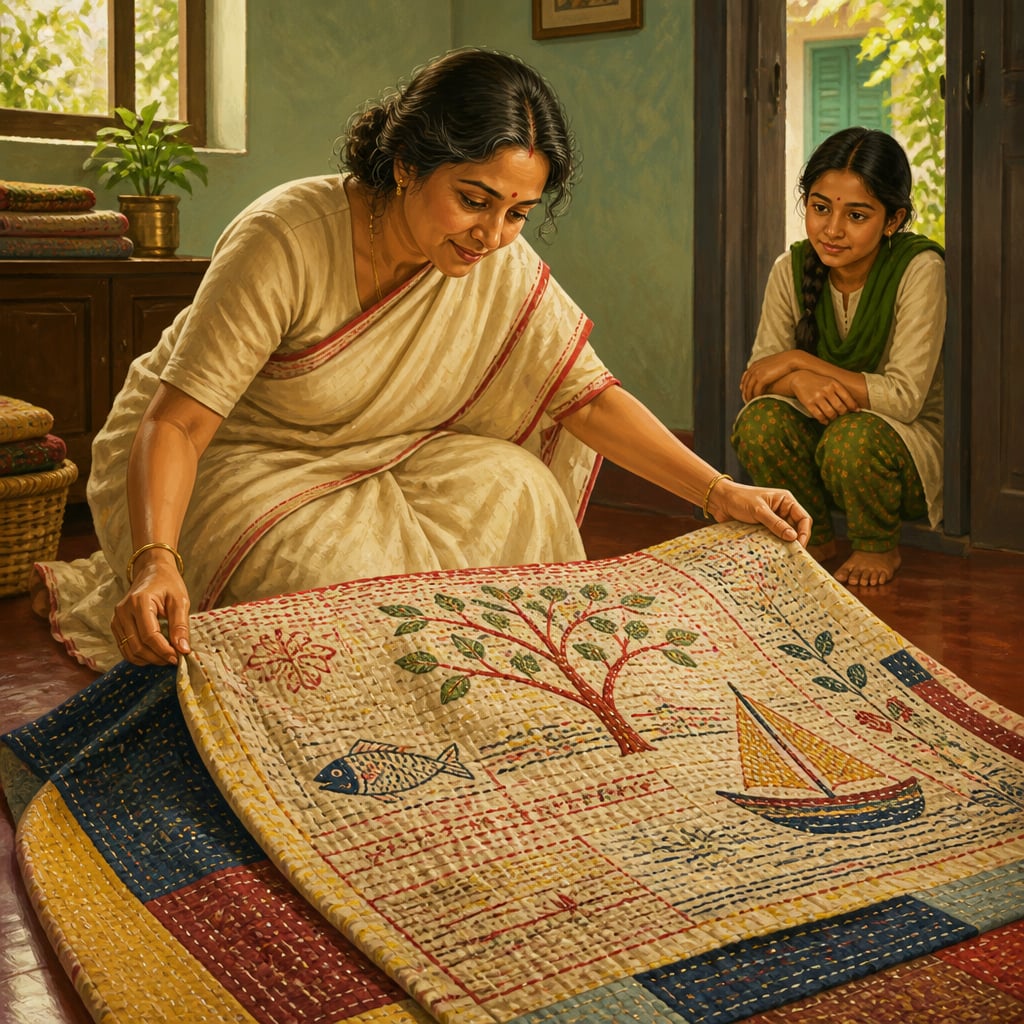
Shamlu Dudeja unfolding a village nakshi kantha quilt in her Kolkata flat

In the late 1980s, in a small flat in south Kolkata, a mathematics teacher in her fifties named Shamlu Dudeja was running free arithmetic classes for rural women. She had been hired by a small NGO to teach basic counting, so that women who had never been to school could check their own household accounts at the market. One afternoon, after the class was over, a shy student from a village in Birbhum district stayed back and asked her if she wanted to see the quilt she was stitching for her unborn grandchild. The woman unfolded the cloth across the packed-earth floor. It was made of five old saris her daughter-in-law had once worn as a bride, layered one on top of the other, held together by thousands of tiny running stitches. On the surface of those stitches, the woman had embroidered a tree, four peacocks, a lotus in the centre, and, hidden inside one corner, a small fish facing a small boat. Shamlu stared at it for a long time. She had been trained in Euclidean geometry. Nobody had taught her that you could embroider a theorem onto cloth.

What she was looking at was a kantha. And the women of Bengal had been making them for at least five hundred years.

What kantha actually is

Kantha is the simplest kind of embroidery and the most patient. You take three, five or seven old cotton saris, usually white or cream, usually from a household where someone you love has worn them thin. You stack them flat on the floor, smooth out every crease, and tack the edges so the layers behave as one cloth. Then, using a single cotton thread drawn from the border of the saris themselves, you begin a running stitch. One small stitch down. One up. One down. One up. You walk the needle across the entire stack of cloth, covering it in tight parallel rows until the layers are quilted into one thick, soft, padded fabric. That quilt is a kantha. The word comes from the Sanskrit kontha, which simply means rags or ragged cloth.

Two things make kantha unlike every other embroidery tradition in India:

This is why kantha was never considered 'proper' embroidery for most of its history. Zardozi had royal patronage. Chikankari had the Mughal court. Phulkari had weddings. Kantha was done at home, by women, out of cloth nobody wanted, using the humblest stitch in the world. That is exactly what makes it the most honest textile tradition in India.

Nakshi kantha: the narrative stitch

A Birbhum grandmother stitching a narrative nakshi kantha in her courtyard

There are two main kinds of kantha. A plain kantha is a functional quilt covered in simple running-stitch rows. It is used to wrap a baby, to nap on in the afternoon, to keep warm in a damp Bengal winter. A nakshi kantha is the special kind. The word nakshi comes from naksha, which means design or figure. On a nakshi kantha, the maker adds a second layer of running stitch, this time in colour, to draw pictures on top of the plain white quilt.

These pictures are the heart of the tradition. A classic nakshi kantha has a central motif, often a lotus medallion called arshilata, surrounded by borders of trees, animals, birds, boats, temples, mosques, rice fields, men and women, and sometimes whole epic scenes. The corners of the quilt usually hold four small motifs: four peacocks, four elephants, four fish, or four lamps. A running vine border, often filled with paisley kalka motifs, frames the whole composition.

The imagery is not random. A newborn's kantha usually carries a tree of life and a fish, for fertility and abundance. A bride's kantha carries a lotus and a peacock, for beauty and marital joy. A household kantha carries rice sheaves, boats and village scenes, for everyday prosperity. A devotional kantha carries temple spires, lamps and pages from scripture. The woman stitching the quilt is not decorating cloth. She is writing a blessing for the person who will eventually use it.

Where kantha comes from

Written references to kantha appear as early as the sixteenth-century Bengali Chaitanya Charitamrita, which describes saints sitting on simple kanthas. The tradition is certainly older than that. Villages in Birbhum, Bankura, Nadia, Murshidabad and Jessore (now in Bangladesh) have been making kanthas for at least five hundred years, passing the craft from mother to daughter without interruption.

For most of that history, the craft was invisible to the outside world. No court ordered kanthas. No merchant exported them. They stayed inside the household, stitched at the pace of ordinary village life, and were eventually worn out and buried under new kanthas. A single quilt could take anywhere from six months to two years of after-dinner work to complete.

The first person to drag kantha into the public imagination was the Bengali folk poet Jasimuddin, who in 1929 published Nakshi Kathar Math (The Field of the Embroidered Quilt), a long narrative poem in fourteen cantos that told a tragic village love story using the kantha as its central metaphor. The poem was an instant classic, is still taught in schools in Bangladesh, and is the reason the words nakshi kantha entered the literary consciousness of the Bengali-speaking world. Jasimuddin did not revive the craft. He gave it a name the city could recognise.

Partition, Liberation, and the broken loom

Then came 1947. The Partition of Bengal cut the kantha heartland in half. Jessore, Faridpur, Jamalpur and Kushtia, all major centres, ended up in East Pakistan, which later became Bangladesh. Birbhum, Bankura, Nadia and Murshidabad stayed in West Bengal. Millions of women were displaced in both directions. The oral chain of mother-to-daughter teaching was disrupted at its most fragile moment.

The Bangladesh Liberation War of 1971 made things worse and, in a strange way, better. Worse because it displaced another wave of stitchers. Better because it gave the new nation of Bangladesh an urgent reason to reclaim its folk heritage, and nakshi kantha became, almost overnight, a symbol of Bangladeshi national identity. By the mid-1970s, scholars and NGOs on both sides of the border were documenting surviving kanthas in museums and trying to figure out how to keep the craft alive as an income-generating skill, not just a family hobby.

What saved it

Three things pulled kantha back from near-invisibility in the second half of the twentieth century, and all three were built by women.

The first was Aarong, founded in 1978 in Dhaka as the retail arm of BRAC, the world's largest non-governmental organisation. Aarong went directly into Bangladeshi villages, trained stitchers, paid them fair piece-rates, and built the country's first large-scale ethical supply chain for hand-stitched kantha. Today, Aarong sources from over 65,000 rural artisans across Bangladesh, the majority of them kantha women. It is the reason you can now buy an authentic nakshi kantha saree at a branded retail store in Dhaka, and it is why the craft has become one of Bangladesh's best-known cultural exports.

The second was Shamlu Dudeja and the SHE Foundation (Self Help Enterprise) in Kolkata, which she founded in 1988 after that afternoon she spent looking at a Birbhum student's embroidered quilt. Shamlu realised that rural West Bengali women already held a world-class craft. They did not need to be taught it. They needed a market, a fair price, and a supply chain that did not swallow their earnings on the way to the city. SHE Foundation set up that supply chain. Over the next three decades it trained and employed thousands of women in Birbhum and Bankura, placed kantha saris on Indian runways, and sold the work in boutiques in Kolkata, Mumbai and New York. Shamlu's daughter Malika Varma later carried the brand into international retail.

The Bailou couture studio reviewing a finished kantha-stitched silk saree

The third was Bailou, founded in Kolkata in 1999 by the husband-and-wife designers Bappaditya Biswas and Rumi Biswas. Bailou went a step beyond revival. It took kantha into couture. Bappaditya spent years working with stitchers in Birbhum and Bankura, learning their vocabulary of motifs, and then commissioning new design briefs that combined kantha with traditional Bengali jamdani weaving and hand-painted silk. The results have been worn at the Met Gala in New York. More importantly, the design dialogue trained a new generation of Bengali stitchers to read modern pattern briefs without losing the older running-stitch grammar of their grandmothers.

The weaving question

In the Brihadaranyaka Upanishad, the philosopher Gargi asks the sage Yajnavalkya a now-famous question: on what are all the worlds woven, warp and weft? The sage gives her a long chain of answers that climbs up through water, air, sky and the heavens, until he arrives at the imperishable. Every kantha is a small, practical answer to Gargi's question. On what are all the worlds woven? On old cloth, on running stitches, on the patience of women who had every reason not to bother. The village grandmothers of Birbhum and Jamalpur were not asked philosophical questions, but every time they layered a worn sari and pulled a thread through it, they were telling the world the same thing Yajnavalkya told Gargi. Everything we love is held together by something quieter than itself.

The quilt on the courtyard floor

Back in Kolkata, almost forty years after Shamlu Dudeja first unfolded that student's quilt on the floor of her classroom, the SHE Foundation now works with thousands of stitchers across Birbhum and Bankura. Aarong's warehouses in Dhaka hold nakshi kantha saris that will travel to buyers in Tokyo and London. Bailou's Kolkata atelier is cutting a silk kantha jamdani for a couture client in Paris. And somewhere in a village courtyard, a grandmother is still sitting cross-legged on the packed-earth floor, layering five old saris on top of one another, threading a single cotton strand, and beginning the only stitch she ever needed to know. One down. One up. One down. One up. The quilt takes as long as it takes. Nothing important has ever been in a hurry.

Key figures

Jasimuddin

Bengali folk poet who published Nakshi Kathar Math (The Field of the Embroidered Quilt) in 1929, the epic poem that brought nakshi kantha into literary consciousness

Shamlu Dudeja

Mathematics teacher who founded the SHE Foundation (Self Help Enterprise) in Kolkata in 1988 and built the largest kantha livelihood programme in West Bengal

Bappaditya Biswas

Kolkata-based fashion designer, co-founder of Bailou (with Rumi Biswas) in 1999, who brought kantha into international couture

Case studies

Shamlu Dudeja and the SHE Foundation (Kolkata, 1988)

In the mid-1980s, Shamlu Dudeja was a Kolkata-based mathematics teacher in her fifties. She had been hired by a small NGO to teach basic arithmetic to rural women in villages outside the city, so that women who had never been to school could check their own household accounts. One afternoon, a student from Birbhum stayed back after class and showed her a quilt she was stitching for her unborn grandchild. The quilt was built from five old saris and covered in thousands of tiny running stitches that spelled out a lotus, four peacocks, a tree of life and a hidden fish. Shamlu, trained in Euclidean geometry, recognised immediately that what she was looking at was a sophisticated form of art. What shocked her was that nobody, including the woman stitching it, thought it was worth anything. In 1988, Shamlu founded the SHE Foundation (Self Help Enterprise) in Kolkata to fix that.

Shamlu's founding insight was a Dharmic one. In the traditional view, a craft does not need to be invented or imported; it already exists, held in the hands of a community, and the task of the teacher is simply to recognise and honour what is already there. The Upanishads speak of this as the work of the acharya, the one who sees. Shamlu did not bring the women a craft. She brought them the seeing of it. That is the difference between a charity programme that imports a skill and a livelihood programme that pays people for skills they already have. Every honest revival in the Dharmic tradition has worked this way.

Over the next three and a half decades, the SHE Foundation trained and employed thousands of women across Birbhum and Bankura, built a direct supply chain from village stitchers to Kolkata boutiques, and placed kantha saris on Indian fashion runways. Shamlu's daughter Malika Varma later expanded the brand into international retail. Rural stitchers who had never been paid for their craft were now earning monthly incomes, running their own bank accounts, and sending their daughters to school on the strength of the stitch. SHE Foundation is now the largest kantha livelihood programme in West Bengal.

The most powerful form of revival is not teaching a community a new skill but paying them a fair price for a skill they already have. Shamlu's story is a reminder that many of the things we call 'development' are actually just acts of seeing. Pay attention. Recognise the work. The rest follows.

SHE Foundation was founded in 1988 and, across its operational history, has trained and employed thousands of kantha stitchers across Birbhum and Bankura in West Bengal, making it the single largest kantha livelihood programme in India.

Bailou: Bappaditya and Rumi Biswas Take Kantha to Couture

In 1999, the husband-and-wife designers Bappaditya Biswas and Rumi Biswas founded Bailou in Kolkata. Their idea was unusual for the time. Instead of using kantha as a folk decoration on top of factory cloth, they wanted to build entire couture pieces around the running stitch itself, combined with Bengali jamdani weaving and hand-painted silk. Doing that meant going directly to Birbhum and Bankura, sitting with stitchers in their village workshops, and spending years learning the vocabulary of arshilata lotuses, kalka paisleys, corner motifs and hidden fish. It also meant teaching the same stitchers how to read a modern designer's brief without losing the older grammar of their grandmothers. Bappaditya was not a wholesaler. He was a translator between two worlds that had never spoken to each other directly.

In the Dharmic tradition, a true revival is never a one-way transfer. It is always a dialogue, a samvad, between the elder who holds the vocabulary and the younger who carries it into new contexts. The guru-shishya relationship works exactly this way: the shishya does not just receive the tradition, she asks it questions the tradition has not been asked before, and the tradition answers. Bailou's entire design method is a long samvad between contemporary couture and village kantha, mediated by a designer who refuses to take either side for granted. That is why it produces work neither side could have made alone.

Over two and a half decades, Bailou has built a design house whose pieces have been worn at the Met Gala in New York and sold through boutiques in Paris, Tokyo and Mumbai. More importantly, the stitchers who work with Bailou have become a new kind of artisan: fluent in the traditional motifs of nakshi kantha and also able to execute contemporary design briefs at couture standards. Bailou's collaborations have trained a younger generation of Bengali stitchers who might otherwise have abandoned the craft for factory work. The house has proved, definitively, that hand-stitched kantha can command the same prices as the finest European fabric.

Luxury is not the enemy of tradition. When done honestly, a couture-level market gives a village craft something it has never had before: a fair price. Bailou's story shows that taking a tradition 'upmarket' can be an act of respect, as long as the people doing the actual work are the ones whose hands shape the final result.

Bailou was founded in Kolkata in 1999 and has spent over twenty-five years working directly with kantha stitchers in Birbhum and Bankura; its pieces have been worn at the Met Gala and sold in couture boutiques in Paris, Tokyo and New York.

Aarong and BRAC: Bangladesh's Ethical Kantha Supply Chain

In 1978, seven years after the birth of Bangladesh, the NGO BRAC set up a small retail outlet in Dhaka called Aarong. Its goal was to create an honest, direct market for rural women's handicrafts, most of all for the nakshi kantha stitched in villages across the new country. At the time, kantha was still mostly domestic work. Most village stitchers had never been paid a fair piece-rate for a finished quilt. Middlemen took almost all the margin. Aarong's idea was to cut the chain: train stitchers through BRAC's Ayesha Abed Foundation, pay them directly for each completed piece, and sell the finished work at branded retail. The model had never been tried at scale in Bangladesh.

Aarong's approach sits inside an older Dharmic and Islamic tradition of dana and zakat, which both treat fair exchange as a form of spiritual discipline. The point of Aarong is not charity. It is what the Arthashastra would recognise as a guild reformed for modern conditions: the craft is organised, the recipes are protected, the stitchers are paid a just wage, and the buyer pays a price that reflects the real labour. This is what a srestha or just trade chain looks like when it is taken seriously. The BRAC founder Fazle Hasan Abed, who also founded Aarong, spent his life arguing that development is meaningless unless it restores fair economic relationships, not just food aid.

Over the next four and a half decades, Aarong grew from a single Dhaka shop into the largest fair-trade handicraft chain in South Asia, sourcing from more than sixty-five thousand rural artisans across Bangladesh, most of them kantha stitchers. Its flagship stores in Dhaka, Chittagong, and Sylhet carry the full range of nakshi kantha saris, bedspreads, scarves and wall hangings. Aarong and BRAC are now the reason nakshi kantha is the best-known traditional textile of Bangladesh, and the reason village stitchers who once worked for almost nothing can now earn a living wage from their craft. The model has been studied and copied by NGOs and fair-trade groups across the world.

Ethical and large-scale are not opposites. Aarong proved that a craft can be sustained at the level of sixty-five thousand rural stitchers without being industrialised, watered down or stripped of its authenticity, as long as the supply chain is designed around the artisan instead of the middleman. That lesson applies to almost every living tradition that is trying to survive the modern economy.

Aarong was founded in 1978 and now sources from over sixty-five thousand rural artisans across Bangladesh, the majority of them kantha stitchers, making it the largest fair-trade kantha supply chain in the world.

Historical context

Late Medieval Bengali folk tradition through Partition and modern revival (c. 1500-2025 CE)

Kantha is one of the oldest continuously practised women's crafts in eastern India. The earliest written references appear in the sixteenth-century Chaitanya Charitamrita and other Vaishnava texts. For centuries it remained a strictly domestic craft, invisible to the court, the market and the museum, passed from mother to daughter inside village households in Birbhum, Bankura, Nadia, Murshidabad, Jessore, Faridpur and Jamalpur. The Bengal Renaissance of the late nineteenth and early twentieth centuries began to take folk arts seriously, and Jasimuddin's 1929 poem gave nakshi kantha its first literary identity. Partition in 1947 broke the tradition in half. The Bangladesh Liberation War of 1971 displaced stitchers again but also turned kantha into a national symbol of the new Bangladesh. Beginning in the late 1970s, NGOs and designers on both sides of the border (Aarong in Dhaka from 1978, SHE Foundation in Kolkata from 1988, Bailou from 1999) rebuilt the craft into a modern livelihood and fashion language, the first time in its history that kantha had a formal market economy around it.

Living traditions

Kantha has moved from invisible women's domestic labour to one of the most recognisable hand-craft traditions in South Asia. Aarong in Bangladesh employs over sixty-five thousand rural artisans in a fair-trade supply chain. SHE Foundation in Kolkata has trained and paid thousands of West Bengali stitchers over three and a half decades. Bailou and a new generation of Indian designers have taken kantha onto international runways and into couture houses. The craft is now taught at Visva-Bharati's Kala Bhavan, sold in museum shops from London to Tokyo, and protected as an intangible cultural heritage by both the Indian and Bangladeshi governments. What was once stitched for nothing is now traded for what it is worth, and the grandmothers of Birbhum and Jamalpur are finally being paid for the quilts their mothers were paid nothing for.

Reflection

More in Suchi Kala (सूचि कला) - Embroidery

All lessons in Suchi Kala (सूचि कला) - Embroidery · Traditional Crafts & Textiles course