Kutchi Mirrors: Rabari, Ahir & Jat Traditions
A salt desert, three communities, and the bold mirror-studded embroidery that turned cloth into a portable home, a dowry bundle, and a Tokyo handbag in the same lifetime.
On the edge of the Rann of Kutch, a salt desert on the western edge of India, three communities have been embroidering cloth for centuries. The Rabari, who herd camels and sheep and worship the goddess Ashapura. The Ahir, who herd cattle and sing songs about Krishna. The Jat, who arrived from the deserts of Sindh and Balochistan and brought a finer style with them. Each community has its own stitches, its own motifs, its own way of setting small round mirrors into the cloth. For centuries, a Kutchi girl spent fifteen years of her life embroidering the bundle she would take into her husband's house. Then the Rabari community decided in 1995 to stop the dowry tradition, and the 2001 Bhuj earthquake almost ended everything, and the Kala Raksha Trust and Qasab and SEWA Kutch built new ways for the women to keep earning from their stitches. This lesson follows Pabiben Rabari, a woman from a dryland village in Kutch who built her own brand and now sells her village's stitches to buyers in Tokyo and New York, and traces the thread back from her to the grandmother who taught her the first stitch.
A Courtyard in Bhadroi
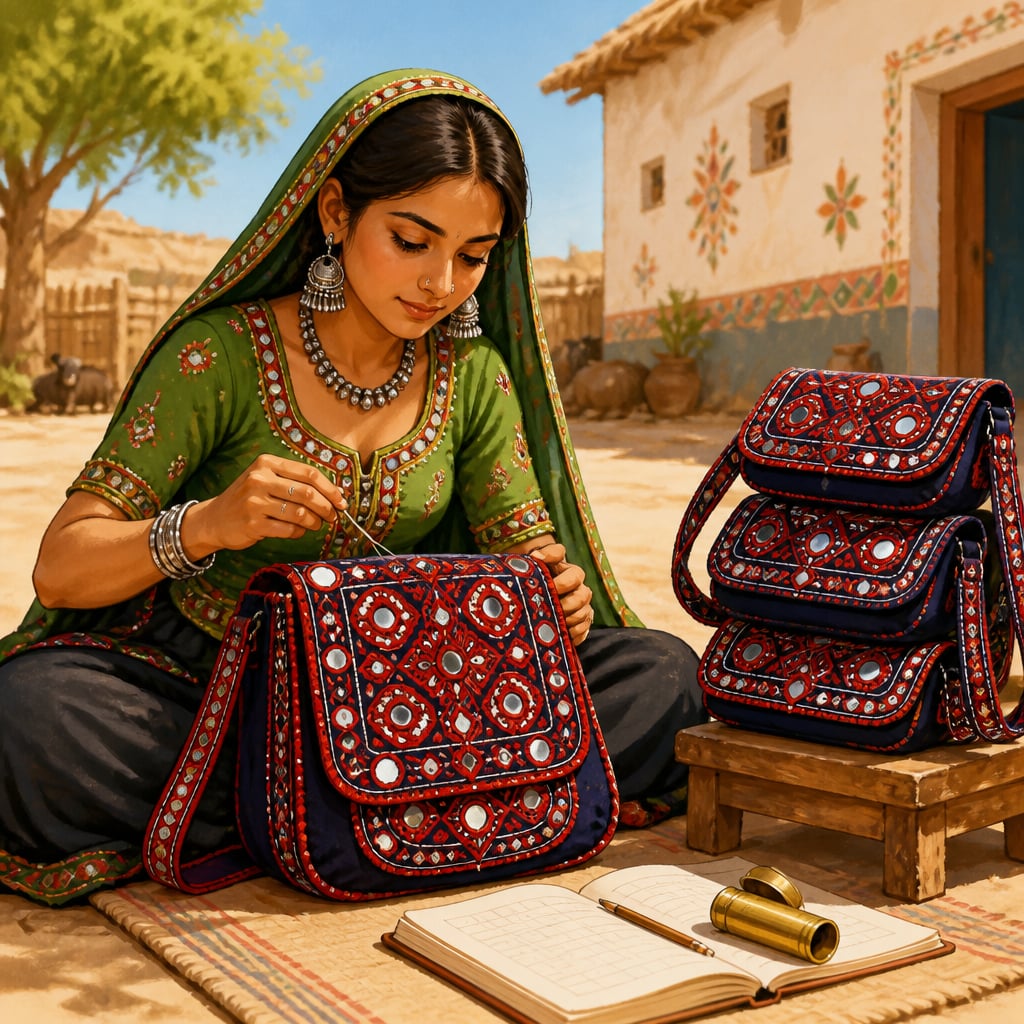
In a small courtyard in the village of Bhadroi, in the Anjar region of Kutch, in the western edge of Gujarat, on a bright winter afternoon in the late 2010s, Pabiben Rabari sits on a low wooden stool with a piece of red wool cloth across her lap. She is holding a curved needle. She has been stitching since sunrise. Next to her foot is a bundle of tiny round mirrors, each no bigger than a fingernail, and a heap of bright thread in red, yellow, green, and white. Behind her, a cloth bag is half-finished. The bag is for a buyer in Tokyo.
Her hands move very fast. She places a mirror on the cloth. She loops the thread around it with the curved needle, one loop on each side, eight loops in all. The mirror is locked in. She moves to the next. Her grandmother taught her to do this when she was six years old. Her grandmother learned it from her own grandmother. None of them went to school. None of them could read or write. But between them, they hold a visual language so precise that a Rabari woman from another village, looking at the pattern on this bag, could tell you within a minute which sub-community of the Rabari Pabiben belongs to, and whether she is married or not.
Pabiben's grandmother embroidered her own dowry bundle for fifteen years before her wedding. Pabiben is embroidering a bag that will be sold in Japan next month. The stitches are the same. The grandmother's hands and the granddaughter's hands are doing the same thing. What changed is everything else. This lesson is the story of what stayed and what changed.
Three Communities, One Desert
Kutch is a district in the western edge of Gujarat. Most of it is a salt desert called the Rann of Kutch. In the monsoon months, the Rann fills with shallow water and becomes a flat white lake. In the dry months, it becomes a cracked white plain the size of a small country. Around the edges of the Rann live a few dozen pastoral communities who have herded camels, sheep, goats, and cattle across this dryland for many hundreds of years.
Three of these communities are the main embroidery traditions this lesson covers.
- The Rabari: a Hindu pastoral community who herd camels and sheep. They worship the goddess Ashapura Mata, and Shiva, and the hero-deities of the dryland. They migrated into Kutch from Rajasthan and Sindh many centuries ago. Their embroidery is bold, mirror-heavy, and built on a long chain-like stitch called the kanbi.
- The Ahir: a Hindu herding community whose mythology traces them to Krishna and the gopas (cowherds) of Vrindavan. Their embroidery is dense, fine, and covered with small peacocks, parrots, and flower motifs, worked mostly in chain stitch.
- The Jat: a Muslim community who arrived from the deserts of Sindh and Balochistan, further west. They brought with them a much finer cross-stitch style called suf and khambiri, worked without any drawing on the cloth, from pure visual memory in the woman's head.
Each of these three communities, plus several smaller ones (the Mutwa, the Sodha Rajput, the Meghwal, the Harijan embroiderers of the Banni grasslands) has its own distinct embroidery style. A trained eye can tell them apart in a second. For most of their history, that was the whole point. The cloth a woman wore, or carried as her dowry, was the flag of her community, her sub-community, her marital status, and her village all at once.
The Stitches

Kutchi embroidery is not one technique. It is a family of about a dozen named stitches, each with its own history and its own visual role. The most important ones are:
| Stitch | Community | What it does |
|---|---|---|
| Kanbi (chain stitch variant) | Rabari | The long bold line that outlines Rabari figures and borders. Worked very fast with a curved needle. |
| Suf (surface satin, geometric) | Jat | Tiny geometric cross-stitches worked without any sketch, counted directly on the cloth's own weave. |
| Khambiri (counted thread) | Jat | A finer variant of suf, used on wedding garments and ritual cloths. |
| Mochi bharat (ari hook chain) | Mochi community (cobblers) | Dense chain stitch worked with a hooked awl called an ari, originally used on leather, later adapted to cloth. |
| Abhla work (mirror work) | All communities | The round mirrors held onto the cloth with a ring of chain or buttonhole stitches. The signature of the whole Kutch tradition. |
| Rabari chain and herringbone combinations | Rabari | The bold geometric infill that gives Rabari embroidery its big-scale visual pattern, visible from ten metres away. |
The round mirrors are called abhla. Traditionally they were made from blown glass, cut into rough disks and then mounted. Modern mirrors are machine-cut. The technique of anchoring a mirror onto cloth with a ring of looped stitches, so that it does not fall out and does not need any backing, is an Indian invention that has spread from Kutch across the subcontinent. It arrived from Persia, was reshaped here, and now wherever you see a mirror stitched onto Indian cloth in any state, the technique traces back to Kutch.
Cloth as Identity, Cloth as Home
For a pastoral Kutchi woman, her own embroidered cloth was the most visible, portable, and durable possession she owned. A Rabari woman traditionally embroidered her own bridal bodice (kanjari), her own skirt border (ghaghra), her own veil (odhna), her own baby-carrier bag, her own camel-cover, her own dowry bundle, and her children's clothes. All of this came with her when her community moved their herds across the dryland. The cloth was not stored in a house. The cloth travelled with the woman wherever she went.
The bold Rabari style, with its big mirrors and its long kanbi lines, is partly a pastoral language. A Rabari caravan moving across the flat white Rann could be seen from kilometres away because of the red-and-yellow mirror work on the women's shawls. The embroidery was a flag. It said: this is a Rabari camp. Approach with respect. These are the women of Ashapura.
A Rabari girl started learning the kanbi stitch around age five. By her teens, she had begun her own dowry bundle (kothlo). The bundle contained about thirty to forty pieces: cloths, bags, borders, camel trappings, pillow covers, and household decorations. A full dowry took fifteen years of evening work to finish. When she was married, she carried it with her, and it told her husband's community exactly who she was and where she had come from.
रैभ्यासीदनुदेयी नाराशंसी न्योचनी। सूर्याया भद्रमिद्वासो गाथयैति परिष्कृतम्॥
raibhyāsīdanudeyī nārāśaṃsī nyocanī sūryāyā bhadramidvāso gāthayaiti pariṣkṛtam
Raibhi was her bridal gift, Narashamsi led her home. Surya's beautiful garment comes adorned with song.
Rig Veda 10.85.6
The Rig Veda hymn of Surya's wedding calls the bridal garment an object adorned with song. The Kutchi dowry bundle is exactly this: a cloth adorned by the singing voice of the women who embroidered it through the evenings of a girl's childhood. The song and the stitch were the same work.
The End of the Dowry
By the late 20th century, the dowry system was beginning to break the Rabari community. A girl who had to embroider fifteen years of kothlo bundles before her marriage was marrying later and later. In some villages, girls were not marrying until they were in their late twenties, because the dowry work took that long. The delay was hurting their health and their economic prospects.
In 1995, the Rabari community elders, after years of internal debate, made an extraordinary collective decision. They announced that the community would stop demanding embroidered dowries. A Rabari girl would no longer be required to spend her youth embroidering the bundle she would carry into her marriage. The community ended, by its own choice, the single most important traditional use of its own embroidery.
This decision saved the girls. It also almost ended the tradition. Because once the dowry was no longer needed, the fifteen-year apprenticeship that had taught every Rabari girl the full stitch vocabulary was gone. Girls stopped learning. The older women still knew the stitches, but they had no one to teach.
And then, on the morning of 26 January 2001, the earth shook.
The Earthquake and What Came After
At 8:46 am on Republic Day 2001, a magnitude 7.7 earthquake struck the Kutch district. The epicentre was near the town of Bhachau. More than twenty thousand people died. Hundreds of villages were destroyed. The historic city of Bhuj lost most of its old buildings. Many of the pastoral villages where Rabari, Ahir, and Jat women had been embroidering for generations were flattened in less than a minute.
What followed was a strange thing. The earthquake drew more outside help to Kutch than the region had ever seen. Indian and international NGOs, designers, documentary filmmakers, government programmes, and architects arrived in the weeks after the disaster. Some of them stayed. Several of them recognised that the embroidery tradition, already weakened by the 1995 dowry decision, was about to disappear, and that it could also be part of the economic recovery.

Three cooperatives became the main pillars of the post-earthquake embroidery revival:
- Kala Raksha Trust, founded in 1993 in Sumrasar Sheikh village by the American textile historian Judy Frater together with local artisans. After the earthquake, Kala Raksha expanded quickly. It documented regional stitch variations, paid women directly per piece, and later founded a design school called the Kala Raksha Vidhyalaya, where artisan women learned to design their own contemporary products.
- Qasab, a cooperative in Bhuj that brings together embroiderers from many of the Kutchi communities, handles bulk orders from Indian and international buyers, and pays on piece rate.
- SEWA Kutch, the Kutch chapter of the Self-Employed Women's Association founded by Ela Bhatt, which mobilised thousands of Kutchi women into direct earning through embroidery, weaving, and other crafts.
These three organisations did not save the Kutchi stitch by themselves. The older women still had to teach the younger ones, and the younger ones still had to learn. But the cooperatives gave the women a reason to keep learning. If the stitches were no longer needed for a dowry, they could still be needed for a bag, a cushion, a cotton stole for a Mumbai buyer, a handbag for a Tokyo buyer.
In 2003, the Government of India registered Kachchh Embroidery as a Geographical Indication. It was one of the first Indian embroidery traditions to receive legal protection. The registration covers Rabari, Ahir, Jat, Mutwa, Sodha, Meghwal, and other Kutchi sub-community styles, all under the shared Kutch origin.
The Thread in Pabiben's Hand
Back in the courtyard in Bhadroi, Pabiben Rabari ties off the last stitch on the Tokyo bag. She holds the bag up to the afternoon light. The mirrors catch the sun. The red wool glows. The kanbi chains cross the cloth in the same geometry that her grandmother would have recognised on a dowry kothlo fifty years ago.
Pabiben does not work alone. She runs her own enterprise, Pabiben.com, which she founded in 2016 after working with Kala Raksha and other cooperatives. Through it, she now employs more than 200 women from her village and nearby villages, mostly Rabari. They embroider bags, stoles, cushion covers, and other products for buyers around the world. A Pabiben bag has appeared in a Hollywood film. The women who make them are paid directly, by the piece, into their own bank accounts, on their own names.
The stitches Pabiben uses are exactly the stitches her grandmother used for her dowry kothlo. The mirrors are set the same way. The red wool is the same colour. What changed is the destination. The cloth her grandmother embroidered stayed in the village and lived in the household of her new in-laws. The cloth Pabiben embroiders travels to Tokyo, Paris, and New York, and the money travels back to the village.
This is how a dying tradition sometimes becomes a living economy. The dowry ended. The earthquake came. The cooperatives built new markets. The older women taught the younger ones even when nobody was marrying. The bridal garment of Surya in the Rig Veda is still being adorned with song, every afternoon, in a courtyard on the edge of the Rann of Kutch, by a woman who now owns the cloth and the stitches and the account where the money lands.
Key figures
Pabiben Rabari
A Rabari embroiderer from Bhadroi village in the Anjar region of Kutch, Gujarat. In 2016 she founded Pabiben.com, a small enterprise that employs Rabari and other Kutchi women as embroiderers and sells bags, stoles, cushion covers, and other products to urban Indian and international buyers. She is widely recognised as one of the first rural Indian women to build and run her own branded enterprise entirely from a village.
Judy Frater
An American textile historian and ethnographer who has worked in Kutch since the late 1970s. In 1993, together with local artisans, she founded the Kala Raksha Trust in Sumrasar Sheikh village to preserve Kutchi embroidery traditions, document regional stitch variations, and pay women directly for their work. In 2005 she co-founded the Kala Raksha Vidhyalaya, the first design school for traditional artisans in India.
Ela Bhatt
An Indian lawyer, Gandhian, and social reformer who founded the Self-Employed Women's Association (SEWA) in 1972. SEWA is India's largest trade union of women workers in the informal economy, including embroiderers, weavers, street vendors, agricultural labourers, and home-based workers. Through SEWA Kutch, the organisation mobilised tens of thousands of Kutchi women into cooperative earning after the 2001 earthquake.
Case studies
The Rann, the Migration, and the Cloth That Travelled
In the medieval centuries before the 20th century, the pastoral communities of Kutch were not settled villagers in the modern sense. They were herders who moved their animals seasonally across a wide dryland that stretched from Rajasthan in the east, through Kutch, and into Sindh and Balochistan in the west and north-west. The Rabari herded camels and sheep. The Ahir herded cattle. The Jat moved with mixed herds. The families walked with the animals. Children were born in temporary camps. Marriages were made between communities whose migration paths crossed at particular times of the year. In this pastoral life, a family did not own a house. They owned what they could carry. The women of these communities developed an extraordinary tradition of embroidering their own cloths, bags, camel-covers, and garments, because cloth was the one form of wealth, identity, and household decoration that could travel with the herd.
The traditional pastoral view of property is that a family's wealth lies in its animals and in what can be carried on their backs. A Rabari woman's embroidered kanjari and kothlo were her portable home, her dowry, her ritual cloth, her community flag, and her identity marker all at once. The bold visual language of the stitches was a direct response to the pastoral scale: patterns had to be readable from a distance because Rabari camps were seen from far across the flat Rann. The small mirrors were a deliberate catch of the desert sun. The songs that accompanied the embroidery were portable the way the cloth itself was portable. Everything in the tradition was designed around the assumption that the woman and her cloth would be on the move together.
The pastoral way of life gradually gave way to a semi-settled one over the course of the 20th century. The 1947 partition of India closed the migration routes between Kutch and Sindh. The 20th-century pressure toward schooling and government-issued documents pushed families toward fixed villages. Modern cash economies replaced some of the old barter networks. But the embroidery tradition that came out of the pastoral centuries did not disappear. It stayed in the villages, in the women's courtyards, and in the stitches the grandmothers kept teaching the granddaughters. The portable design vocabulary of the Rann, the bold patterns meant to be seen from a distance, the small mirrors, the dowry bundle built over a girl's childhood, all survived the transition from the herd to the house.
A living craft tradition is almost always shaped by the way of life that produced it. The Kutchi embroidery we see today in a Kala Raksha showroom or a Pabiben.com bag still carries the shape of a pastoral life in which a family owned what it could carry, in which identity travelled on the body, and in which cloth was the most portable wealth a woman could hold. Understanding the tradition requires understanding the Rann, the migration, and the herds. When the pastoral life ended, the tradition did not. But the meaning of the stitches shifted from 'this is who I am on the road' to 'this is who I am in my village and my market'.
The pastoral origins of Kutchi embroidery are still visible in every piece sold through Kala Raksha, Qasab, SEWA Kutch, or Pabiben.com. The bold scale, the mirror work that catches the sun, the red-and-yellow wool, the long kanbi lines: these are not arbitrary design choices. They are the visible memory of a way of life that moved across a salt desert. When a buyer in Tokyo or Mumbai carries a Pabiben bag, she is carrying a small fragment of the Rann of Kutch in her hand.
Anthropological studies of the Rabari community in the 20th century documented annual migration distances of several hundred kilometres for many Rabari families, spanning parts of Kutch, Rajasthan, and historically Sindh. The full migration pattern was effectively ended by the 1947 partition and by 20th-century settlement pressures. Today only a minority of Rabari families still follow partial seasonal migration.
Three Cooperatives and a Bank Account in Her Own Name
By the late 1990s, Kutchi embroidery was facing three simultaneous threats. The Rabari community had ended its own dowry embroidery tradition in 1995, removing the main reason to learn the stitches. Urban markets were flooded with machine-printed imitations that undercut hand embroidery on price. And on 26 January 2001, the Bhuj earthquake killed more than twenty thousand people, destroyed entire villages, and flattened the material infrastructure of the craft in a single morning. In the years that followed, three cooperatives became the main structural answer to all three threats at once. Kala Raksha Trust, founded in 1993 by Judy Frater and local artisans at Sumrasar Sheikh village, documented the regional stitches, trained women to design their own contemporary pieces at the Kala Raksha Vidhyalaya, and paid women directly on piece rate. Qasab, a Bhuj-based cooperative, brought together embroiderers from many Kutchi communities under one commercial roof and handled bulk orders from Indian and international buyers. SEWA Kutch, the Kutch chapter of Ela Bhatt's Self-Employed Women's Association, mobilised thousands of Kutchi women into direct earning through embroidery, weaving, and other crafts.
From a dharmic perspective, the cooperative model rebuilt something the dowry system had always done imperfectly: it gave the woman who held the stitch some measure of ownership over its economic value. In the traditional dowry system, a Rabari woman's fifteen years of embroidery work produced a kothlo that she carried into her husband's house, where control of the cloth passed to her in-laws. In the cooperative model, the same stitch work produces a piece that is paid for directly into the woman's own bank account. The craft is the same. The economic destination has moved from the in-laws' chest to the woman's own name. The dharmic logic is continuous. The institutional plumbing is radically different.
Over the past two decades, Kala Raksha, Qasab, and SEWA Kutch have together connected thousands of Kutchi women to urban and international buyers and paid them directly on piece rate. A typical woman working with one of these cooperatives can now earn a meaningful monthly income entirely from her stitches, while continuing to manage her household and her family's pastoral work. The cooperatives have also preserved regional stitch variations that might otherwise have been homogenised into generic 'Kutch mirror work' by the mass market. The Kala Raksha Vidhyalaya has trained a new generation of artisan designers who create their own contemporary pieces rather than executing outside designers' patterns. The post-2001 cooperative model is now studied as one of the most successful rural craft economies in India.
A dying craft is saved in two steps. Step one is to keep the technique alive through teaching lines. Step two is to build a new economic destination for the work after the traditional one has disappeared. The Kutchi women held the stitches through the 1990s because older women kept teaching younger ones. The cooperatives held the craft economy through the 2000s by building direct-to-buyer channels that paid women on their own names. Either step alone would have failed. Both together turned the craft into a living rural economy.
The Kala Raksha and Qasab model, with direct piece-rate payment into the artisan's own bank account and preservation of regional stitch variations, is now studied and copied in other Indian craft revivals. The same basic idea, documented stitches plus a cooperative plus direct payment, has been adopted by Kantha embroidery cooperatives in Bengal, Banarasi weavers' collectives in eastern Uttar Pradesh, and Channapatna toy-making groups in Karnataka. The Kutchi women were one of the first to prove that the model works at scale.
Kala Raksha Trust today works with artisans across several dozen Kutchi villages. Qasab connects roughly 1,200 artisan members. SEWA Kutch mobilises several thousand women across the district. Together these three pillars, along with smaller independent enterprises like Pabiben.com, reach a meaningful fraction of the estimated 25,000 to 50,000 active Kutchi embroiderers.
Bhujodi and the Shamji Vishram Vankar Lineage
About eight kilometres from the town of Bhuj, in the village of Bhujodi, the Vankar (weaver) community has been handweaving wool and cotton cloth for generations. The Bhujodi weavers traditionally produced the base fabrics on which Rabari, Ahir, and other Kutchi communities embroidered their bodices, shawls, and dowry pieces. Without the Bhujodi loom, many of the most iconic pieces of Kutchi embroidery would not have had their cloth. The most widely recognised weaver family in Bhujodi is the Vishram Valji Vankar family, whose son Shamji Vishram Vankar has become one of the best known Indian handloom artists of the 21st century. He was awarded the Padma Shri in 2019 for his work in reviving Kutchi handloom weaving, and he has collaborated with major Indian designers including Sabyasachi Mukherjee, Abraham and Thakore, Raw Mango, and Anavila Misra to bring Bhujodi wool cloth into Mumbai and international fashion weeks. His brother Shamji Vankar Vishram and other members of the family run related workshops in the same village.
Kutchi embroidery and Bhujodi weaving are two halves of one tradition. The Rabari woman's wedding cloth is not a cloth she wove. It is a cloth the Vankar weaver wove, and then she embroidered on top of it. The Rabari and the Vankar depended on each other in a specific rural-economic relationship: the weaver produced the base, and the embroiderer produced the surface. In the traditional economy, cloth moved back and forth between the Vankar workshop and the Rabari courtyard on a regular basis. The Bhujodi loom was as much a part of the Kutchi embroidery ecosystem as the embroiderer's needle. In modern designer collaborations, this relationship is now visible at a different scale: a Sabyasachi collection that uses Bhujodi wool is often also embroidered by Kutchi women from nearby villages, linking the two halves of the old village economy to an international fashion market.
Today the Shamji Vishram Vankar workshop is one of the most visible Kutchi handloom enterprises. It combines traditional Bhujodi wool weaving with contemporary design commissions for Indian and international buyers. The workshop has trained dozens of younger weavers and has helped rebuild Bhujodi as a craft village after the 2001 earthquake. Visitors to Kutch now regularly visit Bhujodi to see Vankar weavers at their pit looms, buy directly from the workshop, and understand the full tradition of which Kutchi embroidery is one part. The Vankar family's Padma Shri recognition in 2019 is one of the clearest national honours that Kutchi craft has received in the 21st century.
A craft is rarely produced by a single community in isolation. The most visible output (Kutchi mirror embroidery, in this case) usually depends on the invisible work of another community (the Bhujodi weavers) whose role in the finished piece is not obvious to the buyer. Honouring a living craft tradition means honouring the full chain of people who make it possible, not just the most photographed step. When you buy a Rabari or Ahir embroidered piece, you are also, indirectly, buying the work of a Vankar weaver in Bhujodi who made the base cloth.
For buyers interested in the full Kutchi craft ecosystem, a visit to both Bhujodi (for weaving) and Sumrasar Sheikh or Anjar (for embroidery) gives a more complete picture of the tradition than either alone. Many of the most successful contemporary pieces come from collaborations that span the two communities. Bhujodi wool under Rabari or Ahir embroidery is one of the defining contemporary Kutchi products.
The Bhujodi weavers today work with several dozen Indian and international designers. The Shamji Vishram Vankar workshop has received the Padma Shri (2019) and multiple state and national craft awards. Bhujodi is now one of the two main craft villages on the standard Kutch craft-tourism itinerary, along with Ajrakhpur (the Khatri block-printing village).
The 2003 Kachchh Embroidery Geographical Indication
After the 2001 earthquake, as the Kutchi craft economy was being rebuilt through Kala Raksha, Qasab, and SEWA Kutch, a new problem became visible. The term 'Kutch embroidery' had no legal definition in India. Any factory in any state could sell a machine-printed cotton with a scattering of glued-on plastic mirrors, label it 'Kutch mirror work', and price it at a tenth of what a real hand-embroidered Rabari or Ahir piece cost. The genuine Kutchi women, whose cooperatives were starting to sell real pieces through Kala Raksha and Qasab showrooms, were being undercut in the urban market by imitations that used their name. In response, Gujarat-based craft organisations and the Indian textile ministry filed an application for a Geographical Indication registration under the Geographical Indications of Goods Act of 1999. The application had to define the specific techniques covered, the communities recognised as holders of the tradition, and the geographic boundaries within which a piece could legitimately be called 'Kachchh Embroidery'.
From a dharmic perspective, naming rights are not a modern legal abstraction. They are a community's right to protect the work of its own ancestors from being stolen under the same name. The Rabari, Ahir, Jat, Mutwa, Meghwal, Sodha, and other Kutchi communities had held their distinct embroidery vocabularies for centuries without any legal shield. The 2003 GI registration recognised that these communities, through their unbroken teaching lineages, held a collective right to the word 'Kachchh Embroidery' that could be defended in Indian courts. The registration was not the creation of a new right. It was the formal recognition of a right that had always existed in the community's own practice.
In 2003, the Geographical Indications Registry in Chennai formally registered Kachchh Embroidery as a GI. The registration covers Rabari, Ahir, Jat, Mutwa, Sodha, Meghwal, and other Kutchi sub-community styles, all under the shared Kutch origin. It was one of the first Indian embroidery traditions to receive GI protection. Since 2003, the word 'Kachchh Embroidery' has had a legal meaning in India that can be defended in court. Enforcement is still imperfect. Mass-market imitations still exist, and rural buyers are often still misled. But the cooperatives, designers, and individual entrepreneurs who work with verified Kutchi pieces now have a legal basis for authentication and for disputing fraudulent claims.
A legal name is one of the weakest-looking and most important pieces of protection a craft tradition can have. Before the 2003 registration, any factory could steal the word 'Kutch embroidery'. After the registration, the word belongs, in Indian law, to the communities that have actually held the tradition. The GI does not solve the enforcement problem by itself. But it gives the real makers a legal weapon they did not have before. Combined with the cooperative model (Kala Raksha, Qasab, SEWA Kutch, Pabiben.com), it closes the gap between the women who hold the stitch and the buyers who pay for it.
The 2003 registration is now the legal foundation for the authentication tags that Kala Raksha, Qasab, SEWA Kutch, Pabiben.com, and other cooperatives issue on verified Kutchi pieces. Buyers who see a 'Kachchh Embroidery' GI label can be reasonably confident that the piece is handmade in Kutch by a woman from one of the recognised communities, and that the sale returns value to her. The combination of the GI label plus a named cooperative plus a named village is the strongest authentication chain currently available for Kutchi embroidery.
Kachchh Embroidery was registered in 2003 under the 1999 GI Act. It was one of the first handloom or craft traditions of Gujarat to receive GI protection, alongside Sankheda furniture, Agates of Cambay, and Kutch Shawls. Since then, more than 30 crafts and textile traditions of Gujarat have received GI protection, using the Kachchh Embroidery registration as a reference model.
Historical context
The Kutchi embroidery story runs from the medieval migration of the Rabari, Ahir, and Jat communities into the Rann region, through the pastoral centuries when embroidered cloth was the main identity marker of each community, through the 1995 Rabari community decision to end embroidered dowries, through the devastation of the 26 January 2001 Bhuj earthquake, and into the 2003 Kachchh Embroidery Geographical Indication registration and the contemporary cooperative economy built by Kala Raksha, Qasab, SEWA Kutch, and independent entrepreneurs like Pabiben Rabari.
Kutch is a district in the western edge of Gujarat, bordered by Sindh (now in Pakistan) to the west and north, the Gulf of Kutch to the south, and the Rann salt desert to the north and east. For centuries it has been a meeting point of pastoral communities moving across the dryland of north-western South Asia. The Rabari, Ahir, and Jat are three of the larger embroidering communities, but the region also hosts the Mutwa, the Sodha Rajput, the Meghwal, the Harijan embroiderers of the Banni grasslands, and many sub-groups within each of these. Each community has its own stitch vocabulary, its own motifs, and its own rules for what can be worn by whom. The shared features, especially the round mirror (abhla) anchored by looped stitches, make them recognisable as one Kutch family even as the sub-traditions remain distinct. The 2003 Geographical Indication registration groups them together under the shared name 'Kachchh Embroidery'.
The Kutchi mirror embroidery tradition has close technical cousins across the northwestern Indian and Pakistani dryland, in the Sindhi rilli quilts, the Balochi dowry cloths, and the suf work of southern Punjab. Further west, Persian and Central Asian mirror work on cloth shares the same root technique but uses different motifs. The end of the traditional dowry system in Rabari communities in 1995 is one of the clearest cases in the world of a pastoral community collectively voting to end an ancient practice of their own to protect the welfare of their girls. The post-earthquake cooperative revival has parallels with post-disaster craft economies in Nepal (after the 2015 Gorkha earthquake) and in post-tsunami Aceh (after 2004), where craft cooperatives became central to the rebuilding of village economies.
The 2003 Kachchh Embroidery GI registration covers roughly a dozen named sub-community styles. Current estimates put the total number of active Kutchi embroiderers across these communities at between 25,000 and 50,000 women, concentrated in villages across the Kutch district. The three main cooperative pillars, Kala Raksha Trust, Qasab, and SEWA Kutch, together connect many thousands of these women to urban and international buyers. A single full Rabari wedding bodice can take six months to embroider and hold several hundred abhla mirrors.
Kutchi embroidery is the clearest example in Indian craft of a tradition that has adapted to two near-fatal transitions in a single generation. First, the end of its traditional use: the 1995 Rabari community decision to stop demanding embroidered dowries removed the main reason the craft had been taught for centuries. Second, a natural disaster: the 2001 Bhuj earthquake destroyed many of the villages where the craft was practised and killed many of its older keepers. The tradition did not merely survive both shocks. It became a larger and more visible economy than it had been before, through the cooperative model built by Kala Raksha, Qasab, SEWA Kutch, and individual entrepreneurs like Pabiben Rabari. Kutchi embroidery is one of the best modern case studies of how a dying craft can become a living rural economy if the women who hold the stitch are given direct access to the market.
Living traditions
The 2003 Geographical Indication registration and the cooperative model built after the 2001 earthquake have together turned Kutchi embroidery into one of the most successful examples of rural craft revival in India. Kala Raksha Trust, Qasab, SEWA Kutch, and independent enterprises like Pabiben.com directly connect Kutchi women to urban Indian and international markets. Designer partnerships with labels such as Sabyasachi, Raw Mango, Abraham and Thakore, and Anita Dongre have brought Kutchi embroidery into Mumbai and international fashion weeks. The Living and Learning Design Centre in Ajrakhpur and the Kala Raksha Vidhyalaya continue to document and teach the tradition to a new generation.
- Mother-to-daughter stitch teaching in the courtyard: For centuries, the core Kutchi teaching method was the mother, aunt, or grandmother seated in the village courtyard with a group of girls, teaching by watching and correcting. The girl would practise on scraps of leftover cloth. The mother would re-do any bad stitch and explain nothing in words. By her teens, the girl's hands carried the family's full stitch vocabulary. This method is still used today, especially in villages working with the cooperatives, where the older women who are paid per piece also become the teachers of the younger women joining the workshop.
- Cooperative piece-rate production for urban and international buyers: The main economic form of Kutchi embroidery today is piece-rate production through a cooperative. A woman in a Rabari or Ahir village receives a pre-cut piece of cloth and a list of required stitches from Kala Raksha, Qasab, SEWA Kutch, or a similar organisation. She embroiders it at home, in her own hours, while also managing her household and pastoral work. When she finishes, the cooperative pays her directly, usually into her own bank account, and sells the piece to an urban buyer, designer, or international retailer. The model keeps the stitch in the village and sends the money back there.
- Singing while embroidering: Kutchi women have traditionally sung while they embroidered. The songs are wedding songs, devotional songs for Ashapura Mata or Krishna, and long narrative ballads about community heroes. The rhythm of the song matches the rhythm of the stitch. This is the living form of the Rig Veda's image of a bridal garment 'adorned by song'. The singing continues today in the village workshops of Kala Raksha, Qasab, and SEWA Kutch, and in the private courtyards where women still embroider for their own families.
Reflection
- Is there any piece of Kutchi embroidery in your home? A cushion cover, a wall hanging, a bag, a kurta with mirror work, an embroidered jacket? Look at it closely. Can you tell whether it was made by hand or by machine? Do you know which community's style it comes from? What would change in how you see this piece, and in how you buy the next one, if you could tell a real Rabari kanbi from a factory-printed imitation?
- The Rabari community chose, in 1995, to end a fifteen-year dowry embroidery tradition because it was harming their own daughters. Is there any tradition in your own family, community, or workplace that is now doing more harm than good? Who would have to agree for it to change? What conversation with whom would you need to have to begin that change?
- The Kutchi cooperative model's single most important innovation was paying women directly, into their own bank accounts. Think about the women you know whose work supports a household. Does the money they earn reach their own name, or is it bundled into a household account that is not really theirs? What would change for them, and for the household, if the payment structure was different?