Terracotta: From Bankura Horses to Temple Facades

Three Centuries of Brick, Clay and Devotion in Bengal, Rajasthan and the South

Meet the Kumbhakar potters of Panchmura whose long-necked horse became the emblem of the All India Handicrafts Board, the Malla kings of Bishnupur whose terracotta temples stand uncracked four centuries later, the Velar villages of Tamil Nadu that still cast life-size guardian horses for Aiyanar, and the Padma Shri masters of Molela who refused to let their plaque tradition die. Learn how a single lump of clay can hold a deity, a temple wall, and a national symbol all at once.

An Office at Connaught Place
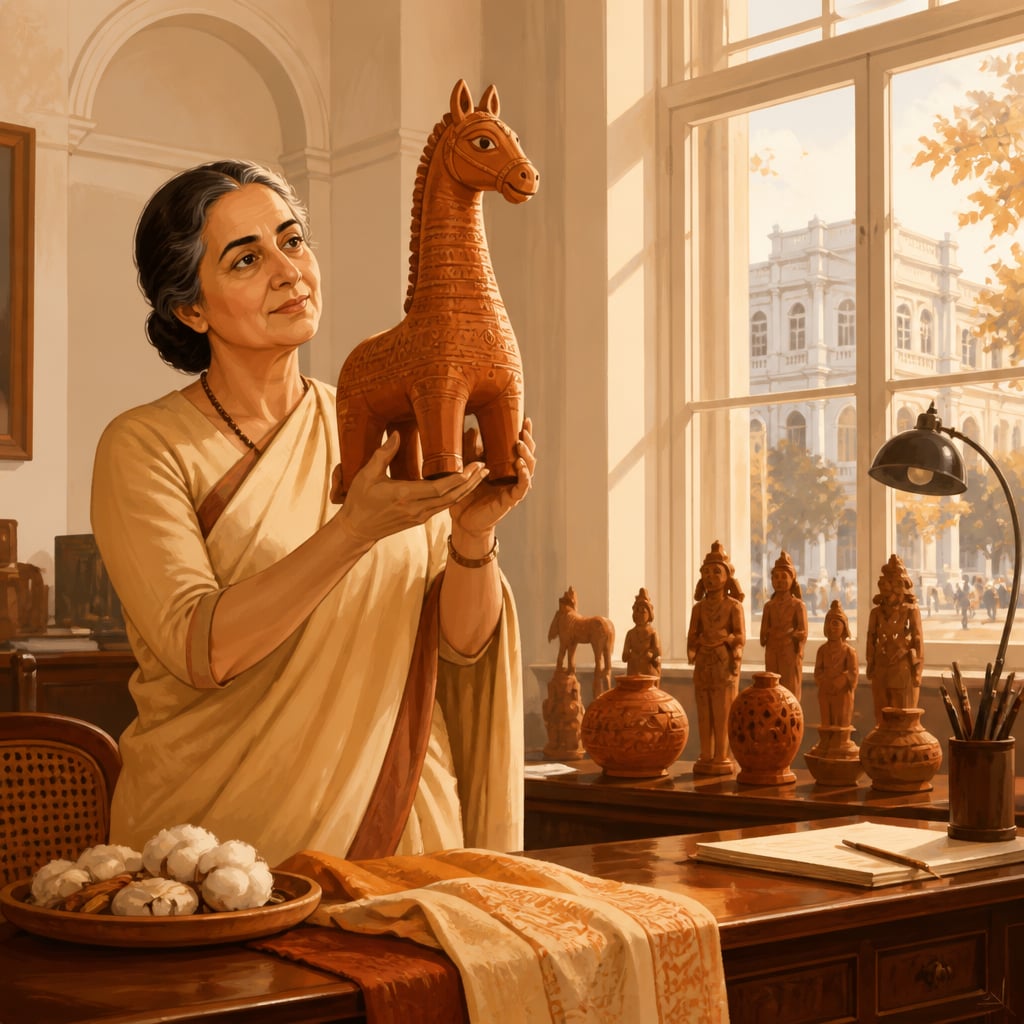
Kamaladevi Chattopadhyay holding the Bankura horse in her Connaught Place office in 1959

In the autumn of 1959, in a high-ceilinged office at Connaught Place in New Delhi, a fifty-six year old woman named Kamaladevi Chattopadhyay sat at a long table covered with sample objects from every corner of India. She had been a freedom fighter, a women's rights leader, and three years earlier she had founded the All India Handicrafts Board, the first government body in independent India tasked with protecting and promoting traditional craft. The Board needed an emblem. Spread across the table in front of her were small terracotta horses, painted Madhubani panels, Bidri inkwells, Channapatna toys, Kashmiri papier-mache boxes, and a hundred other things. She was looking for one object that could speak for the entire craft tradition of independent India.

She picked up a horse. It was the colour of brick. It was long-necked, long-eared, alert, and almost completely abstract. It had come from a village called Panchmura, in Bankura district in southern Bengal, where Kumbhakar potters had been making this exact shape for the snake goddess Manasa for at least three hundred years. Kamaladevi held it up to the light. It was the strangest object on the table. It was also, she could see, the only one that felt like it belonged to no particular century. She set it down in front of her secretary and said it would be the emblem.

Sixty-five years later, the Bankura horse is still the symbol of every government-recognised craft in India. It appears on Crafts Council letterhead, on Tribes India shopfronts, and on the Padma Shri certificates handed to master craftsmen. The choice Kamaladevi made in 1959 turned out to be one of the more consequential decisions in the history of Indian craft policy. To understand why she picked it, and why it deserved to be picked, we have to walk into a Panchmura potter's courtyard, into the temple compound of Bishnupur, and into a few villages much further south.

Mritika: clay as the original substance

The Sanskrit word for clay is mritika. It is one of the oldest words in the language, and it appears in the Chandogya Upanishad, one of the earliest philosophical texts of India, in a verse that has shaped Indian thinking about reality for nearly three thousand years. The sage Uddalaka Aruni is teaching his son Svetaketu the nature of the world. He picks up a lump of clay and a clay pot and says:

यथा सोम्यैकेन मृत्पिण्डेन सर्वं मृन्मयं विज्ञातं स्या- द्वाचारम्भणं विकारो नामधेयं मृत्तिकेत्येव सत्यम्॥

yathā saumyaikena mṛtpiṇḍena sarvaṃ mṛnmayaṃ vijñātaṃ syād vācārambhaṇaṃ vikāro nāmadheyaṃ mṛttiketyeva satyam

Just as, my dear, by knowing one lump of clay all that is made of clay is known. The modification is only a name, a verbal handle. The clay alone is real.

Chandogya Upanishad 6.1.4

This is the philosophical charter of every Indian potter. The horse, the pot, the lamp, the temple tile, the votive plaque are all only names. The clay is the same clay. A Kumbhakar potter in Panchmura can stand in front of his wheel and recite the verse. He may not have studied Vedanta. But the verse is what his hands have always known.

The community of potters in India is one of the oldest professional groups in the country. They are called Kumhar in Hindi, Kumbhakar in Bengali, Kumbara in Karnataka, Kuyavar in Tamil. The name comes from the Sanskrit kumbhakara, the maker of pots. Every Indian village had its own Kumhar family, and many still do. Their work covered the whole range of clay: cooking pots for the kitchen, water pots for the well, oil lamps for the festival, votive horses for the village shrine, and bricks and tiles for the temple wall. Terracotta as an art form, with figures and reliefs, grew out of the same hands that made the cooking pot.

Panchmura and the long-necked horse

Panchmura is a small Kumbhakar village a few kilometres from Bishnupur in Bankura district, West Bengal. The village sits on a thick deposit of red clay. For at least three centuries, possibly much longer, the Kumbhakar families of Panchmura have shaped the same long-necked horse from this clay. The horse is between thirty centimetres and two metres tall. The body is geometric, almost cylindrical. The legs are short. The neck is improbably long, the ears are tall and alert, and the eyes are two punched holes. The horse looks more like an idea of a horse than a copy of one.

The horses are not toys. They are votive offerings. A Panchmura horse is bought by a devotee and placed at the open-air shrine of Dharmaraj, a folk deity of the Bankura forests, or of Manasa, the snake goddess of Bengal, in the hope that a wish will be granted. When the wish is granted, more horses are offered. The shrines around Bankura are dotted with rows and rows of these horses, weathering slowly back into the earth they came from.

What makes the Panchmura horse extraordinary, and what Kamaladevi recognised in 1959, is that the form is fully resolved. There is nothing accidental about it. The Kumbhakar potters arrived at it over many generations, and they have not changed it since. It is one of the most stable shapes in the entire history of Indian craft. In 2018, the Bankura Panchmura Terracotta Craft received its Geographical Indication tag, formally recognising what every Bengali had always known: that this horse belongs to this village.

Bishnupur: the city of terracotta temples

The Shyamrai terracotta temple at Bishnupur glowing in late afternoon light

Sixty kilometres away from Panchmura, in the same district, stands one of the most remarkable architectural sites in India. Bishnupur was the capital of the Malla dynasty, a Bengali Hindu kingdom that ruled the region from the seventh century to the eighteenth. In 1587, the Malla king Bir Hambir converted to Vaishnavism under the influence of Srinivas Acharya, a disciple of the great Bengali saint Chaitanya Mahaprabhu. Over the next century and a half, the Malla kings poured the wealth of the kingdom into building Vishnu temples in Bishnupur. They had a problem. Bengal has very little stone. What it has, in unlimited quantity, is alluvial clay.

So the Malla architects did something almost no other royal builders in India had done at scale. They built their temples out of brick, and they covered every external surface with carved terracotta tiles. The tiles tell the entire story of the Bhagavata Purana. Krishna lifting Mount Govardhan, Krishna stealing butter, Krishna playing the flute for the gopis, the battle scenes from the Mahabharata, royal hunting parties, courtly women at their toilet, elephant processions. There are thousands of panels. They are still in place. The bricks under them are still uncracked.

The temples themselves use uniquely Bengali roof shapes, named after the village hut forms they imitate:

These roof shapes are the brick-and-terracotta translation of the Bengali village house. The architects did not import a foreign vocabulary. They cast the homes of the people in fired clay, scaled them up, and dressed them in mythology. The result is the only city in India where Vishnu temples look like village huts, and the village huts look like temples.

All twenty-eight surviving Malla temples in Bishnupur are protected by the Archaeological Survey of India and form a candidate cluster on UNESCO's tentative World Heritage list.

Other terracotta worlds

The Bankura horse and the Bishnupur temple are the most famous, but they are not alone. Indian terracotta is a continent of regional traditions.

Molela, a small village in Rajasthan, is famous for its hollow terracotta plaques of deities. The Kumhar potters of Molela do not throw their plaques on a wheel. They build them up by hand from rolled slabs of clay, then fire them in open kilns. The plaques depict Devnarayan, the local hero-deity of the Gujjar community, along with Shiva, Durga, Ganesha and tribal goddesses. Molela plaques are bought by Bhil and Garasiya villagers from across southern Rajasthan and Gujarat and installed at small open-air shrines in the forest.

Gorakhpur in Uttar Pradesh has its own terracotta tradition, focused on horses, elephants, dolls and ritual lamps painted in bright colours after firing. Gorakhpur terracotta received its GI tag in 2014.

Velar potter finishing life-size Aiyanar guardian horses in a Tamil Nadu workshop

Tamil Nadu has the most dramatic terracotta tradition of all. In hundreds of villages across the state, especially in the Pudukkottai region, hereditary Velar potter families build life-size hollow terracotta horses, sometimes three or four metres tall, as votive offerings to Aiyanar, the village guardian deity. Each horse can take weeks to build, and is consecrated at an annual village festival. The Aiyanar horses are unbroken descendants of the votive figures already mentioned in Sangam-period Tamil literature two thousand years ago.

Decline and quiet recovery

The story of terracotta in the twentieth century is the same story as the rest of Indian craft. Cheap aluminium pots replaced clay water pots in village kitchens. Plastic toys replaced Panchmura horses in city homes. Factory-made cement and ceramic tiles replaced hand-fired terracotta in temple restoration. The Kumbhakar communities lost the everyday market that had supported them for centuries. By the 1970s, only the votive function and the festival function were keeping village pottery alive at all.

Recovery has been slow and patchy. Three things have helped. The first is GI protection. Bankura Panchmura, Gorakhpur, Molela and several other terracotta clusters now have legal name protection. The second is ASI conservation work at sites like Bishnupur, which has trained a new generation of brick-and-tile masons in traditional techniques. The third, and perhaps the most important on a daily basis, is the rise of artisan-direct cooperatives and design studios. Dastkar, Tribes India, iTokri, Sasha and Good Earth all now buy directly from village Kumhars and bring their work to urban customers at fair prices. A Panchmura horse that would have sold for fifty rupees to a passing trader in 1985 sells today, through a Dastkar bazaar in Delhi, for many times that, with most of the difference going back to the potter.

And in 1959, Kamaladevi Chattopadhyay, sitting at her table in Connaught Place, picked up the horse from Panchmura and changed the way independent India would think about clay. She was a Vedanta reader. She had probably read the Chandogya Upanishad. She knew that the horse and the cooking pot are the same clay, and that the clay alone is real. The lump of mritika she held in her hand that day became the symbol of a country.

Key figures

Bir Singh (Vir Singha)

Malla king of Bishnupur (reigned 1626 to 1656); the royal patron under whom the most ornate of the Bishnupur terracotta temples were built

Kamaladevi Chattopadhyay

Freedom fighter, women's rights leader, and founding chairperson of the All India Handicrafts Board (1956); the woman who chose the Bankura horse as the symbol of independent India's craft tradition

Mohanlal Kumhar

Padma Shri master terracotta artist of Molela village, Rajsamand district, Rajasthan; reviver of the Molela tradition of hollow clay deity plaques

Case studies

Bir Singh and the Shyamrai Temple of 1643

In 1587, the Malla king Bir Hambir of Bishnupur converted to Vaishnavism under the influence of Srinivas Acharya, a disciple of the Bengali saint Chaitanya Mahaprabhu. The conversion turned the Malla court from a regional Shakta dynasty into one of the most committed Vishnu-worshipping royal houses in eastern India. Bir Hambir's son and successor Bir Singh, who reigned from 1626 to 1656, inherited both the new faith and a kingdom rich enough to act on it. He decided to build Vishnu temples in his capital. He had a problem. Bengal had almost no stone. What it had, in unlimited quantity, was alluvial clay. So Bir Singh and his architects did something almost no other royal builders in India had done at scale. They built their temples entirely of brick, and they covered every external surface with carved terracotta tiles depicting the Bhagavata Purana. In 1643, after years of construction, Bir Singh consecrated the Shyamrai temple, a five-towered pancha-ratna whose walls carry thousands of small terracotta panels. Krishna lifting Mount Govardhan, Krishna stealing butter, the battle scenes of the Mahabharata, royal hunting parties, courtly women at their toilet, elephant processions. Every panel is fired clay.

The Shilpa Shastras, the classical Sanskrit treatises on architecture and sculpture, treat the local material as the divine instruction of place. A temple should be made of what the soil offers, not of what has to be imported from a thousand kilometres away. Bir Singh's terracotta temples are a textbook example of this principle. He did not haul stone from Rajasthan or Karnataka. He used what Bengal gave him, which was clay, and he raised it to the level of devotional architecture. The Chandogya Upanishad's teaching that the clay is the truth and the form is only a name finds its most literal architectural expression here: the same mritika that the village potter shapes into a horse becomes, in Bishnupur, the wall of a temple. The substance is the same. Only the scale and the dedication change.

Almost four hundred years later, the Shyamrai temple is still standing. The bricks are still uncracked. The terracotta tiles are still in place. The temple is part of the Bishnupur compound protected by the Archaeological Survey of India and is a candidate for UNESCO World Heritage status. Bir Singh's decision to use local clay rather than imported stone made his temples more vulnerable in theory and more resilient in practice. The building tradition he established at Bishnupur has become the single most important architectural inheritance of southern Bengal.

Building with what your soil actually gives you is not a limitation. It is an act of cultural confidence. Bir Singh's terracotta temples are the most uniquely Bengali Hindu architecture ever built precisely because he refused to import stone from somewhere else. The local material was the right material. Four centuries are now backing him up.

The Bishnupur compound contains twenty-eight surviving Malla dynasty terracotta temples, including the Shyamrai (1643), Jor Bangla / Keshto Rai (1655), Lalji (1658) and Madanmohan (1694). The Rasmancha (1600) is the oldest surviving brick structure in Bengal.

The Aiyanar Horses of Tamil Nadu: A Two-Thousand-Year Tradition

In hundreds of villages across Tamil Nadu, especially in the Pudukkottai, Sivaganga and Ramanathapuram districts, hereditary Velar potter families build life-size hollow terracotta horses as votive offerings to Aiyanar, the village guardian deity. Each horse can be between one and four metres tall. The body is hollow and is built up over several weeks, section by section, from rolled coils of clay. The Velar potter does not work alone. The whole family is involved, and the kiln is fired in a temporary structure built specifically for the firing. When the horse is ready, it is carried in procession to the village Aiyanar shrine on the day of the annual festival. There it is consecrated with sacred ash, garlanded, and installed in a long open-air row of horses from previous years. The Sangam-period Tamil literature of the early centuries of the Common Era already refers to these votive horses by name. They are mentioned in some of the oldest surviving poems in Tamil.

The Aiyanar horses are an extraordinary example of what the Dharmic tradition calls bali-yajna, the offering at the village shrine that returns the substance of the offering to the substance of the place. The horse is made of clay from the village soil. It is consecrated to the deity who guards the village. It is then deliberately allowed to weather back into the same soil over the decades that follow. The form is given, the substance returns. The Chandogya Upanishad's teaching that the clay is the only reality and the form is only a name is enacted here, not as philosophy but as a centuries-long village ritual. The horse is real for as long as it stands. Then it returns to the mritika it always was.

The Velar potter community has continued this tradition unbroken since the Sangam period, almost two thousand years. Aiyanar shrines across Tamil Nadu still receive new horses every year. Some shrines hold three or four hundred horses in long parallel rows, ranging in age from a few months to several decades. The newest are bright red. The oldest have weathered grey and are already half returning to the earth. The tradition survives because the village still needs the deity, the deity still needs the offering, and the Velar still know how to build the horse.

A craft tradition that is two thousand years old does not survive by being preserved. It survives by still being needed. The Aiyanar horses are not in a museum. They are in shrines, and the villages still order them. The lesson for any tradition under threat is the same: find the function it still serves, and the form will look after itself.

Some Aiyanar horses are over four metres tall, hollow inside, and are built by Velar potter families over several weeks. The tradition is documented in Sangam-period Tamil literature dating from the early centuries of the Common Era, making it one of the oldest continuously practised votive sculpture traditions on earth.

Mohanlal Kumhar and the Revival of Molela Plaques

Molela is a small Kumhar village in Rajsamand district in southern Rajasthan, fifteen kilometres from the famous Shrinathji temple at Nathdwara. For at least four hundred years, the Kumhars of Molela have been making something very unusual: hollow terracotta plaques of deities, built up by hand from rolled slabs of clay, fired in open kilns, and sold to Bhil and Garasiya pilgrims who carry them home to install at small open-air shrines in the forest. The most important deity is Devnarayan, the hero-god of the Gujjar community, who is depicted on a horse with a snake on his shoulder. Other plaques show Shiva, Durga, Ganesha and a wide range of tribal goddesses. By the late twentieth century, the tradition was within a generation of disappearing. Cheap printed posters and factory-made ceramic icons were replacing the Molela plaques in pilgrim markets. Younger Kumhars were leaving the village for wage work in Udaipur. The hand-built deity plaques were becoming a curiosity. Mohanlal Kumhar, born into a Molela Kumhar family and trained from childhood in the slab-building method, refused to let it die.

Mohanlal Kumhar's life is a working example of what the Gita calls sahaja karma, the work one is born into, the work that should not be abandoned just because it has become difficult. The Chandogya teaching that the clay is the only reality also lives in his hands every day. He does not need to read the verse. He has shaped Devnarayan from the same lump of clay that becomes Shiva, Durga and Ganesha on different mornings of the same week. The form changes. The substance does not. The Molela tradition is a daily enactment of a philosophy that India's classical texts have only ever tried to describe.

Over four decades, Mohanlal Kumhar trained dozens of younger Molela Kumhars, brought the village's plaques to museum exhibitions in Delhi, Bhopal, Paris and London, and rebuilt a national and international market for hand-built terracotta deity panels. The Government of India awarded him the Padma Shri for his lifetime contribution to traditional terracotta. The Molela cluster, anchored by his workshop, is now one of the strongest village terracotta economies in India. Younger Kumhars are returning to the village. The kilns are firing again.

A village tradition does not need a movement to save it. It needs one person who refuses to be the last one. Mohanlal Kumhar did not invent anything new at Molela. He simply held the line for thirty years, until the tide of cheap copies went out. The Padma Shri came later. The decision to stay came first.

Mohanlal Kumhar of Molela received the Padma Shri for his contribution to traditional terracotta. The Molela cluster he anchors is one of the few Indian terracotta clusters where the next generation is actively returning to the craft instead of leaving it.

Dastkar and the Panchmura Cooperative

Dastkar was founded in 1981 by Laila Tyabji and a small group of designers and craft activists in Delhi. Its purpose was simple but ambitious: to build long-term relationships between traditional craft communities and urban customers, with no anonymous middlemen, fair prices paid directly to the artisans, and a national marketing platform that the artisans themselves could trust. Over the next four decades, Dastkar built dozens of such relationships across India, including with the Kumbhakar potters of Panchmura village in Bankura district, West Bengal. By the early 2000s, the Panchmura horse, despite being the official emblem of the All India Handicrafts Board for forty years, was still being sold to passing traders at a fraction of its retail price. The Kumbhakar families had no direct access to the Delhi or Mumbai markets where their horses sold for many times what they were paid. Dastkar set up a Panchmura cooperative arrangement: orders placed directly with the village, prices negotiated transparently, full payment to the potter, and a stall at the annual Dastkar Nature Bazaar in Delhi where Panchmura horses were sold under the village name.

Dastkar's model is a modern restatement of an older Dharmic principle. The Arthashastra is unusually clear about the role of intermediaries in artisan trade: the trader who stands between the maker and the buyer must not be allowed to swallow more than a fair share of the value. The fair-trade cooperative restores the direct relationship between the Panchmura Kumbhakar and the Delhi customer that the long supply chain had quietly destroyed. In the village potter's own framework, it is also a recognition that the horse is not separable from the hands that shaped it. The Vedantic teaching that the form is only a name and the substance is the clay extends naturally into a fair-trade ethic: the form is the horse, the substance is the maker, and you cannot honour one without honouring the other.

Over the past two decades, the Dastkar Nature Bazaar has become one of the most important annual marketplaces for Indian traditional craft, and Panchmura horses sold there go for many times what a passing trader would pay in the village. The Kumbhakar families now have a direct national market and a stable annual income from the cooperative. Other artisan-direct platforms (Tribes India, iTokri, Sasha, Good Earth) have built on the same model. The Bankura Panchmura Terracotta Craft received its Geographical Indication tag in 2018, partly on the strength of the documentation and visibility that Dastkar and similar organisations had built up over the previous thirty years.

Fair pricing is not a charitable act. It is the restoration of a relationship that anonymous intermediaries had quietly broken. Dastkar's Panchmura cooperative proved that customers will pay the real price of a Bankura horse if they can see who made it and where it came from. The middleman was the problem. The price was always fine.

Dastkar was founded in 1981 by Laila Tyabji and now runs craft cooperatives, exhibitions and the annual Dastkar Nature Bazaar in Delhi, with long-term relationships with hundreds of traditional craft communities across India, including the Panchmura Kumbhakar potters of Bankura district.

Historical context

Vedic philosophy of clay through Malla dynasty temple building to contemporary craft revival (c. 800 BCE to 2025 CE)

Indian terracotta is one of the oldest continuous craft traditions on the subcontinent. Fired clay figurines have been excavated from every Indus Valley site, from Mehrgarh in 7000 BCE to the late Harappan settlements. The Vedic and Upanishadic texts treat clay (mritika) as the philosophical example of the relationship between substance and form. Across post-Vedic India, the Kumhar potter community grew into one of the most ubiquitous occupational castes, present in almost every village. The art of terracotta sculpture and architecture peaked in two distinct centres. The first was the Sunga and Kushana terracotta plaques of the Ganges plain in the centuries around the Common Era. The second, fifteen hundred years later, was the Malla dynasty's terracotta temple programme at Bishnupur, which translated the entire Bhagavata Purana into brick and tile. Alongside these elite traditions, a vast and equally important folk tradition of votive terracotta survived in the villages: Panchmura horses for Manasa and Dharmaraj in Bengal, Molela plaques for Devnarayan in Rajasthan, Aiyanar horses for the village guardian in Tamil Nadu, and similar offerings in almost every region. The twentieth century brought aluminium pots, plastic toys and cement temples that nearly destroyed all of it. Recovery began with Kamaladevi Chattopadhyay's institutional work in the 1950s and has continued through the GI tag programme and the rise of artisan-direct cooperatives over the last two decades.

Living traditions

The Bankura Panchmura Terracotta Craft received its Geographical Indication tag in 2018, formally protecting the Kumbhakar community of Panchmura against mass-produced ceramic copies. Gorakhpur terracotta got its GI in 2014, and Molela terracotta is part of an active GI application. The Bishnupur temple compound is on UNESCO's tentative World Heritage list and is maintained by the Archaeological Survey of India. The Crafts Museum in Delhi, founded by Kamaladevi Chattopadhyay, holds the country's most important institutional terracotta collection. Dastkar, Tribes India, iTokri, Sasha and Good Earth all now buy directly from village Kumhars at fair prices, and the Panchmura horse silhouette continues to appear on the letterhead of every craft body in the country, sixty-five years after Kamaladevi picked it up off her table at Connaught Place. Most Indian villages still have a working Kumhar family. The cooking pot has gone to aluminium, the water pot has gone to plastic, but the festival horse and the wedding lamp have not. The clay tradition is bent. It has not broken.

Reflection

More in Mritika Kala (मृत्तिका कला) - Pottery & Terracotta

All lessons in Mritika Kala (मृत्तिका कला) - Pottery & Terracotta · Traditional Crafts & Textiles course