Blue Pottery: Persian Glazes, Rajasthani Soul

A Persian tile tradition that travelled from Kashan to Jaipur, almost died in the 1950s, and was rebuilt in a Bani Park workshop by a miniature painter using a dough that had no clay in it at all.

Jaipur Blue Pottery is the only major pottery tradition in India, and one of very few in the world, that uses no clay. Its dough is made from quartz powder, powdered glass, multani mitti (fuller's earth), borax, and katira gum, and can only be shaped in moulds because it cannot be thrown on a wheel. The craft descends from the Persian tile tradition of Kashan (from which the word kashi, meaning tile, comes) and travelled to India through Multan, Sindh, and Delhi before Maharaja Sawai Ram Singh II of Jaipur brought it to Rajasthan in the 1860s. For a few decades it flourished at the royal Sawai Jaisingh Kala Bhavan art school. Then it slowly died. By the 1950s, only one or two old potters in Jaipur still knew the recipe. In the early 1960s, Rajmata Gayatri Devi and Kamladevi Chattopadhyay, the founding chairperson of the All India Handicrafts Board, asked a young Santiniketan-trained Jaipur miniature painter named Kripal Singh Shekhawat (1922 to 2008, Padma Shri 1974) to learn the craft from the last old master and revive it. He did, at his Kripal Kumbh workshop in Bani Park, Jaipur. In 1978, Neerja Chaudhary founded Neerja International, which turned the revived craft into a global luxury export brand. This lesson walks into Kripal Singh's workshop on the morning a crumbling white dough became a blue bowl.

A Workshop in Bani Park
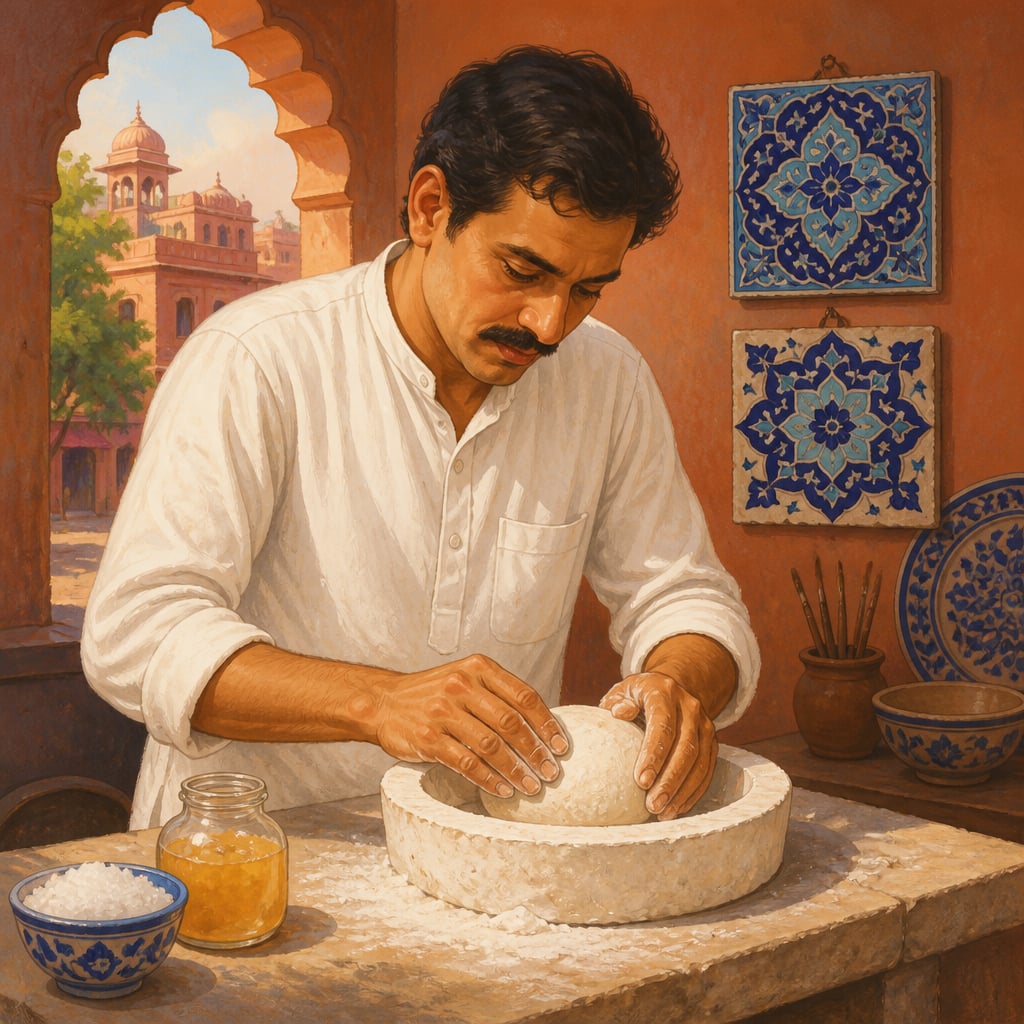
Kripal Singh Shekhawat pressing the quartz dough at his Bani Park workshop

On a summer afternoon in the mid 1960s, in a small workshop in the Bani Park neighbourhood of Jaipur, Kripal Singh Shekhawat stood at a stone slab mixing a white dough the colour of bone. In a row of bowls beside the slab were his five ingredients: powdered quartz, powdered glass, multani mitti (fuller's earth), a spoonful of borax, and a thick plant gum made from katira. No clay. None. He pressed the dough flat with his palm. It was crumbly, not sticky. It broke at the edges when he tried to shape it with his fingers. No potter's wheel in the world could have thrown it.

On the wall above the slab hung two small blue-glazed tiles, each about the size of a cigarette packet. They were almost a hundred years old. They had been brought to him a few months earlier by the Maharani of Jaipur, Rajmata Gayatri Devi, who had placed them in his hand and asked him to find out how they were made. The one old man in the city who still remembered the recipe was nearly eighty. He had taught Kripal Singh the five ingredients, the basic mould shaping, and almost nothing else. The old man's sons had all left the craft for other work.

Kripal Singh was not a potter. He was a miniature painter, trained at Nandalal Bose's Kala Bhavan at Santiniketan and at the Rajasthan School of Art in Jaipur. He had spent his twenties copying Rajput miniatures on paper. Now, in his early forties, he stood in front of a crumbling white dough that was not clay, trying to rebuild a tradition that had almost died in his own city in his own lifetime.

He pressed the dough into a shallow plaster mould shaped like a bowl. Later that afternoon he would paint it with cobalt oxide, coat it in a silica glaze slurry, and fire it in a small wood-fired kiln for an entire night. If the firing went right, the bowl would come out as a piece of Jaipur Blue Pottery: white on the inside, deep blue on the outside, glassy to the touch, waterproof. If the firing went wrong, the dough would collapse back into the five white powders he had started with, and he would begin again tomorrow.

This is the story of how a Persian tile tradition travelled two thousand kilometres from Kashan to Jaipur, how it almost died in the twentieth century, and how one miniature painter rebuilt it in a Bani Park workshop using a dough that had no clay in it at all.

From Kashan To Jaipur

The ancestor of Jaipur Blue Pottery is the Persian tile tradition of Kashan, a city in central Iran that was one of the great ceramic centres of the Islamic world from about the twelfth century CE onward. Its tile work was so dominant that the Persian word for a glazed tile, kashi, comes from the city's own name. The craft of making such tiles was called kashi-kari, literally 'Kashan work'.

The cobalt-blue-on-white palette of Jaipur Blue Pottery comes from the later Timurid and Safavid phase of this tradition, shaped by the Chinese blue-and-white porcelain that reached Persia along the Silk Road during the Yuan and Ming dynasties. Blue-tile facades from the fifteenth and sixteenth centuries still cover the Bibi Khanum mosque in Samarkand, the Blue Mosque in Tabriz, and the Iznik tile rooms of Topkapi Palace in Istanbul. Jaipur Blue Pottery is their youngest cousin.

Kashi-kari came to India with Turco-Persian artisans during the Delhi Sultanate and the Mughal period. It settled first in Multan and Sindh, in what is now Pakistan, where blue-tiled shrines still stand. It spread eastward through Lahore and Delhi. By the early nineteenth century, most of the old workshops had closed.

Maharaja Sawai Ram Singh II inspecting new Blue Pottery tiles in his Jaipur courtyard

The turning point for Rajasthan was Maharaja Sawai Ram Singh II of Jaipur (1835 to 1880). Ram Singh was a reformer and a patron of the arts. He founded the Sawai Jaisingh Kala Bhavan in 1857 as a state school of art and industry, one of the first of its kind in India. A few years later, during a wrestling match at his court, he watched a small blue-glazed bowl made by two visiting potters from Delhi and decided his own city needed the craft. He invited the Delhi masters to Jaipur and put them in charge of a Blue Pottery department at the Kala Bhavan. Within a decade, Jaipur was making its own Blue Pottery, using quartz from the nearby hills and cobalt imported from central India. For the last few decades of the nineteenth century, the Jaipur workshops were among the finest Blue Pottery studios in the world.

And then, very slowly, the craft died.

The Dough That Isn't Clay

Before we get to the death and the revival, it is worth understanding why Jaipur Blue Pottery is such an unusual craft. It is the only major pottery tradition in India, and one of very few anywhere in the world, that uses no clay at all.

A Jaipur Blue Pottery dough is made from five ingredients, mixed by hand to a strict ratio:

Ingredient Rough share Role
Quartz powder about 50 percent The body. Gives the finished piece its white colour and its glassy feel.
Powdered glass about 20 percent Binds the quartz and flows when fired to give a smooth surface.
Multani mitti (fuller's earth) about 10 percent The only earth in the mix. Provides a little plasticity during shaping.
Borax about 10 percent A flux. Lowers the melting point of the glass so the body fuses in a wood-fired kiln.
Katira gum and water about 10 percent Binds the dough while it is being moulded.

The mix has no kaolin, no ball clay, no stoneware, no porcelain. Because it contains no clay, it cannot be thrown on a potter's wheel. A wheel needs a sticky, plastic dough that will rise between the potter's hands. The Jaipur dough is crumbly. It behaves more like damp chalk than like clay. It can only be shaped by two methods: pressed by hand into an open plaster mould, or formed over a solid wooden dumma (form).

Once the shape is formed and dried in the sun, the artisan paints the white surface with metal-oxide pigments. Cobalt oxide gives the famous Jaipur blue. Copper oxide gives a turquoise green. Iron oxide gives a soft brown. The painted piece is then coated in a silica-based glaze slurry and fired in a wood-fired kiln at about 800 to 850 degrees Celsius. A single firing fuses everything at once: the quartz body, the glass flux, the painted oxides, and the glaze on top. A finished Jaipur Blue Pottery bowl is, in effect, a single sheet of painted glass held in the shape of a bowl.

This is why the craft is so fragile and so valuable. One mistake in the ratios, one uneven fire, one weak glaze, and the piece comes out of the kiln as a pile of white sand. A good piece comes out the colour of a Rajasthani winter sky.

The Revival At Bani Park

By the 1950s, Jaipur Blue Pottery was almost gone. The Sawai Jaisingh Kala Bhavan workshops had closed during the decline of the princely state after independence. A handful of old potters still knew the recipe, but they had no apprentices. The craft had perhaps one working generation left.

At the same time, two remarkable women had decided that India's dying crafts were worth saving at the national level. Kamladevi Chattopadhyay, the freedom fighter and reformer, had become the founding chairperson of the All India Handicrafts Board in 1952 and was travelling the country identifying crafts in danger. Rajmata Gayatri Devi, the Maharani of Jaipur, had taken a personal interest in the crafts of her own city. In the early 1960s the two met in Jaipur to talk about Blue Pottery. Gayatri Devi identified Kripal Singh Shekhawat, a young Santiniketan-trained miniature painter in the city, as a possible revivalist and brought him the two old tiles.

Kripal Singh spent the next few years apprenticing with the last old Jaipur potter, learning the five-ingredient recipe by hand, and experimenting with new shapes. He was not bound by the old repertoire. He painted Rajput miniature motifs on his bowls: peacocks, flowering vines, mango trees, hunting scenes from the Kishangarh school he had studied at Kala Bhavan. He widened the palette to include the soft turquoise green of the copper oxide. He taught the technique to his sons and to a small group of young apprentices from the city's kumhar (potter) community. By the late 1960s, his Kripal Kumbh workshop in Bani Park was producing Jaipur Blue Pottery again, and the craft had a living future.

The government of India awarded Kripal Singh Shekhawat the Padma Shri in 1974. He died in 2008, at the age of eighty-six. His workshop is still open, now run by his descendants. Every modern piece of Jaipur Blue Pottery in the city's markets, every blue-glazed tile in a new Jaipur hotel lobby, every export carton shipped to New York or London, traces its recipe back through Kripal Singh to the old man who taught him.

The Neerja Brand

Reviving a craft is one thing. Turning it into an economy is another. For most of the 1960s and early 1970s, Jaipur Blue Pottery was still small and local, and the market was thin. Without a buyer, no revival can last.

Neerja Chaudhary preparing the first Jaipur Blue Pottery export shipment in 1978

The second turning point came in 1978, when Neerja Chaudhary, a young Jaipur businesswoman, founded Neerja International to design, produce, and export Jaipur Blue Pottery at scale. She believed the craft could reach a global market if it were redesigned for the way modern homes and hotels used ceramics. Her studio began making not only traditional bowls and vases but also dinner plates, architectural tiles, door knobs, bathroom fittings, jewellery, and lamps. Within a decade, Neerja International was exporting Jaipur Blue Pottery to Bloomingdale's in New York, Liberty in London, and design galleries across Europe.

The Neerja brand turned a near-dead craft into a luxury export industry. By the 2000s, Jaipur Blue Pottery was a regular fixture at international craft fairs, on design blogs, and in the lobbies of the Taj and Oberoi hotels in Jaipur. Today, several hundred artisans in and around Jaipur work full time in Blue Pottery. The craft that was almost gone in 1960 is now one of the most visible handicrafts of Rajasthan.

The One Craftsman

About three thousand years before Kripal Singh Shekhawat stood at his stone slab, a Vedic sage named Vishwakarma Bhauvana composed a hymn about the maker of the world. The hymn is in the tenth book of the Rig Veda.

विश्वतश्चक्षुरुत विश्वतोमुखो विश्वतोबाहुरुत विश्वतस्पात्। सं बाहुभ्यां धमति सं पतत्रैर्द्यावाभूमी जनयन्देव एकः॥

viśvataś-cakṣur uta viśvato-mukho viśvato-bāhur uta viśvatas-pāt saṁ bāhubhyāṁ dhamati saṁ patatrair dyāvā-bhūmī janayan deva ekaḥ

With eyes on every side, faces on every side, arms on every side, feet on every side, the one God fashions heaven and earth, fanning them together with his arms and wings.

Rig Veda 10.81.3, Vishwakarma Sukta

The Vishwakarma of the Rig Veda is the archetype of every Indian craftsman. He is the maker who builds the world out of its own materials, in silence, with his hands, alone. A Jaipur Blue Pottery artisan at his stone slab is a very small version of the same figure. The five ingredients are the materials. The kiln is the fire. The cobalt is the colour. The finished bowl is the world.

Modern Echoes

Today, contemporary Indian designers including Sabyasachi Mukherjee and Ritu Kumar feature Jaipur Blue Pottery in their home collections. The Taj Jai Mahal Palace in Jaipur has commissioned Blue Pottery tiles and plates for its heritage suites and dining rooms. International collectors buy through Neerja International and directly from the Kripal Kumbh studio. The Iznik Foundation in Turkey, which is running a parallel revival of the Persian-descended Iznik tile tradition that is Jaipur Blue Pottery's own cousin, has exchanged visits with the Jaipur workshops in recent years. In 2004, the design historian Jasleen Dhamija wrote that the Kripal Singh revival was one of the clearest examples in twentieth-century India of a craft rescued from extinction by the right pairing of a patron, a scholar, and a single gifted artisan.

On a summer morning in Jaipur, a visitor walking through the lanes of Bani Park can still see a dough that is not clay being pressed into a plaster bowl, painted in cobalt blue, glazed in silica, and fired in a small kiln behind a house. Kripal Singh is gone. His old teacher is gone. But the dough is the same dough, the kiln is the same kiln, and the bowl that comes out of the fire is still the colour of the Rajasthani winter sky.

Key figures

Kripal Singh Shekhawat

A Rajasthani miniature painter and master craftsman (1922 to 2008) who revived the Jaipur Blue Pottery tradition in the 1960s. He was trained at Nandalal Bose's Kala Bhavan in Santiniketan and at the Rajasthan School of Art in Jaipur, originally as a painter of Rajput-style miniatures. In the early 1960s, at the request of Rajmata Gayatri Devi and Kamladevi Chattopadhyay, he apprenticed with the last surviving old Blue Pottery master in Jaipur, learned the five-ingredient recipe, and founded his own workshop, Kripal Kumbh, in the Bani Park neighbourhood. He was awarded the Padma Shri by the government of India in 1974.

Maharaja Sawai Ram Singh II

The Kachwaha Rajput king of Jaipur from 1835 to 1880, and one of the most enlightened reformer-rulers of nineteenth-century princely India. Ram Singh II abolished sati, founded modern schools and hospitals in Jaipur, introduced gas lighting to the city (Jaipur was one of the first Indian cities to be gas-lit), painted the old city pink in 1876 to welcome the Prince of Wales (giving it its enduring nickname 'the Pink City'), and founded the Sawai Jaisingh Kala Bhavan in 1857 as a state school of art and industry.

Rajmata Gayatri Devi

The third Maharani of Jaipur (1919 to 2009), wife of Maharaja Sawai Man Singh II, and later a member of the Lok Sabha for the Swatantra Party from 1962 to 1977. Born into the royal family of Cooch Behar, educated in Shantiniketan, London, and Switzerland, she was one of the most internationally known Indian women of the twentieth century. She founded the Maharani Gayatri Devi Girls' Public School in Jaipur in 1943 and took a lifelong interest in the crafts and heritage of Jaipur.

Case studies

Sawai Ram Singh II and the 1860s Introduction of Blue Pottery to Jaipur

Maharaja Sawai Ram Singh II of Jaipur ruled from 1835 to 1880 and was one of the most enlightened reformer-kings of nineteenth-century princely India. He abolished sati, founded modern schools and hospitals, introduced gas lighting to Jaipur (one of the first Indian cities to be gas-lit), painted the old city pink in 1876 to welcome the Prince of Wales (giving it its lasting nickname), and founded the Sawai Jaisingh Kala Bhavan in 1857 as a state school of art and industry. In the 1860s, at a wrestling match held at his court, he watched a small blue-glazed bowl being made by two visiting potters from Delhi who had brought a demonstration sample with them. The king was impressed enough to invite the Delhi masters to Jaipur and put them in charge of a new Blue Pottery department at the Kala Bhavan. Within a decade, the Jaipur workshops had trained local apprentices, had begun to use quartz from the nearby hills and cobalt imported from central India, and were producing some of the finest Blue Pottery in the world at that moment.

Ram Singh's act was a classic example of royal craft patronage in the older Indian tradition. He did not simply buy a few pieces from the Delhi masters as souvenirs. He invited them to settle in his city, placed them inside a state institution (the Kala Bhavan), paid them to train local apprentices, and built a long-running transmission channel. The Arthashastra of Kautilya and the medieval silpa-shastra tradition both emphasise that a king who wants a craft to take root in his territory must do three things: import the masters, endow them with security, and build the institution in which they teach. Ram Singh did all three. The Kashan-to-Jaipur route of the craft is therefore not a story of tourist souvenir shopping. It is a story of institutional transplantation.

For the last three decades of the nineteenth century, the Jaipur Blue Pottery workshops were among the finest in the world at this technique. The king's investment paid off during his own lifetime and continued to pay off for thirty years after his death. The craft slowly declined in the first half of the twentieth century as the princely state lost its patronage base, and was nearly extinct by the 1950s. But the Kripal Singh revival of the 1960s, and the Neerja International export brand of 1978, were both built on the technical foundation Ram Singh II had laid a hundred years earlier.

If you want a craft, a discipline, or a tradition to take root in a new place, do not just buy the finished object. Import the masters, give them institutional security, and build the teaching channel in which they can train local apprentices. A single king did exactly this in Jaipur in the 1860s, and the craft he planted is still growing a hundred and sixty years later.

Ram Singh's 1860s institutional model is a template still used by Indian state handicrafts boards and by international craft revival programmes. The Iznik Foundation of Turkey, the Herat blue-tile revival in Afghanistan, and UNESCO's craft-safeguarding programmes all use versions of the same three-step approach: bring the masters, endow the institution, train the apprentices. Contemporary policy discussions in the Indian Textiles Ministry and the Ministry of Culture regularly cite Jaipur Blue Pottery as a model case of a royally sponsored nineteenth-century craft that survived into the twenty-first century via this pathway.

Maharaja Sawai Ram Singh II ruled Jaipur from 1835 to 1880. He founded the Sawai Jaisingh Kala Bhavan in 1857 and, in the 1860s, invited Blue Pottery masters from Delhi to teach at the new school. By the 1880s, Jaipur was one of the finest Blue Pottery centres in the world.

Kripal Singh Shekhawat and the 1960s Bani Park Revival

By the early 1950s, Jaipur Blue Pottery was nearly extinct. The Sawai Jaisingh Kala Bhavan workshops founded by Ram Singh II had closed during the decline of the princely state after independence. Only a handful of old potters in the city still knew the five-ingredient recipe, and they had no apprentices. At the same time, Kamladevi Chattopadhyay, the founding chairperson of the All India Handicrafts Board in 1952, and Rajmata Gayatri Devi, the Maharani of Jaipur, had begun identifying crafts in danger of dying at the national level. In the early 1960s, the two women met in Jaipur to discuss Blue Pottery. Gayatri Devi found a young Santiniketan-trained miniature painter, Kripal Singh Shekhawat (1922 to 2008), and asked him to learn the technique from the last surviving old master and revive it. Kripal Singh, who was in his early forties and had spent his whole working life as a painter, agreed. He apprenticed with the old man, learned the recipe, and founded his own workshop, Kripal Kumbh, in the Bani Park neighbourhood of Jaipur. Within a few years his workshop was producing high-grade Jaipur Blue Pottery again.

The Kripal Singh revival is the clearest twentieth-century example in India of the three-part structure that any traditional craft revival seems to need: a patron (Gayatri Devi), a policymaker or scholar (Kamladevi Chattopadhyay), and a craftsman (Kripal Singh). None of the three could have done it alone. The Arthashastra and the silpa-shastra tradition both emphasise that a craft is preserved by a triangle of resources, institutional authority, and technique, and that the loss of any one side collapses the other two. Kripal Singh also embodied a second principle from the silpa tradition: that the right student for a craft in danger is sometimes an outsider whose trained eye from a related discipline can refresh a visual vocabulary that has gone stale within the community. He brought the motif world of Rajput miniature painting onto the curved surface of the Jaipur Blue Pottery bowl, and this combination is now the defining visual signature of the craft.

By the late 1960s, Kripal Kumbh was producing Jaipur Blue Pottery at a grade that matched the finest nineteenth-century work, with a richer and more Rajasthani visual vocabulary on top. Kripal Singh trained a generation of Kumhar apprentices from the city's potter community, and his sons and students now run several of the active Blue Pottery workshops in Jaipur. The government of India awarded him the Padma Shri in 1974. He died in 2008 at the age of eighty-six. His workshop remains open today under his descendants and continues to set the aesthetic standard for the craft across Rajasthan.

A dying craft is saved by a three-person team, not by one hero. Find the patron, find the policymaker, find the craftsman, and make sure all three are present before you declare the revival begun. And when you pick the craftsman, do not automatically pick a lifelong insider. An outsider with a trained eye from a related discipline may be the one who brings the craft its next hundred years.

The Kripal Singh revival is now studied in Indian craft policy schools as a model three-person revival case, alongside the Banarasi Brocade revival and the Swamimalai bronze continuation. It is also cited by design writers including Jasleen Dhamija and Rta Kapur Chishti as a clear example of how the Kamladevi Chattopadhyay-era All India Handicrafts Board worked in practice. Contemporary craft revivalists across the subcontinent, from Bangladesh's Nakshi Kantha programme to Pakistan's Multan blue-tile efforts, use versions of the same three-way structure.

Kripal Singh Shekhawat lived from 1922 to 2008 and founded Kripal Kumbh in Bani Park, Jaipur, in the 1960s. He was awarded the Padma Shri in 1974. His descendants still run the workshop, which is considered the reference studio for Jaipur Blue Pottery today.

Neerja International and the 1978 Export Turn

Reviving a craft is one thing. Turning it into an economy is another. For most of the 1960s and early 1970s, Jaipur Blue Pottery was still small and local, and the next generation of apprentices had no strong economic reason to stay in the workshops. The second turning point came in 1978, when Neerja Chaudhary, a young Jaipur businesswoman who had watched the Kripal Singh revival as a young woman, founded Neerja International to design, produce, and export Jaipur Blue Pottery at scale. She believed the craft could reach a global market if it were redesigned for the way modern homes and hotels actually used ceramics. Her studio began making not only the traditional bowls and vases but also dinner plates, architectural tiles, door knobs, bathroom fittings, lamps, and jewellery. She worked with contemporary Indian and international designers on the palette and the glaze quality. Within a decade, Neerja International was exporting Jaipur Blue Pottery to Bloomingdale's in New York, Liberty in London, and design galleries across Continental Europe. Neerja Chaudhary herself received multiple Indian and international craft and design awards for her work.

The traditional Indian craft economy, as described in the Arthashastra and in the medieval silpa-shastra texts, always treated the maker and the marketplace as two halves of a single institution. A king who wanted a craft to survive had to both endow the workshop and guarantee the market, whether that market was the royal court, the temple establishment, or the caravan trade. What Neerja Chaudhary did in 1978 was the modern equivalent of the second half. The Kripal Singh workshop had rebuilt the technique in the 1960s, but without a market the technique would have died in one generation. Neerja International rebuilt the market in the 1970s and 1980s and turned the craft into a full economy. It is the second of two levers that saved the tradition.

By the 2000s, Jaipur Blue Pottery was a regular fixture at international craft fairs, on design blogs, in interior magazines, and in the lobbies of the Taj and Oberoi hotels in Jaipur. Several hundred artisans in and around Jaipur now work full time in Blue Pottery, and a much larger number work part time. Other workshops followed the Neerja model and built their own export channels. The near-dead craft of 1960 is now one of the most visible handicrafts of Rajasthan and a global design object.

Technique alone does not save a craft. A craft needs a market the same way a fire needs oxygen. The Kripal Singh revival and the Neerja International export turn are the two levers, in the right order, that saved Jaipur Blue Pottery. The same two-lever structure is the template for any small-scale craft, business, or tradition that is currently being revived somewhere in the world today.

Neerja International is now studied in Indian business schools (IIM Ahmedabad, ISB Hyderabad) as a model case of a heritage-craft export business. The same two-lever revival structure (rebuild technique, then rebuild market) has been applied to other endangered crafts, including the Tenganan double ikat revival in Bali, the Herat blue-tile revival in Afghanistan, and several Bangladeshi Nakshi Kantha programmes. Contemporary Indian designers including Sabyasachi Mukherjee and Ritu Kumar continue to source Jaipur Blue Pottery through Neerja International and its peers for their home collections and hotel commissions.

Neerja International was founded by Neerja Chaudhary in Jaipur in 1978. Within a decade it was exporting Jaipur Blue Pottery to Bloomingdale's in New York, Liberty in London, and design galleries across Continental Europe. Several hundred full-time Blue Pottery artisans now work in and around Jaipur, up from the two or three old potters who remained in the late 1950s.

Historical context

The Jaipur Blue Pottery story runs from the twelfth-century Persian tile tradition of Kashan, through the Timurid, Safavid, and Ottoman blue-tile era, through the Turco-Persian arrival of kashi-kari in Multan and Delhi during the Delhi Sultanate and the Mughal period, through the 1860s introduction of the craft to Jaipur by Maharaja Sawai Ram Singh II, through the near-extinction of the 1940s and 1950s, and into the 1960s Kripal Singh Shekhawat revival and the 1978 founding of the Neerja International export brand.

Glazed blue tile work came to India with Turco-Persian artisans during the Delhi Sultanate and the Mughal period. It settled first in Multan and Sindh, where blue-tiled shrines still stand, and spread eastward through Lahore and Delhi. By the early nineteenth century the tradition was thin on the subcontinent. The turning point for Rajasthan was Maharaja Sawai Ram Singh II of Jaipur (1835 to 1880), who invited potters from Delhi to his Sawai Jaisingh Kala Bhavan art school in the 1860s and put them in charge of a Blue Pottery department. For the last three decades of the nineteenth century, Jaipur was one of the finest Blue Pottery centres in the world. The tradition then declined slowly through the first half of the twentieth century and was almost extinct by the 1950s. In the early 1960s, Rajmata Gayatri Devi and Kamladevi Chattopadhyay identified the craft as worth saving and entrusted its revival to a young Jaipur miniature painter, Kripal Singh Shekhawat, who rebuilt it at his Kripal Kumbh workshop in the Bani Park neighbourhood. In 1978, Neerja Chaudhary founded Neerja International, which turned the revived craft into a global export brand.

Jaipur Blue Pottery's nearest living cousin is the Iznik tile tradition of Turkey, which descends from the same Persian kashi-kari ancestry and which was similarly revived in the late twentieth century, notably through the Iznik Foundation in Iznik, Turkey. Both traditions use quartz-based bodies (not clay) and cobalt-blue-on-white palettes. Further afield, the blue-and-white porcelain traditions of Jingdezhen in China and Delft in the Netherlands share the same colour language but use very different bodies (true porcelain and tin-glazed earthenware respectively). Jaipur, Iznik, Jingdezhen, and Delft together form a four-sided family of blue-and-white ceramic traditions whose Silk Road connections are still being traced by twenty-first-century design historians.

In the 1860s, Maharaja Sawai Ram Singh II invited Blue Pottery masters from Delhi to his Sawai Jaisingh Kala Bhavan, founded in 1857. By the 1950s the craft was almost extinct. In the 1960s, Kripal Singh Shekhawat apprenticed with the last old master and rebuilt the craft at his Kripal Kumbh workshop in Bani Park, Jaipur. He was awarded the Padma Shri in 1974. In 1978, Neerja Chaudhary founded Neerja International, which turned the revived craft into a global export brand reaching Bloomingdale's, Liberty, and European design galleries.

Jaipur Blue Pottery is the clearest twentieth-century example in India of a craft that was rescued from near-extinction by the right pairing of a royal patron, a national policymaker, and a single gifted artisan. It is also one of the very few ceramic traditions in the world that uses no clay, a technical peculiarity that has shaped both its fragility and its beauty. The story is a lesson in how crafts die, how they can be saved, and what kind of people it takes to bring a nearly dead tradition back to life.

Living traditions

Jaipur Blue Pottery is one of the most visible handicrafts of contemporary Rajasthan. It is featured in the home collections of Sabyasachi Mukherjee and Ritu Kumar, commissioned by the Taj and Oberoi hotels in Jaipur for heritage rooms and dining spaces, and exported globally through Neerja International and several smaller studios. The Kripal Kumbh workshop continues under the descendants of Kripal Singh Shekhawat and trains a new generation of Kumhar apprentices. The Iznik Foundation of Turkey, which is running a parallel revival of the Persian-descended Iznik tile tradition, has exchanged visits with the Jaipur workshops in recent years. The design historian Jasleen Dhamija has written that the Kripal Singh revival is one of the clearest examples in twentieth-century India of a craft rescued from near-extinction by the right pairing of a patron, a scholar, and a single gifted artisan.

Reflection

More in Mritika Kala (मृत्तिका कला) - Pottery & Terracotta

All lessons in Mritika Kala (मृत्तिका कला) - Pottery & Terracotta · Traditional Crafts & Textiles course