Longpi & Black Pottery: Northeast & Manipur Traditions
Two Tangkhul Naga villages in the hills of Ukhrul, a weathered serpentinite outcrop that exists nowhere else in India, a bonfire instead of a kiln, a leaf instead of a glaze, and a six-century-old women's craft that is now appearing in Delhi flagship stores and on Indian food television.
In the Tangkhul Naga village of Longpi Khullen, in the Ukhrul district of Manipur, a master potter named Machihan Sasa kneels on a bamboo mat and kneads a grey-black paste that is half crushed serpentinite rock and half weathered clay. He has no potter's wheel. There has never been a wheel in the village. He has no kiln either. He fires his vessels in an open bonfire in the yard behind his house, and when the pots come out red-hot he rubs them with the fresh leaves of the Pasania (Machilus) tree to seal the signature matt black surface that gives Longpi Hampai its name. The technique runs back through a matrilineal teaching lineage that survived Christian conversion, colonial disruption, and the near-disappearance of every other pre-modern household craft in the Naga hills. In 2023, the Government of India awarded Machihan Sasa the Padma Shri for keeping the craft alive. This lesson walks into his workshop and traces the Longpi story from the hillside of rock above the village, through the bonfire and the leaf, to the Delhi flagship stores and Indian food television shows that now carry Longpi pots into kitchens a thousand miles from Ukhrul.
A Village in the Ukhrul Hills
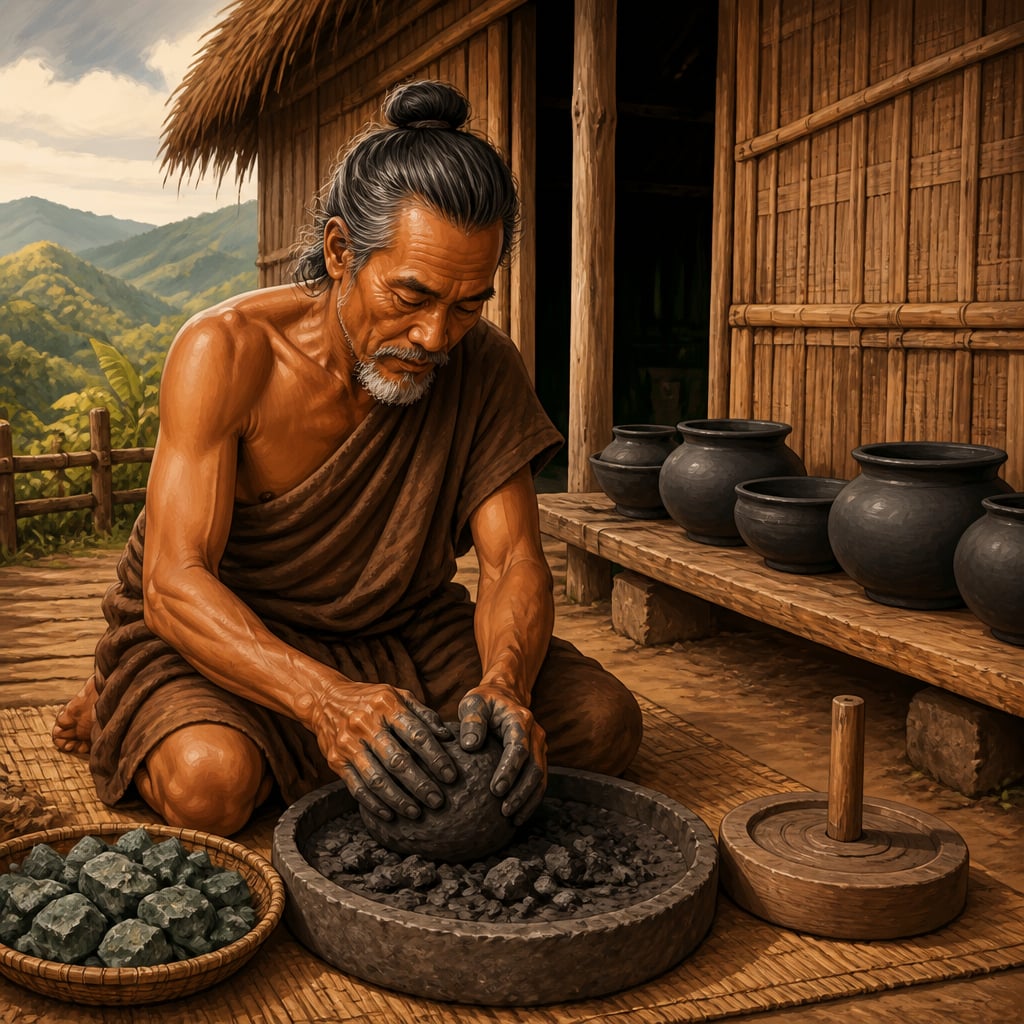
In the Tangkhul Naga village of Longpi Khullen, in the Ukhrul district of Manipur, high in the hills east of Imphal and close to the Myanmar border, on a bright autumn morning in the late 2010s, Machihan Sasa kneels on a mat of woven bamboo. In front of him is a low wooden stool. On the stool is a lump of grey-black paste that looks almost like wet cement. It is not ordinary clay. It is a mixture of crushed serpentine rock and a specific weathered clay, ground to powder, mixed with water, and kneaded to the consistency of bread dough.
He has no potter's wheel. There is no wheel in the village. There has never been a wheel in the history of Longpi pottery. He shapes the paste between his hands and the flat of a small wooden paddle, turning the piece on a flat wooden disc that sits on the stool. His mother taught him this work when he was a boy. His mother learned it from her mother, who learned it from hers, and so on back through the Tangkhul matrilineal lineage for as far as the village memory runs.
The vessel he is making will be a cooking pot. When it is dry, he will stack it on a layer of firewood in the open yard behind the house, cover it with more wood, and burn the pile in a bonfire for several hours. There is no kiln. There has never been a kiln. At the end of the fire, he will pull the pot out red-hot and rub it with the fresh leaves of the Pasania (also called Machilus) tree. The leaf juice, heated by the pot, leaves a deep matt black polish that looks almost like metal. This is the black of Longpi Hampai, the black pottery of the Tangkhul Naga hills.
In 2023, the Government of India awarded Machihan Sasa the Padma Shri for his role in keeping this craft alive. He is one of the few living masters who still know the full sequence from the quarry of the rock to the final leaf-rubbing. The rock comes from a hillside near Longpi Khullen that for as long as anyone remembers has been the only source of true Longpi pottery stone in India.
This lesson is the story of that hillside, that leaf, that bonfire, and the small matrilineal tradition in a corner of Manipur that has held the whole technique together without a wheel, without a kiln, and without a textbook.
A Village, a Rock, and No Wheel
Longpi Khullen and its smaller sister village Longpi Kajui sit in the hills of Ukhrul district, in the eastern part of Manipur, close to the border with Nagaland. Both are Tangkhul Naga settlements. For generations, the women of these two villages have been the main makers of a distinctive black stoneware that Manipur calls Longpi Hampai, the pots of Longpi. The tradition is small. Only these two villages produce the real thing. No other village in Manipur, and no other village in the northeast, has the right combination of rock and clay to make it.
The material is the reason. In most of India, pottery starts with wet river clay, shaped on a wheel, and fired in a kiln. Longpi pottery starts with something else. The potters walk out of the village to a specific hillside where the outcropping rock is a grey-black weathered serpentinite, a soft metamorphic stone with a slightly soapy feel. They break the rock into pieces with hammers, carry the pieces back, and grind them by hand against a flat grinding stone into a fine grey-black powder. To this powder they add a specific weathered clay, taken from a nearby spot, in a rough ratio of three parts rock to one part clay. They mix the powder and the clay with water, and knead the mixture until it has the plasticity of bread dough.
This paste is the raw material of Longpi Hampai. It is not ordinary clay. It is ground stone with clay added as a binder. When it is fired, the stone component gives the finished pot a strength, a density, and a heat retention that ordinary clay pottery cannot match.
Because the material is half stone, it cannot be thrown on a wheel. The paste is too heavy and too coarse to spin. The Longpi potters build each vessel by hand, from the base up, pressing and smoothing the walls between their palms and the flat of a small wooden paddle, turning the piece on a flat disc of wood. A Longpi pot is hand-built, coil by coil and press by press, the way the potters of the Indus Valley sites built their own large storage vessels more than four thousand years ago. Longpi is one of the only living wheel-free pottery traditions left in the subcontinent.
यथा सोम्यैकेन मृत्पिण्डेन सर्वं मृन्मयं विज्ञातं स्यात्। वाचारम्भणं विकारो नामधेयं मृत्तिकेत्येव सत्यम्॥
yathā saumyaikena mṛtpiṇḍena sarvaṃ mṛnmayaṃ vijñātaṃ syāt vācārambhaṇaṃ vikāro nāmadheyaṃ mṛttiketyeva satyam
Just as, my dear, by knowing a single lump of clay, everything made of clay is known. The modification is just a name, a matter of speech. The clay alone is real.
Chandogya Upanishad 6.1.4
In the Chandogya Upanishad, Uddalaka teaches his son Shvetaketu that the pot and the jar are only names. The clay is what is real. The Upanishadic image fits Longpi very precisely. Every vessel the Tangkhul women make is the same ground stone and the same weathered clay, shaped differently for a few years of use, and eventually returning to the hillside from which the rock came.
The Bonfire and the Leaf

The firing is the second great difference from the rest of Indian pottery.
In a standard Indian village, a potter uses a closed or semi-closed mud kiln, in which the pots are stacked above a firebox and fired indirectly. The kiln protects the vessels from direct flame and keeps the heat even. Longpi has never used such a kiln. The Longpi potters fire their vessels in the open air.
The dried pots are stacked in the yard behind the potter's house on a bed of firewood. More firewood is piled on top. The whole pile is lit, and the fire is allowed to burn for several hours. The pots sit in the middle of an open bonfire, exposed to the full heat of the flames. A bonfire built this way can reach eight hundred to nine hundred degrees Celsius, high enough to fuse the mineral components of the stoneware paste into a dense, durable body.
When the fire has burned down, the still red-hot pots are pulled from the ashes with long wooden tongs and rubbed immediately, while they are hot, with the fresh leaves of the Pasania tree, a member of the laurel family that grows in the forests around Ukhrul. The juice of the fresh leaf, pressed against the hot surface, reacts with the fired stone. It leaves a deep matt black polish that cannot be removed by washing. The leaf-rubbing has to be done in the first seconds after the pot comes out. A few seconds too late, and the polish does not bond properly. Timing is everything.
The result is a black stoneware that has almost no parallel in Indian pottery. It is strong, heat-resistant, naturally non-stick, and finished with a dark organic polish that deepens over years of use. A Longpi pot is designed for slow cooking. The stone body holds heat long after the fire is off. The surface does not leach into the food. A traditional Longpi cooking pot, used daily, can last for decades, and the black only gets richer with use.
A Matrilineal Craft in a Christian Village

For most of the history of Longpi Hampai, the craft has been held by women. In the Tangkhul tradition of these two villages, the mother teaches the daughter. The daughter teaches the grand-daughter. The rock-gathering, the grinding, the shaping, the firing, and the leaf-rubbing are all women's work. A Tangkhul girl in Longpi Khullen in the early twentieth century typically began learning the craft from her mother around age ten and had full command of all the stages by her early twenties.
This matrilineal transmission is the main reason the craft survived the colonial and post-independence disruption of most Naga hill traditions. Christian missionaries arrived in the Tangkhul hills in the early twentieth century, mainly American Baptists, and converted most of the Tangkhul to Christianity over the following decades. The conversion replaced most of the older animist ritual practices. But Longpi Hampai was a household craft, not a religious one. The conversion did not break the mother-to-daughter line. The pots continued to be made for cooking, boiling water, storing grain and rice beer, and serving food, inside Tangkhul Christian households that had otherwise changed almost everything else about their ritual life.
In the last thirty years, men have entered the craft too, partly because of the growing urban market and partly because some women left the village for jobs in Imphal and Shillong. Machihan Sasa is one of the best-known male masters. He represents a second generation of potters whose economic logic is different from his mother's. She made pots for the village. He makes pots for the country.
From the Village Hearth to the Delhi Kitchen
For most of its history, Longpi Hampai never left the Ukhrul hills. The vessels were cooking pots for Tangkhul households, storage jars for grain and rice beer, serving bowls for feast days. A few pieces trickled down into the Imphal markets. Almost nothing reached the rest of India.
This began to change in the early 2000s. The Manipur Handloom and Handicrafts Development Corporation began supporting the Longpi potters with training, marketing help, and access to urban craft fairs. Craft retailers like iTokri in Gwalior, the government-owned Tribes India outlets, and the luxury home brand Good Earth began stocking Longpi pieces at prices that returned a fair share to the village.
The biggest single boost to Longpi's urban visibility came from Indian food television. A handful of celebrity chefs, including names like Kunal Kapur, began featuring Longpi cookware on their shows and social channels, pointing out two qualities that urban cooks immediately understood. The black stone body is naturally non-stick, and the heat retention makes it perfect for the slow-cooked dals, curries, and rice dishes that are the backbone of Indian regional cuisine. An urban home cook in Gurgaon or Bangalore who had never heard of Ukhrul saw a Longpi pot on her television and wanted one in her own kitchen.
The Padma Shri and the Two Villages
In 2023, the Government of India announced Machihan Sasa among the Padma Shri recipients for his work in Longpi Hampai. The award was not only for his own pottery. It was for his role as a teacher. He has trained younger potters in both villages, including several men who might otherwise have left for urban jobs, and he has hosted the craft researchers, designers, and journalists who have helped carry the craft to a national audience.
The two villages today still produce all the genuine Longpi pottery in India. The hillside of weathered serpentinite is still the only source of the rock. There is still no wheel. There is still no kiln. The Pasania leaves are still rubbed on the red-hot pots as they come out of the bonfire.
Modern Echoes
The direct-to-buyer principle that Longpi's urban revival depends on is the same idea the Indian craft economist Ritu Sethi and her Craft Revival Trust have been arguing for across Indian craft traditions for more than two decades. Indian craft survives when the maker and the final buyer meet, with as few people in between as possible. The Dastkari Haat Samiti in Delhi and the North East Zone Cultural Centre in Dimapur have both included Longpi potters in their major craft melas, where urban buyers can meet the potters in person and watch them grind the rock and rub the Pasania leaves. The natural non-stick property of the Longpi stone body, once just a useful quality of a village cooking pot, has become a marketing line in a Good Earth flagship store, a talking point on Indian food television, and one of the reasons a cook in Gurgaon now wants a pot from a village she has never visited.
Back in the yard behind Machihan Sasa's house in Longpi Khullen, the bonfire has burned down. He pulls the first pot from the ashes with a long wooden stick. The stone is still red-hot. He reaches for a handful of fresh Pasania leaves and begins to rub. The surface turns dark and smooth. The rock and the leaf have met as they have met for generations. The pot will leave the village tomorrow on a truck bound for Imphal, and from there to a Delhi kitchen where a cook will use it the way it was meant to be used.
Key figures
Machihan Sasa
A Tangkhul Naga master potter from Longpi Khullen village in Ukhrul district, Manipur. He runs a household workshop in the village that produces hand-built Longpi Hampai vessels using the full traditional sequence: quarrying weathered serpentinite from the local hillside, grinding the rock to powder, mixing with clay, hand-building the vessels without a wheel, firing in an open bonfire in his yard, and rubbing the red-hot pots with fresh Pasania leaves. In 2023, the Government of India awarded him the Padma Shri, the fourth highest civilian honour in the country, for his role in preserving and reviving the Longpi Hampai tradition.
Laila Tyabji
An Indian craft designer, writer, and activist, and one of the co-founders of Dastkar, a Delhi-based non-profit society that supports traditional craftspeople across India. Since the 1980s, Laila Tyabji has been one of the most consistent public advocates for Indian craft, writing widely on craft policy, organising the Dastkar craft bazaars in Delhi and other cities, and championing lesser-known traditions including the crafts of the northeast. She received the Padma Shri in 2012 for her work in craft preservation.
Ritu Sethi
An Indian craft researcher, editor, and policy advocate. She is the founder of the Craft Revival Trust and the founding editor of Asia InCH, an online encyclopedia of the crafts and textiles of South Asia. She has been one of the most consistent voices in Indian craft policy for more than two decades, advising the Ministry of Textiles, UNESCO, and several state governments on the legal and economic protection of traditional crafts, including the crafts of the northeast.
Case studies
The Hillside, the Rock, and the Two Villages
Longpi Hampai begins with geology. On a specific hillside near the Tangkhul Naga village of Longpi Khullen, in Ukhrul district of Manipur, a weathered outcrop of grey-black serpentinite rock has been exposed at the surface for longer than anyone can remember. Somewhere in the deep past, the women of Longpi Khullen and the smaller sister village of Longpi Kajui discovered that if they broke this rock into pieces, ground it to powder, and mixed it with a specific weathered clay from a nearby spot, the resulting paste could be shaped by hand into pots that held up under fire and held heat like metal. Over many generations, a full tradition grew around this discovery: the quarry protocol, the grinding stones, the hand-building technique with a wooden paddle and a flat wooden disc, the open bonfire firing, and the crucial finishing with fresh Pasania leaves on the red-hot pot. All of it stayed inside the two villages. No other Tangkhul village developed the craft, because no other village had the rock. No non-Tangkhul village picked it up either. The tradition was locked to one specific geology and one specific community.
From the perspective of the Chandogya Upanishad's 'one lump of clay' teaching, the Longpi story is a textbook illustration of the ancient Indian idea that every crafted form is a temporary rearrangement of a single underlying material. The Longpi potters take a single paste, made from one hillside and one clay source, and shape it into dozens of different household vessels. The cup, the cooking pot, the kettle, and the serving bowl are all the same stone and the same earth, given different names and different shapes for a few years of kitchen use. When the pot eventually breaks, the shards return to the ground. The Upanishadic philosophical move, in which form is a vacha (a matter of speech) and only the underlying substance is real, is something the Longpi women have been practising every day for generations without ever having heard of the Upanishad.
The two Longpi villages have been the only genuine source of Longpi Hampai for as long as any written record, any oral tradition, or any ethnographic fieldwork can trace. The craft never spread, because the rock never existed anywhere else. When outside interest began to grow in the early 2000s, the Manipur Handloom and Handicrafts Development Corporation chose to support the existing village tradition rather than try to train potters elsewhere. The rock-grinding, hand-building, bonfire firing, and leaf-rubbing sequence is still practised today almost exactly as it was in the early twentieth century, and almost certainly much earlier than that. The two villages remain the entire production base of the tradition.
Some traditions belong to one place in a way that cannot be argued with. The weathered serpentinite of the Longpi hillside is not a neutral material that happens to be available in one village. It is a specific geological fact that makes the craft possible, and it is the reason the two villages are the only producers and always have been. When you find a craft tradition that is this tightly locked to its geography, the right policy is almost always the same: protect the village, support the living practitioners, and do not try to transplant the technique to a new location. The craft is the place, and the place is the craft.
The two-village model of Longpi Hampai is now studied as a case of extreme geographical concentration in Indian craft. It sits alongside the Bidar fort soil of Bidriware, the Madhubani region of Mithila painting, and the Salvi family tradition of Patan Patola as examples of Indian traditions in which the geography and the craft are inseparable. For craft policy, the lesson is that the protection of the physical village and the specific raw material site matters as much as the protection of the artisan community.
Longpi Khullen and Longpi Kajui together produce all the genuine Longpi Hampai in India. Current estimates put the number of active potter households at fewer than a hundred. The hillside of weathered serpentinite near Longpi Khullen is the only known source of the raw rock and is protected by local village custom from outside quarrying.
Machihan Sasa and the 2023 Padma Shri for Longpi Hampai
By the late twentieth century, Longpi Hampai was in a strange position. The craft itself was still alive. The two villages still quarried the rock, still hand-built the pots, still fired them in bonfires, and still rubbed them with Pasania leaves. But the household demand inside the village was shrinking, as aluminium, steel, and plastic vessels arrived even in the hill kitchens. The urban Indian market had almost no idea the tradition existed. Most of the active potters were older women nearing the end of their working lives, and the younger generation, both boys and girls, were leaving the village for schooling and salaried jobs in Imphal and beyond. The tradition was not dead, but it was in clear danger of becoming a museum craft within a generation if nothing changed. Into this situation stepped Machihan Sasa, a Tangkhul Naga master from Longpi Khullen, who chose to stay in the village, take over his mother's workshop, and run it as his full-time work. He also began training younger potters in both Longpi Khullen and Longpi Kajui and hosted the craft researchers, journalists, designers, and government officials who came looking for the craft.
From a dharmic perspective, Machihan Sasa was doing what the Indian craft tradition has always asked of its master practitioners. He was not only producing household objects for the market. He was holding the jnana (knowledge) of the craft, teaching the next generation, and making himself available to the outsiders who could help carry the tradition into a wider world. The Shilpa Shastra texts of classical India, and the older oral teaching traditions of every Indian craft community, describe the master as someone whose duty is transmission, not only production. The Indian state's Padma Shri honour, awarded to him in 2023, recognised this second role explicitly. It is given for distinguished service in a field, and in craft it often recognises the master who keeps the tradition alive for others as much as the master who makes the finest individual pieces.
In 2023, the Government of India announced Machihan Sasa among the Padma Shri recipients for his work in Longpi Hampai. The award brought a wave of new attention to the two Longpi villages and to the craft as a whole. National newspapers, food television programmes, and craft magazines ran features. Urban retailers like Good Earth, Tribes India, and iTokri expanded their Longpi offerings. Younger villagers who had been considering leaving the craft for urban jobs reconsidered. The Manipur Handloom and Handicrafts Development Corporation intensified its training and marketing support. Longpi Hampai did not suddenly become a big tradition. It remained small and geographically locked to its two villages. But the 2023 Padma Shri gave it a national profile it had never had before, and the attention has meaningfully improved the economic viability of the craft for the current generation of potters.
A small craft tradition can often be saved by one or two stubborn masters in one critical generation. The wider structures, the state corporations, the designer collaborations, the online retailers, the food television features, are all downstream of what those masters do. Machihan Sasa did not invent any new technique. He simply refused to let his mother's craft die in his generation. The Padma Shri in 2023 is one of the clearest recent national recognitions that this kind of stubborn continuity is itself a form of national service.
For any small craft tradition facing the risk of generational loss, the Machihan Sasa case is now studied as a clear example of how a single master's public visibility can change the economic math of the whole village. The visibility brings urban retail interest, the retail interest brings cash, and the cash keeps younger potters in the village. It is not a guaranteed formula, but it is one of the most reliable patterns in modern Indian craft revival.
Machihan Sasa was awarded the Padma Shri, India's fourth highest civilian honour, in 2023 for his contributions to Longpi Hampai pottery. He is among the few Tangkhul Naga craftspeople to have received a national civilian honour at this level and the first at that level specifically for the Longpi pottery tradition.
Longpi on Indian Food Television
For most of the twentieth century, the urban Indian home kitchen was equipped mainly with steel, aluminium, and eventually non-stick cookware from large industrial brands. Traditional regional pottery, cast iron, and stone vessels were seen as rural, old-fashioned, or inconvenient. In the early 2010s, this began to shift. A growing number of Indian food writers, home cooks, and celebrity chefs started arguing on television and social media that traditional regional cookware, including Longpi pottery, cast iron kadhais, earthen handis, and soapstone pots, produced better food for several concrete reasons. The stone and clay bodies held heat longer, which suited the slow-cooked dals, curries, and rice dishes that are the backbone of Indian regional cuisine. The natural surfaces did not leach into the food the way some modern synthetic non-stick coatings could. And the vessels themselves carried a regional identity that packaged industrial cookware did not. Indian celebrity chefs, including names like Kunal Kapur, began featuring Longpi pottery on their cooking shows, in their social feeds, and in food-writing columns, pointing out specifically that the black stone body is naturally non-stick and that the heat retention of the Longpi stoneware is ideal for slow cooking. The Longpi potters, sitting in Longpi Khullen a thousand kilometres from any major urban kitchen, suddenly had a new market.
From a dharmic perspective, the food-television revival of Longpi is a rediscovery of what the Indian culinary tradition has always known. The Chandogya Upanishad's 'one lump of clay' teaching placed the potter's vessel at the centre of a metaphysical argument, and every Indian regional cuisine from the Kashmiri yakhni to the Tamil sambar to the Tangkhul household stew evolved around specific cookware that suited specific techniques. When urban Indian kitchens began moving away from stainless steel and industrial non-stick back toward clay, cast iron, and stone, they were not adopting something new. They were returning to the material culture of their own grandmothers, through the unlikely medium of a celebrity chef on a cooking show. The Longpi potters, who never stopped making the pots, simply had to wait for the urban market to come back around.
The food-television visibility of Longpi, combined with direct retail placements by brands like Good Earth and online retailers like iTokri, has created a genuine urban demand for the craft. An urban home cook in Gurgaon or Bangalore who had never heard of Ukhrul now sees a Longpi pot on her television and wants one in her own kitchen. The cookware has appeared in food styling for Indian publications, in restaurant kitchens running regional menus, and in designer home photography. The craft is still small, and the two villages still produce the entire supply, but the demand is now national rather than only local. The combination of the 2023 Padma Shri to Machihan Sasa, the designer retail placements, and the food television visibility has given Longpi Hampai its strongest urban profile in its history.
A traditional craft often survives not by being preserved as heritage but by being rediscovered as useful. The urban Indian home cook who buys a Longpi pot in 2024 is not buying it out of loyalty to the Tangkhul Naga tradition. She is buying it because the black stone body is genuinely a better slow-cooking vessel than her old aluminium pan. The craft survives because the object still works in a modern kitchen. The right framing, delivered by a trusted food voice on television or social media, can re-open a centuries-old tradition to a new generation of buyers in a way that a museum plaque or a government subsidy cannot. The material matters more than the narrative, and when the material genuinely does the job, the narrative takes care of itself.
For any small regional craft whose original use is household cooking, the food-television and social-media channel is one of the most direct routes to urban visibility. The Longpi case is now a useful model for other small Indian pottery traditions, including the Longpi-adjacent black pottery of parts of Nagaland and the black soapstone cookware traditions of Nepal and the high Himalayas. A village potter with a working product and a national food media willing to feature it can rebuild a market in a few years that would have taken decades under the old state-handicraft-emporium model.
Indian food television and social media have meaningfully grown the urban market for traditional Indian regional cookware since the early 2010s, including Longpi Hampai, cast iron kadhais, earthen handis, and soapstone vessels. Celebrity chefs and food writers including Kunal Kapur and several other Indian culinary voices have publicly endorsed Longpi cookware for its natural non-stick surface and heat retention qualities.
Historical context
The Longpi Hampai story runs through many centuries of Tangkhul Naga household life in the Ukhrul hills, through the twentieth-century Christian conversion of most Tangkhul communities, through the 1972 formation of Manipur as a full Indian state, through the early-2000s support of the Manipur Handloom and Handicrafts Development Corporation, and into the 2023 Padma Shri awarded to Machihan Sasa. The exact origin date of the craft is not recorded. Tangkhul oral tradition traces it back many generations, and archaeological evidence of hand-built stoneware in the Naga hills suggests a lineage going back at least several centuries before the arrival of the first colonial ethnographers.
Manipur is a small hill state in the far north-east of India, bordered by Nagaland to the north, Mizoram to the south, Assam to the west, and Myanmar to the east. The Ukhrul district sits in the eastern part of the state, in the high hills along the Indo-Myanmar border. The district is home to the Tangkhul Naga community, one of the major Naga tribes of India. Longpi Khullen and Longpi Kajui are two Tangkhul villages in the district, and together they hold the only living tradition of Longpi Hampai in the country. No other village in Manipur, in Nagaland, or in any other Indian state produces the same black stoneware using the same weathered serpentinite rock and the same Pasania leaf finishing. The craft is a small but genuinely unique piece of the Indian ceramic landscape.
Hand-built, wheel-free stoneware traditions are rare in the modern world. Most surviving wheel-free pottery lives in small indigenous or hill communities that have not fully integrated into industrial ceramics markets. The Longpi tradition has close parallels in the black stoneware traditions of the Mizoram and Nagaland hill villages, in the traditional Bhutanese earthen cookware, and in the soapstone and serpentine cooking vessels used in some Nepali and Tibetan communities. The use of plant-leaf finishing on red-hot pottery is less common; it has parallels in some African pottery traditions, especially in the Sahel, where green vegetable matter is used to darken and seal hand-built pots as they come from the fire. Longpi is one of the very few Indian pottery traditions that share this wider Asian and African wheel-free, bonfire-fired, leaf-finished family.
Current estimates put the number of active Longpi Hampai potters at fewer than a hundred households, concentrated in Longpi Khullen and Longpi Kajui villages in Ukhrul district. The production is entirely hand-built, fired in small household bonfires, and shipped through a combination of the Manipur Handloom and Handicrafts Development Corporation, private retailers, and direct craft fair sales. A single Longpi cooking pot of moderate size takes several days to complete from rock-gathering to finished piece. Urban retail prices range from roughly Rs. 500 for a small cup to a few thousand rupees for a large cooking pot or kettle, and top-end designer commissions through brands like Good Earth can reach considerably higher.
Longpi Hampai is one of the clearest examples in modern Indian craft of a tradition that has survived at the edge of the country through three twentieth-century disruptions: the Christian conversion of the Tangkhul community, the political reorganisation of the northeast after 1947, and the near-disappearance of household pottery in most of India as aluminium, steel, and plastic replaced earthenware in village kitchens. The Longpi potters survived all three because the craft was a household skill transmitted from mother to daughter, because the raw material existed only in their own hillside, and because the finished pots were so good at slow cooking that the villagers themselves never stopped using them. In the last two decades, urban Indian interest in regional cookware, health-conscious kitchenware, and authentic craft has given the tradition a new market far from the Ukhrul hills. Longpi is now both a living village craft and a national heritage, and the 2023 Padma Shri to Machihan Sasa is the clearest recent marker of this transition.
Living traditions
The early-2000s intervention of the Manipur Handloom and Handicrafts Development Corporation, combined with the support of Dastkar, the Craft Revival Trust, and Indian online craft retailers, has turned Longpi Hampai from a purely local household craft into a recognised Indian craft tradition with a national urban market. The 2023 Padma Shri to Machihan Sasa is the clearest recent marker of this transition. Good Earth, iTokri, Tribes India, and several other urban retailers now carry Longpi pieces, and Indian food television has helped create consumer demand for the stoneware in Mumbai, Delhi, Bangalore, and other metro kitchens. The two Longpi villages continue to be the only genuine producers, and the hillside of weathered serpentinite remains the single raw material source.
- Rock quarrying and hand grinding: The first stage of any Longpi Hampai production is a walk out of the village to the hillside where the weathered grey-black serpentinite outcrops. The potter breaks pieces of rock off the outcrop with a hammer, carries them back to the village in a basket, and grinds them by hand against a flat grinding stone into a fine grey-black powder. This is the most physically demanding stage of the craft, and historically it was done by the women of the household together, often with older children helping. The same hillside has been the one source for as long as anyone in the village remembers, and the potters know by experience which parts of the outcrop give the best paste.
- Hand-building without a wheel: After the rock powder is mixed with clay and water into a kneadable paste, the potter shapes each vessel by hand on a flat wooden disc that sits on a low wooden stool. The paste is built up from the base in coils, and the walls are pressed and smoothed between the palm and the flat of a small wooden paddle. There is no potter's wheel and there has never been one in the village. The whole tradition works by hand, using only the paddle, the disc, the fingers, and the potter's sense of proportion. A skilled Longpi potter can produce a cooking pot, a kettle, or a bowl in a few hours, and the shapes follow a traditional vocabulary that is transmitted from mother to daughter without any written pattern book.
- Bonfire firing and Pasania leaf finishing: The dried pots are stacked in the yard behind the potter's house on a bed of firewood, covered with more wood, and fired in an open bonfire for several hours. When the fire has burned down, the still red-hot vessels are pulled out with long wooden tongs and rubbed immediately, within seconds, with fresh leaves of the Pasania (Machilus) tree. The leaf juice reacts with the hot fired stone and leaves the signature matt black polish that cannot be removed by washing. The whole firing and finishing process is done without electricity, without a kiln, and without any modern ceramic equipment. It is one of the most minimal pottery techniques still practised anywhere in the country.
Reflection
- A Longpi cooking pot, used every day, lasts for decades, and the black surface only gets richer with use. Is there anything in your own kitchen, or in your own daily life, that actually improves with use rather than wearing out? A cast iron pan. A leather wallet. A pair of hiking boots. A knife that sharpens better over years. What does it say about the difference between objects designed to wear out and objects designed to deepen?
- The Longpi Hampai tradition survived the Christian conversion of the Tangkhul community because it was a household craft and not a religious one. Is there any practice in your own family, community, or workplace that has survived a major change in the surrounding belief system or culture precisely because it was anchored in daily life rather than in ritual? A recipe, a way of greeting, a bedtime story, a craft, a song. Why did it survive when other things did not?
- The next time you buy anything handmade, try to count the number of people who stand between you and the person who actually made it. For a Longpi pot bought from a village cooperative, the chain can be very short. For the same pot bought from a high-end designer showroom, the chain may be longer, but each person in it adds genuine value. What would change in your buying habits, and in the lives of the makers, if you tried to make that number as small as possible while still paying fairly for the work in the chain?