Khurja, Chinhat & Khanapur: The Ceramics Corridor
Three Potter Towns, One Kumhar Community, and a Kiln That Knows How to Wait
Meet the Khurja potters of Bulandshahr who absorbed Persian glaze chemistry from Timur's army and Multani refugee families after Partition, the Chinhat stoneware workshop near Lucknow that taught Indian village potters to fire above 1,200 degrees, and the Khanapur Kumbhar community of Karnataka whose red earthenware water jars still outperform steel in the hot months. Learn how India's three-layered ceramics corridor works, and meet the master who made it a fine art.
Khurja, November 1947
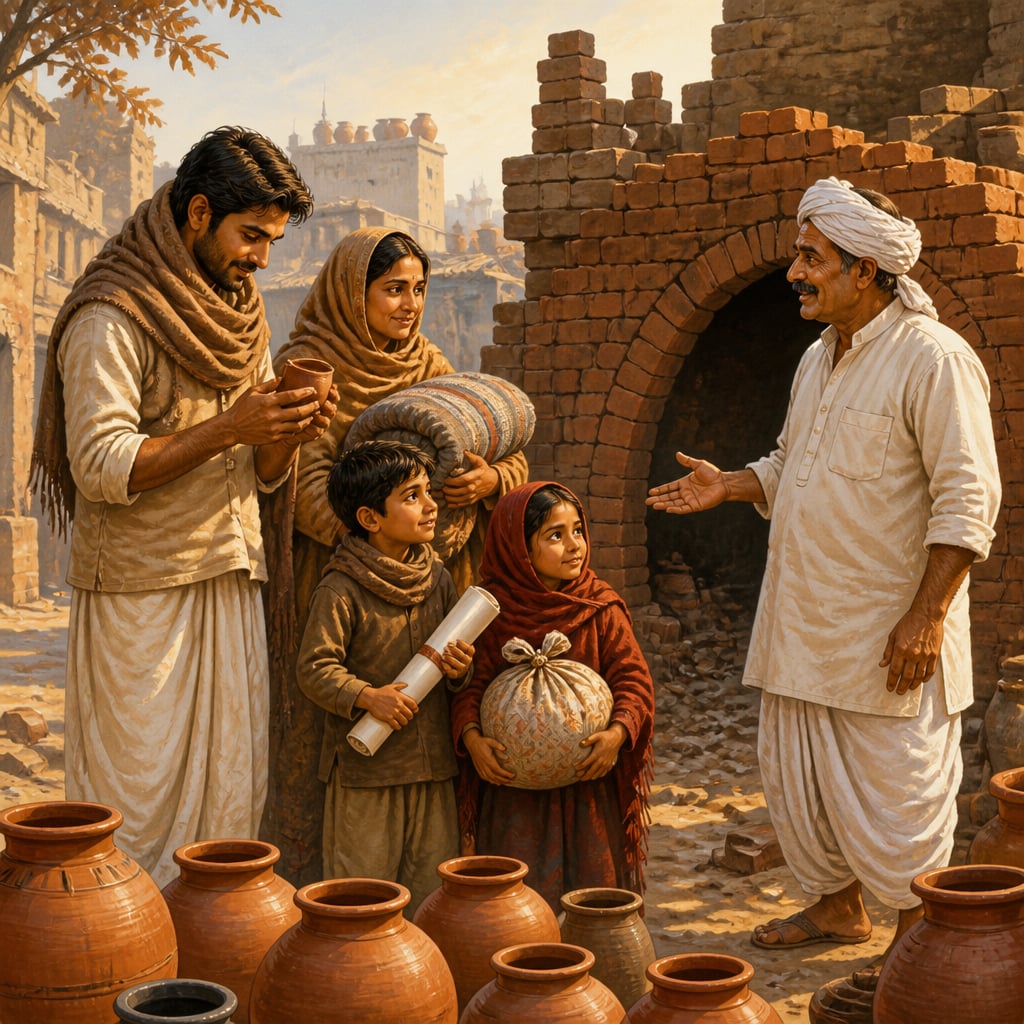
A cold November morning in Khurja, 1947. In the potters' lane off the Delhi road, a master kiln-operator sits on his haunches in front of a brick downdraft kiln that has gone cold for the third day in a row. Call him Raghunath Prajapat, a composite figure drawn from the working lives of Khurja's Kumhar potter families in the months after Partition. The coal ration is late. The December firing of glazed tableware is almost due. This morning a new family has arrived at his door. They have crossed the new border at Lahore and travelled east for three weeks. The father, a potter from Multan, carries a bundle of river-bed clay samples wrapped in a cotton cloth, and a single glaze recipe written in Persian on a scrap of paper. He does not yet know if Raghunath can teach him how the Khurja kilns work. Raghunath does not yet know if he can feed both households through the winter.
Forty years later, Khurja will supply more than seventy per cent of the household ceramics used in Indian homes, and the Multani glaze recipes brought to this lane by refugee families will be indistinguishable from the ones that had been in Khurja since Timur's army passed through in 1398. This lesson is about how that happened, and about two other towns, Chinhat near Lucknow and Khanapur in north Karnataka, that tell the same story in different ways.
What ceramics actually are
Ceramics is the art of turning earth into rock by fire. Soft clay, dug from a riverbed or a field, is shaped on a potter's wheel or pressed into a mould, dried in the sun, and then fired in a kiln at temperatures between 700 and 1,300 degrees Celsius. At the lower end of that range, the clay fuses into earthenware, a porous, soft, red-orange material that is still slightly permeable to water. This is the clay of matkas, diyas and the traditional kulhad tea cup. At the higher end, above about 1,200 degrees, the clay particles vitrify into a glass matrix, producing stoneware: dense, heavy, waterproof, capable of holding boiling tea without leaking. Above that lies porcelain, fired at over 1,300 degrees and made from a special white kaolin clay.
The difference between a matka and a coffee mug is not the clay type. It is the temperature. And the difference between one Indian potter town and another is usually the kiln.
Three things to hold in mind:
- Earthenware is ancient, universal, and found in every village of India.
- Stoneware is the art of the high-temperature kiln, and in India it is a twentieth-century arrival.
- Glazed ceramics is the marriage of mineral glaze chemistry and high-temperature firing, and it is the signature of Khurja.
The origin story of Khurja
Khurja is a small town in Bulandshahr district, about a hundred kilometres east of Delhi, at the edge of the Upper Ganga-Yamuna plain. It is also the oldest glazed pottery town in North India. The local story begins with Timur's invasion in 1398. When Timur sacked Delhi and moved back towards Samarkand, some of the Persian potters who had been travelling with his army are said to have broken off and settled in Khurja, where the riverbed clay was good and the trade road to Delhi was short. Whatever the exact origin, the Khurja kiln lanes are visibly Persian in their blue-and-white floral palette, and the Urdu-Persian words for kiln, glaze and pigment are still used on the workshop floor today.
For five hundred years, Khurja was a moderate regional centre. Then, in 1947, it became a hub.
The partition surge
When the new border between India and Pakistan cut through Punjab, tens of thousands of Multani and Lahori families migrated east. Multan and Lahore had been two of the most important glazed pottery towns in the subcontinent, and hundreds of working potter families were among the refugees. Khurja, which already had kilns and an established Kumhar community, became the natural landing place. Over the next ten years the Khurja potter's lane doubled, then tripled. The Multani glaze recipes merged with the older Khurja ones. Cobalt blue from Multan joined the copper green and iron brown of the pre-Partition palette. The town scaled up so quickly that by the 1960s, Khurja was supplying tableware not just to India but to the Soviet Union, East Germany, Nepal and the Gulf.
By the 1980s, around five hundred working kilns were running in Khurja. A single small workshop could turn out two thousand pieces a week. A large factory could do fifteen thousand.
Chinhat: the stoneware experiment
Twenty kilometres east of Lucknow, the village of Chinhat had always been a traditional earthenware centre. Its Kumhar families made everyday pots, water jars and roof tiles. In 1957, the newly independent Government of India, acting through the Uttar Pradesh Small Industries Corporation, set up a pottery training centre at Chinhat. The idea was simple: take traditional village potters who already knew the wheel and teach them high-temperature stoneware. The workshop was staffed by experts trained at British and Japanese potteries. Over the next twenty years Chinhat became the first place in India where village-born potters made everyday stoneware for the Indian home.
The Chinhat workshop had a second, quieter effect. It became a training pipeline for a new kind of Indian potter: the studio potter. Young men and women who were not born into Kumhar families came to Chinhat to learn the wheel, the glaze and the high kiln. From Chinhat they fanned out to Delhi, Bombay, Pune and Pondicherry, where they set up their own small studios. The line from Chinhat runs directly to the contemporary Indian studio pottery movement.
Khanapur: the red clay of the south
Fifteen hundred kilometres south of Khurja, in Belagavi district of north-west Karnataka, Khanapur represents the other half of the ceramics corridor. Khanapur is not a glaze town and not a stoneware town. It is a red earthenware town, and it is one of the oldest continuously working Kumbhar clusters in the Deccan. Khanapur potters have been making unglazed water jars, cooking pots and roof tiles for the Kannada-speaking villages of north Karnataka and Goa for at least eight centuries. The clay of Khanapur is famously iron-rich, which gives its pots a deep terracotta red and, according to local tradition, keeps stored water cool and sweet through the hottest months. Unlike Khurja, Khanapur never industrialised. The potters still use slow foot-kicked wheels and small mud-brick kilns. A single family workshop fires once or twice a month.
Together, these three towns form India's ceramics corridor: Khurja for glazed pottery, Chinhat for stoneware, Khanapur for traditional red earthenware.
The Kumhar community
All three traditions are held by the Kumhar (or Kumbhar) potter community, one of the most widely distributed craft castes in India. The Kumhar has worked the wheel from Sindh to Bengal and from Kashmir to Kanyakumari for at least two thousand years. Rigvedic and Buddhist texts already name the potter as a craftsman who shapes the earth into usable form. In every Indian village, the Kumhar family is the one that supplies the matka for the marriage, the diya for Diwali, and the kumbha for the cremation.
What separates a Khurja Kumhar from a Khanapur Kumbhar is not caste. It is kiln temperature, glaze chemistry, and the moment in history their town either industrialised or did not.
The studio potter revival

Parallel to the Khurja factories and the Chinhat workshop, a very different pottery tradition was being built by a small number of Indian studio potters from the 1950s onwards. The father of the movement is Sardar Gurcharan Singh (1895 to 1995), a remarkable figure who trained in Japan under Kenzan-style potters in the 1920s, returned to India, and founded the Delhi Blue Pottery studio in 1952. Gurcharan Singh was the first Indian to insist that pottery could be a fine art and not only an industrial trade. His students and their students fanned out to set up studio potteries across India. Nirmala Patwardhan, who had trained at the Leach Pottery in St Ives in England, returned to India and helped build training centres that linked the Khurja and Chinhat industrial worlds to the contemporary studio world.
The result, by the early 2000s, was an unusual three-layer Indian pottery ecosystem:
- Industrial Khurja supplied bulk glazed tableware to Indian homes.
- Chinhat stoneware supplied mid-priced artisanal tableware.
- Studio potters in Delhi, Pondicherry and Pune produced high-end individual pieces.
All three layers drew from the same clay and the same Kumhar community.
The modern brand revival

Through the 2010s, a new generation of Indian home-goods brands began building direct relationships with Khurja glaze masters and Chinhat stoneware potters. Ellementry, founded in Jaipur in 2017, set up an in-house design studio that sends patterns and quantities directly to Khurja kiln owners, and treats the Khurja potter as a design partner rather than a faceless supplier. Claymen, founded in Delhi by the artist Aman Khanna, produces limited-run figurative ceramic sculpture fired in Khurja kilns and sells through concept stores in New York and Paris. Good Earth, Nicobar and Freedom Tree all carry lines built on Khurja and Chinhat production. The direct-to-brand model has done for Khurja what Anokhi once did for Bagru: it has given the potter a design partner instead of a wholesaler, and a reason to keep firing.
In 2014, Khurja Pottery received its Geographical Indication tag. The tag gives Khurja's kilns the legal standing to defend their trade name against machine-made imports sold as Khurja ware in the metro markets.
Back at the kiln
It is now early 2015. Raghunath Prajapat of our opening scene is long gone, but his grandson runs one of Khurja's registered kilns. The Multani family's great-grandson has his own workshop two lanes away. Their cobalt blue is indistinguishable. On a Tuesday morning, a small pallet of hand-sculpted ceramic figures arrives at the kiln for firing. They have been made in Aman Khanna's Delhi studio and will be shipped to a design store in Paris next month. The kiln is loaded by hand. The fire is lit on a schedule that has not really changed since 1398. Six hundred years of Persian glaze chemistry, seventy years of Multani refugee knowledge, and two generations of contemporary studio design are about to spend sixteen hours together inside a downdraft kiln in Bulandshahr district.
That is the ceramics corridor. Three towns, one community, and a kiln that knows how to wait.
Key figures
Sardar Gurcharan Singh
The father of Indian studio pottery (1895 to 1995), founder of the Delhi Blue Pottery studio in 1952, and the mentor of a generation of potters who linked the industrial Khurja kilns to the contemporary studio movement
Nirmala Patwardhan
Indian studio potter, trained at Bernard Leach's St Ives pottery in England, who built training links between the Khurja and Chinhat industrial worlds and the contemporary Indian studio pottery scene
Aman Khanna
Contemporary Delhi-based artist and founder of Claymen Studio, which produces figurative ceramic sculpture fired in Khurja kilns and sells through international design stores
Case studies
Timur's Army and the Origin Legend of Khurja Pottery
In December 1398, Timur's army crossed into the Indian plains, sacked Delhi, and began its long march back towards Samarkand. The army included, in the older Persian tradition, its own community of craftsmen: weavers, metal workers, and potters who had been travelling with the court for years. According to Khurja's oral history, a group of those Persian potters broke off from the return march somewhere east of Delhi, where the riverbed clay looked promising and the village was far enough from the main road to be safe, and decided to settle. They set up kilns using the glaze recipes they had carried from Kashan and Samarkand, and they began to work. That settlement is said to be the seed of Khurja pottery. Whether the story is fully accurate or partly legendary, the Persian signature on the Khurja blue-and-white palette is unmistakable, and the Urdu-Persian vocabulary of the Khurja kiln is visibly older than 1947.
The Khurja origin story is the Dharmic principle of parampara-through-migration at its most literal. A craft is rarely invented in isolation; it arrives with a group of families who are willing to stay. The Sanskrit idea of desha, the place that receives a tradition, is not a neutral container. Soil, water, clay and trade routes all have to be right. Khurja was right. Its clay accepted the Persian glaze; its position on the Delhi road gave the potters a market; its Kumhar community accepted the foreign craftsmen. The result, six centuries later, is a town whose signature palette still quietly announces where the original families came from.
For five hundred years after 1398, Khurja remained a moderate but continuously active glazed pottery centre. Its palette, its vocabulary and its kiln design all retained visible Persian roots. When the second wave of glaze knowledge arrived in 1947 with Multani refugee potters, Khurja already had the infrastructure to absorb it. The 1398 origin and the 1947 surge are not two separate stories. They are the same tradition welcoming a second Persian-trained family five centuries apart.
A craft that has once welcomed a migrant family is a craft that will probably welcome another. The Khurja lane has done this twice, six hundred years apart, and each time the town grew instead of shrinking. Parampara is not a wall. It is a door that has been taught how to open.
Khurja's cobalt blue and white floral palette is still visibly closer to the Persian ceramics of Kashan than to any purely Indian pottery tradition, six hundred years after Timur's army is said to have left its first potters behind.
Sardar Gurcharan Singh and the Delhi Blue Pottery Revival (1952)
In 1922, a young Sardar Gurcharan Singh travelled to Japan to study pottery at the Tokyo Higher Industrial School, and later apprenticed under teachers in the Kenzan lineage, one of the most important traditions of Japanese studio pottery. He returned to India in the mid-1920s with something no other Indian potter of his generation had: a full technical command of high-temperature stoneware, reduction firing, and glaze chemistry. Through the 1930s and 1940s he ran a small practice in Delhi while working on glaze recipes and training early students. In 1952, with Indian independence only five years old and traditional pottery in the middle of a long slow decline, he founded the Delhi Blue Pottery studio, a teaching workshop dedicated to the idea that pottery was a fine art worth a lifetime of serious study. It was the first studio pottery in India.
Gurcharan Singh's life is a modern working of the Dharmic principle of vidya-dana, the gift of knowledge. He could have held his Japanese training as a private advantage and run a small luxury studio for the Delhi elite. Instead, he treated the knowledge as something that belonged to the whole Kumhar community and built a teaching workshop around it. The Upanishadic tradition says that the guru who refuses to teach the student ready to learn is failing his own dharma. Gurcharan Singh taught everyone who came to him, regardless of caste, family or background, and in doing so he turned a single skill into a national movement.
The Delhi Blue Pottery Trust is still active more than seventy years later, run by Gurcharan Singh's family and still teaching. Every Indian studio potter alive today can trace a teacher-line back to his studio. The dialogue between the industrial kilns of Khurja, the stoneware workshops of Chinhat and the contemporary studio world exists because one man insisted in 1952 that pottery was not only a trade, it was also a discipline. Without his bridge, the Khurja kilns would still be firing, but the brand-to-potter revival of the 2010s would not have had anyone in the middle to translate design into clay.
A single person who refuses to hoard a skill can change the shape of an entire craft. Gurcharan Singh did not save Khurja directly, and he did not save Chinhat or Khanapur. He built the teaching lineage that made all three towns legible to the contemporary design world. Sometimes the most generous thing a master can do is open a classroom.
Sardar Gurcharan Singh founded the Delhi Blue Pottery studio in 1952 and worked there until his death in 1995, a teaching career of forty-three years that touched every generation of Indian studio pottery that followed.
Ellementry and the Direct Design Relationship with Khurja
Ellementry was founded in Jaipur in 2017 as an Indian home-goods brand built around slow, handmade materials: stoneware, hand-woven cotton, natural brass. From the start, the founders decided not to source Khurja ceramics through the usual wholesale channels. Instead, they set up an in-house design studio, built direct relationships with Khurja kiln owners, and began sending finished patterns, material specifications and monthly quantities straight to the potters. The Khurja workshop is treated as a design partner, not a faceless supplier. Pattern tests go back and forth. Kiln schedules are shared. Seasonal collections are planned around what the Khurja potters can deliver without overworking their kilns. Within five years, Ellementry had become one of Khurja's most reliable high-margin clients and one of India's most visible contemporary stoneware brands.
The Ellementry approach is a contemporary working of the Dharmic principle of yajamana-karta, the relationship between a patron and a maker, where the patron is not a buyer hunting for the cheapest rate but a partner committed to the long-term health of the maker's workshop. The old Rajput and Mughal court commissions worked this way. So did the Chhipa printer commissions at Bagru before the colonial wholesale market broke them. Ellementry has quietly rebuilt the yajamana-karta link between a design studio and a village kiln, inside a twenty-first century supply chain, and shown that the old model is still economically viable.
Ellementry now stocks hundreds of Khurja-made stoneware pieces across its retail and online stores, and the direct-to-kiln model has been copied by a second generation of Indian home brands including Claymen, Nicobar, Good Earth and Freedom Tree. For the Khurja kilns themselves, the change has meant steadier orders, higher margins, and a new generation of young potters willing to stay in the town because the work is no longer only bulk tableware for wholesalers.
A craft does not need a museum to survive. It needs a buyer who treats the workshop as a partner and commits to real orders, real payments, real patience, and real design conversation. Ellementry has quietly rebuilt a four-hundred-year-old relationship between a patron and a kiln, and the Khurja lane is breathing easier because of it.
Ellementry was founded in Jaipur in 2017. Its direct design relationship with Khurja kilns has since been copied by more than a half-dozen Indian home-goods brands, creating the first serious contemporary market for Khurja stoneware in half a century.
Historical context
Late Sultanate-period glazed pottery through post-independence studio revival and contemporary design brands (c. 1400 to 2025 CE)
The Indian ceramics corridor is not one tradition but three, held by the same Kumhar or Kumbhar potter community but worked at very different kiln temperatures. Khurja in Bulandshahr district of Uttar Pradesh is the oldest glazed pottery centre in North India, with a Persian-influenced cobalt blue palette traditionally dated to Timur's invasion of 1398 and decisively scaled up after Partition in 1947 by Multani refugee families. Chinhat, twenty kilometres east of Lucknow, is a much younger tradition built on an older earthenware village: in 1957 the UP Small Industries Corporation set up a pottery training centre that taught village Kumhar potters to fire high-temperature stoneware for the first time, creating the pipeline that fed the Indian studio pottery movement. Khanapur in Belagavi district of Karnataka is the oldest of the three, an unglazed red earthenware cluster that has been making water jars, cooking pots and roof tiles for the villages of north Karnataka and Goa for at least eight centuries. Linking these three worlds is a small community of Indian studio potters, beginning with Sardar Gurcharan Singh in Delhi in 1952 and continuing through Nirmala Patwardhan, Ray Meeker at Pondicherry, Brahmdeo Ram Pandit in Mumbai and Aman Khanna in Delhi. Contemporary home brands like Ellementry, Claymen, Good Earth, Nicobar and Freedom Tree now commission directly from Khurja and Chinhat, giving the corridor a new design relationship that looks more like the Bagru Chhipa printer model than like traditional wholesaling.
Living traditions
The ceramics corridor today runs on three layers that speak to each other. Khurja supplies bulk glazed tableware and, through brands like Ellementry, Claymen, Good Earth, Nicobar and Freedom Tree, a rapidly growing design-driven export market. Chinhat continues to turn village Kumhar potters into stoneware masters, and its training lineage now feeds studio potteries across India. Khanapur's red earthenware is still the preferred summer water vessel in the villages of north Karnataka, and the Khanapur cluster is one of the last working examples of pre-industrial Indian pottery at scale. The 2014 Geographical Indication tag for Khurja and the continued health of the Delhi Blue Pottery Trust together mean that, for the first time in a century, the industrial, village and studio ends of Indian pottery are in the same conversation. A Khurja kiln that fires a Claymen figure one day and a bulk tea-set the next is the living answer to the Chandogya Upanishad's question about clay. The clay does not change. Only the shape we give it does.
- Khurja Glaze Mixing and Downdraft Kiln Firing: The full Khurja cycle: riverbed clay is prepared by soaking and sieving, wheel-thrown or mould-cast into shapes, biscuit-fired at around 900 degrees, then dipped in a glaze mix of feldspar, silica, metal oxide and clay binder, and fired again in a downdraft brick kiln at around 1,200 degrees for sixteen hours. A single firing may carry two thousand pieces. The blue-and-white floral palette of Khurja is painted by hand on the biscuit between the two firings.
- Chinhat High-Fire Stoneware on the Traditional Wheel: At Chinhat, Kumhar potters trained in the UPSIC tradition combine the traditional foot-kicked wheel with modern electric kilns fired to 1,250 degrees Celsius. The wheel technique is village; the kiln is studio. The result is a unique hybrid: everyday stoneware tableware made by village potters on the same wheels their grandfathers used, but fired dense enough to hold boiling tea. The clay is Chinhat's own, mixed with imported kaolin for whiteness.
- Khanapur Red Earthenware for Water and Fire: Khanapur Kumbhar families prepare iron-rich local clay, throw water jars and cooking pots on slow foot-kicked wheels, dry them in the shade for three days, and fire them in small mud-brick kilns fuelled by coconut husk and rice straw at around 800 to 900 degrees. The finished red earthenware is unglazed and slightly porous, which is exactly what makes it breathe and keep water cool. A single family workshop fires once or twice a month.
- Khurja Potters' Lane and Pottery Development Centre: Khurja's working potters' district, where several hundred registered kilns and family workshops still operate. Visitors can walk through the lanes and watch the full Khurja cycle: clay soaking pits, wheels, biscuit kilns, hand-painted blue floral decoration, glaze mixing, and the large downdraft kilns at the back of each family compound. The Pottery Development Centre on the edge of town runs public demonstrations and has a small museum of Khurja pieces from the last century.
- Chinhat Pottery Training Centre: The original Uttar Pradesh Small Industries Corporation pottery training centre, opened in 1957, and still the teaching heart of Indian village stoneware. Visitors can watch traditional Kumhar potters working on foot-kicked wheels and then see the same pieces fired in the high-temperature electric kilns inside the training workshop. The centre also runs short courses for outside learners and operates a small retail outlet selling Chinhat stoneware directly.
- Delhi Blue Pottery Trust and Studio: The studio founded by Sardar Gurcharan Singh in 1952 and still run by his family as an active teaching pottery. Visitors can see the original kilns, a collection of early pieces by Gurcharan Singh himself, and meet working studio potters who are training under the same lineage today. The Trust also runs public workshops and sells contemporary studio pieces made on site.
Reflection
- The Chandogya Upanishad teaches that knowing one lump of clay completely is worth more than a shallow acquaintance with a thousand. Which one small, specific thing in your own work or life do you already half-know, and what would change if you decided to know it properly before moving on to the next thing?
- Khurja's kilns tripled in size after Partition because the town welcomed potter families who arrived with clay samples and Persian glaze recipes, and absorbed their knowledge instead of fencing it out. What in your own work environment has grown because it welcomed an outsider's recipe, and what has shrunk because it refused?
- Khurja, Chinhat and Khanapur all work the same material and are held by the same Kumhar community, but their traditions are separated by kiln temperature, glaze chemistry and a few decisions made in the twentieth century. Is a tradition defined by what it uses, who makes it, or the choices that shape it along the way?