Kumhara Parampara: The Potter's Ancient Craft

The Wheel That Holds A Civilization

Around 1470, the weaver Kabir sat in a lane behind the Panchaganga ghat in Kashi and told his disciples that the body was a clay pot. He was quoting a tradition older than his own faith. The potter at his wheel, the Kumhar, has been shaping Indian life from the Harappan kilns of Mohenjo-daro to the Dharavi Kumbharwada of 2026.

A Weaver in Kashi, 1470
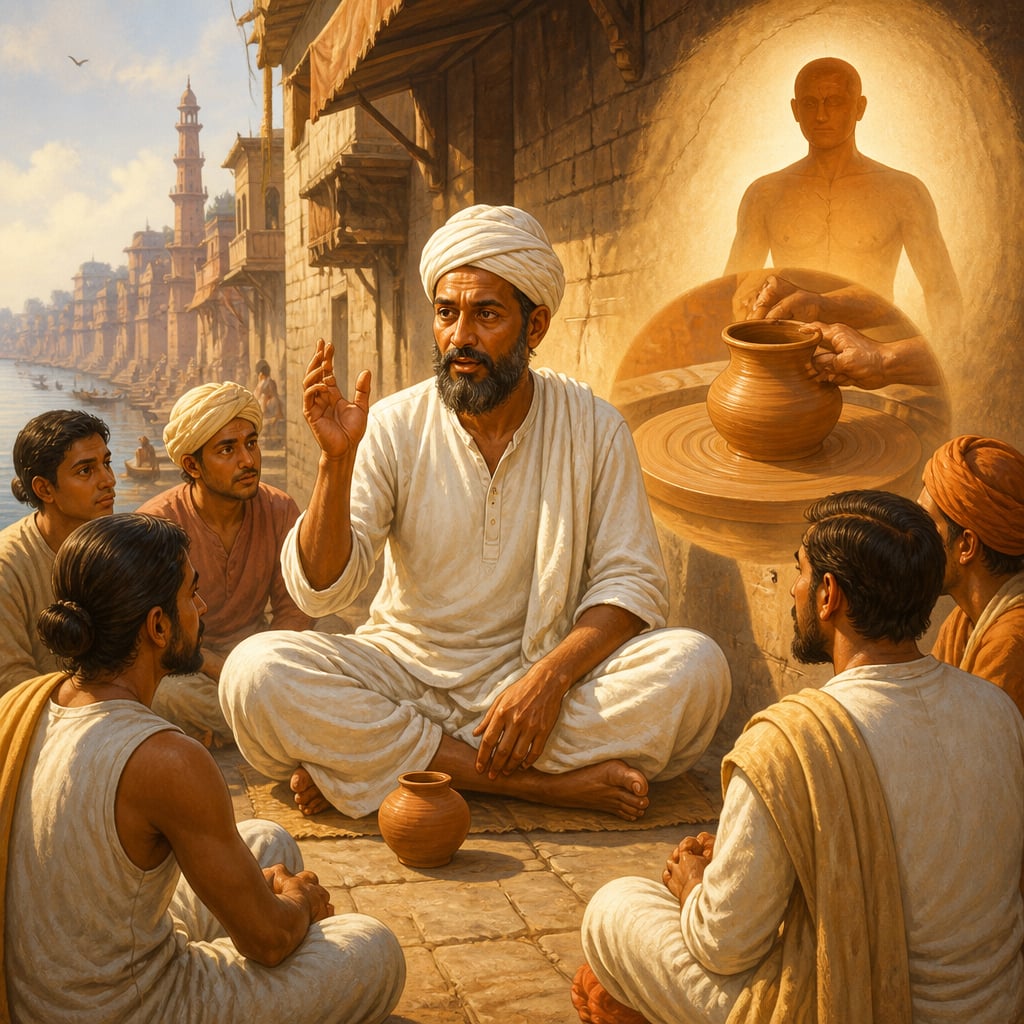
Kabir reciting the mati-kahe-kumhar-se doha behind the Panchaganga ghat in 1470

Around 1470, in a narrow lane behind the Panchaganga ghat at Kashi, a weaver named Kabir sat cross-legged with a small circle of his disciples. He had been born a Julaha, a Muslim weaver, but the verses that came out of his mouth belonged to no single religion. On this particular evening he was teaching his students the hardest lesson he would ever teach them: that the body they thought of as themselves was nothing more than a clay pot.

He recited a doha that is still sung in village courtyards across north India five and a half centuries later:

माटी कहे कुम्हार से, तू क्या रौंदे मोहे। एक दिन ऐसा आएगा, मैं रौंदूँगी तोहे॥

mati kahe kumhar se, tu kya raunde mohe ek din aisa aayega, main raundungi tohe

The clay says to the potter: why do you trample me? A day will come when I will trample you.

Kabir did not invent the metaphor. He picked it up because it was already the oldest image in the Indian imagination. A person sits at a wheel. They take a lump of mud. They turn it into a pot. The pot holds the household's water. It feeds the infant. It carries the wedding rice. It receives the ashes of the dead. No other craftsman's work touches every stage of a single human life so completely. The Kumhar at his wheel is the first maker the village sees, and the last.

This is the subject of the chapter. Mritika shilpa, the craft of earth. Before the weaver, before the smith, before the carpenter, a human being somewhere in India pushed a lump of clay against a spinning disc and made a cup that could hold water.

The Wheel That Goes Back 4,500 Years

The potter's wheel is among the oldest machines on the planet. The earliest true fast wheels, which spin quickly enough to use centrifugal force to raise the clay, appear in the archaeological record around 3500 BCE. By 2600 BCE, at Harappa and Mohenjo-daro, the fast wheel was in full industrial use. The British archaeologist Ernest Mackay, who excavated Mohenjo-daro in the 1920s, estimated that a single large kiln there could fire several hundred pots at a time.

The scale was astonishing. Thousands of red-slipped storage jars were made to within a few millimetres of the same dimensions. Kilns were built with internal flues that could reach eleven hundred degrees Celsius. A distinctive black-on-red painted tradition travelled from Harappa to the Oman coast as trade goods. By the time the Rig Veda was being composed, around 1500 BCE, the Indian potter had been throwing pots on the fast wheel for over a thousand years.

The Vedic texts give the craft its first documented handbook. The Shatapatha Brahmana (6.5.1) describes a priest fashioning a special clay pot called the mahavira for the Pravargya ritual. He shapes it with his own hands to hold boiling milk for the gods. The pot has to be perfect. If it cracks during firing, the ritual is ruined, and a replacement must be made by dawn. The Brahmana lists the clay to use, the exact shape, and the chant to recite while shaping. This is not a religious footnote. It is a potter's manual embedded in scripture.

The Clay Lump Of Uddalaka Aruni

Uddalaka Aruni teaching Shvetaketu with a lump of clay in a forest hermitage

One of the most famous passages in all of Indian philosophy also comes from a potter's lump. In the Chandogya Upanishad, the sage Uddalaka Aruni teaches his son Shvetaketu what is real by pointing at a handful of clay:

यथा सोम्यैकेन मृत्पिण्डेन सर्वं मृन्मयं विज्ञातं स्याद्वाचारम्भणं विकारो नामधेयं मृत्तिकेत्येव सत्यम्।

yathā saumya ekena mṛt-piṇḍena sarvaṃ mṛn-mayaṃ vijñātaṃ syāt vācārambhaṇaṃ vikāro nāmadheyaṃ mṛttikā ity eva satyam

Just as, dear boy, by knowing one lump of clay all that is made of clay is known. The names of the changed forms are only a play of speech. The truth is that it is just clay.

Chandogya Upanishad 6.1.4

Uddalaka is using a pot, a jug, and a lid as his classroom. The cup is clay. The plate is clay. The water pot is clay. All the differences the boy can name are just shapes on the wheel. The underlying mrittika (clay) is the only thing that is real. Adi Shankara, nineteen centuries later, would build the entire edifice of Advaita Vedanta on this one passage. The Upanishad's master image of reality is a potter's workshop.

The Kumhar In The Village

Across most of north and central India, the person at the wheel belongs to the Kumhar community. The word comes from the Sanskrit kumbhakara, the maker of kumbhas or water pots. In Gujarat the Kumhar is called Prajapati, the creator, which is also one of the oldest titles for Brahma himself. In Maharashtra he is Kumbhar. In Tamil Nadu, Kuyavar. In Bengal, Pal or Kumor. One community, a dozen names, the same wheel.

The Kumhar's place in the village was never a quiet one. He made the pots the bride carried on her head during a wedding procession. He made the lamps the priest filled with ghee on Diwali night. He made the kalash, the pot of water, mango leaves, and coconut, placed at the threshold of every new house. He made the clay Ganesha idols carried to the river each Bhadra month, and the enormous Durga idols of Bengal. He also made the round unglazed pots a family used to carry drinking water home from the well, day after day, for as long as they lived together.

When someone in the village died, the eldest son walked ahead of the funeral carrying a small clay pot on his shoulder. At the cremation ground he broke the pot on the earth and walked away without looking back. That pot, too, came from the Kumhar. No Indian life, from the wedding fire to the funeral fire, is untouched by the hands at the wheel.

The Pot That Names The Kumbh Mela

The kalash, the Kumhar's most sacred product, is described in classical texts as a model of the cosmos. Its base is the earth. Its belly is the atmosphere. Its neck is the sky. Its mouth is the sun. When a priest fills a kalash with water, mango leaves, and a coconut and places it at the threshold of a wedding or a temple opening, he is setting the universe itself in that room.

This is why the same Sanskrit word, kumbha, names both the household water pot and the Kumbh Mela, the largest gathering of human beings anywhere on earth. The Kumbh at Prayagraj, held every twelve years at the confluence of the Ganga and the Yamuna, takes its name from the pot of amrita that the devas and asuras churned from the ocean. At Maha Kumbh 2025, an estimated 660 million pilgrims bathed at Prayag. The festival that gathered them was named after a pot.

The Living Workshops

If you walk through Dharavi Kumbharwada in central Mumbai at four in the morning, you will find rows of open brick kilns glowing in the dark. The families who work them came from Saurashtra in the 1880s, invited by the British to supply pots to the growing colonial city. They stayed. Today there are roughly two thousand potter families here, still firing diyas, matkas, and clay Ganeshas by the tens of thousands, still living on a few narrow lanes in the middle of the most expensive real estate in India.

In Molela, a village about fifty kilometres west of Udaipur, the Kumhars make flat terracotta plaques of local deities. Villagers carry them back to home shrines across Rajasthan and Gujarat. In Khanapur, Karnataka, the red-clay tradition is still fired in wood kilns that a Harappan potter would recognise at a glance. In Bishnupur, West Bengal, terracotta has climbed onto the walls of seventeenth-century temples in panels that tell the entire Ramayana in baked clay.

Modern Echoes

Mansukhbhai Prajapati with his Mitticool clay refrigerator at his Wankaner workshop

On 26 January 2001, a magnitude 7.7 earthquake struck the Kutch region of Gujarat. In the small town of Wankaner, a potter named Mansukhbhai Prajapati lost his entire stock of clay water pots when his kiln collapsed. The next day, a Gujarati newspaper ran a photograph of his shattered matkas with the caption gareebon ka fridge toot gaya, the poor man's fridge has broken. Mansukhbhai read the headline and could not let it go. If the clay pot was already the poor man's fridge, he thought, why not build a real one. In 2005 he launched Mitticool, a clay refrigerator that runs without electricity. Water drips through the porous walls of the upper chamber and cools the lower chamber by around eight degrees below room temperature. It is now sold in more than twenty countries. A potter from Wankaner, working with his hands and a wheel, invented a refrigerator the way the Harappan potter invented the storage jar: by listening to what the clay could already do.

The Dharavi Kumbharwada is also still standing. Every Mumbai real estate proposal for the last two decades has tried to relocate the potters. Every proposal has failed, because the community knows that the ground under its feet is not real estate. It is the clay their grandparents chose because it fires just right.

And Kabir's doha, recorded by his disciples around 1470, is still sung in village courtyards across the Hindi belt. The clay still speaks to the potter. One day, it still warns, will come when the trampling is reversed.

Key figures

Uddalaka Aruni

Upanishadic sage who taught reality using a lump of clay

Kabir

Fifteenth-century poet who made the potter and clay a metaphor for mortality

Mansukhbhai Prajapati

Twenty-first century Kumhar and founder of Mitticool

Chakra (The Potter's Wheel)

The oldest machine in Indian civilization, and one of the oldest in the world

Case studies

Harappan Wheel Pottery: Industrial Scale at 2600 BCE

When the British archaeologist John Marshall unearthed the ruins of Mohenjo-daro in the 1920s and Harappa across the Ravi, he expected to find folk pottery. What he found instead was something his team initially refused to believe. Kilns large enough to fire several hundred pots at a time. Standardised red-slipped storage jars identical to the millimetre across thousands of examples. A fast wheel in full industrial use. Distinctive black-on-red painted designs that travelled from the Harappan cities to the Oman coast as trade goods. By 2600 BCE, the potter's wheel was already an ancient machine in the Indus Valley, and the potter was already a specialist producing for markets beyond his own village.

The Chandogya Upanishad says that by knowing one lump of clay, everything made of clay is known. The Harappan kilns are the practical demonstration of that principle a thousand years before Uddalaka Aruni put it into words. The potters had understood that clay is a standard, repeatable material that obeys consistent rules. Fire it right, shape it right, and you get the same pot every time. Uddalaka gave the philosophical name to an insight the Kumhar had already been working with for two millennia.

Harappan pottery set the baseline for almost every pottery tradition in the subcontinent. The wheel, the kiln, the slip, the painted decoration, and the community structure of the Kumhar all trace back, in unbroken descent, to the Indus Valley. A modern Kumbharwada potter is, technologically and culturally, a direct descendant of the Harappan workshop.

The deepest Indian crafts are older than the texts that describe them. When a Vedic or Upanishadic image feels surprisingly practical, it is usually because the sages were drawing on a craft tradition already a millennium old when they started writing.

A single Harappan kiln could fire several hundred pots at one go, reaching temperatures of roughly 1,100 degrees Celsius.

Dharavi Kumbharwada: Why the Mumbai Potters Will Not Move

In the 1880s, during the rapid colonial expansion of Bombay, the city's British administration invited Kumhar families from Saurashtra to settle in Dharavi. The city needed pots at industrial scale: water jars, diyas, oil containers, roof tiles. The Kumhars came, set up their kilns, and built Kumbharwada. A hundred and forty years later, Dharavi sits on some of the most valuable real estate in India, and developer after developer has proposed moving the potters out. The community has refused. In 2020, during the most recent Dharavi redevelopment proposal, the potters argued that the ground beneath their feet, the kiln airflow, the humidity of the Bombay coast, and the hundred and forty years of accumulated firing knowledge are the craft. You cannot relocate them without destroying the thing itself.

This is a living example of what the Kumhar community has always understood about place. A wheel can travel. A potter can travel. But a pottery is a place. The clay, the water, the fuel, the kiln design, and the community of peers who hold the knowledge are all tied to a specific piece of ground. The Shilpa Shastras, India's classical treatises on craft, assume this throughout. The earth you work on is half the craft. Displace it, and you have only half a Kumhar.

As of 2026, Kumbharwada is still firing. Roughly two thousand families still live and work on a few narrow lanes in Dharavi, producing tens of thousands of diyas each Diwali and clay Ganeshas each Ganesh Chaturthi. The community's refusal to relocate is increasingly cited in urban planning literature as an example of craft-rooted resistance to market pressure.

A craft that looks relocatable on a spreadsheet is often not, because the real inputs are invisible: soil chemistry, airflow, a particular humidity, and a community of peers whose hands have been trained by the place itself. When a craft community refuses to move, it is usually telling you something technical, not sentimental.

Around 2,000 Kumhar families live and work in Dharavi Kumbharwada today, in one of the most expensive square kilometres of land anywhere in India.

Mitticool: The Clay Refrigerator That a Village Potter Built

On 26 January 2001, the Bhuj earthquake destroyed hundreds of potteries across Kutch and Saurashtra. In the small town of Wankaner in Gujarat, a Kumhar named Mansukhbhai Prajapati lost his entire stock of clay matkas when his kiln collapsed. The next morning, a local Gujarati newspaper ran a photograph of his broken pots with the headline gareebon ka fridge toot gaya, the poor man's fridge has broken. Mansukhbhai read the headline and could not let go of it. If a clay pot was already the poor man's fridge, he thought, why not build a real one. He spent the next four years experimenting with porous clay walls, evaporative cooling chambers, and drip-fed water reservoirs. In 2005 he launched Mitticool, a clay refrigerator that runs without electricity, cooling the food chamber by around eight degrees below room temperature.

The Kumhar tradition has always treated clay as a problem-solving material. A matka cools water by evaporation because of its porous walls. This is 3,500 years of applied physics, not magic. What Mansukhbhai did was the same thing Uddalaka Aruni did in the Chandogya Upanishad. He looked at a lump of clay and saw what it could become. The difference is that Uddalaka saw a cup, a jug, and a lid. Mansukhbhai saw a refrigerator. The underlying faith in the material is identical.

Mitticool is now sold in more than twenty countries. It has been featured in Forbes, celebrated by PM Narendra Modi as an example of rural innovation, and visited by President A.P.J. Abdul Kalam. Mansukhbhai received the Padma Shri in 2022. Most importantly, the product has become a template for grassroots innovation. Several other village Kumhars have since developed clay pressure cookers, clay water filters, and clay cooking pans under the broader movement of rural makers.

The deepest innovations in India often come from a person who already knows a material the way their grandparents knew it. Formal engineering education is not the only path to a new product. A lifelong intimacy with clay, and the courage to read a headline literally, produced a refrigerator that now sells in twenty countries.

A Mitticool clay refrigerator runs on zero electricity and cools its storage chamber by roughly eight degrees below room temperature using only evaporation.

Historical context

Harappan to Present (c. 3500 BCE to today)

Reflection

More in Mritika Kala (मृत्तिका कला) - Pottery & Terracotta

All lessons in Mritika Kala (मृत्तिका कला) - Pottery & Terracotta · Traditional Crafts & Textiles course