Natungram & Krishnanagar: Bengal's Clay Dolls
Hyper-real clay portraits from Ghurni and wooden owls from a Burdwan village, two Bengali doll traditions shaped by courts, goddesses, and stubborn family workshops.
A Fisherman in the Palm of a Hand
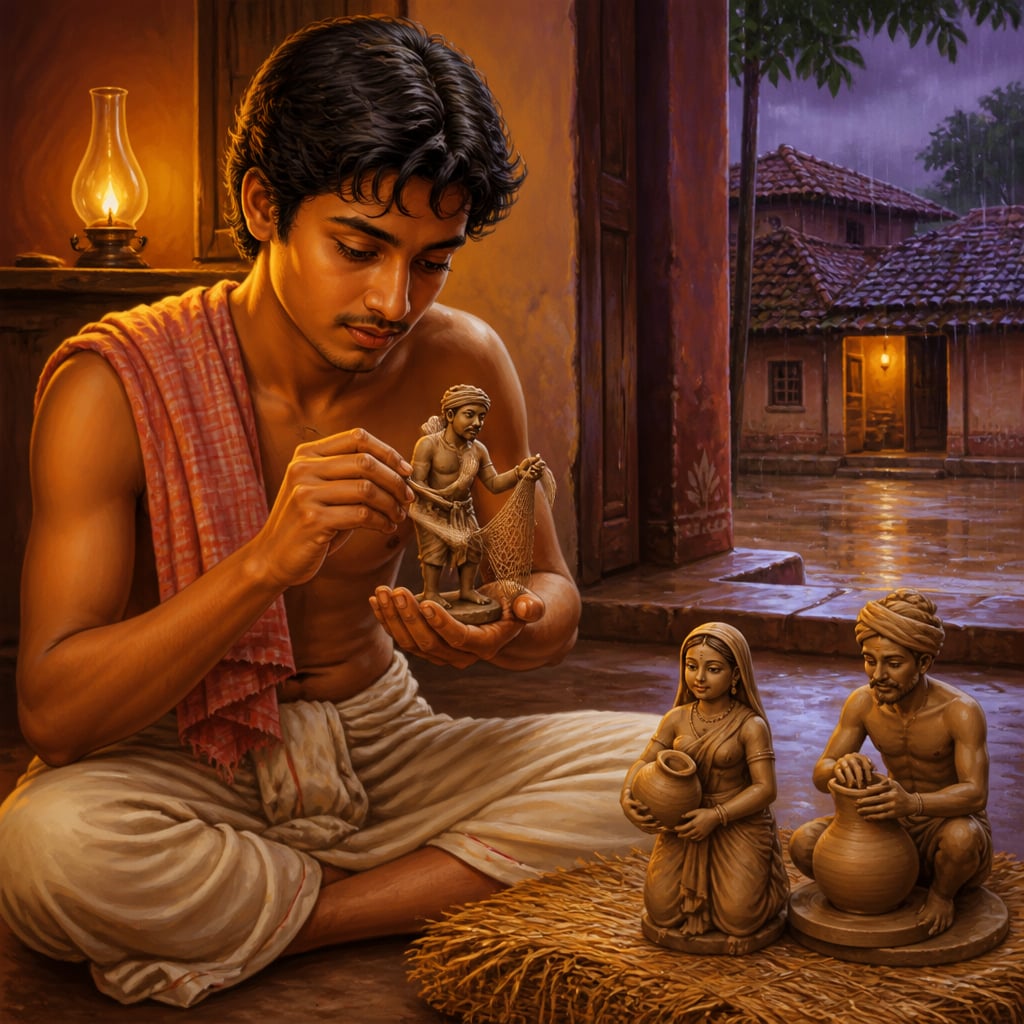
It is a wet monsoon evening in Ghurni, the potters' quarter of Krishnanagar, sometime in the year 1850. Inside a low clay-walled workshop, an apprentice we will call Nitai Pal (a composite figure, drawn from the working lives of Ghurni clay modellers of that century) leans over a bamboo table. A small oil lamp throws a nervous light on his fingers. In his left palm sits a clay figure barely the size of a mango. It is a Bengali fisherman. The figure wears a thin dhoti, a gamchha on his shoulder, and a bamboo creel on his back.
Nitai is not finishing the fisherman's body. He has already done the hands, the ribs, the tired knees. Tonight he is working only on the face. He presses a splinter of bamboo into the clay near the eyes. He opens the nostrils with a fine needle. He uses the tip of his own thumbnail to set the curve of the mouth. Outside, the Jalangi river is rising. Inside, Nitai is trying to make a seven-centimetre human being look as if he has lived a full life of waking before dawn, wading into cold water, and coming home hungry.
He has a reason to be nervous. His master's best clay figures have been packed into straw and crates. In a few weeks, a British official in Calcutta will put those crates on a ship. The ship will carry them across the ocean to a giant glass building in London called the Crystal Palace. There, in 1851, the figures will sit in the world's first Great Exhibition. Visitors from all over Europe will bend down, squint, and ask the same question: are these real people, shrunk by some Indian magic? Or are they toys?
Why This Question Matters
That question, asked in London in 1851, is still the right question to ask about the doll traditions of Bengal. For more than three hundred years, two small places in West Bengal have made figures from the land itself. Krishnanagar, in Nadia district, works in clay from the banks of the Jalangi river. Natungram, a village in Purba Bardhaman, works in softwood from the local mango and gamhar trees. One tradition is hyper-real. The other is almost cartoon-like. Both are called putul, the Bengali word for doll. Both sit at the edge of being called toys, being called folk art, and being called fine sculpture. Neither is entirely any of those things.
This lesson is about how these two traditions were born, how they survived, and why they still matter in a world that can print a plastic doll in three minutes.
The Nadia King and the Ghurni Settlement
Krishnanagar's clay-doll story begins with a king. Maharaja Krishna Chandra Roy ruled the kingdom of Nadia from 1728 to 1782. He was a patron of scholars, poets, and craftspeople. He is also the king in whose court the famous jester Gopal Bhar served, a character Bengali children still know from storybooks.
During his reign, the Maharaja invited families of kumbhakars (potters and clay workers) from nearby regions to settle in a neighbourhood of Krishnanagar called Ghurni. The soft, fine alluvial clay of the Jalangi river was ideal for detailed modelling. The artisans who came were not the rough village potters who made cooking pots. They were image-makers. They made temple icons, festival figures, and small decorative pieces for noble homes.
Once settled at Ghurni, these families began to specialise in something rare in India. Instead of stylised, symbolic figures, they started to make clay portraits of ordinary people. A blind beggar. A Vaishnava minstrel. A Muslim grocer. A British sahib on horseback. They modelled each figure from observation, not from a fixed iconography. Over generations, the Pal family surname became almost a guild mark. Even today, most serious Krishnanagar clay modellers carry that surname.
How a Krishnanagar Doll Is Actually Made
The technique is deceptively simple and extremely demanding. The artisan first prepares clay from the Jalangi river. The clay is cleaned, filtered, and mixed with small amounts of jute fibre or cotton to keep it from cracking. This mixed clay is then pressed into two halves of a mould to form the basic body. Arms, legs, and heads are sometimes modelled by hand and attached afterwards.
Once the figure is assembled, the real work begins. The artisan carves features into the soft clay using bamboo splinters, needles, and trimmed fingernails. Wrinkles go in one by one. The hollow of a collarbone is dug out by pressing the thumb. Each doll is then slowly sun-dried over days. After drying, the figure is fired in a low-temperature kiln, much gentler than a pot kiln, because the delicate limbs would crack in high heat.
The final stage is painting. Krishnanagar dolls are famous for their skin-tone painting. Artisans mix earth pigments and water-based paints to match the actual skin colours of Bengali villagers, from the deep brown of a ferryman to the pale yellow of an old zamindar. Eyes are painted last, in a ritual step called chakshu daan, the gift of sight, borrowed from Bengal's Durga idol tradition.
Kumartuli and the Krishnanagar Bloodline

To understand why Krishnanagar matters, look at Kolkata every autumn. In September, the city bursts into Durga Puja, one of the largest public festivals in the world. Millions of people visit thousands of pandals to see giant clay idols of Goddess Durga killing the buffalo demon. Almost all those idols come from a single neighbourhood in north Kolkata called Kumartuli, the potters' colony.
Most Kumartuli master idol-makers trace their family craft back to Krishnanagar. In the nineteenth century, as Calcutta grew into a colonial capital, noble families needed skilled idol-makers for their household pujas. Pal families from Ghurni migrated to Kumartuli and set up permanent workshops. The realism they had trained in, the ability to give a human face to a divine figure, is still visible in Kumartuli's Durga idols today. When a Kolkata grandmother says a particular Durga's face looks like the goddess herself, she is often looking at a technique that was perfected on small clay beggars in Ghurni two hundred years ago.
Natungram and the Owl of Lakshmi
About 200 kilometres west of Krishnanagar, in Purba Bardhaman district, a very different doll tradition lives in a single village called Natungram. Here the medium is not clay but wood. The Sutradhars, a community of traditional wood carvers, make brightly painted kather putul (wooden dolls). Their most famous product is not a human figure at all. It is an owl.

The owl, called pyancha or pecha in Bengali, is the vahana or vehicle of Goddess Lakshmi, the goddess of wealth and household well-being. In Bengal, Lakshmi Puja is celebrated on the full moon night after Durga Puja, and it is one of the most important household rituals of the year. Families all over West Bengal place a pair of Natungram wooden owls on their puja altar as a blessing from the goddess.
The Natungram owl is instantly recognisable. It is a stout, almost cube-shaped body with a round head, two huge staring eyes, and bold geometric patterns in red, black, yellow, and white. Nothing about it is realistic. Everything about it is designed to look directly back at the worshipper. The Sutradhar carver uses a single block of mango or gamhar wood, shapes it with a small chisel and adze, and then paints it with natural pigments. A family of carvers can produce dozens of owls in a day.
Two Traditions, One Bengal
Put a Krishnanagar fisherman and a Natungram owl side by side and you see two different answers to the same question: what is a doll for? The Krishnanagar answer is that a doll is a frozen portrait of the real world, a way of holding a person in your hand. The Natungram answer is that a doll is a living symbol, a way of inviting a goddess into your house.
Both answers are honest. And both are under the same modern pressure. Cheap plastic toys from other countries flood Indian markets. Collectors prefer older pieces. Young people in both villages look at the hours of work and the low prices and wonder if their children should learn the craft at all.
Recognition and Revival
Some good news has arrived in recent decades. In 2007, Krishnanagar clay dolls received a Geographical Indication tag from the Government of India. This legal protection means no one outside Nadia can sell a clay figure as a Krishnanagar doll. The tag also helps artisans apply for loans, join government craft melas, and get their children into craft schools.
Individual masters have been recognised too. Subir Pal, a Krishnanagar clay modeller from a Pal family of Ghurni, was awarded the Padma Shri in 2014 for his contribution to the craft. Subir Pal is known for hyper-realistic clay portraits of contemporary Bengali life, including figures of village mothers, political leaders, and scenes from rural households. His work shows that the Ghurni tradition is still capable of the same trick that astonished London in 1851.
Natungram has also seen a careful revival. West Bengal's state handicrafts programmes have brought Natungram carvers to urban craft fairs. The village is now a small tourist stop for heritage travellers. Orders for wooden owls no longer come only at Lakshmi Puja season. Interior designers, boutique hotels, and overseas gift shops now buy Natungram owls year-round.
What You Carry Home
If you ever visit Ghurni or Natungram, do not look at these dolls the way you look at a souvenir shelf. Look at them the way Nitai Pal's master looked at his clay fisherman on that wet evening in 1850. A doll here is not a toy. It is a small, stubborn claim about what is worth remembering: a face, a goddess, a village, a family's craft, a Bengal that refuses to disappear.
Key figures
Maharaja Krishna Chandra Roy
The ruler of Nadia from 1728 to 1782 who invited clay-modelling families to settle in Ghurni, the potters' neighbourhood of Krishnanagar. His patronage transformed a regional pottery centre into a workshop for portrait dolls and ritual figures, giving birth to what is today known as the Krishnanagar clay doll tradition. His court is also remembered as the home of the jester Gopal Bhar, whose stories are still read by Bengali children.
Jadunath Pal
A celebrated Krishnanagar clay modeller whose figures were sent to the Great Exhibition of 1851 at the Crystal Palace in London. His realistic clay portraits of Bengali villagers amazed European visitors who had never seen Indian craftwork of such fine detail. Jadunath Pal is remembered as one of the first Ghurni artisans to win international recognition for Bengal's clay dolls.
Subir Pal
A contemporary Krishnanagar clay modeller from the Pal family lineage of Ghurni, awarded the Padma Shri in 2014 for his contribution to the clay doll tradition. Subir Pal is known for hyper-realistic clay portraits of village women, workers, and rural Bengali life. His work has kept the Ghurni tradition visible in national museums and craft exhibitions, proving that the same skill that travelled to London in 1851 is still alive in Krishnanagar today.
Case studies
Maharaja Krishna Chandra Roy founds the Ghurni settlement
Maharaja Krishna Chandra Roy ruled the kingdom of Nadia from 1728 to 1782 from his court at Krishnanagar. Famous as a patron of Sanskrit scholars and Bengali poets, he decided to strengthen the craft life of his capital by inviting skilled clay-working families from nearby regions to settle in a quiet neighbourhood on the banks of the Jalangi river. This neighbourhood came to be called Ghurni. The Maharaja assigned the families land to build homes and workshops, and allowed them quiet access to the fine alluvial clay of the river. Freed from daily hardship, the artisans moved beyond everyday pots. They began modelling festival figures for the court, small ritual idols for noble homes, and eventually portrait dolls of everyday Bengalis. Over generations, the Pal surname became associated with the neighbourhood, and Ghurni slowly grew into the most famous clay-modelling centre in eastern India.
A craft rarely becomes a tradition by accident. Krishnanagar's clay dolls exist because an eighteenth century Bengali king understood that beauty needs a roof over its head. Maharaja Krishna Chandra Roy did not ask Ghurni's artisans to produce anything specific. He gave them land, clay access, and freedom from harassment. That is the basic contract of classical Indian patronage, and it is why so many Indian crafts carry the names of small towns rather than individual geniuses. The lesson for us is that protecting traditional knowledge is not only about rules and tags. It is also about giving artisans a place to live and work without fear.
Ghurni is today synonymous with Krishnanagar clay dolls. Most major Pal family workshops still operate from the same small cluster of streets that were settled under Krishna Chandra Roy's patronage, and the Krishnanagar Clay Dolls Geographical Indication tag legally names Ghurni as the source of this craft.
State patronage is not about prizes or press releases. It is about land, safety, and raw material. Give artisans those three things and real traditions can take root for centuries.
Maharaja Krishna Chandra Roy ruled Nadia from 1728 to 1782, a reign of over fifty years that gave Ghurni several generations of uninterrupted royal protection.
Jadunath Pal and the Krishnanagar figures at the 1851 Great Exhibition
In 1851, the Crystal Palace in London hosted the Great Exhibition, the first international showcase of industrial arts and crafts from around the world. India, then part of the British Empire, sent hundreds of objects chosen by East India Company officials. Among them were clay figures from Krishnanagar, attributed to the Ghurni master Jadunath Pal. The figures were small, detailed portraits of Bengali villagers. A fisherman with his net. A water carrier with a clay pot. A sadhu with matted hair. Each was painted in natural skin tones with painstaking realism. European visitors had never seen Indian clay art of this quality. The figures were widely admired, received critical attention in exhibition catalogues, and helped establish a nineteenth century reputation for Krishnanagar as a source of serious miniature portrait sculpture.
Indian crafts often reach the world on accident rather than on purpose. Jadunath Pal did not plan to become an international artist. British collectors, looking for curiosities from their eastern colony, packed his clay figures into crates and sent them to a glass hall in London. What happened there still matters. European visitors, used to the smooth marble of classical sculpture, were stunned to find tiny clay villagers with wrinkles, calloused palms, and tired eyes. For a moment, the question of what counts as art shifted. A doll from a Bengali village could sit beside a European statue and earn the same kind of respect. The story is a reminder that our traditional crafts have always been more sophisticated than foreign audiences expected, and that the world notices when we take them seriously.
The 1851 exhibition turned Krishnanagar into a known name in European art circles. Over the following decades, collectors, museum curators, and officials began commissioning figures from Ghurni, and Krishnanagar dolls entered major museum collections in Britain and continental Europe, where some examples can still be seen today.
International recognition does not create Indian craft. It only confirms what our artisans were already doing. When we do not invest in our own traditions at home, we end up seeing their best work in foreign museum cases instead of in our own living rooms.
The 1851 Great Exhibition drew over six million visitors in five and a half months, making it by far the largest audience Krishnanagar clay dolls had ever reached in a single season.
Natungram wooden owls on the Bengali Lakshmi Puja altar
In the village of Natungram in Purba Bardhaman district, West Bengal, the Sutradhar community has carved and painted wooden dolls for many generations. Their signature piece is the pyancha, a stylised wooden owl that represents the vehicle of Goddess Lakshmi. Every year, in the days leading up to Kojagori Lakshmi Puja on the full moon night after Durga Puja, Natungram's workshops enter their busiest season. Carvers use local mango and gamhar wood, shape it with small chisels, and paint each owl with thick bands of red, yellow, black, and white. The owls are then sent in bundles to markets across West Bengal. Bengali households buy a pair, bring them to the puja altar, and ask the goddess to keep the family's rice store full and the household's health stable for the coming year. This demand has repeated, without a real break, for at least two centuries.
Most Indian crafts live or die based on whether ordinary households still need them. Natungram owls have survived for one very simple reason. Bengali families still believe that the Goddess Lakshmi enters the home through her owl vahana, and that a blessed pair of carved wooden owls on the altar will keep the household's rice, money, and health safe for one more year. This is not a museum reason. It is a domestic reason. The Sutradhar families of Natungram do not compete with global art markets. They compete with the annual calendar. Every Lakshmi Puja, Bengali homes buy owls again. That quiet, repeating demand is the real reason Natungram still has wood carvers at all. The lesson is that living rituals are the best protection any craft can have.
Natungram is now officially recognised as one of West Bengal's living craft villages. State handicraft programmes have built workshops, trained new carvers, and included Natungram on heritage tourism routes, so the village supplements its traditional Lakshmi Puja season with year-round sales to urban buyers and designers.
A ritual that people still perform is the strongest scaffolding a craft can have. When we let rituals fade, we also quietly put the crafts that served them out of work.
Kojagori Lakshmi Puja is celebrated in Bengali homes on the full moon night of the Ashwin month, giving Natungram carvers one firm date each year when almost every Bengali family becomes a potential customer.
Subir Pal, Padma Shri clay modeller of Krishnanagar
Subir Pal was born into a Pal family of clay modellers in the Ghurni quarter of Krishnanagar and trained in the family workshop from childhood. As an adult, he became known for hyper-realistic clay portraits of everyday Bengali life, including village women, fishermen, farmers, and rural household scenes. His figures are small, often under thirty centimetres tall, but they carry minute detail in the face, hands, and clothing. Over the years, Subir Pal's work has been exhibited at national craft museums, featured in state handicrafts programmes, and collected by private patrons across India. In 2014, the Government of India awarded him the Padma Shri, one of the country's highest civilian honours, for his contribution to Indian art and craft. He remains based in Krishnanagar and continues to train younger members of his family in the clay tradition.
The Indian concept of a master artisan is not about fame. It is about being the right hand in a long chain of hands. Subir Pal belongs to a family that has shaped Ghurni clay for generations, and his Padma Shri is less a personal prize than a public acknowledgement that this chain is still unbroken. In a country where traditional crafts are often celebrated only at funerals, state recognition for a living Pal of Krishnanagar matters. It tells the next generation that staying in the family workshop is a respectable career, not a backward choice. It also forces urban India to look at Ghurni as a living centre of fine art, not a nostalgic stop on a heritage tour.
Subir Pal's Padma Shri has become a rallying point for the Krishnanagar clay doll tradition. Younger Pal family artisans now cite his recognition when they argue that the craft still has a future, and visitors to Ghurni often seek out his workshop as part of heritage tours of Nadia district.
National honours matter most when they land on a living master inside a living tradition. A Padma Shri for an active Ghurni modeller is a vote for the entire neighbourhood, not just for one artisan.
Subir Pal was awarded the Padma Shri in 2014, and the Krishnanagar Clay Dolls craft had already received its Geographical Indication tag in 2007, giving the tradition both legal protection and personal recognition within a single decade.
Living traditions
- Krishnanagar clay portrait modelling
- Natungram wooden owl carving
- Chakshu daan on clay dolls
Reflection
- Krishnanagar dolls are hyper-realistic while Natungram owls are bold and symbolic. Which style of art speaks to you more, and why?
- The Pal families of Ghurni pass their craft from parent to child without a formal school. Do you think family-based learning has advantages that modern art colleges cannot match?
- If you were to commission a Krishnanagar clay portrait today, whose face would you ask the artisan to shape, and what detail would you want the doll to remember forever?