Khilona Parampara: India's Toy-Making Heritage
The Chisel and the Aale Mara
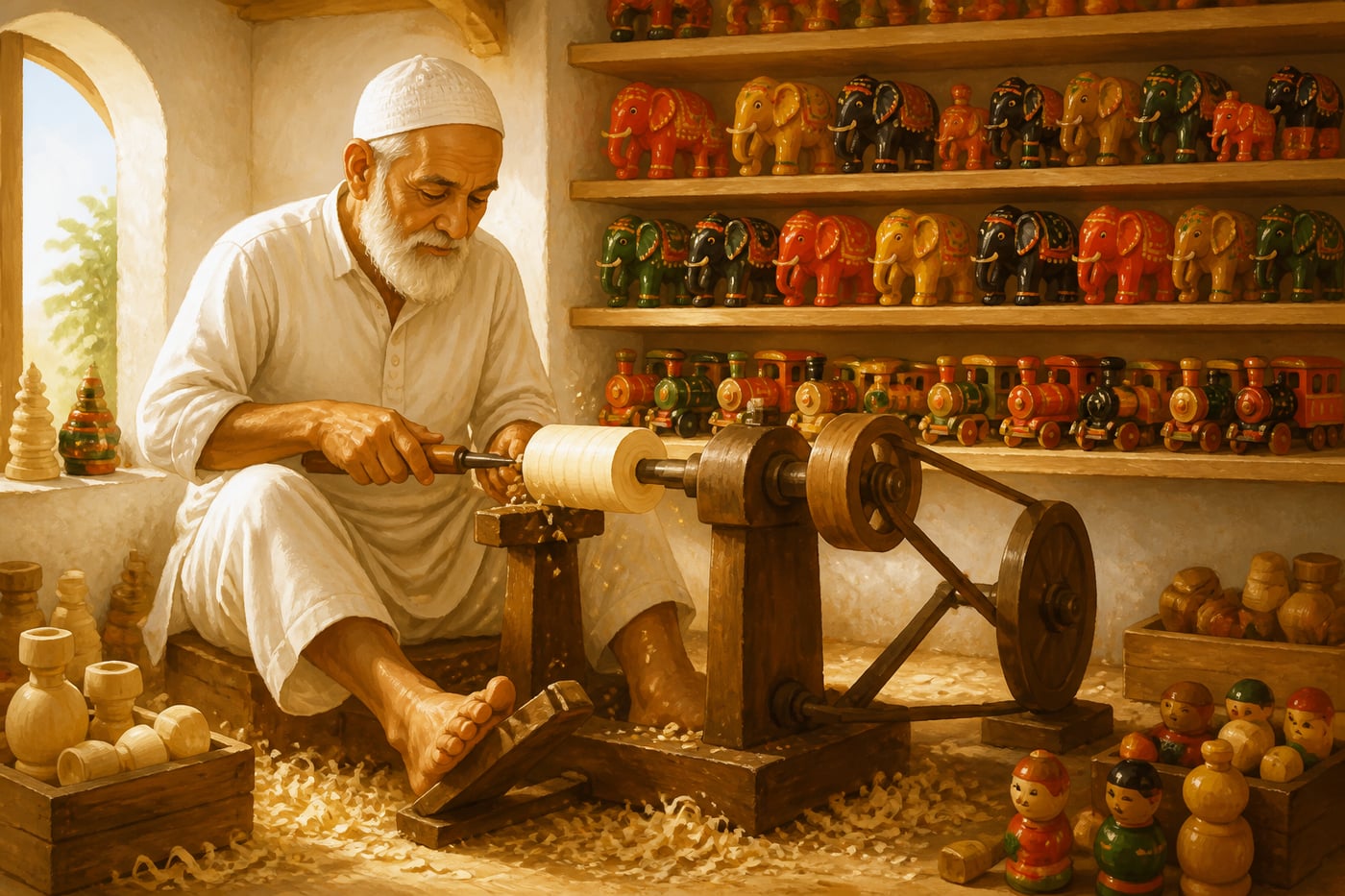
Bavas Miyan presses the chisel against the spinning aale mara wood. Shavings curl off like saffron. Around him, the workshop smells of lac sticks melting against friction heat, that sweet burnt-sugar scent every Channapatna boy grows up breathing. He is turning a toy horse. Not for an order. For no one.
Behind him, stacked against a whitewashed wall, are eighty unsold wooden elephants and train engines from last month. Chinese plastic toys have arrived at the Ramanagara bus stand in cardboard cartons. They cost eight rupees each. Bavas Miyan's hand-turned wooden elephant, dipped five times in lac and polished with kewra leaf, takes three days to make and sells for twenty. Two hundred families in Channapatna still depend on the lathe. Three of those families have already sent their sons to Bengaluru for security guard jobs.
The craft is five generations old in Bavas Miyan's own family. He does not know it yet, but in seventeen years Channapatna will receive the first Geographical Indication tag ever granted to a handicraft in Karnataka. He does not know that his unsold horses will one day sit in Crate and Barrel store windows in San Francisco. Right now he just keeps turning.
The Oldest Toys In The World
India has been making toys longer than almost anyone. That fact still startles people. When archaeologists brushed the dust off Mohenjo-daro and Lothal in the 1920s and 1930s, they found something no one had expected. Buried among seals and cooking pots and beads, in the rooms where children had slept four thousand five hundred years ago, they found toys.
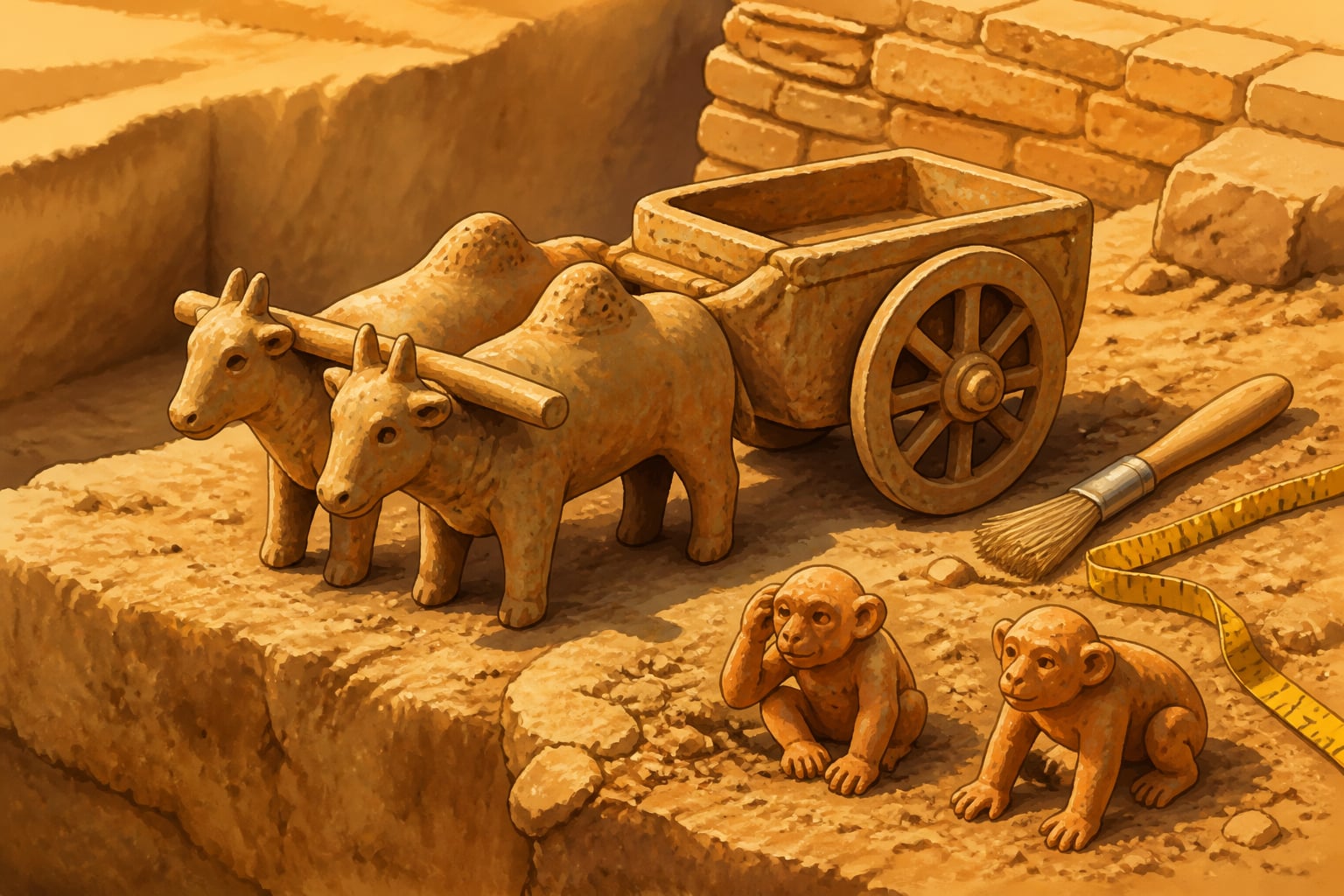
- Terracotta bullock carts with working wheels
- Miniature clay cattle and sheep
- A monkey with jointed arms that slid down a string
- Whistling birds of baked clay
- Spinning tops and rattles
These are the earliest surviving toys anywhere in the world. The children of the Indus cities played, and their mothers and fathers made them playthings, and those playthings look startlingly like the terracotta toys still sold outside Bankura temples in West Bengal today. The continuity is not an accident. It is a living craft that never broke.
What The Texts Called A Toy
The Sanskrit word for toy is krīḍanaka. It comes from the root krīḍ, to play, the same root that gives us the krīḍā of a cricket ground and the līlā of divine play. A krīḍanaka was anything a child could hold and make mean something. Clay horses. Wooden chariots. Dolls stitched from cotton scraps.
The Rig Veda does not describe toys directly, but it describes their makers. The Rbhus are a family of three divine craftsmen in the Rig Veda, mentioned more than a hundred times. They fashion a chariot for the Ashvin twins that moves without being pulled. They make a cow out of raw hide that yields milk. They cut one wooden cup into four and each becomes whole. The Rbhus are the divine archetype of the Indian craftsman. They take base matter and, through patient skill, transform it into something that works, something that delights, something alive.
A toy is the smallest version of this Rbhu work. A child presses a clay cow to her cheek and the cow moos in her imagination. A boy rolls a wooden cart and in his mind the horses drag it forward. The craftsman has made matter that can be inhabited.
Four Cradles Of The Indian Toy
India's toy-making tradition is not one tradition. It is at least a dozen, grown up in different soils, speaking different languages, using whatever wood or clay the local land offered.
Channapatna sits on the Bengaluru to Mysuru highway. Its toys are lathe-turned from ivory wood and dipped in lac resin boiled from the secretion of tiny scale insects. The lac gives each toy its mirror shine and a naturally food-safe, non-toxic surface. Channapatna turners learned their craft from Persian masters. Tipu Sultan, in the 1790s, invited craftsmen from Persia to teach the villagers of his kingdom, and the lathe stayed long after the British broke the sultanate. Today Channapatna is called Gombegala Ooru in Kannada. Toy Town.
Kondapalli, near Vijayawada in Andhra Pradesh, carves softwood figurines. Its carvers belong to the Aarya Kshatriya community and trace their lineage, by tradition, to Muktirishi, a sage described in the Brahmanda Purana. Their toys are gentle, rounded, painted in white and pink and ochre. Village scenes. Dashavatara sets. The famous Kondapalli bullock cart that every Andhra grandchild once owned.
Etikoppaka, eighty kilometres north along the coast, turns toys from Ankudu tree wood and colours them with dyes drawn from seeds, bark, roots and lac. Every pigment is edible. You can put an Etikoppaka spinning top in a toddler's mouth and nothing will happen. This matters. Etikoppaka toys still travel into Montessori classrooms across Europe for exactly that reason.
Natungram, in West Bengal's Burdwan district, carves wooden owls and raja-rani doll pairs in a lineage that reaches back to Krishnanagar court patronage of the 1700s. The owls are Lakshmi's vehicle. Families still buy them at Diwali.
Four cradles. Four bloodlines. One unbroken habit of making little worlds for children.
The Festival Where The Toys Come Out

Every autumn, across Tamil Nadu, Karnataka and Andhra Pradesh, women pull down wooden steps from cupboards and arrange them in the front room of the house. The festival is Navaratri. The display is Bommala Koluvu, or Kolu, or Gombe Habba depending on which language you speak at home.
On each step go the dolls. A pantheon of painted terracotta and wood. Raja and rani. Krishna and Yashoda. A wedding procession in miniature. Dashavatara. Marapachi dolls carved from red sandalwood and passed down at marriage. A woman's kolu is partly inherited from her mother and grandmother, partly added to every year. Some dolls are a hundred years old. Friends visit. They are given sundal and haldi-kumkum. For the nine nights of Navaratri, the toys are not children's playthings. They are the house's ancestors and deities, put on display to remind everyone where the household came from.
This is the secret of why Indian toy-making did not die. The toys were never only for children. They were also religious objects, festival objects, marriage gifts, heirlooms. A culture that makes its gods out of clay and wood cannot forget how to make a clay cow.
The Near-Death And The Return
And yet the craft almost broke. Through the 1990s and early 2000s, every toy cluster in India shrank. Chinese plastic imports undercut handmade prices by seventy per cent. Artisans' sons walked away from the lathe. By 2004, Channapatna had fewer than four thousand working artisans, down from close to ten thousand a generation earlier. Etikoppaka was worse.
Three things turned the tide.
- Legal protection. In 2005, Channapatna received the Geographical Indication tag, the first for any handicraft in Karnataka. Kondapalli, Etikoppaka and Nirmal soon followed.
- Design partnerships. Maya Organic in Bengaluru, Fairkraft Creations in Karnataka, and a handful of independent studios began placing orders at fair prices, paying in advance, and carrying Channapatna pieces into international design retailers.
- Policy shift. In 2020, the Government of India restricted the import of 171 categories of plastic toys without BIS safety certification. The domestic market suddenly needed the wooden lathe again.
By 2024, Channapatna had crossed twelve thousand artisans. It was exporting to more than forty countries. Bavas Miyan did not live to see most of this. He passed away in 2011. But his students saw it, and their students are seeing it, and the aale mara lathe is spinning again in workshops his grandsons now run.
Modern Echoes
The krīḍanaka that Bavas Miyan kept turning that afternoon in 1988 for no buyer was not an economic object. It was a prayer. A refusal to let go of something his grandfather had taught his father. That refusal, in the end, is what every living craft is.
One person who keeps turning the wood when the market says stop. One child who hugs the painted horse and makes it gallop in a story only she can hear. One grandmother who unpacks the kolu dolls every October and tells her grandchildren which one came from her own wedding in 1963.
The Rig Veda says the Rbhus became immortal because they kept working with their hands and refused to be idle. India's toy-makers are on the same long road. They are still turning the wood. Somewhere outside Ramanagara, right now, the lac is melting sweet against friction heat, and a new little horse is being born.
Key figures
The Rbhus
Divine craftsmen-brothers
The three Rbhus are the archetype of the Indian craftsman in the oldest layer of Hindu scripture. They fashion Indra's horses, the Ashvins' self-moving chariot, a milk-yielding wooden cow, and a drinking cup that multiplies when divided. They earn immortality, the Rig Veda says, not through penance but through skilled work with their hands. Every lathe turner, wood carver and clay dollmaker in India is, in some sense, a descendant of the Rbhus.
Tipu Sultan
Ruler of Mysore and patron of the Channapatna lathe tradition
In the 1790s, Tipu Sultan invited Persian master turners to his kingdom and settled them in the small town of Channapatna on the Bengaluru to Mysuru road. They taught local craftsmen how to turn wood on the lathe and coat it in lac. The British dismantled Tipu's state after his death at Srirangapatna in 1799, but they left the lathe alone. The Persian technique married to local ivory wood and Kannada craft sensibility, and Channapatna became Gombegala Ooru, the Toy Town of Karnataka.
Bavas Miyan
Channapatna master turner, Shilp Guru awardee
Bavas Miyan was one of the great late-twentieth-century masters of the Channapatna lathe. He kept turning wood through the darkest years of the 1990s, when Chinese plastic imports had gutted the local market and his peers were leaving the craft. He trained hundreds of apprentices, received the Shilp Guru award from the Government of India, and lived just long enough to see the Geographical Indication tag and the first wave of designer collaborations begin to revive his town.
The Aarya Kshatriya community of Kondapalli
Hereditary toy carvers of Andhra Pradesh
The Aarya Kshatriya community of Kondapalli village, near Vijayawada, has carved the famous rounded softwood toys of Andhra for at least four centuries. Their tradition traces itself, by family lore, to a sage named Muktirishi described in the Brahmanda Purana. Generations of Aarya Kshatriya carvers have kept the Kondapalli bullock cart, the dashavatara set, and the village-scene tableaux alive even as markets changed around them.
Case studies
Channapatna And The GI Tag That Saved A Toy Town
By the late 1990s, Channapatna was bleeding artisans. Chinese plastic toys had collapsed wooden-toy prices to a fraction of production cost. Families that had turned lac-dipped wood on lathes for five generations were sending their sons to Bengaluru to work as security guards and factory labour. The workshops on the Bengaluru to Mysuru road looked half-derelict, and artisan numbers had fallen below four thousand from close to ten thousand a generation earlier.
The Dharmashastra tradition treats a hereditary craft as both livelihood and kula dharma, the family's sacred duty. To let a five-generation lineage die is a moral failure, not just an economic loss. The Rig Vedic Rbhus earned immortality through patient, persistent craft. Channapatna's survival depended on reframing the lathe as heritage and dharma, not merely trade.
In 2005 Channapatna received Karnataka's first Geographical Indication tag for a handicraft, legally protecting the name and creating a distinct market identity. Kondapalli, Etikoppaka and Nirmal followed within a few years. Design brands like Maya Organic and Fairkraft Creations began placing orders at fair prices and paying advances directly to the turners. By 2024 the cluster had crossed twelve thousand artisans and was exporting to more than forty countries.
Legal protection alone is not enough. What saved Channapatna was GI protection plus design partnerships plus a revived cultural memory of why handmade toys matter. Three levers, pulled together.
2005 Channapatna GI tag filing. 12,000+ active artisans by 2024. Exports to 40+ countries.
Harappan Bullock Carts: The Oldest Toys In The World
In the 1920s and 1930s, John Marshall, Ernest Mackay and their teams were still excavating Mohenjo-daro, Harappa and Lothal. Among the seals, beads and cooking pots they unearthed something unexpected: miniature terracotta bullock carts with working wheels, whistle-birds, spinning tops, rattles, and an articulated monkey that slid down a twisted string. These objects were dated to around 2500 BCE, making them the oldest surviving toys ever discovered anywhere on earth.
The Puranas treat play, līlā, as a divine activity. Krishna's boyhood among wooden carts and butter pots is not a distraction from godhood but a central expression of it. A culture that sees divine play as holy will make toys for its children as an act of dharma, not as indulgence.
The Harappan toys now sit in the National Museum in Delhi and in the Mohenjo-daro and Lothal site museums. More importantly, the craft itself never broke. Terracotta bullock carts still sold outside Bankura temples in Bengal today look almost identical to the 4,500-year-old examples from Lothal. India is effectively the only civilisation on earth with an unbroken children's toy tradition going back to the Bronze Age.
Continuity is the deepest form of cultural wealth. You cannot buy it, manufacture it, or fast-track it. You can only fail to protect it.
c. 2500 BCE Harappan terracotta toys at Mohenjo-daro, Harappa, Lothal. Still made in near-identical form at Bankura 4,500 years later.
Maya Organic: Fair-Trade Channapatna In A Global Store
Maya Organic is a Bengaluru-based social enterprise that works directly with Channapatna turners. It faced a classic craft-sector problem: middlemen took most of the value, artisans received near-famine wages, and international buyers had no visibility into the supply chain. The open question was whether a premium-priced handmade wooden toy could actually survive in a global market competing against mass-produced alternatives ten times cheaper.
The varna tradition binds a craftsperson's livelihood to the kula, the extended family workshop. A fair wage, in this framework, is not charity. It is the employer's dharma, restoring the ancient guild relationship between patron and artisan that royal courts once provided and that industrial markets destroyed.
Maya Organic now pays Channapatna artisans directly, uses only natural lac dyes, supports women-led turning units, and distributes through international design retailers. Several artisan families that had sent their sons to Bengaluru's factory floors in the early 2000s have brought them back to the lathe because the income has become competitive again and the work carries dignity.
Premium craft markets exist, but only if someone shortens the chain. The middleman problem in Indian crafts is not purely economic. It is relational.
Fair-wage direct sourcing from Channapatna. Distribution into international design retail since the mid-2000s.
Fairkraft Creations: Three Craft Clusters Under One Roof
Most Indian craft brands work with a single cluster. Fairkraft Creations, a Karnataka-based fair-trade studio, took a harder path. It works simultaneously with Channapatna (lac-turned ivory wood), Kondapalli (softwood figurines), and Etikoppaka (vegetable-dyed lathe toys). The challenge was quality control and design coherence across three very different communities using different tools, different woods, and different aesthetics.
The shrenis, the classical Indian craft guilds described in the Arthashastra and the Jataka tales, often connected multiple villages under one trading banner so that regional specialities could reach distant urban markets. Fairkraft is, in effect, a modern shreni, binding three clusters into a single distribution system while leaving each workshop's identity intact.
Fairkraft now supplies international markets with three distinct product lines, each faithful to its cluster of origin. The company provides design guidance and advance payments but keeps the making in the artisan's own workshop with the artisan's own tools and wood. Cross-pollination between the three clusters has strengthened all of them, because an order slump in one is buffered by steady demand in the others.
Reviving one craft cluster is hard. Reviving three at once is harder, but the cross-pollination of orders, designs and pricing creates a kind of insurance no single cluster can give itself.
Simultaneous sourcing from Channapatna, Kondapalli and Etikoppaka. Each product line is kept distinct and traceable to its cluster of origin.
Reflection
- What is one handmade toy or object from your childhood that is still in your family's home? Who made it, and why has it not been thrown out?
- Channapatna's artisans almost lost their craft to cheaper plastic imports. When you buy a child's gift, do you ever ask where it was made and by whom? What would change if you did?
- The festival of Bommala Koluvu treats dolls as deities and ancestors, not children's toys. Can the same object be both a plaything and sacred, or does one meaning cancel the other?