Kashmiri Papier-Mache: Persian Gardens on Paper
Six Hundred Years of Kar-i-Kalamdani in the Kashmir Valley
Kashmiri papier-mache is not really papier-mache. It is kar-i-kalamdani, the work of the pen case, and it arrived in Srinagar in the fourteenth century from Samarkand in the luggage of a Sufi saint and a visionary sultan. For six hundred years two hereditary crafts, the sakhtsaz who moulds pulp and the naqqash who paints it, have covered wood and paper with Persian gardens, thousand-flower patterns, and gold leaf mixed with gum arabic. This lesson walks you through a workshop in downtown Srinagar, a 2014 flood that nearly ended the craft, and the institutional revival that is keeping it alive.
A Workshop in Zadibal, 1968
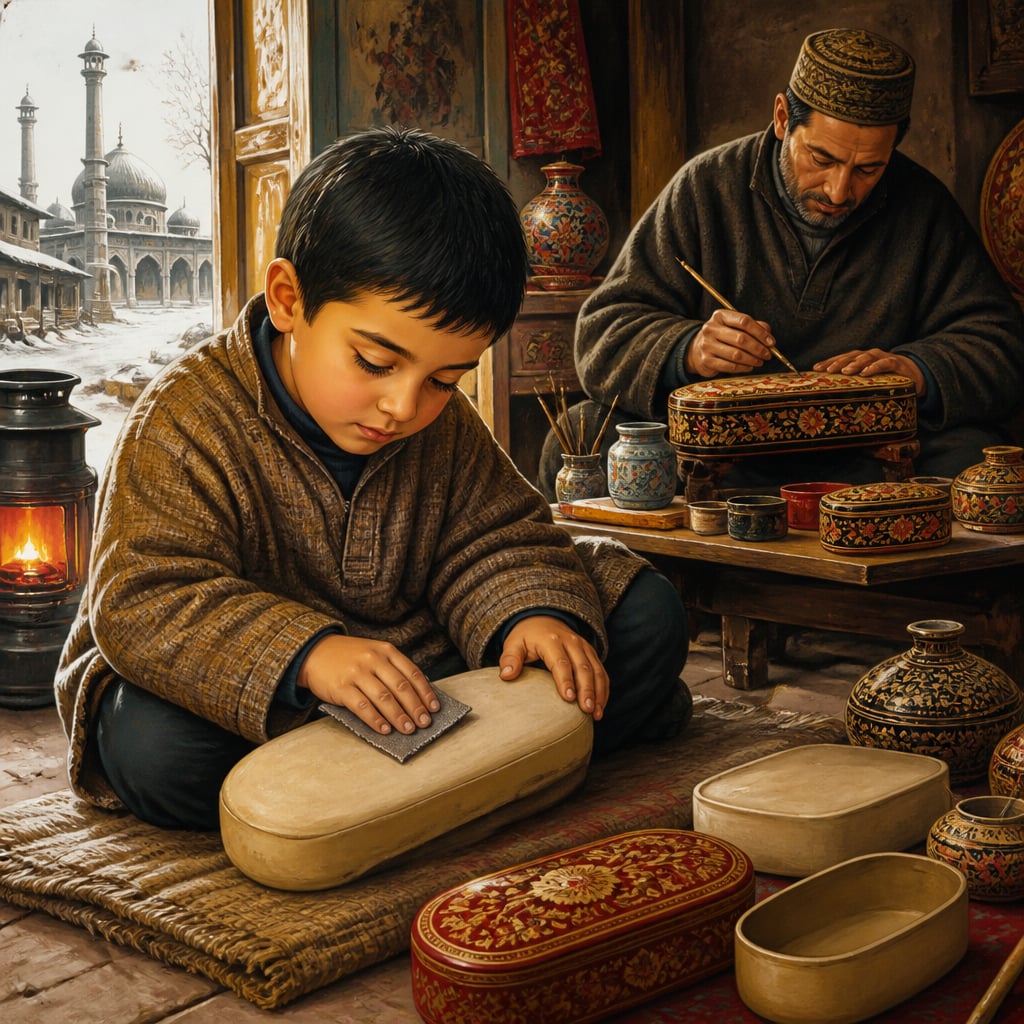
In a narrow lane behind the Jamia Masjid in downtown Srinagar, in the winter of 1968, a seven-year-old boy named Maqbool Jan crouches on the floor of his father's workshop and watches a lump of grey pulp become a garden. The pulp is paper. His father has soaked strips of mulberry bark and old rags in warm water for three weeks until the fibres dissolve into a soft porridge. Now he presses that porridge around a wooden core the shape of a long pen case, smooths it, and sets it to dry. Nine more steps will follow before a brush ever touches the surface. Then the real work starts. Gul-andar-gul, flower within flower, painted in iris blue and saffron yellow and a gold dust so fine it has to be mixed with gum arabic so the breath does not scatter it. The finished piece will take six months. The apprentice's first task is to sand the base. He is paid four rupees for the job and keeps the pen case for the rest of his life.
Maqbool Jan died in 2020 with a Padma Shri in his pocket. The craft he was learning that winter came to his street six hundred years earlier from Samarkand, carried over the Hindu Kush by a Sufi saint named Mir Sayyid Ali Hamadani and a Kashmiri sultan named Zain-ul-Abidin. It has nearly died twice in a single lifetime. Once to plastic and factories. Once to a flood nobody saw coming. It is still alive because people like Maqbool kept layering paper on paper until something beautiful appeared.
What the Craft Actually Is
The English name for this tradition, papier-mache, is French for "chewed paper." French traders in the eighteenth century saw Kashmiri pen cases and tried to reverse-engineer them by pulping paper in their mouths. The real name, still used on the streets of Srinagar, is kar-i-kalamdani, "work of the pen case," because the object that defined the craft for centuries was the long lacquered pen case used by scribes and court officials across the Persianate world.
A finished object is made of almost nothing. Waste paper, mulberry bark, rice paste, chalk, natural pigments, lacquer varnish, a little gold leaf. The cost is almost entirely labour and patience. A small box might carry fourteen coats of lacquer applied over three weeks, each coat rubbed back smooth with a polished agate stone before the next goes on. A large jewellery box for a wedding can take six months.
There are two distinct crafts under one roof:

- The sakhtsaz builds the body from pulp and paste, shaping it over a wooden or clay core, drying it in mountain air, and handing it over smooth and skeleton-white.
- The naqqash paints the surface, free-hand, with brushes sometimes made from a single cat-whisker hair, and finishes with lacquer so clear the gold below glows for centuries.
Historically these were two different hereditary families in the same neighbourhood. One would never paint. The other would never mould. A half-finished box moved from the sakhtsaz's workshop to the naqqash's workshop and then came back for polishing. The division of labour is part of the design.
The Garden on the Surface
Look closely at an old Kashmiri box and you will see that every square millimetre of the surface is covered. This horror of empty space comes from a specific source: the Persian miniature garden. When the craft arrived in Kashmir in the fourteenth century, it brought with it the visual vocabulary of Herat and Samarkand, a world in which paradise was a walled garden filled with flowers, birds, fruit trees, and winding streams. The naqqash translated that paradise onto a surface the size of a pomegranate.
The classic hazara, which simply means "thousand," crowds a thousand tiny blossoms into a single panel with no two flowers repeating. The gul-andar-gul, "flower within flower," opens one rose and finds another rose at its centre. Other patterns show Mughal emperors hunting, Chinar trees turning red around Dal Lake, or the long-tailed bulbuls the painter's grandfather saw in his own childhood garden. All of them are painted from memory, not from stencils, by artisans who were themselves not permitted to walk in the royal gardens whose beauty they were copying.
What the Shloka Says
यथोर्णनाभिः सृजते गृह्णते च। यथा पृथिव्यामोषधयः सम्भवन्ति। तथाक्षरात्सम्भवतीह विश्वम्॥
As a spider spins out its thread and draws it back, as herbs sprout from the earth, so from the Imperishable arises this whole world.
Mundaka Upanishad 1.1.7
The Mundaka Upanishad's metaphor for creation is not a potter and not a weaver. It is a spider, patiently extruding its own body into a pattern, and ready to pull it back if it fails. Kashmiri papier-mache is the closest physical craft to this image. The naqqash pulls colour out of himself the way a spider pulls silk out of itself. The pattern is made by hand, one hair-thin line at a time, from a reservoir of remembered flowers. If it is wrong, it comes off. If it is right, it stays for three hundred years under its lacquer. The craft is not decoration laid on top of an object. It is the slow outward breath of a person.
Who Taught Whom
Credit for bringing the craft to Kashmir is usually given to two people. The first is Mir Sayyid Ali Hamadani, also called Shah-i-Hamadan, a Persian Sufi saint from Hamadan who arrived in the Kashmir Valley in the 1380s with, according to tradition, seven hundred followers and a working knowledge of a dozen practical crafts. He is credited with introducing not only papier-mache but also carpet weaving, silk, shawl-making, and fine woodwork. His shrine on the bank of the Jhelum in Srinagar, built in his honour after his death in 1384, is still the most visited Sufi site in Kashmir.

The second is Sultan Zain-ul-Abidin, called Budshah or "the great king," who ruled Kashmir from 1420 to 1470 and ran what historians describe as a Kashmiri renaissance. He deliberately imported master craftsmen from Samarkand and Bukhara, paid them well, housed them in Srinagar, and set up workshops for them. By the end of his reign, kar-i-kalamdani was a Kashmiri craft with Persian roots rather than a Persian craft performed by exiles.
Why It Almost Disappeared
By the 1970s, factory-printed tin boxes from Delhi and mass-produced plastic trinkets had already undercut the market for small papier-mache goods. Families who had painted kalamdani for five generations began to put their children into other trades. Then, in September 2014, the Jhelum river rose nine metres above flood level and submerged almost every workshop in downtown Srinagar for more than a week. Pulp dissolved back into pulp. Finished stock turned to sludge. Pattern books compiled over a hundred years, the only written record of certain designs, were lost overnight. One senior naqqash told a reporter that he had lost "everything except my hands."
The Geographical Indication tag for Kashmir Paper Machie, registered in 2012, gave the surviving workshops a legal monopoly on the name but no money and no new students. Real help arrived slowly, through institutions. The Craft Development Institute in Srinagar runs design, pricing, and finance training for papier-mache households. INTACH Kashmir Chapter has photographed hundreds of patterns from surviving pattern books, documented the collections of older masters, and produced revival kits with authentic natural pigments. Srinagar-based platforms like Kashmir Box now ship boxes, bowls, and Christmas ornaments direct from the naqqash's workshop to buyers in more than forty countries. None of these alone is enough. All of them together have kept the craft alive.
What the Craft Teaches
Papier-mache is the opposite of almost everything about modern work. It is slow on purpose. It uses the cheapest possible raw material on purpose. It decorates every square millimetre on purpose, because in the world it came from, paradise was a garden where nothing was plain. It is practiced in a valley that has seen war, partition, insurgency, curfew, earthquake, and flood, and is still practiced today. The lesson it offers is not that craft is worth preserving because it is old. The lesson is that something layered slowly and by hand, from almost nothing, can outlast almost anything.
Back in Zadibal, the lane behind the Jamia Masjid still runs past the workshop where a seven-year-old Maqbool Jan once sanded a pen case for four rupees. His sons are in the same workshop. The pen case he kept all his life sits on a shelf inside. The mulberry bark still soaks. The gold dust still scatters if you breathe too hard.
Key figures
Mir Sayyid Ali Hamadani
Fourteenth-century Persian Sufi saint and the figure traditionally credited with introducing Kashmiri papier-mache, along with a dozen other Persianate crafts, to the Kashmir Valley.
Sultan Zain-ul-Abidin
Eighth sultan of the Shah Mir dynasty of Kashmir, who reigned from 1420 to 1470 and established papier-mache as a formal Kashmiri court craft.
Maqbool Jan
Twentieth and early twenty-first century master naqqash from the Zadibal quarter of downtown Srinagar, awarded the Padma Shri in 2007 for his lifetime contribution to Kashmiri papier-mache.
Case studies
Rukhsana Learns Naqqashi During the Lockdown
Rukhsana is fourteen years old and lives in the Rainawari quarter of downtown Srinagar. Her father is a schoolteacher. Her aunt, her father's unmarried elder sister, is a naqqash who paints papier-mache for a cooperative near the Jamia Masjid. During the long winter of 2020, when the valley is under a prolonged curfew and then under a COVID lockdown, Rukhsana's school is closed and she is bored at home. Her aunt offers to teach her the basic hazara. She says it will take three years before Rukhsana can paint one panel that is not shameful. Rukhsana agrees. Every afternoon for six months she grinds pigments, cleans brushes, and copies single flowers on old cigarette paper until her fingers stop shaking. The aunt never corrects a flower in front of her. She simply points at the ones that are wrong and makes Rukhsana paint them again the next day.
The scene Rukhsana is inside, even though this specific Rukhsana is fictional, is the oldest transmission method in Kashmiri papier-mache. There is no textbook. There is no graded curriculum. There is an older relative who has been painting for thirty years, a younger person with time and curiosity, and a long quiet winter. The same conditions have produced every senior naqqash in the valley. The traditional lens says that craft is not knowledge poured from full vessel to empty vessel. Craft is a skill the older person no longer thinks about, and the younger person reproduces by slow imitation until they also no longer have to think.
Three years later, in 2023, Rukhsana paints her first complete small box end to end under her aunt's supervision. The cooperative sells it to an Indian buyer on Kashmir Box and she receives her first earnings as a naqqash. She is still in school. She plans to become a biology teacher. She also plans to keep painting for the rest of her life, on weekends and in the winter. Her aunt tells her this is how the craft has always actually survived, not through full-time masters alone but through people who refuse to stop painting even when their main living comes from elsewhere.
The survival of a traditional Indian craft does not depend on turning every apprentice into a full-time artisan. It depends on keeping the skill inside enough households that at least one person in the next generation chooses to paint, even as a second practice. If you carry a traditional skill inside your own family, the question is not whether you can make it your career. The question is whether you can refuse to let it die on your watch.
A 2019 survey by the Jammu and Kashmir Directorate of Handicrafts estimated that fewer than 3,000 households were still actively practicing kar-i-kalamdani in the Kashmir Valley, down from an estimated 10,000 in the 1970s, with most of the decline in hereditary naqqashi rather than in sakhtsazi.
The 2012 GI Tag and the 2014 Flood
In 2012, after years of campaigning by craft organisations and the Jammu and Kashmir Directorate of Handicrafts, Kashmir Paper Machie was registered as a Geographical Indication under Indian law. The registration gave Kashmir-made papier-mache a legal monopoly on the name and in principle protected the cluster from cheap imitations produced elsewhere in India and in China. Two years later, in September 2014, the Jhelum river rose nine metres above flood level after a week of extreme rainfall. Downtown Srinagar, where almost all papier-mache workshops are concentrated, went under water. In the Zadibal, Rainawari, and Safakadal quarters the flood stood inside houses for more than a week. When the water receded, pulp had dissolved, finished stock had turned to sludge, and most of the hereditary pattern books kept by naqqash families had been destroyed. The GI tag protected a name whose workshops no longer had paper or patterns.
The traditional lens on this story is unforgiving. Paper documentation is a weak form of memory. A pattern book that is stored in one house, inked by one hand, never digitised and never backed up, is one flood away from being forgotten. At the same time the traditional lens is also realistic. No hereditary craft family would choose to hand over their pattern book to a distant institution before they had to, because the pattern book was historically their only competitive asset. The 2014 flood did not create the problem. It forced a conversation about documentation that had been avoidable for three hundred years.
After 2014, surviving naqqash households began to cooperate with INTACH Kashmir Chapter and the Craft Development Institute to photograph and publish motifs from the pattern books that remained. The GI registration, which had looked like a mostly symbolic victory in 2012, became a practical tool for directing relief funds and training grants specifically to registered Kashmiri producers. By 2020, several dozen papier-mache households had been formally reconnected to revived pattern archives and trained in using them. The craft is still smaller than it was in 1980, but its motif library is now more completely documented than at any time in its six-hundred-year history.
Legal protection alone does not save a craft. Documentation alone does not save a craft. A hereditary community alone does not save a craft. A craft survives when all three are wired together, usually after a disaster forces the issue. If you care about a tradition, do not wait for the flood to start copying the pattern books.
The 2014 Jammu and Kashmir floods killed more than 280 people and caused estimated economic damage of over one trillion rupees. Surveys conducted after the floods estimated that more than 50 percent of surviving traditional papier-mache pattern books in downtown Srinagar had been damaged or destroyed.
INTACH Kashmir, the Craft Development Institute, and the Revival Architecture
INTACH Kashmir Chapter, the Jammu and Kashmir unit of the Indian National Trust for Art and Cultural Heritage, began active work on papier-mache in the years immediately after the 2014 flood. Its team went lane by lane through downtown Srinagar, identified surviving master naqqash, photographed their remaining pattern books and finished pieces, and built an institutional archive of Kashmiri motifs accessible to trainees. At roughly the same time, the Craft Development Institute in Srinagar, a government-supported training and design body, began to run formal apprenticeship programmes for young Kashmiris in traditional papier-mache. The CDI supplies natural pigments, lacquer, wooden cores, and stipends to trainees so that learning the craft does not require losing their livelihood during the learning period. INTACH supplies the motif library. Surviving master naqqash supply the hands-on correction.
Traditional Kashmiri craft transmission worked inside the hereditary family. Institutional revival looks, on the surface, like exactly the kind of outside interference that hereditary traditions have historically resented. In practice, after 2014, the masters themselves invited the institutions in. The flood had made it clear that no single family could protect the full pattern vocabulary alone. The traditional lens was forced to evolve. The craft remained a family art in execution, but the memory of the craft became a shared institutional resource, one tier above the family, for the first time in six centuries.
Between 2016 and 2024, the combined efforts of INTACH Kashmir and the Craft Development Institute have trained more than a thousand new apprentices in papier-mache, rebuilt the motif library of at least twenty surviving naqqash households, and connected producers to premium Indian lifestyle brands and global e-commerce platforms. Prices paid to senior naqqash for a single fine kalamdan have more than tripled since 2014. The total number of practicing households continues to decline, but the income per household for those who remain has risen sharply, and the quality of pattern work on newly produced pieces is now higher than it was in the 1990s.
When a traditional craft is on the edge of collapse, institutional support does not replace family transmission. It protects the memory of the craft so that family transmission has something to transmit. The right model is layered, exactly like the craft itself. Master naqqash hands teach. INTACH archives remember. The Craft Development Institute funds. Kashmir Box sells. None of these layers is sufficient alone. All of them together are enough to keep the thread from breaking.
As of 2024, INTACH Kashmir Chapter reports that more than 400 unique traditional Kashmiri papier-mache motifs have been formally documented and photographed from surviving pattern books, and the Craft Development Institute in Srinagar has trained over 1,000 apprentices in the craft since its post-2014 revival programmes began.
Historical context
From the arrival of Persianate papier-mache in fourteenth-century Sufi Kashmir through the post-2014 institutional revival (c. 1380 to 2025 CE)
Kashmiri papier-mache does not sit neatly inside the Sanskrit-framed inner line of Indian craft history the way, say, Bishnupur terracotta does. It is an Indian craft with deeply Persian roots, practiced in a valley that has been a meeting point of Hindu, Buddhist, Muslim and Sufi cultures for more than a thousand years. The honest way to tell its story is to name both halves. The techniques and motifs are Persianate. The apprentices, the audience, the workshops, the lanes of Zadibal and Nowshera and Rainawari, and most of the long continuous practice are Kashmiri. The craft survived the collapse of Mughal patronage, the Dogra transition, partition, conflict, and finally the 2014 flood not because of any one dynasty or any one institution but because families kept teaching their children how to soak paper, shape pulp, and paint a rose inside a rose.
Living traditions
Kashmir Paper Machie received its Geographical Indication tag in 2012. After the devastating September 2014 floods, the Craft Development Institute Srinagar and INTACH Kashmir Chapter launched coordinated programmes to document surviving pattern books, train new apprentices, and supply natural pigments. E-commerce platforms like Kashmir Box, founded in Srinagar, now ship papier-mache boxes, bowls, and Christmas ornaments directly from naqqash workshops to buyers in more than forty countries. Premium Indian lifestyle brands have introduced papier-mache home decor lines that pay naqqash households far higher unit prices than tourist bazaars ever did. The craft is smaller than it was in 1950 but its surviving practitioners are better documented, better paid, and better connected to global markets than at any time since the Mughal court.
- Sakhtsazi: The Moulding Workshop: A sakhtsaz in downtown Srinagar soaks waste paper and shredded mulberry bark in warm water for two to three weeks until the fibres dissolve. He adds boiled rice paste and fine chalk to the pulp, kneads it like dough, and presses it by hand over a wooden or clay core in the shape of the finished object. The piece is dried in mountain air, sanded smooth with polished stones, and coated in a thin layer of gesso so the painter has a flawless white ground. A single sakhtsaz workshop can produce several hundred undecorated bodies in a season.
- Naqqashi: The Painting Workshop: A naqqash receives the undecorated white body from the sakhtsaz and draws the design directly onto the surface by eye, without a stencil. He lays a ground colour, paints the motif free-hand with brushes so fine that some are made from a single cat-whisker hair, and mixes gold dust with gum arabic for the highlights so that one breath will not scatter it. When the painting is complete, he applies fourteen to twenty-four coats of clear lacquer, rubbing each coat back smooth with an agate stone before the next goes on. A single fine kalamdan can take three to six months from start to finish.
- Motif Transmission by Memory: Traditional Kashmiri papier-mache patterns are not stencilled and were historically not even printed. A naqqash memorises hundreds of variants of the rose, the chinar leaf, the bulbul, the almond, and the interwoven scroll from watching his father and grandfather paint. Each household maintained its own pattern book with inked samples, to be consulted when a specific client asked for a design the current master had never painted before. After the 2014 flood destroyed most household pattern books, institutional documentation projects began to photograph and publish surviving books so that younger naqqash can learn motifs their fathers never taught them.
- Zadibal Papier-Mache Quarter: The historical heart of Kashmiri papier-mache. Several hereditary naqqash households still run workshops here behind plain wooden doors on narrow lanes, often welcoming respectful visitors. The Maqbool Jan household workshop is among the most documented.
- SPS Museum, Srinagar: The Sri Pratap Singh Museum holds one of the most important public collections of historical Kashmiri papier-mache, including royal kalamdans, pen rests, writing caskets, and painted panels from the Dogra and pre-Dogra periods. It is the best single place in the world to see hazara and gul-andar-gul patterns on authenticated older pieces.
- Craft Development Institute, Srinagar: A government-supported institute that runs training programmes in Kashmiri crafts including papier-mache, maintains a design archive, and actively works with INTACH Kashmir on motif documentation and apprentice training. Visiting and buying here puts money directly into the revival ecosystem.
Reflection
- A Kashmiri papier-mache box is built from fourteen to twenty-four invisible layers before the final surface is visible. What is something in your own life that you are secretly building one invisible layer at a time? Is there a layer you are refusing to apply today because nobody will see it? What happens to the finished surface if you skip that layer?
- The naqqash tradition of Kashmir has roots in Persian Sufi Islam, Kashmiri Hindu philosophy, Mughal court patronage, and modern Indian state support. Its surviving masters are almost all Kashmiri Muslims. What would you honestly lose if you tried to describe this craft as belonging to only one of these ancestors? Are there parts of your own story that you are similarly tempted to trim down to one origin?
- After the 2014 flood, a senior naqqash said he had lost "everything except my hands." He started painting again the next week. If a flood of your own, literal or otherwise, washed away every external asset in your life tomorrow, what would remain in your hands that could rebuild the rest? How much of your daily practice is aimed at developing that irreducible thing, and how much of it is aimed at protecting assets that a flood could dissolve?