Lacquerware & Ganjifa: Painted Traditions
Gold leaf from Nirmal, royal lacquer from Sawantwadi, and the ten avatars of Vishnu painted one card at a time on India's own hand-made playing decks.
A Fish on a Wooden Circle
It is a hot afternoon in Sawantwadi, a small princely capital tucked into the green hills of the Konkan coast. The year is somewhere around 1748. Inside a low stone workshop, not far from the Bhonsle royal palace, a court painter we will call Govinda Chitari (a composite figure, drawn from the Chitari community of hereditary painters who served the Sawantwadi court) is leaning over a wooden disc no larger than a rupee coin. A small brass brazier warms his right elbow. A tray of tiny shell cups holds ground pigments in red, yellow, black, and green. A thin brush made from squirrel hair hovers above the wooden disc. The disc is already covered in a smooth layer of black lacquer, polished until it catches the afternoon light.
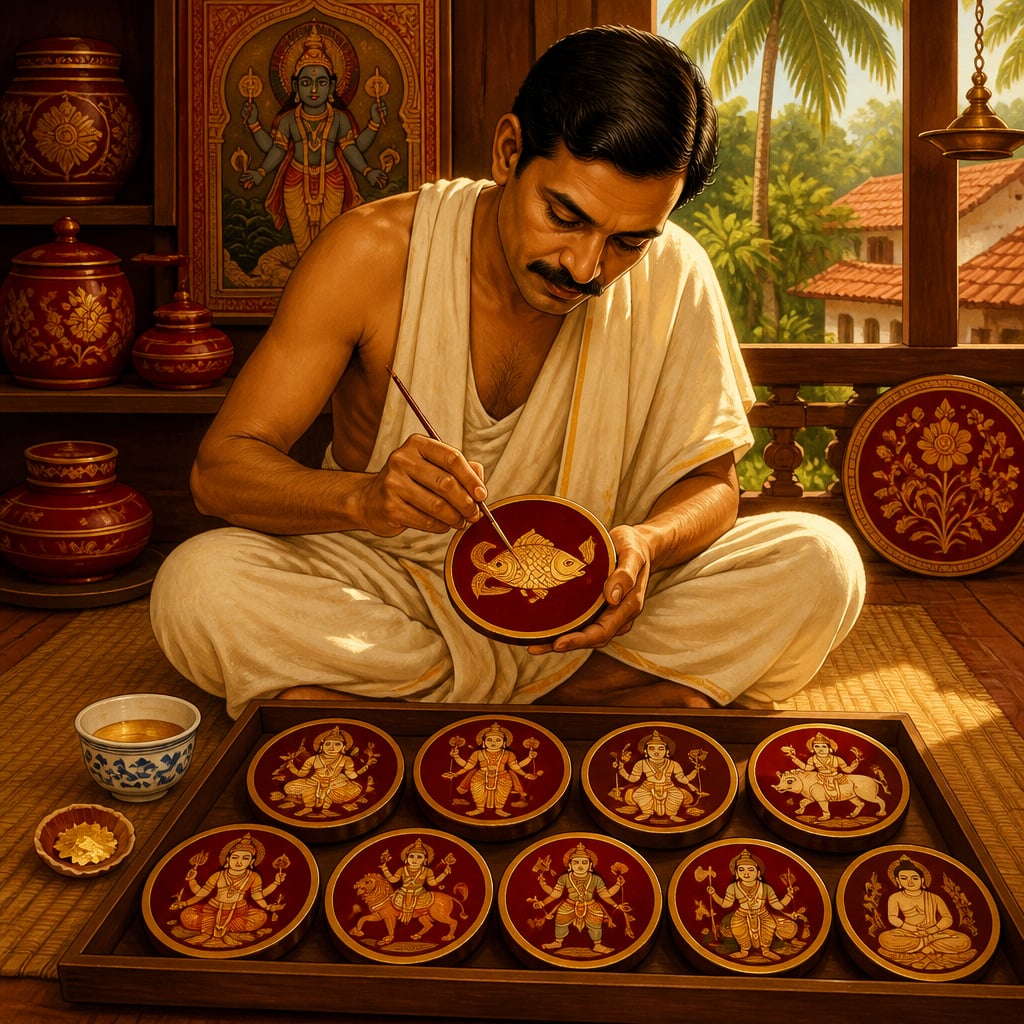
Govinda is painting a fish. Not any fish. This is Matsya, the first of the ten avatars of Vishnu, the one who saved the Vedas and the first humans from the great flood. The fish's body curls across the disc like a question mark. Govinda needs to get the scales right. Each scale is smaller than a grain of rice, and each one must be tipped with a flake of real gold leaf. This single card, the Matsya raja card, is one of one hundred and twenty cards that make up a full Dashavatara Ganjifa deck. He has eight more avatars to paint after this. The Bhonsle raja has asked for the completed deck before the Dussehra festival, and the Dussehra moon is already growing in the night sky.
Govinda dips the squirrel brush into a drop of gold. He holds his breath. The scale lands exactly where it should. He is not just painting a playing card. He is painting a small, portable temple.
Why a Playing Card Deserves a Lesson
When most modern Indians hear the word cards, they think of plastic rectangles bought for twenty rupees at a railway station shop. But for more than four centuries, India was home to one of the world's most astonishing painted card traditions, and some of those decks were produced on the same lacquered wood that also became trays, toys, boxes, and royal furniture. This lesson is about two things held together in one hand. The first is Indian lacquerware, the art of coating wood in layer after layer of coloured lac and polishing it to a mirror finish. The second is ganjifa, the hand-painted playing card tradition that used that same lacquered surface as its canvas. Two towns, Nirmal in Telangana and Sawantwadi in Maharashtra, carry the most famous versions of this joined tradition, and both have quietly refused to disappear.
What Lacquer Actually Is
The lacquer used in Indian craft is not the industrial varnish that hardware shops sell today. It is a natural resin produced by a tiny insect called Kerria lacca, which lives on the branches of trees like the palash and the ber. The insect secretes a reddish-brown resin to protect its young. Artisans collect the encrusted twigs, melt the resin, strain it, and mix it with natural pigments to produce sticks of coloured lac.
To apply the lac to wood, the artisan presses a stick of heated coloured lac against a piece of wood spinning on a lathe or held against a foot-powered wheel. The friction melts the lac onto the surface. Layer by layer, the artisan builds up colour and shine. A final polish with a dry palm leaf gives the object its characteristic mirror finish. On a flat surface like a tray, box, or card, the lac is applied cold and then fused with gentle heat, and the surface is polished by hand. The result is a material that is smooth, waterproof, food-safe, and deeply coloured all the way through.
Nirmal: The Gold-Leaf School of the Deccan

Nirmal is a small town in the Adilabad district of northern Telangana. Its lacquerware tradition goes back at least several centuries, and for generations the local Nakash community of painters made decorative panels, small trays, and toys for the Deccan sultanates and later for the Nizams of Hyderabad. Nirmal's signature style is instantly recognisable. A jet-black lacquered background is painted with tiny scenes inspired by Mughal and Deccan miniature painting, usually horses, hunting parties, court figures, floral vines, or episodes from the Ramayana and Krishna stories. The painted figures are then highlighted with flakes of real gold leaf. Held in sunlight, a Nirmal tray looks as if tiny gold lamps have been lit inside the painting.
The material used in Nirmal is unusual. Instead of hardwoods, the Nakash artisans use the lightweight wood of the Ponki tree, soft enough to be carved, sanded, and shaped into large trays, furniture panels, jewellery boxes, and wall pieces. The object is primed with tamarind-seed paste, smoothed, and then painted in several patient layers before the gold work begins. A single large Nirmal tray can take a skilled artisan several weeks to complete.
Sawantwadi: The Maratha Lacquer School
Sawantwadi lies on the other side of peninsular India, in the Sindhudurg district of Maharashtra, near the Goa border. For over three hundred years, the town was the capital of a Maratha princely state ruled by the Sawant Bhonsle family. The Bhonsle rulers patronised a community of court painters called the Chitari who produced lacquered wooden toys, fruits, chess sets, and most famously, Ganjifa playing cards.
Sawantwadi's lacquerware tradition has its own personality. The Chitari style favours bright colours, rounded forms, and playful subjects. Painted mangoes, jackfruits, custard apples, and guavas so lifelike that tourists sometimes try to bite into them. Rows of lacquered wooden village toys. Chess sets carved into Maratha soldiers and courtiers. And at the top of the craft pyramid, hand-painted Ganjifa decks whose tradition at Sawantwadi would eventually become one of the most important revived playing card traditions in the world.
What Ganjifa Actually Is
Ganjifa is a family of hand-painted circular playing cards that reached India from Persia during the late fifteenth and early sixteenth centuries. The Mughal emperor Babur is said to have played the game, and by the time of Akbar in the sixteenth century, ganjifa had become a standard courtly entertainment recorded in the Ain-i-Akbari. A Mughal standard deck had ninety-six cards divided into eight suits of twelve, and each suit had its own colour and courtly theme.
After ganjifa arrived in India, Hindu artisans and patrons slowly transformed the game. The Persian suits were replaced with themes drawn from Indian religious life. The most famous Indian version is the Dashavatara Ganjifa, in which the deck has ten suits instead of eight, and each suit is devoted to one of the ten avatars of Vishnu. Matsya the fish, Kurma the tortoise, Varaha the boar, Narasimha the man-lion, Vamana the dwarf, Parashurama, Rama, Krishna, Buddha, and Kalki. Each suit has twelve cards, giving a full deck of one hundred and twenty cards. The highest card in each suit, called the raja, shows the avatar on his throne. The second highest, the mantri, shows the avatar's minister or companion. The ten lower cards carry symbolic objects associated with that avatar.
The Dashavatara Ganjifa is one of the clearest examples of how Indian craft absorbs a foreign object and rebuilds it as a spiritual teaching. A Persian gambling game became a painted procession of incarnations. The player who shuffled the deck was also, in a quiet way, reciting the story of how dharma survives age after age.
Decline and a Royal Rescue
Like most Indian craft traditions, both Nirmal and Sawantwadi suffered heavily through the twentieth century. Printed cardboard playing cards wiped out most of the Indian market for painted ganjifa by the mid nineteen hundreds. The abolition of princely states in 1947 ended royal patronage. By the nineteen seventies, only a handful of ageing Chitari painters were still producing Sawantwadi Ganjifa, and the craft was within one generation of disappearing.

The rescue came from an unexpected source. Maharani Satvashiladevi Bhonsle, a member of the Sawantwadi royal family, began systematically documenting the surviving Chitari painters, recording old decks, training apprentices in the palace itself, and building a collection of Dashavatara and other ganjifa types. Her patient revival work from the nineteen seventies onward turned Sawantwadi into one of the few places in the world where a living hand-painted ganjifa tradition still exists. Visitors to the Sawantwadi palace today can watch painters finishing circular cards exactly as Govinda Chitari might have done in 1748.
Nirmal's revival took a different route. In 1955, the Nirmal Arts and Crafts Society was formed to organise artisans into a cooperative, and the Telangana state handicrafts programme continues to support the craft today through government emporia, craft fairs, and design collaborations. A modern Nirmal tray made under this system still uses the same black lacquer, tamarind primer, ponki wood, and real gold leaf that the Nakash community has used for generations.
Sawantwadi Ganjifa almost disappeared in the twentieth century. In 1971, Raja Shivramraje Bhonsle of Sawantwadi walked into the Victoria and Albert Museum in London and saw a cabinet of circular playing cards labelled "Sawantwadi Cards" that he did not recognise as his own. He returned home, found the eighty-year-old Ganjifa painter Pundalik Chitari still making two sets a year, learned the art from him, and founded Sawantwadi Lacquerwares that same year to keep the tradition alive. Today, his grandchildren Yuvraj Lakham Sawant Bhonsle and Yuvrani Shraddha Sawant Bhonsle run a studio inside the Sawantwadi Palace where twenty artists, thirteen of them women, paint Ganjifa full time. A deck that a king once did not recognise in a London museum is now the living trade of a royal house and a cooperative of women in the same small town on the Konkan coast.
What You Carry Home
Indian craft has never been a collection of isolated objects. It has always been a quiet conversation between kings, painters, resin insects, foreign visitors, and the gods themselves. A Sawantwadi Dashavatara deck is a prayer disguised as a game. A Nirmal tray is a Mughal miniature laid flat for a morning cup of tea. The next time you see one of these objects in a museum or an emporium, look for the gold. Look for the ten avatars. Look for the thousands of tiny brush strokes that tell you a human being once held the brush. That human being, in a small workshop in Sawantwadi or Nirmal, is still there today, still working, still refusing to let the brush fall silent.
Key figures
Maharani Satvashiladevi Bhonsle
A member of the Sawantwadi royal family who led the deliberate revival of the nearly extinct Sawantwadi Ganjifa tradition from the nineteen seventies onward. She documented surviving Chitari painters, collected older decks for reference, trained new apprentices within the palace itself, and turned Sawantwadi into one of the very few places in the world where a living hand-painted Ganjifa tradition can still be watched today.
Lakshmibai Sawant Bhonsle and the Sawant dynasty
The Maratha Sawant Bhonsle family ruled Sawantwadi as a princely state from the seventeenth century until its merger with independent India in 1948. Over three centuries, the family patronised the Chitari community of painters, commissioned Ganjifa decks, lacquered toys, and royal furniture, and provided the continuous state support that allowed Sawantwadi's lacquerware tradition to mature into one of India's most refined painted craft schools.
Lady Hydari
A Hyderabad noblewoman who, in 1955, helped establish the Nirmal Arts and Crafts Society to rescue the fading Nirmal lacquerware tradition. Her initiative organised the Nakash painters into a cooperative, revived the use of ponki wood and real gold leaf, and secured government handicrafts support for Nirmal under the new Indian state of Andhra Pradesh, and later Telangana.
Case studies
The Sawant Bhonsle princely state and the Chitari painters
The Sawant Bhonsle family ruled the small princely state of Sawantwadi, in the Konkan coastal belt of what is now Maharashtra, from the seventeenth century until the state's merger with independent India in 1948. Sawantwadi was a minor Maratha court compared to Satara or Kolhapur, but its rulers took unusual care of their artisan communities. A hereditary community of painters called the Chitari lived and worked in streets close to the palace, producing lacquered wooden toys, painted fruits, chess sets, and Ganjifa playing cards for royal and public use. The rulers gave them land, regular commissions, raw material supplies from state forests, and ceremonial recognition at court festivals. Each generation of Chitari painters trained the next inside the family home, and the court workshop absorbed techniques borrowed from Mughal miniature painting, Deccan lacquer work, and traditional Vaishnava iconography. By the eighteenth century, Sawantwadi had become one of the most refined painted-lacquer craft centres in the Konkan, and the Chitari Ganjifa decks had become court collectibles exchanged between royal families across western India.
Most of India's greatest craft traditions did not grow out of free-market demand. They grew out of long, patient royal patronage. Sawantwadi is one of the clearest examples. For three centuries, a single Maratha royal family gave the Chitari community of painters a stable home, regular commissions, and protection from economic shocks. In exchange, the Chitari produced generation after generation of skilled painters who slowly perfected the town's lacquerware and ganjifa. This is how traditional Indian states built craft ecosystems. They did not issue grand policies. They simply kept the workshop alive year after year. When we study these princely craft relationships, we understand that protecting a tradition is almost always about protecting the everyday conditions that allow artisans to keep working.
The Sawant Bhonsle patronage system sustained the Chitari community for more than three hundred years and gave the Sawantwadi lacquerware and ganjifa traditions enough depth to survive even the collapse of princely patronage in 1948. Today, the descendants of those same Chitari families still paint inside the royal palace workshop, and Sawantwadi remains one of the very few places in the world where a living hand-painted ganjifa tradition can be observed directly.
A long relationship between a royal household and an artisan community is worth more to a craft than a hundred short interventions. Slow, steady patronage is the soil in which real traditions grow.
The Sawant Bhonsle family patronised the Chitari painters of Sawantwadi for more than three hundred years, from the seventeenth century until the merger of the princely state with India in 1948.
The Dashavatara Ganjifa and Vishnu's ten incarnations
Ganjifa entered India from Persia in the late fifteenth and early sixteenth centuries. The Mughal emperor Babur is said to have played it in his leisure hours, and by the reign of Akbar in the sixteenth century, the game was recorded in the Ain-i-Akbari as a recognised court entertainment, usually played with a ninety-six card deck in eight suits. As the game spread from the Mughal court into Rajput, Maratha, and Deccan princely circles, Hindu patrons began commissioning new decks that replaced the Persian courtly suits with themes from their own religious imagination. The most famous of these reinventions was the Dashavatara Ganjifa, in which the deck was expanded to ten suits and one hundred and twenty cards. Each suit was devoted to one avatar of Vishnu, starting from Matsya the fish and ending with Kalki the final incarnation yet to come. Within each suit, the highest card, called the raja, showed the avatar on his throne, while the second card, the mantri, showed the avatar's minister. The ten remaining cards carried numbered symbols tied to that avatar's mythology. The deck was most strongly associated with workshops in Sawantwadi in Maharashtra and Puri in Odisha, and copies were exchanged as gifts between royal families, carried on pilgrimage, and sometimes used in temple storytelling rituals.
Indian thought has a beautiful habit of hiding philosophy inside everyday objects. A child's spinning top can carry the wheel of time. A village water pot can carry the story of creation. And a playing card, shuffled over an evening game, can carry the doctrine of the avatars. The Dashavatara Ganjifa is the clearest example of this habit in the world of cards. A Persian gambling game walked into India in the sixteenth century. Within two hundred years, Hindu patrons and artisans had remade it into a ten-suit meditation on how dharma is rescued again and again. Matsya saves the Vedas. Kurma supports the churning of the ocean. Varaha lifts the earth. Narasimha breaks a tyrant. This is not decoration. It is doctrine in miniature. The lesson is that the Indian tradition does not need special sacred objects. It can turn anything it touches into a teaching.
The Dashavatara Ganjifa is today one of the most visually striking examples of India absorbing and transforming a foreign cultural import. Surviving decks are held in major museum collections in India, the United Kingdom, and the United States, and new hand-painted decks are still produced by Chitari painters at the Sawantwadi royal workshop.
The Indian tradition is confident enough to absorb foreign inventions without losing its own voice. When a Persian game arrives in India, it walks out a few generations later carrying the ten avatars on its back.
A full Dashavatara Ganjifa deck contains one hundred and twenty hand-painted circular cards, divided into ten suits of twelve cards each, with one suit for every avatar of Vishnu from Matsya to Kalki.
Maharani Satvashiladevi Bhonsle and the Sawantwadi ganjifa revival
By the early nineteen seventies, the Sawantwadi ganjifa tradition was almost extinct. Printed cardboard playing cards had wiped out the commercial market for hand-painted decks decades earlier. The abolition of princely states in 1948 had ended the royal commissions that once sustained the Chitari painters. Only a handful of ageing artisans in Sawantwadi were still producing ganjifa, and no younger painters were being trained to replace them. In this environment, Maharani Satvashiladevi Bhonsle, a member of the Sawantwadi royal family, decided to personally rescue the craft. She began by visiting the remaining Chitari painters, recording their techniques, and building a reference collection of surviving Dashavatara and other ganjifa decks. She then opened training space within the Sawantwadi palace itself, inviting apprentices to learn directly from the older masters. She commissioned new decks to create income for the painters, promoted Sawantwadi ganjifa at craft fairs and museum events, and campaigned for wider recognition of the tradition as a living heritage rather than a dead one.
Most traditional crafts in modern India have not died because they were defeated by printing presses or plastic. They have died because nobody with time, resources, and patience decided to rescue them at the right moment. Maharani Satvashiladevi Bhonsle's story is the opposite. She had all three at the right moment, and she used them. The Sawantwadi ganjifa revival is a good reminder that heritage is a verb. It is what you do in the years when a craft is weakest. Her decision to turn her own palace into a training workshop for Chitari apprentices is the kind of quiet private investment that no government scheme can replace. The lesson is that every living Indian craft today carries the fingerprints of somebody who refused to let it die when the easier thing was to shrug and walk away.
Her patient work over several decades transformed Sawantwadi into one of the very few places in the world where a living hand-painted ganjifa tradition still exists. Today, the Sawantwadi palace continues to host a working ganjifa and lacquerware atelier where visitors can watch Chitari painters producing Dashavatara decks, chess sets, painted fruits, and lacquered toys using methods unchanged for centuries.
Craft revivals do not need huge state budgets. They need a specific person who decides, at the right moment, that the craft is worth more than their own comfort. Sawantwadi ganjifa is alive today because one royal household chose to make it their personal project.
When Maharani Satvashiladevi Bhonsle began her revival work in the nineteen seventies, the Sawantwadi ganjifa tradition was down to a handful of active painters. The palace workshop today continues to train new apprentices and remains one of the only living hand-painted ganjifa centres in the world.
Nirmal Toys under the Telangana handicrafts system
Nirmal lacquerware in Adilabad district, Telangana, had enjoyed centuries of support from the Deccan sultanates and the Nizams of Hyderabad. When Hyderabad was merged into independent India in 1948, that patronage system ended almost overnight, and the Nakash painters found themselves without a reliable market for their gold-leaf lacquer trays and panels. In 1955, local supporters led by Lady Hydari helped establish the Nirmal Arts and Crafts Society as a cooperative to stabilise the craft. The society organised artisans into production units, supplied raw materials, maintained quality standards, and marketed finished pieces through state handicrafts emporia. Over the following decades, the cooperative model was absorbed into the Andhra Pradesh and later the Telangana state handicrafts development system, which provided marketing, craft fair access, pricing support, and steady government procurement. The Nirmal Toys and Arts and Crafts brand remains a central product line of the Telangana handicrafts network today, and new generations of Nakash artisans continue to train within the same workshop tradition.
When a royal court collapses, a craft faces a simple question. Who will pay the artisans next month? For Nirmal, the answer came from a new kind of patron. Not a king, but a cooperative. In 1955, the Nirmal Arts and Crafts Society was formed to pool resources, coordinate production, and give Nakash painters a steady income. Seven decades later, that cooperative is still the reason Nirmal's gold-leaf lacquerware is available in state emporia across India. The lesson is that cooperatives, handicraft boards, and state emporia are not romantic institutions, but they are often what keep traditions alive in the gap between royal patronage and private brand building. The Nirmal story shows that post-independence India quietly invented a new support system for crafts, and that system deserves more credit than it usually gets.
Nirmal lacquerware is now one of the most visible traditional crafts of Telangana. Its gold-leaf trays, boxes, and paintings are available in Lepakshi emporia across India, and the craft has been studied as a model for how cooperative and state handicraft structures can sustain a tradition long after its royal patronage has ended.
In modern India, state handicraft cooperatives and emporia are often the invisible scaffolding that holds traditional crafts together. They are not glamorous, but they work, and they deserve our attention as consumers and citizens.
The Nirmal Arts and Crafts Society was founded in 1955, and for more than seven decades it has served as the primary institutional home for Nirmal's Nakash lacquer painters, making it one of the oldest continuously operating craft cooperatives in southern India.
Living traditions
- Nirmal gold-leaf lacquer painting
- Sawantwadi Chitari lacquer toys and fruits
- Hand-painted Dashavatara Ganjifa
Reflection
- The Dashavatara Ganjifa deck turns a playing card into a small painted temple. Can you think of other everyday objects in your own home that quietly carry spiritual meaning without shouting about it?
- Sawantwadi Ganjifa was rescued from near extinction by one determined member of the royal family. If you had the chance to revive a dying craft, which tradition would you choose to protect, and what would your first step be?
- Nirmal painters use real gold leaf on wooden trays that cost thousands of rupees, while machine-printed versions sell for a fraction of the price. What are you actually paying for when you choose a hand-painted piece over a printed one?