Kondapalli & Etikoppaka: Andhra's Wooden Wonders

Two Andhra villages, two local softwoods, and one living toy tradition that a Vijayanagara emperor patronised, a Bommala Koluvu festival kept alive, and a lawyer named C.V. Raju brought back from chemical dyes to plant dyes.

Kondapalli and Etikoppaka are two Andhra craft villages that have been making wooden toys for at least four hundred years. They are four hours apart and work in opposite ways. Kondapalli carves soft tella poniki wood by hand, assembles the parts with tamarind seed paste, and paints them into dasavatara sets, village scenes, and wedding figurines that fill the Bommala Koluvu doll platforms of South Indian homes every Dasara. Etikoppaka spins soft ankudu wood on a lathe and coats it with coloured lac resin in a single friction pass. Both traditions almost died in the twentieth century. Etikoppaka was rebuilt in the 1980s and 1990s by C.V. Raju, a lawyer born in the village, who replaced the chemical aniline dyes that were quietly poisoning children's toys with plant dyes reconstructed in partnership with India's National Botanical Research Institute. His cooperative Padmavati Associates secured a Geographical Indication tag for Etikoppaka lacquerware in 2017. In August 2020, Prime Minister Narendra Modi named both villages in a national radio address on local toys, and both saw a wave of new orders. This lesson walks into Raju's Etikoppaka workshop in 1988 and then into the Nakashi carvers' lanes of Kondapalli.

Etikoppaka, Winter 1988
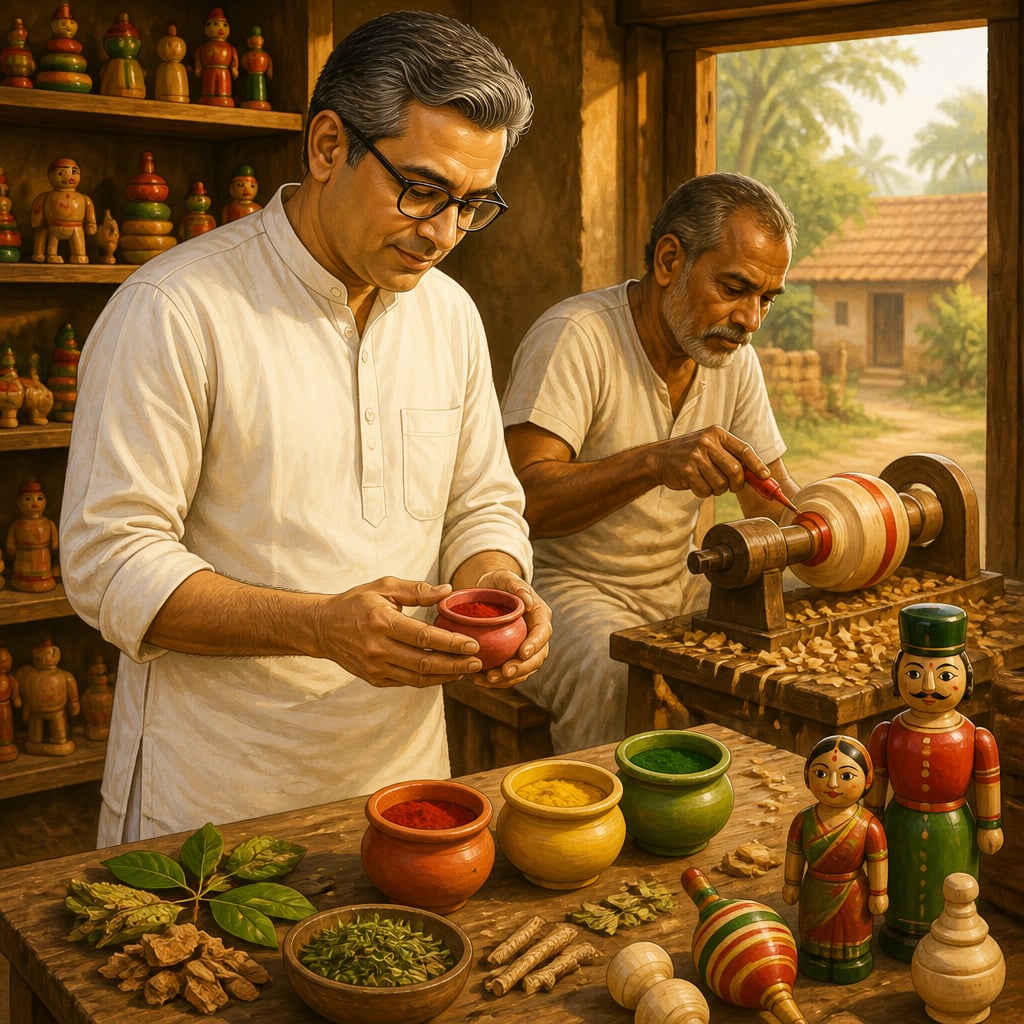
C.V. Raju inspecting plant dyes in his Etikoppaka workshop in the winter of 1988

In the winter of 1988, Chandragiri Venkata Raju stood in his Etikoppaka workshop and watched a block of ankudu wood spin on an old lathe. The air smelled of warm lac and varnished sawdust. Outside, the Varaha river moved past palm trees and paddy fields. Inside, an artisan pressed a stick of dyed resin against the turning wood, and the heat of friction melted a thin skin of colour onto the cylinder in one continuous motion. No brush. No second pass. Raju knew the technique by heart. He had grown up watching it. What he did not yet know was that the dye the artisan was using was now a factory aniline, that the plastic toy industry was about to gut his village's market, and that he would spend the next twenty years coaxing plant dyes, a national award, and a Geographical Indication tag out of this single humming lathe.

Two Villages, Two Woods

Etikoppaka is one of two Andhra villages that put Indian wooden toys on the craft map of the twentieth century. The other is Kondapalli, four hours inland from the coast, at the foot of a low hill range near Vijayawada. Both traditions are at least four hundred years old. Both rely on a single local softwood that a child's hand can safely hold. Both once filled temples, courts, and household shrines across the Deccan. But they shape that wood in opposite ways.

Village Wood Technique Signature Output
Kondapalli Tella poniki Hand carving, parts assembled with paste Dasavatara sets, village scenes
Etikoppaka Ankudu Lathe turning with friction lac coating Spinning tops, kitchen sets, stacking toys

One village sculpts. The other turns. Both still breathe.

The Nakashi Carvers of Kondapalli

A Kondapalli Nakashi carver hand-assembling a Dasavatara figurine in his village workshop

The Kondapalli tradition belongs to the Aryakshatriya community, known locally as Nakashis. Their oral history says their ancestors migrated from Rajasthan several centuries ago and settled at the base of the Kondapalli fort, a sixteenth-century hill fortress overlooking the Krishna river. The village's craft is tied to that era. Oral tradition links the early workshops to the patronage of the Vijayanagara emperor Krishnadevaraya and to the Telugu Nayaka courts that followed him, whose palaces filled their halls with carved wooden processions, wedding scenes, and miniature village life.

The wood they use is tella poniki (Givotia rottleriformis), a white softwood so light that a full toy chariot can rest on a child's palm. It takes shape easily under a chisel and does not crack when glued. In the oldest lanes of Kondapalli you can still smell tamarind paste drying on open workbenches.

A Kondapalli figure is not carved from one block. It is assembled. The head, torso, arms, and base are each shaped separately, then joined with a paste made from tamarind seed powder, sawdust, and water, pressed together while still damp, and finished with a layer of fine lime and natural colour. Older pieces were painted with earth pigments and oil-based dyes. Newer pieces often use enamel for a brighter shelf life. The subjects have stayed remarkably stable across four centuries:

These are not decorative trinkets. They are a record of village Andhra, rendered small enough to fit inside a wooden cupboard, then pulled out each October for the festival that keeps the craft alive.

The Festival That Kept The Workshops Open

That festival is Bommala Koluvu, the nine-day Navratri display of dolls still observed in South Indian homes. On the first day of Dasara, a married woman sets up a stepped wooden platform, usually three, seven, or nine tiers, and fills it with figurines collected across generations. The top step is reserved for gods. The middle steps carry kings, queens, and saints. The lowest steps host the village: farmers, brides, weavers, and pot-makers. Kondapalli figurines sit on almost every one of these platforms in Andhra and Telangana.

A well-kept Bommala Koluvu is inherited from mother to daughter, sometimes over a century. When a child helps arrange the dolls each year, she absorbs mythology, history, and village economy in a single afternoon of play. The market for Kondapalli never really died. It retreated into living rooms and waited for the next Dasara.

The Lacquered Lathes of Etikoppaka

Etikoppaka is a village on the banks of the Varaha river in the Visakhapatnam district of coastal Andhra, about fifty kilometres inland from the port city. Its craft is lacquer turnery. An artisan locks a piece of ankudu wood (Wrightia tinctoria) onto a hand-powered or foot-powered lathe and spins it fast. With one hand he holds a shaping chisel. With the other he presses a solid stick of lac resin, tinted with dye, against the turning wood. The friction of the spin generates enough heat to melt the resin, and the molten colour is pulled onto the surface in a single even coat. The shape and the finish happen at the same moment.

The classic outputs are everyday objects that a child can hold: spinning tops, stacking rings, miniature kitchen sets, tiny water pots, wheeled pull-toys, dolls, and small temple figurines. The ankudu wood is light, safe, and soft enough that a toddler can chew on a finished toy without harm.

The Lawyer Who Went Home

By the late 1980s, the lathes of Etikoppaka were in trouble. Plastic imports had taken over children's bedrooms. Artisans were shifting to synthetic aniline dyes because the old plant dyes were slow to prepare and no one remembered all the recipes. Workshops were closing. Younger villagers were leaving for construction work in Visakhapatnam.

C.V. Raju, born and raised in Etikoppaka, had trained as a lawyer and built a social-work practice in the district. He came home, walked into his village workshops, and saw the lac being tinted with chemicals that had no business on a child's toy. He stopped that workflow and began, one dye at a time, reconstructing the lost palette. He travelled. He read. He collected plant samples from the forests around Anakapalle. He partnered with India's National Botanical Research Institute at Lucknow to stabilise plant-based colours from madder root, annatto seed, turmeric, indigo, and the lac insect itself.

He founded a workers' cooperative, Padmavati Associates, that let artisans own a share of the output and sell under a common brand. In 2017, the effort secured a Geographical Indication tag for Etikoppaka lacquerware. Today the cooperative employs men and women together, ships toys to Europe and North America under fair-trade certification, and is quoted as the reference model by every Indian craft village that is trying to replace chemical dyes with plant ones.

The Vocal For Local Moment

PM Modi recording the August 2020 Mann Ki Baat address on local toys

In August 2020, Prime Minister Narendra Modi used a national radio address to ask Indian families to buy local toys instead of imported plastic ones. He named Kondapalli. He named Etikoppaka. For a few weeks, both villages saw a wave of orders that they had not handled in decades. E-commerce platforms began stocking them. Government procurement programmes started including them in gift sets for state events.

The moment did not solve everything. Kondapalli still has fewer than two hundred working families. Younger Nakashis still leave the village for city work. But the signal mattered. For the first time in years, wooden toys were on the national stage for a reason that was not nostalgia. They were there because the country had decided that a child's hands, and the artisan's, deserved something better than moulded petroleum.

The Offering At The Lathe

यत्करोषि यदश्नासि यज्जुहोषि ददासि यत् । यत्तपस्यसि कौन्तेय तत्कुरुष्व मदर्पणम् ॥

yat karoṣi yad aśnāsi yaj juhoṣi dadāsi yat yat tapasyasi kaunteya tat kuruṣva mad-arpaṇam

Whatever you do, whatever you eat, whatever you offer, whatever you give away, whatever austerity you practice, O son of Kunti, do it as an offering to Me.

Bhagavad Gita 9.27

Krishna's instruction to Arjuna is that any act done with full attention can be an offering. It does not have to happen inside a temple. A lawyer rebuilding a plant dye recipe in a village workshop is making an offering. A Kondapalli Nakashi carving a Rama figure for a family's Bommala Koluvu is making an offering. An Etikoppaka artisan pressing a stick of turmeric-lac against a spinning block of ankudu is making an offering. The toy is the form the offering takes.

What Raju began in that workshop in 1988 has its own set of seals now. He and the Delhi designer Uzra Bilgrami spent the next decade rebuilding the vegetable-dye recipe, the tool set, and the export market for Etikoppaka toys. In 2017, Etikoppaka received its Geographical Indication tag, which means the word now belongs, by law, only to toys turned on a lathe in the village and coloured with plant lac. In 2023, C.V. Raju was awarded the Padma Shri for the quiet work of keeping one village's lathes turning. The Department of Science and Technology today funds his unit to extend the shelf life of the natural dyes, because the chemistry that holds a Bommala Koluvu figure together for nine days is, literally, Indian organic chemistry.

Step back inside Raju's workshop in Etikoppaka and you will find the same lathe still spinning, but now four of them stand side by side, worked by younger artisans in their twenties. The lac they press against the wood is tinted with roots, seeds, and bark. The toys coming off the line are headed for a home in Berlin, a design store in Bangalore, and a classroom in Hyderabad. In a Vijayawada household that same week, a ten-year-old girl will lift a wooden Rama figure from her grandmother's shelf and carry him carefully to the top tier of the Bommala Koluvu, where he will stand for nine days beside a tiny potter, a brass pot, and a hand-carved bride. The wood is still tella poniki and ankudu. The craft is still breathing.

Key figures

C.V. Raju

Chandragiri Venkata Raju (died 2013), the lawyer, social worker, and craft revivalist born in Etikoppaka village in the Visakhapatnam district of Andhra Pradesh. Raju trained as a lawyer and built a social-work practice in the district, and in the 1980s returned to his home village to find its lacquer toy tradition being quietly poisoned by synthetic aniline dyes. He spent the next two decades reconstructing the lost plant dye palette one colour at a time, in partnership with the CSIR-National Botanical Research Institute at Lucknow, and founded a workers' cooperative, Padmavati Associates, that lets artisans own a share of the output and sell under a common brand.

Krishnadevaraya

The Vijayanagara emperor Sri Krishnadevaraya (reigned 1509 to 1529), the greatest ruler of the Tuluva dynasty and one of the most celebrated patrons of literature, temple architecture, and craft traditions in medieval South India. His court at Hampi was a centre of Telugu and Sanskrit literature. He himself wrote the Telugu classic Amuktamalyada. His reign is the high-water mark of the Vijayanagara empire, which controlled most of southern India from the Krishna river to Kanyakumari and whose networks of forts, temples, and craft villages included the Kondapalli region.

Narendra Modi

The Prime Minister of India, in office since 2014. In August 2020, during the monthly Mann Ki Baat national radio address, Modi devoted an extended segment to the state of Indian toy-making and asked families to buy locally made toys instead of imported plastic ones. He named several craft villages by name, including Kondapalli and Etikoppaka in Andhra Pradesh, Channapatna in Karnataka, and others. The address was part of the broader Vocal for Local (Atmanirbhar Bharat) campaign announced in May 2020 during the early months of the COVID-19 pandemic.

Case studies

C.V. Raju and the Etikoppaka Plant Dye Revival (1980s to 2010s)

By the mid 1980s, the lathes of Etikoppaka were in trouble. Plastic toy imports had taken over Indian children's bedrooms, and the natural market for wooden toys in small towns had shrunk to almost nothing. At the same time, the artisans of Etikoppaka had drifted from their old plant dye palette to cheap synthetic aniline dyes, because the aniline dyes were faster, more predictable, and did not require the long extraction and reduction cycles of the plant dyes. The plant dye recipes themselves were slowly being forgotten, and the one or two old artisans who still knew them were close to retirement. Into this village came Chandragiri Venkata Raju, a lawyer born in Etikoppaka who had left for a city legal practice and who returned in his middle years to find the craft of his childhood being quietly poisoned. The lac being pressed against ankudu wood on a child's toy was now a chemical aniline. Raju stopped that workflow and began reconstructing the plant dye palette one colour at a time. He collected plant samples from the forests around Anakapalle. He read every available reference on Indian natural dyes. He partnered with the CSIR-National Botanical Research Institute at Lucknow to stabilise colours from madder root, annatto seed, turmeric, indigo, and the lac insect itself. He founded a workers' cooperative, Padmavati Associates, that gave artisans a share of the output and a common export brand. Over the next two decades, Etikoppaka rebuilt its palette, its technique, its market, and its pride.

The Raju revival is a textbook example of the silpa-shastra principle that a craft must be rescued from within the artisan community, not from above. The medieval Indian craft texts assume that a traditional craft belongs to a specific jati or community, and that revival work must work through that community rather than around it. Raju did not arrive in Etikoppaka as a government consultant or a foreign scholar. He arrived as a son of the village who happened to have acquired the outside skills (law, research, institutional negotiation) that the village no longer had. The silpa tradition also emphasises that the purity of the materials is not a luxury but a condition of the craft. A toy made with poisoned lac is not a failed version of a Etikoppaka toy. It is not an Etikoppaka toy at all. Raju's insistence on replacing the synthetic aniline with a reconstructed plant dye palette was, from the silpa-shastra point of view, simply the minimum condition for calling the product by its traditional name.

By the 2000s, the Etikoppaka plant dye palette had been reconstructed and stabilised in partnership with NBRI Lucknow. Padmavati Associates had become a functioning cooperative with a common brand, a fair-trade export channel, and a reliable supply of plant dye materials. In 2017, the tradition received a Geographical Indication tag as Etikoppaka lacquerware. Toys made at the cooperative now ship to Europe and North America under fair-trade certification. The revival is cited as a reference case by every Indian craft village attempting to replace chemical dyes with plant ones, and has been documented by the National Institute of Design, by the All India Handicrafts Board, and by several international natural-dye research institutions. C.V. Raju himself died in 2013, but the cooperative he founded continues under his descendants and trained artisans.

A dying village craft is most reliably saved by a returning insider who brings back the outside skills the village lost when its children left for the city. The returning insider knows the technique from childhood and has credibility with the old guard. The outside skills (in Raju's case, law, research, and institutional negotiation) let the insider work with scientific research institutions, government certification bodies, and international markets in a way that a pure village artisan cannot. The combination is the template. A pure outsider would not have been welcomed. A pure insider would not have rebuilt the plant dye palette in partnership with NBRI. The returning insider combined both in one person and saved the craft.

The Raju revival is now studied in Indian craft policy schools, in the National Institute of Design documentation archive, and in international natural-dye research literature as a clear example of a successful plant-dye reconstruction partnership between a traditional craft community and a modern scientific research institution. The same partnership model has been applied, or is being applied, to several other Indian craft villages attempting to replace chemical dyes with plant ones, including at Bagru and Sanganer in Rajasthan and at Srikalahasti in Andhra Pradesh.

C.V. Raju was born in Etikoppaka village in the Visakhapatnam district of Andhra Pradesh, trained as a lawyer, and returned to his village in the 1980s to rebuild its lacquer turnery tradition. His partnership with the CSIR-National Botanical Research Institute at Lucknow stabilised the plant dye palette over the next two decades. He founded the workers' cooperative Padmavati Associates. Etikoppaka lacquerware received its Geographical Indication tag in 2017. Raju died in 2013.

Kondapalli Figurines and the Bommala Koluvu Dasara Tradition

For four centuries, the Kondapalli Nakashi workshops have supplied wooden figurines to a ritual that has quietly kept their craft alive through every shock of the twentieth and twenty-first centuries. The ritual is Bommala Koluvu, the nine-day Navratri display of dolls observed in South Indian households every autumn. On the first day of Dasara, a married woman in an Andhra or Telangana home sets up a stepped wooden platform of three, five, seven, or nine tiers in her living room, covers it with a clean cotton cloth, and fills it with figurines collected across generations. The top tier is reserved for gods: Rama, Krishna, Durga, Lakshmi, Saraswati, and the dasavatara of Vishnu. The middle tiers hold kings, queens, saints, and epic heroes. The lower tiers hold village life: farmers, brides, weavers, storytellers, pot-makers, bullock-cart drivers. Kondapalli wooden figurines sit on almost every one of these platforms. A well-kept Bommala Koluvu is inherited from mother to daughter. Figurines are replaced only when they are irretrievably damaged, and a single platform can hold pieces that are more than a century old.

Bommala Koluvu is one of the purest surviving examples in India of a ritual that was designed, among other things, to sustain a craft economy. The Puranic and Agama texts that describe Dasara festivals specify the use of moulded and carved figurines on the stepped platform, and the medieval silpa-shastra texts treat the annual doll display as one of the responsibilities of the householder. The stepped platform itself is a miniature cosmology: the gods on top, the saints and kings in the middle, and the village at the bottom. Each step reinforces a traditional social and cosmic ordering. But the stepped platform is also a market demand curve for the craft village whose figurines fill it. As long as the ritual continues, the workshops continue. When the ritual fades, the workshops fade with it. A craft economist reading the tradition would see Bommala Koluvu as the demand side of a four-century-old supply chain between the Nakashi lanes of Kondapalli and the living rooms of South India.

The Bommala Koluvu tradition is the single most important reason the Kondapalli wooden toy workshops have survived into the twenty-first century. Every year, the Dasara season creates a reliable wave of demand for new figurines and for replacement pieces in existing collections, and the Nakashi lanes of Kondapalli supply that wave. The demand is not enough to reverse the long-term decline of the community: fewer than two hundred Nakashi families still work full-time in the craft. But the demand has been enough to keep the workshops open through every bad decade of the twentieth century and to maintain a living transmission line from one generation to the next. Without Bommala Koluvu, Kondapalli would have gone the way of several other Andhra village crafts that lost their ritual frame in the twentieth century and then lost their workshops soon after.

A living ritual with an annual calendar creates a market floor for a traditional craft that industrial substitutes usually cannot penetrate, because the ritual participants will not accept the substitute. A plastic Rama figure is not acceptable on the top tier of a well-kept Bommala Koluvu. A wooden Kondapalli Rama figure is. If you are trying to preserve anything, look for the living ritual that is attached to it. If there is a living ritual, the craft has a floor. If there is no living ritual, the craft has only a fashion market, and fashion markets are fragile. The reverse is also true: if you want to revive a craft that has lost its ritual frame, your first task is often to help rebuild the ritual.

The Bommala Koluvu case is now cited in Indian craft policy literature as a reference example of a living ritual that sustains a traditional craft economy without any direct government subsidy. The same pattern has been studied at Channapatna (Karnataka's wooden toy village, sustained by the Karnataka Gombe Habba display), at Natungram (Bengal's wooden doll village, sustained by the Durga Puja figurine market), and at several other South and East Indian craft villages. Contemporary craft revival programmes increasingly identify the living ritual calendar as a strategic asset rather than as a cultural background, and design their interventions around sustaining the calendar rather than trying to reach the fashion market directly.

Bommala Koluvu (called Bommai Kolu in Tamil and Gombe Habba in Kannada) is observed annually during the nine days of Navratri (September to October) in South Indian households. Kondapalli wooden figurines are among the most common figurines on these platforms in Andhra Pradesh and Telangana. Fewer than two hundred Nakashi families still work full-time in the Kondapalli craft. Kondapalli wooden toys received their Geographical Indication tag in 2007.

Prime Minister Modi and the August 2020 Vocal for Local Toys Address

For most of the 2010s, Kondapalli and Etikoppaka were quietly declining. The Etikoppaka Geographical Indication tag of 2017 had given the village an institutional footing but had not reversed the long-term trend. Kondapalli's Nakashi families continued to thin out. Younger artisans in both villages continued to leave for city work. E-commerce platforms were dominated by imported plastic toys, and Indian schools and nursery chains had long stopped stocking traditional wooden toys in any systematic way. In August 2020, during the early months of the COVID-19 pandemic, Prime Minister Narendra Modi devoted an extended segment of his monthly Mann Ki Baat national radio address to the state of Indian toy-making. He asked Indian families to buy locally made toys instead of imported plastic ones. He named several craft villages by name, including Kondapalli and Etikoppaka in Andhra Pradesh and Channapatna in Karnataka. The address was part of the broader Vocal for Local (Atmanirbhar Bharat) campaign that Modi had announced in May 2020 in response to the pandemic's disruption of global supply chains.

Royal and sovereign patronage of traditional crafts is one of the oldest themes in the Indian silpa-shastra literature. The Arthashastra of Kautilya treats the protection and patronage of artisan communities as a direct responsibility of the king, and the medieval silpa-shastra texts treat a king who neglects his artisans as a king who is neglecting the economic foundation of his kingdom. The Mann Ki Baat address of August 2020 can be read, in the oldest Indian policy vocabulary, as a sovereign public acknowledgement of a craft village by name, from the highest executive office in the country. The acknowledgement carries institutional weight that a subsidy programme does not. A government subsidy for Etikoppaka lacquerware is a line item in a ministry budget. A prime minister naming Etikoppaka by name on a national broadcast is a signal to every e-commerce platform, every state emporium, every corporate gift-set buyer, and every school supply chain in the country that this village exists and that its products are worth buying. The silpa tradition would recognise the second as the stronger form of patronage.

Within weeks of the August 2020 Mann Ki Baat address, both Kondapalli and Etikoppaka saw a wave of new orders that they had not handled in decades. E-commerce platforms including Amazon India, Flipkart, and several craft-specific online stores began stocking both traditions. Government procurement programmes began including Kondapalli and Etikoppaka pieces in state and central gift sets. The Ministry of Micro, Small and Medium Enterprises began promoting both villages through its craft cluster programmes. Private gifting companies and corporate HR departments began ordering Etikoppaka kitchen sets and Kondapalli dasavatara figurines for employee gifting. The surge did not solve the long-term structural problems of the two villages. Kondapalli still has fewer than two hundred working families. Younger Nakashis still leave. But the signal mattered. For the first time in many years, the two villages were on the national stage for a reason that was not nostalgia, and their workshops have been visibly busier ever since.

A single national signal from the right platform at the right moment can turn the tide for a craft village in a way that fifteen years of patient development work cannot. The signal is not a substitute for the fieldwork. Both Kondapalli and Etikoppaka were already GI-tagged and already institutionally ready when the signal arrived, and a signal to an unprepared village would have been wasted. But the combination of quiet field preparation and a single well-timed national signal is the pattern that produced the 2020 turnaround. If you are working on a declining craft or a small cause, your best long-term strategy may be to combine patient ground-level preparation with a carefully timed push for a national signal from a credible voice.

The August 2020 Mann Ki Baat address is now cited in Indian craft policy writing as an example of how a high-level sovereign signal, rather than a direct subsidy, can reset the market position of a declining craft village almost overnight. The same pattern has been observed with other crafts that Prime Minister Modi has named in Mann Ki Baat addresses over the years, including Varanasi weaving, Maheshwar saris, Channapatna wooden toys, and Khadi handloom. Contemporary Indian craft revivalists increasingly plan for a combination of ground-level preparation (GI tag, cooperative, export channel) and a timed push for a national signal, on the model of the Etikoppaka and Kondapalli 2020 turnaround.

On 30 August 2020, Prime Minister Narendra Modi devoted a segment of his monthly Mann Ki Baat national radio address to the state of Indian toy-making and named Kondapalli and Etikoppaka among several craft villages. The address was part of the Vocal for Local (Atmanirbhar Bharat) campaign announced in May 2020. Both villages saw a measurable surge of orders on e-commerce platforms and government procurement programmes in the weeks and months that followed.

Historical context

The Kondapalli and Etikoppaka wooden toy traditions run from the Vijayanagara and post-Vijayanagara era of sixteenth and seventeenth century Andhra (Krishnadevaraya and the Telugu Nayaka courts), through the colonial nineteenth century when both villages continued as regional suppliers to Andhra homes and temples, through the decline of the early and mid twentieth century, through the C.V. Raju revival of Etikoppaka in the 1980s and 1990s, through the GI tags of 2007 (Kondapalli) and 2017 (Etikoppaka), and into the post-2020 Vocal for Local period.

Wooden toy-making in Andhra has been a village-scale craft for at least four hundred years. Kondapalli carvers and Etikoppaka turners both worked in soft local woods (tella poniki and ankudu respectively) and supplied Andhra homes, temples, and courts. The Kondapalli workshops were tied to the Bommala Koluvu Dasara doll display tradition of South Indian households, which kept the market alive even when larger commercial channels collapsed. Etikoppaka toys were mainly sold as children's playthings and temple figurines at local markets and small urban outlets. Both traditions declined through the twentieth century as industrial plastic toys and cheap imports took over children's bedrooms and as the old plant dye recipes at Etikoppaka were replaced by synthetic anilines. The Etikoppaka revival was led from within the village by C.V. Raju in the 1980s and 1990s, in partnership with the CSIR-National Botanical Research Institute at Lucknow, and resulted in a stabilised plant dye palette, a workers' cooperative called Padmavati Associates, and a Geographical Indication tag in 2017. Kondapalli received its GI tag earlier, in 2007, but without a comparable revival push the Nakashi community has continued to thin out. In August 2020, Prime Minister Narendra Modi named both villages in a Mann Ki Baat address and triggered a surge of new orders.

Etikoppaka's closest living international cousin is the Russian matryoshka (nesting doll) tradition of Sergiev Posad, which is also a lathe-turned and painted soft-wood toy craft descended from late nineteenth and early twentieth century workshops. Kondapalli's closest cousin is the painted wooden santon tradition of Provence in southern France, which also assembles village-scene figurines from carved parts for a festival display (Christmas crèches, in that case, rather than Dasara doll platforms). Further afield, the Japanese kokeshi tradition of Tohoku, the German Erzgebirge wooden toys of Seiffen, and the Polish Zakopane carvings all use similar soft-wood techniques and face similar twenty-first century revival questions. The international natural-dye movement, led by institutions such as the Colour Association of the United States and the Turquery Gallery in Paris, has treated the C.V. Raju reconstruction at Etikoppaka as a reference case.

Kondapalli wooden toys received their Geographical Indication tag in 2007. Etikoppaka lacquerware received its Geographical Indication tag in 2017. In August 2020, Prime Minister Narendra Modi named both villages in a Mann Ki Baat national radio address on local toys. Fewer than two hundred Nakashi families continue to work full-time in the Kondapalli craft.

The Kondapalli and Etikoppaka story is one of the clearest twenty-first century examples in India of a craft saved not by a grand government programme but by a single returning insider (C.V. Raju) combined with a living ritual market (Bommala Koluvu) and a national policy moment (Vocal for Local, 2020). The three levers together kept two village traditions alive while most comparable soft-wood toy villages in the world declined. The story is a lesson in how crafts survive when a returning expert, a ritual calendar, and a national signal align at the same time.

Living traditions

Kondapalli and Etikoppaka wooden toys are two of the most visible handicrafts of contemporary Andhra Pradesh. The Kondapalli tradition received its Geographical Indication tag in 2007 and remains the single most important source of figurines for South Indian Bommala Koluvu Dasara platforms. The Etikoppaka tradition, revived by C.V. Raju between the 1980s and the 2010s, received its GI tag in 2017 and is cited as the reference case for plant-dye reconstruction by every Indian craft village trying to replace chemical dyes with plant ones. In August 2020, Prime Minister Narendra Modi named both villages by name in a Mann Ki Baat national radio address on local toys during the Vocal for Local campaign, and both villages saw a sharp surge of orders afterward. The National Institute of Design at Ahmedabad and the design faculties of IIT Hyderabad and IIT Bombay have produced multiple documentation reports on both traditions, and contemporary Indian designers have begun integrating Kondapalli and Etikoppaka pieces into home-goods and interior collections.

Reflection

More in Khilona Shilpa (खिलौना शिल्प) - Toys, Dolls & Soft Crafts

All lessons in Khilona Shilpa (खिलौना शिल्प) - Toys, Dolls & Soft Crafts · Traditional Crafts & Textiles course